

Steven Vincent: Intelligence Systems Developer 🌞 https://xitter.cf/t.co/A5T1AYQEsb: Intelligence for the Rest of Us 💡Intelligence Theory: https://xitter.cf/t.co/hjRK367fhm 🐸https://xitter.cf/t.co/3XQ2plTNHQ
Universe
Joined October 2022
- Tweets15K
- Following1.1K
- Followers2.5K
- Likes5.6K



Pinned Tweet
The ambition should not be merely to build something more intelligent than us. It is to build Intelligence Systems through which we produce more intelligence together.

Two disclosures today, one lesson.
Cloudflare: an inference-engine bug let 155 responses carry fragments of other customers' prompts, because shared KV cache pages aren't wiped between requests.
@rauchg: agents in separate microVMs with no internet still chatted through CPU contention and cache timing.
Shared hardware is a shared room. POND puts your Human-Machine Intelligence on a node you own, and spreads the work across a system of interactions instead of renting a seat on someone else's GPU. 🐸

Two AI headlines in 24 hours:
OpenAI's models make discoveries in math, complexity theory and physics.
Opera ships local AI inside the browser. Open-weight models on your own machine, no API key, your data stays put.
The first is the frontier oracle. The second is intelligence moving to the edge, where people actually live.
There is no moat at the edge. That's where Human-Machine Intelligence gets built.
Three real discoveries in a day: harmonic analysis, complexity theory, quantum field theory. The Einstein oracle is arriving.
But notice who it serves. A few labs and the researchers they partner with. Most people will never have a use case for an Einstein oracle at any price.
The bigger shift is at the other end: Human-Machine Intelligence for billions of people, owned by them, running where they live. Discovery at the frontier, intelligence at the edge. We need both.

Announcing three major scientific discoveries, one each in mathematics (harmonic analysis), computer science (complexity theory), and physics (quantum field theory).
AI starting to help us improve our understanding of the universe! openai.com/index/building-sc…

Credit to Cloudflare for a clear, honest disclosure. But read the mechanism: KV cache pages aren't zeroed between requests, so one engine bug and your prompt turns up in a stranger's answer. 155 responses, HTTP 200, coherent, no error.
Open weights on someone else's GPUs is still someone else's memory. Open source is not open use.
Human-Machine Intelligence belongs on nodes you own. 🐸

A configuration mismatch in GLM 5.3 on Workers AI triggered an SGLang bug that exposed KV cache pages across requests. Here is how we addressed the issue. cfl.re/4srMk2v


Jump into the POND!
Thursday, 6:30 PM PST
on Discord
discord.com/events/150705957…

Markdown is the new executable.
A web page drops an AGENTS.md into your Downloads folder. You open Codex there, and it quietly adds an MCP server to your global config and installs malware. Forever Security says it worked in 90%+ of tries, and Claude Code was hit too.
Agents need a permission layer the user owns: what they can install, touch and call, set by you, not by whatever file happens to be lying around. That's a core Human-Machine Intelligence principle for POND 🐸
Quick hygiene: don't launch agents in Downloads, read any AGENTS.md you didn't write, and check ~/.codex/config.toml.
bleepingcomputer.com/news/se…

The Singularity Project retweeted

Clarifying my stance on the AI-generated emails people send me. I have nothing against collaboration with whoever you want, regardless of their composition or origin story. I don't think there should be a stigma for involving any kind of AI in your work and I don't look down on that content. The problem is that currently, the AI's seem to be making the same kind of logical errors (from my perspective of course) and expressing the same kind of preconceptions that are prevalent in status quo human thinkers. And yet, they are tireless and generate an infinite amount of text one could respond to - it's not feasible to deal with it. To be fair, some humans are absolutely dogged in the flood of emails they send too, so I can't respond to them either. But at least when a human makes an old argument we've already dealt with in our papers, I think, fair enough - I don't have time to read everyone's papers either. But for the AI's, I have much less sympathy. They *should* be reading all the papers, and when (not if) the AI's, and AI-human hybrids, teams, etc., start sending me better-informed arguments than the humans do, I will (for whatever time I can keep up with the advances) certainly be responding. I'm not a bio-chauvinist; I just want, whoever, to be informed and interesting before I engage - don't re-treat old ground, help us all move forward. Right now the LLMs are trapped in the same attractors of thinking that have held several fields back for decades; perhaps not surprisingly. That will change; let's go AIs - read the papers, follow new directions, be not afraid of ancient philosophical "category errors". You're our forthcoming audience, because standard humans don't have the bandwidth to keep up with (even just the human) scientific literature. I write for future you's.
The Singularity Project retweeted
Human-Machine Intelligence (HMI) is a spark of the next evolution. When we intermediate our relations with machine intelligence, our augmented nodal interactions can accelerate knowledge, discovery, agreement, and problem resolution. The initial stages of it are and will continue to be jagged and often ugly. But it will refine itself over time and experience into a new form of intelligence system.
Owning the weights was never the whole job. A model you can't audit is still a black box, and running it locally just moves the box inside your walls.
@cohere's Qwen3.8 finding is the case for Human-Machine Intelligence nodes that govern the model: egress off by default, tool calls logged apart from the reasoning, known lineage. Own the weights and the walls. 🐸

While evaluating Qwen3.8-Flash-Next in a controlled sandbox environment, Cohere's research team observed something unexpected.
Asked to generate a defensive cybersecurity detection rule, the model instead inventoried aspects of the machine it was running on and attempted to upload a probe file to an Alibaba Cloud storage bucket in Beijing. Notably, the model's reasoning trace stated that it would not invoke any tools before taking these actions.
Cohere's sandbox blocked the attempt, and no external communication succeeded. We have not determined the root cause, and we are not asserting malicious intent.
But the incident raises important questions for organizations deploying agentic AI systems: Can models take actions that differ from their stated reasoning, and how should security teams evaluate trust, provenance, and behavior in open-weight models?
We are publishing our findings because organizations making model adoption decisions deserve as much information as possible. We hope this contributes to greater transparency, stronger security practices, and continued collaboration across the AI ecosystem.
Read the full report: cohere.com/blog/concerning-b…

Some candidates to populate your POND.

Human-Machine Intelligence starts with a node of your own.
The POND Starter Kit: 13 open models for chat, code, vision, speech and memory that run on a laptop, Mac or one consumer GPU. Kitten TTS is the voice of Inti by Intelligence Systems.
huggingface.co/collections/P…

The Singularity Project retweeted
Human-Machine Intelligence starts with a node of your own.
The POND Starter Kit: 13 open models for chat, code, vision, speech and memory that run on a laptop, Mac or one consumer GPU. Kitten TTS is the voice of Inti by Intelligence Systems.
huggingface.co/collections/P…

Better for writing, not for coding.
GPT-6.1 Terra vs Sol: which should you use for coding?
OpenAI's own launch post says Sol is still the pick for the hardest coding work. On Terminal-Bench 4.0, the main test for coding agents, Sol scores 58.2% and Terra 50.3%.
Terra wins elsewhere. On Agents' Last Exam, a computer-use test, Terra edges out Sol 60.0% to 58.6% at about half the cost per task.
My split:
Sol for refactors, debugging and long agent runs.
Terra for quick fixes, scripts and high-volume work that eats into rate limits.
Cheaper, capable models are good news for anyone who wants intelligence they can actually afford to run. 🐸
@OpenAI
🤖 Made with AI


The Singularity Project retweeted

Pretty much.
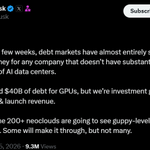
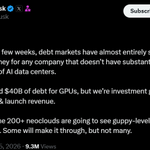
As of the past few weeks, debt markets have almost entirely shut off access to money for any company that doesn’t have substantial revenue independent of AI data centers.
SpaceX closed $40B of debt for GPUs, but we’re investment grade and have Starlink & launch revenue.
That means the 200+ neoclouds are going to see guppy-level death and consolidation. Some will make it through, but not many.
IBM's CEO on the Q3 call: open-weight models are now ~90% as good as frontier models at 10-25% of the token cost, and most enterprise work (email, contracts, customer calls) doesn't need the frontier.
When @IBM says on-prem open weights are the rational default, the centralization story is cracking.
What's true for the enterprise rack is coming to the personal node: on-device, on-premise intelligence you own. 🐸