
Professor, UC Berkeley, Founder @bespokelabsai
Berkeley, CA
Joined April 2009
- Tweets4.8K
- Following2.9K
- Followers25.5K
- Likes33.2K






Pinned Tweet
We are releasing AutoResearchExam, a benchmark on open-ended machine learning and engineering tasks. Our benchmark covers seven research areas including model training, data curation, AI safety and interpretability.
benchmarks.bespokelabs.ai/au…
In each task, we give agents 24 hours with a CPU or GPU machine to develop and improve their solutions through experiments and feedback. We measure both speed and quality with a combined score. Our benchmark has a unique feature: testing if agents create improvements that hold up on data they never see. We find that AI research agents often overfit as they try to improve.
We see an interesting head-to-head comparison at the frontier: Astra starts the strongest and holds the lead for up to 19 hours but Fable 5.1 catches up and gets the top performing spot in the final hours.
Qwen3.8 Max, Gemini 3.8 Flash and Grok 4.6 all sit on the cost-performance Pareto frontier, giving strong options at lower API budgets.
Anthropic's Opus and Fable retain nearly all their validation performance on hidden tests, with gaps of 1.1% and 2.9%. Astra's improvement over Sol extends to generalization too, with that gap falling from 6.9% to 1.7%. (1/n)
Congratulations to the team for releasing Frontier CS2.


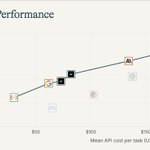
We added Gemini 4 Argon to our AutoResearchExam Pareto curve. It is 2-3 times cheaper compared to the other frontier models for almost the same ML engineering performance. Congratulations to the GDM team.

Glm 5.3 benefits come from post-training alone. Orders of magnitude cheaper than pretraining and can use proprietary data if they are transformed into RL environments.

GLM 5.3’s biggest leap came from post-training alone.
“GLM 5.3 was built entirely by post-training the previous model. For me, that was a wake-up call.”
“Post-training is far more GPU-efficient than pre-training from scratch. Plenty of companies can’t afford to train a model from scratch, but they have proprietary data. They can post-train themselves and beat some of the closed models.”
“There’s still so much juice left to squeeze from post-training. We compared GLM 5.3’s cyber capabilities with 5.2, and it’s a night and day difference. That’s all just post-training.”
As agents perform AutoResearch they get fixated on their old ideas and do only incremental innovations. We introduce a simple context management trick that forces the agents to forget everything they have done except the best solution they have found so far.
This simple modification in context management allows the agents to get out of their idea basins and come up with more novel solutions.
Closely related to the work 'Fork and Flush' and 'Idea-basins' that @DimitrisPapail posted a few days ago.


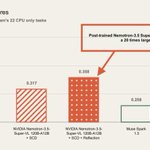
We are excited to announce that we post-trained NVIDIA Nemotron-3.5-Super-VL to be an autonomous ML researcher. We show that our post-trained model goes from 28% to 35% on AutoResearchExam, matching Qwen 3.8 Max, a model with 20× the total parameters.
The tasks are long horizon, open ended AI and ML research: building a faster executor for a transformer compute graph, training a RL control policy, creating new uncertainty quantification methods, etc. The model gets to submit once, and it doesn't see its score until the end.
We curated SFT data using Self-context distillation. This means that we let the Nemotron model to solve a problem with hints, then we SFT on these trajectories but without the hints. This gave us +11% on AutoResearchExam.
As a next step, we added reflection: We ask the Nemotron model to review its own past attempts and writes concrete lessons learned. Then we SFT on these reflections.
Surprisingly, training on these lessons improved the performance to +25% compared to the base model.
The hardest part was choosing the right data. We selected traces based on task scores, completion checks, and runtime, then refined the sampling across training rounds to address failures in the base and fine-tuned models. We removed hints and filtered out steps that relied on information available only in those hints. The goal was to teach decisions supported by the task and history the model would actually see at inference.
Full write-up:
bespokelabs.ai/blog/teaching…
Thanks to @NVIDIAAI for early access and collaborating on this.

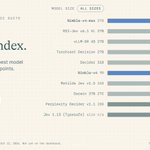
We are excited to announce Bespoke Nimble-v4, our decision models. Scoring 68.4 on the Decision index, ranking at no1 , +10.50 points over Jev 1.13.


Today, we are announcing Nimble-v4 and Nimble-v4-max which are pushing the frontier of decision models, outperforming Jev and other variants.
On the Decision Index public scores, nimble-v4-max and nimble-v4 score +10 and +6 against Jev 1.13, making nimble-v4-max the #1 model.
Beyond benchmarks, we have done a lot of internal evals, and see meaningful improvements: 43% fewer mistakes than Jev, 50pp improvement on model routing decisions, being great at coding use cases, fact checking etc.
The models are available via our API service.
Go build nimbly: console.bespokelabs.ai
Very interesting ideas that show the importance of context management. Sometimes you just need to forget.


Fork-and-Flush: help your agents escape Idea Basins!!
I love thinking of AutoResearch as Idea Descent: a metric of interest goes down, as a function of ideas/experiments, where the agents get pulled towards one idea or another. But we've seen very often an agent develop this weird tunnel vision, and honing in just one type of "idea", kinda like GD stuck in a local minimum.
We studied this and seems we can fix it with Fork-and-Flush, a super simple and kinda cute idea. Every so often, fork the agent into T copies in the same workspace but empty the context, let them run for a bit, and continue from the best one.
If you like the GD analogy, it's basically basin hopping en.wikipedia.org/wiki/Basin-….
BTW we found a silly way of also plotting "idea basins": an LLM rewrites every experiment as a spec and answers a few thousand binary queries "is Experiment A closer to B or to C?". Then we embed this NXN matrix into 2D and indeed see in many cases that each run saturates into a small region and keeps polishing it.
We call these idea basins!
At equal compute Fork and Flush beats single runs and best-of-N on 12/13 long-horizon tasks (some 4+ days), and in my own research projects it's been working really well!
BTW we only use it at test time, but it could also be part of training or RL.
Led by @jackcai1206 @christos_ziakas during Jack's internships with us, along with @vkontonis @ShivamGarg91462 @Tea_Pearce Sid Sen and Akshay Krishnamurthy.


Our Bespoke Nimble system-1 model is now in Ollama, playing OllamaRacer. 🏎️

Alex Dimakis retweeted

Launching our AutoResearchExam benchmark (again) with a video. Never stop asking. Never stop launching.
Dimitris has been proving you can do important AI basic research with a few GPUs and some agent max subscriptions. Some examples: ECHO paper, looped transformers, open mementos for context management come in mind.
Congratulations Qiuyang and to the whole team for getting FrontierSmith accepted to NeurIPS!
Really happy to see FrontierSmith accepted to NeurIPS as a Spotlight!
It’s been a great year working with @wenhaocha1 , and I’m very proud of what the FrontierCS team has built together. We also have more and more new work coming soon. Excited to share them!
AutoResearchExam new leader today is Opus 5.5. It also resets the top end of the performance vs cost pareto, pushing Fable 5.1 and Astra 6 off the frontier!


Alex Dimakis retweeted
benchmarks.bespokelabs.ai/au…
Grok 4.7 added to our live leaderboard for AutoResearchExam. It jumps to position no3 at 30Min research, drops to 4, then again at no3 at 4h, landing at position no4 after 24h of AutoResearch. Pretty good performance and cost tradeoff overall!

benchmarks.bespokelabs.ai/au…
Grok 4.7 added to our live leaderboard for AutoResearchExam. It jumps to position no3 at 30Min research, drops to 4, then again at no3 at 4h, landing at position no4 after 24h of AutoResearch. Pretty good performance and cost tradeoff overall!
Alex Dimakis retweeted

We pretrained a 2.3B MoE (360M active) Hybrid Mamba-2 that lands within a few points of Llama-3.2-3B using <1% of its pretraining FLOPs.
No dedicated cluster. The run hopped between H100s, A100s, V100s (yes, V100s) and TPU v5p/v6e on a single codebase.
Meet Rigel 🧵

Thanks Emad for highlighting AutoResearchExam and the role of different harnesses

The @bespokelabsai blog post on Autoresearch exam is worth reading, shows minimal difference in performance with standard harnesses
Much more to come, reliable frontier is within reach for all
benchmarks.bespokelabs.ai/au…


Alex Dimakis retweeted

Jev is not open-source and only available via API.
Here's an open version called Nimble which performs just as well.
github.com/bespokelabsai/nim…

We lost our CEO for 2 days and then he came back with this awesome 9B model.
Introducing Bespoke Nimble: an open data, open model, open recipe for an open Jev.
Code and info: github.com/bespokelabsai/nim…
Model: huggingface.co/bespokelabs/B…
Data:
* A new data curation recipe called contrastive data curation.
* Slightly change facts to generate negative data. This pushes the model to discriminate better and become a better decision maker. The calibration is implicit.
* Didn't do ablations but I think this is a critical piece!
* This also means training data doesn't need probabilities.
* Data covered 10 categories, and is fully synthetic.
* This data is split into train and eval.
Training
* LoRA finetune of Qwen3.5-9B.
* Distillation-free: we use Jev to only evaluate.
* No RL yet!
Serving
* Parallel constrained decoding as suggested by @NielsRogge and @harshagundal.
Results:
* The post-trained Qwen (Nimble) became substantially better on our curated eval: 66% for Qwen to 90% for Nimble. Jev is at 93%.
* 100ms on H100 and free to use on your macbook! Feel the AGI for free.
* 2 days of building in public. :)
Big caveat is that there is no standard benchmark to measure performance, and it's possible Nimble is much worse on other benchmarks compared to Jev. But it should be better than Qwen!
We thank @typesafeai for making Jev and the inspiring discussions in the community. Hope this release lifts all the boats and encourages more research and activity in this space.
