

@DimitrisPapail
Account based inUnited States
About this account
- Account based in
- United States
- Connected via
- United States App Store
Account-level information from X, not a live location or the device used for a specific post.
Researcher @Microsoft | Prof @UWMadison (on leave) | babas of Inez Lily.
Madison, WI
Joined May 2012
- Tweets11.7K
- Following1.5K
- Followers31K
- Likes15.3K





Pinned Tweet
Idea Basins is my new favorite agent abstraction :)


Fork-and-Flush: help your agents escape Idea Basins!!
I love thinking of AutoResearch as Idea Descent: a metric of interest goes down, as a function of ideas/experiments, where the agents get pulled towards one idea or another. But we've seen very often an agent develop this weird tunnel vision, and honing in just one type of "idea", kinda like GD stuck in a local minimum.
We studied this and seems we can fix it with Fork-and-Flush, a super simple and kinda cute idea. Every so often, fork the agent into T copies in the same workspace but empty the context, let them run for a bit, and continue from the best one.
If you like the GD analogy, it's basically basin hopping en.wikipedia.org/wiki/Basin-….
BTW we found a silly way of also plotting "idea basins": an LLM rewrites every experiment as a spec and answers a few thousand binary queries "is Experiment A closer to B or to C?". Then we embed this NXN matrix into 2D and indeed see in many cases that each run saturates into a small region and keeps polishing it.
We call these idea basins!
At equal compute Fork and Flush beats single runs and best-of-N on 12/13 long-horizon tasks (some 4+ days), and in my own research projects it's been working really well!
BTW we only use it at test time, but it could also be part of training or RL.
Led by @jackcai1206 @christos_ziakas during Jack's internships with us, along with @vkontonis @ShivamGarg91462 @Tea_Pearce Sid Sen and Akshay Krishnamurthy.


In the not so distant future, everyone will own their own model. It will learn from you continuously. It will be optimized for your hardware, and every weight will live on it. Everything yours, and for you. Extremely cool if you ask me.

Introducing Flint, @Recursive_SI’s first model: a fast local coding model built with our automated research system, the Eureka Machine.
• Best-in-class fast local coding
• Up to 2x faster than comparable models: 125+ tokens/sec on a MacBook Pro, 150+ on RTX Spark
• Built from scratch in under 4 months
Private, unmetered intelligence on your own machine. Open weights available now on @huggingface, run it locally on your favorite framework or try it for free on @opencode or @pidotdev.
Most of these pages fitting in maybe one or two context windows, all attended to at the same time, is one of the key reasons (not the only) that math fell. Quite humbling to think about it

Dimitris Papailiopoulos retweeted

We are looking for a Department Chair for the NYU Center for Data Science!
apply.interfolio.com/195991
This is an extraordinary opportunity to influence the trajectory of the field, and there is no better time to do it than now. Feel welcome to reach out if you have questions.
Unlike Math and SWE, it seems friction generated by the complexities of the physical/enterprise/policy world will be the main reason that other areas of science and industry will see delayed AI assisted breakthroughs.


noOS has one job: give the agent flops. The agent converts flops into whatever the USER needs.
Conjecture: within a ~year we will see operating systems that are native to agents and the main interface will be a single mega app. Calling it noOS.
Anthropic advertised in Claude app today that you can make slides, docs etc, and I’ve recently started making slides using it. Underneath seems it's just html and a thin layer on top that feels like keynote. It works really well, and clearly the right design if you ask me!
But i also started noticing that effectively the only app I really use now is Claude or Codex, plus maybe messaging apps. These are mostly the only ones interacting with my OS. In spite of the fact that there's still a file system, a desktop, I still open apps etc etc, in practice I could live inside one MEGA mono-app that talks to the machine for me.
The problem is that everything underneath that mega app (windows, folders, file formats, menus blah blah) are gazillions of thick and maybe inefficient abstraction layers made by humans for humans.
If the main user of the OS is an agent most of those layers are ... useless.
In a noOS compute environment the user interacts with a single MEGA app and underneath there is just a POT OF FLOPS, e.g. CPU and GPU cycles.
The agent launches programs, apps, runs autoresearch, makes your slides, and all it has to do is use that pot of flops well. All abstraction layers between the hardware and the agent can then collapse into maybe one or two.
Welcome to the era of noOS.

In the noOS world there's a pot of FLOPS and a single mega-app, the only abstraction needed is one that allows the agent to effectively convert flops to utility for the user.
Conjecture: within a ~year we will see operating systems that are native to agents and the main interface will be a single mega app. Calling it noOS.
Anthropic advertised in Claude app today that you can make slides, docs etc, and I’ve recently started making slides using it. Underneath seems it's just html and a thin layer on top that feels like keynote. It works really well, and clearly the right design if you ask me!
But i also started noticing that effectively the only app I really use now is Claude or Codex, plus maybe messaging apps. These are mostly the only ones interacting with my OS. In spite of the fact that there's still a file system, a desktop, I still open apps etc etc, in practice I could live inside one MEGA mono-app that talks to the machine for me.
The problem is that everything underneath that mega app (windows, folders, file formats, menus blah blah) are gazillions of thick and maybe inefficient abstraction layers made by humans for humans.
If the main user of the OS is an agent most of those layers are ... useless.
In a noOS compute environment the user interacts with a single MEGA app and underneath there is just a POT OF FLOPS, e.g. CPU and GPU cycles.
The agent launches programs, apps, runs autoresearch, makes your slides, and all it has to do is use that pot of flops well. All abstraction layers between the hardware and the agent can then collapse into maybe one or two.
Welcome to the era of noOS.
one has to look at the 6 month old 27B Qwen and wonder how they packed so much in it


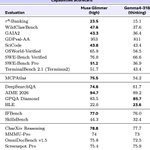
Today we published a technical report on Muse Glimmer, our 30B open-weight model built for agentic tasks on consumer hardware.
It runs at practical speeds on a Mac or PC with a single consumer GPU at 4-bit precision, and leads comparably-sized open models on tool use and multi-step planning.
Read about the model architecture, distillation recipe, quantization and more: go.meta.me/4Bcvxol

kinda sad betraying many generations long tradition among faculty to keep your postdoc picture forever as your profile all the way till retirement.
This is amazing btw

We launched OSS Scanner, which gives critical open source projects free, periodic vulnerability scans from our strongest models.
Each finding includes a proof-of-concept, and a patch where possible.
red.anthropic.com/oss-scanne…

I find it interesting that two very different relationships both look roughly logarithmic:
1. model capability as a function of the FLOPs spent on training or inference
2. value extracted from a market as a function of the capital or effort put in.
In both it seems that say 10× the input buys roughly a constant increment of output. A plausible common cause is that both are search like processes where easy gains are found first, and each further increment requires searching (or exploiting for advantage) an exponentially larger space. Interesting to think about why this happens..
Value extracted is a logarithmic function of capabilities.

OpenAI, Anthropic and other leading AI labs face a growing challenge: Better models aren't necessarily attracting more usage. A 10-point intelligence advantage now earns just 20% more developer traffic, down from nearly 69% in late 2025.
Full story: thein.fo/4hGJ9jY

Hearing from the rumor mill: a frontier lab is preparing to release a new model that is better than their old model. In response, other frontier labs are reportedly releasing new models that are better than their old models. One of these will be the best. It may be a surprise.
God forbid having questions about wildly speculative forecasts, must be because one doesn’t understand scaling laws.

Papailiopoulos Law (in case it’s real :D):
Token usage returns logarithmic value. So to pay for a model, token usage HAS to grow exponentially with its training cost.
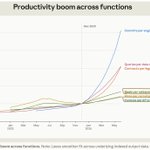
Commits seem to grow exponentially after Dec 2025, while deals and invoices roughly linearly. Seems to be the case that value is logarithmic in tokens generated? Am i reading this right?
from anthropic.com/research/emplo…

Commits seem to grow exponentially after Dec 2025, while deals and invoices roughly linearly. Seems to be the case that value is logarithmic in tokens generated? Am i reading this right?
from anthropic.com/research/emplo…