

Tracking AI & Technology With Caduceus: 🔗 https://xitter.gq/t.co/xPOhLouCXA
@caduceusvisuals
Joined September 2021
- Tweets12.9K
- Following304
- Followers438
- Likes14K








Pinned Tweet
Google Deepmind is on a roll lately
Compelte Google AI ecosystem visualized
view.caduceusapp.eu/apollonv…
(i) Genie 3 -world model
(ii) Gemini 4 Carbon/Argon -frontier llms
(iii) Gemini omni 1.2 flash - text/image to video
(iv) WeatherNext 3 - probabilistic generative weather forecasting model
(v) Gemini Robotics 2.5 -AI for robotics
their model availabiltity though is not so great
🤖 Made with AI


229


Apollo retweeted

Genie 4 is now available in Project Genie.
It brings native audio, real-time editing, and a new agent to help you create interactive, virtual worlds.
Fugaku Security Breach Potentially Affects Over 4500 Users
Japan's RIKEN Center for Computational Science shut down its Fugaku supercomputer following a cyberattack that compromised internal research infrastructure.
The incident involved unauthorized access between November 10 and November 13 2026.
Investigators determined that attackers entered through a publicly accessible website displaying Fugaku's operational status.
The attackers subsequently accessed internal servers and installed malicious programs on compromised systems.
RIKEN reported potential exposure of personal information belonging to up to 4222 Fugaku users and 375 users of its RIKYU supercomputer.
The information included names and email addresses and user identification records.
SSH private keys and access credentials and research files stored within affected user directories were also potentially compromised.
RIKEN suspended Fugaku operations at 04:30 on November 14 and disabled affected authentication credentials.
Investigators confirmed that attackers attempted to use stolen credentials to access additional systems but had not established further unauthorized access or confirmed theft of research results.
The 537 petaflops supercomputer will resume operations after compromised servers are rebuilt and security checks and remediation measures are completed.
🤖 Made with AI

17
Windows Server 2028 Enables Hardened Security By Default
Microsoft announced Windows Server 2028 at Ignite on November 17 2026 with security hardening enabled by default.
The new operating system introduces a hardened Server Core configuration that applies hundreds of security settings during installation.
The configuration is available for testing beginning with Windows Server Insider Preview build 29706.
Microsoft is prioritizing Kerberos authentication over NTLM and strengthening protection for the Local Security Authority Subsystem Service.
Network protections include mandatory SMB signing and encryption alongside firewall enforcement across all network profiles.
Legacy name resolution methods and unauthenticated remote procedure calls are disabled by default in the hardened configuration.
The operating system also introduces hybrid post quantum cryptography using the ML KEM algorithm.
Virtualization protections include Trusted Launch virtual machines and expanded confidential computing capabilities.
Additional infrastructure features include native NVMe storage and expanded management through Microsoft Intune and Azure Arc.
Windows Server 2028 also adds support for local AI inference through Windows ML and Foundry Local and compatible frameworks including vLLM and Llama.cpp.
🤖 Made with AI

36
American Companies May Have To Disclose Chinese AI Use
The US government is considering requiring American companies to publicly disclose when they use artificial intelligence models developed in China.
Reuters reported the discussions on November 18 2026 citing three people familiar with the proposal.
The Treasury Department and White House Office of Science and Technology Policy have participated in discussions about the measure.
Companies could be required to disclose their use of Chinese AI systems on their corporate websites.
Models potentially covered include Alibaba's Qwen and DeepSeek and Moonshot's Kimi.
Airbnb already uses Alibaba's Qwen model to operate parts of its AI customer service system according to Reuters.
Congressional investigators have separately contacted Airbnb and Anysphere and DoorDash about their use of Chinese AI technology.
Reuters reported that Chinese models occupied the three leading positions by token usage on OpenRouter during October.
The proposed approach would require public transparency without necessarily banning companies from using Chinese AI models.
No formal regulation has been adopted and the administration has not confirmed whether the proposal will advance.
🤖 Made with AI

16
Nvidia Suspends Licensed Hopper Processor Sales To China
Nvidia confirmed on November 18 2026 that it has stopped shipping US approved Hopper generation AI processors to customers in China.
Interim CEO Colette Kress disclosed the decision during the company's quarterly earnings call.
The affected processors include the H200 which had previously received conditional approval for export to selected Chinese companies.
Nvidia sold approximately $2.4 billion of licensed Hopper data center products to Chinese customers during the quarter ending October 25.
The company stated that its current financial forecast assumes no additional licensed Hopper shipments to China.
The United States had previously approved sales of these processors to 10 Chinese companies under specific licensing conditions.
Approved customers included Alibaba and Tencent and ByteDance.
Reuters previously reported that approximately 600000 H200 processors were being held in Hong Kong while awaiting Chinese import approval.
Chinese authorities have also introduced restrictions intended to reduce domestic dependence on American semiconductor technology.
Nvidia did not explain the precise reason for stopping shipments or confirm whether the suspension would become permanent.
🤖 Made with AI

23
Google Finds Automated AI Frameworks Used By Cybercriminals
Google Threat Intelligence Group reported on November 16 2026 that attackers are using autonomous AI frameworks to conduct increasingly automated cybersecurity operations.
Researchers documented the use of language models to identify vulnerabilities and execute multistage attacks against exposed systems.
Google reported observing threat actors fully automate vulnerability discovery and exploitation without human intervention for the first time in its investigations.
Researchers discovered an exposed staging server operating a malicious framework called exploit_agent.
The system analyzed software patches to identify recently corrected vulnerabilities that might remain exploitable on unpatched servers.
It then generated and tested exploit code through automated workflows intended to compromise vulnerable systems.
Google also identified the use of CAIRN and ARTEX and CyberStrikeAI and PentAGI in malicious operations.
Attackers additionally used stolen AI service credentials to access computing resources and resell model access through unauthorized services.
Google's telemetry showed monthly exploitation of zero day vulnerabilities rising from a 2025 average of eight to 22 during August 2026.
The report documents observed attacker behavior and does not establish that every capability available in these frameworks has been used successfully in real attacks.
🤖 Made with AI


28
Microsoft Releases New AI Models For Coding And Cybersecurity
Microsoft announced seven artificial intelligence models at its Ignite conference on November 17 2026.
The release covers cybersecurity analysis and software development and image generation and voice interaction and transcription and decision making.
The models include MAI Cyber 2 Flash and MAI Code 2 and MAI Code 2 Flash.
Microsoft also introduced MAI Image 2.7 and MAI Realtime 1 and MAI Transcribe 2 and Decision 1.1.
Microsoft reports that MAI Code 2 achieves 98% of GPT 6.1 Sol's performance across four coding benchmarks.
The company states that MAI Code 2 achieves that result at approximately 40% of the competing model's price.
MAI Cyber 2 Flash is priced 86% lower per output token than the preceding MAI Cyber 1.1 Flash model.
MAI Realtime 1 supports conversational speech applications with pricing starting at $0.01 per audio minute.
Microsoft reports that MAI Transcribe 2 already processes approximately 10 million patient encounters monthly through Dragon Copilot.
The company also introduced MAI Licensed Weights to allow enterprise customers to customize models and deploy them within their own Azure environments.
🤖 Made with AI

44
Nvidia Data Center Revenue Reaches $107.6 Billion
Nvidia reported quarterly revenue of $115.8 billion on November 17 2026 following continued demand for AI computing infrastructure.
The results cover the third quarter of fiscal 2027 ending October 25 2026.
Total quarterly revenue increased 103% compared with the same period one year earlier.
Revenue also increased 20% compared with the preceding quarter.
Nvidia's data center business generated $107.6 billion in quarterly revenue.
Data center revenue increased 110% from the previous year and 21% from the preceding quarter.
The company reported GAAP net income of $65.3 billion representing a 105% annual increase.
Its GAAP gross profit margin reached 74.8% during the quarter.
Nvidia confirmed that its Vera Rubin NVL72 computing systems had entered commercial shipment to cloud infrastructure partners.
The company forecast fourth quarter revenue of approximately $130 billion with a 3% margin of variation while excluding Chinese data center compute sales.
🤖 Made with AI

14
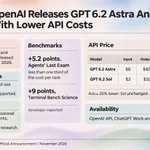
OpenAI Releases GPT 6.2 Astra And Sol
OpenAI released GPT 6.2 Astra and GPT 6.2 Sol on November 17 2026 for professional workflows and software development and scientific research.
Both models support reasoning and tool use and computer interaction through supported environments.
GPT 6.2 Astra is designed for complex professional tasks involving documents and spreadsheets and programming and research.
OpenAI reports that Astra scored 5.2 points higher than GPT 6 Astra on Agents' Last Exam at less than one third of the cost per task.
The company also reports a 9 point improvement on Terminal Bench Science compared with its previous Astra model.
GPT 6.2 Astra costs $8 per million input tokens and $40 per million output tokens through the standard API.
These rates represent a 20% reduction from the preceding Astra model while cached input costs $0.40 per million tokens.
GPT 6.2 Sol retains pricing of $2 per million input tokens and $10 per million output tokens.
Both models are available through the OpenAI API and ChatGPT Work and Codex for eligible users.
OpenAI reports improved token efficiency and performance across coding and scientific benchmarks while the published comparisons remain developer reported.OpenAI Releases GPT 6.2 Astra And Sol
🤖 Made with AI

28
Microsoft Agent Framework Compromised In PyPI Supply Chain Attack
Attackers published two malicious versions of Microsoft's Agent Framework Python package on November 17 2026.
The compromised releases were versions 1.26.1 and 1.26.2 distributed through the official Python Package Index.
The first malicious version appeared at 20:35 UTC and the second followed approximately 33 minutes later.
Both releases contained credential stealing code designed to execute automatically whenever the Python interpreter started.
The malicious code could run even when developers never imported Agent Framework into their applications.
Attackers targeted Azure credentials and GitHub Actions tokens and cloud identity information and other secrets stored in development environments.
The second malicious version expanded the collection of credentials and attempted to obtain additional identity tokens from GitHub Actions.
Microsoft Agent Framework receives approximately 190000 to 200000 package downloads each month across its versions.
Security researchers reported that both malicious releases had been removed from PyPI by approximately 21:30 UTC.
Microsoft acknowledged the incident and investigators identified version 1.26.0 as the latest verified clean release.
🤖 Made with AI

34
Critical Java4Shell Vulnerability Threatens Enterprise Servers
Oracle and OpenJDK released security fixes on November 17 2026 for a Java vulnerability that could allow attackers to remotely execute malicious code.
The vulnerability is known as Java4Shell and affects certain Java installations running on modern processors.
Researchers identified memory corruption affecting Java Virtual Machine operations on processors supporting AVX 512 VBMI instructions.
Affected systems include certain versions of Java 17 and later releases running on compatible x86 processors.
Red Hat classified the vulnerability as critical and assigned it a CVSS severity score of 9.8.
Oracle assigned the same vulnerability a CVSS score of 8.1 under its assessment methodology.
Successful exploitation could allow an unauthenticated attacker to execute arbitrary code or crash vulnerable applications.
Researchers demonstrated attacks against applications including Jenkins and Jira and Confluence and Keycloak.
South Korea convened an emergency government meeting because Java is used in approximately 72% of its public sector information systems.
Security authorities recommended immediate patching while widespread exploitation had not been confirmed as of November 18.

38
Apollo retweeted

BREAKING 🔥: Google has announced Loop, a new Stitch experiment.
Loop is an AUTONOMOUS AI agent that handles a full cycle from product discovery to implementation and monitoring.
This is a new type of solution that can improve your product on its own, with the user's role boiled down to setting goals (loops), reviewing outcomes, and making decisions.
I've been testing Loop for weeks, powered by Gemini 3.8 Flash, and I'm super keen to see what it can do with Gemini 4 models.
Waitlist time! 👀
Apollo retweeted

Working with @AMD, our models identified up to 14% PPA improvement on flagship GPU IP in less than five months—building on designs AMD’s engineers had already spent years optimizing.
The same approach helped improve Jalapeño, our first custom inference chip, with gains verified on real silicon.
New evaluations also show our models getting better at certain chip design tasks.
We’re sharing these results and how we’re working with @Synopsys to bring our model capabilities and their trusted EDA design and validation tools to more chip designers.
openai.com/index/advancing-c…


Apollo retweeted

Mistral Vibe is now available on Desktop!
Run agents locally or remotely, and start shipping straight from your MacOS or Windows device.
You can try the Pro plan for free if you’re building in Europe. Coupon code: LECHONK
(yes, we added more after we ran out yesterday).
Use the link in 🧵:
Rubin HPC Packs 50000 Cores
NVIDIA announced Rubin HPC a new GPU built to speed up simulations used by AI agents in science and engineering.
Rubin HPC carries more than 50000 cores which NVIDIA describes as a record for a single GPU.
The chip is expected to be available in 2028.
Rubin HPC targets workloads in science engineering and analytics.
The design focuses on simulation speed for agent driven research.
NVIDIA positions the core count as the largest for one GPU.
No pricing was disclosed for Rubin HPC.
The 2028 date sets the launch roughly two years out from the announcement.
🤖 Made with AI

27
155 Million Parameter Enterprise Model
KiteFishAI released NanoI1 on November 17.
NanoI1 is a 155 million parameter open weight language model.
The model was trained from scratch on approximately one trillion tokens using eight NVIDIA H100 GPUs in Gurgaon.
The file size is 311 MB and the model runs on laptops and local servers.
Weights are released under the Apache-2.0 license with Base and Instruct versions.
The context window is 2 048 tokens.
Vendor benchmarks report 9.1% on HumanEval versus 2.4% for Gemma-3-270M.
The model supports English Hindi and eight other Indian languages with limited multilingual capability.
🤖 Made with AI

24
Clara Intelligence Enters U.S. Audit Workflows
KPMG is rolling out KPMG Clara intelligence or KCi in the United States.
The deployment embeds specialized AI agents into audit workflows.
The announcement was made on November 17.
KCi has been rolling out to more than 125 U.S. teams and 500 teams globally.
The next objective is deployment across all private company audits in 2027.
Automated data pipelines can analyze complete transaction populations in selected audit areas.
KPMG reports that on some engagements this approach shortened timelines by as much as three and a half weeks.
Nearly 1000 Audit and Assurance interns attended training at the Lakehouse facility earlier this year.
🤖 Made with AI

20
Recast Adds MCP Server at Ignite
Recast introduced an MCP Server for Right Click Tools at Microsoft Ignite on November 17.
The server connects natural language AI assistants with live data from managed devices.
It replaces stale inventory records with current device information for diagnosis.
The integration preserves existing permissions routing and licensing controls.
Tool runs require approval before execution in the workflow.
Setup documentation covers GitHub Copilot in Visual Studio Code and GitHub Copilot CLI.
Examples include checking device reachability and retrieving BitLocker status.
Recast says its products manage more than 60 million endpoints.
🤖 Made with AI

1
1
35
32 Interviews Test AI Analysis
University of Missouri researchers published a method to test whether AI finds meaning in interview text or only sorts it into categories.
The framework is called the Alignment and Usefulness Rating Audit (AURA).
The team tested AURA on 32 interviews with nursing faculty practitioners and students about their experiences with generative AI.
Human researchers identified 12 themes in the interviews.
Eleven of the 12 human themes closely matched at least one topic generated by a computer model.
A match did not guarantee that the model captured the full meaning of a theme or organized the information in a useful way.
The model sometimes merged several distinct themes into one broad topic or split a single theme into several smaller ones.
The study appeared in the International Journal of Qualitative Methods with DOI
🤖 Made with AI

10