

Electrical engineer. USAF Veteran. Fascinated by neuroscience; always learning. Addicted to reading and exploring mountains. Socratic gadfly.
Washington State
Joined February 2024
- Tweets4K
- Following1.9K
- Followers1.5K
- Likes16K




Pinned Tweet
"For a successful technology, reality must take precedence over public relations, for nature cannot be fooled."
Richard P. Feynman
nasa.gov/history/rogersrep/v…
This didn't have to happen...


Worth reading and remebering with your real neurons

A neuron in today's AI models is a formula. A real neuron is a process: it adds up what arrives, slowly forgets it, and fires when enough has built up.
A paper out this week in Nature Nanotechnology, by Guanmin Li and coauthors, builds that process out of materials physics. Then it lets the neuron write its own output straight into a magnetic memory.
The neuron is two tiny pieces of vanadium dioxide, a material that switches from insulator to metal when it gets warm enough. Send it pulses close together and their effect builds up until the first piece switches. Its heat triggers the second piece, two micrometres away, which fires a spike. Send the pulses far apart and the effect fades before anything happens. No capacitor is needed to do the remembering.
The memory is a magnetic wire called a racetrack. Each spike pushes the boundary between two magnetic regions about one micrometre along the wire. Two spikes, two micrometres. Six spikes, six. The count is stored as a position, and it stays there with the power off.
In most hardware of this kind, a neuron's output has to be amplified and digitized before it can be stored. Here the spike does the writing itself.
It is an early device, not a chip. The parts are micrometres across, the wall position was read with a microscope, and the 96.3% on handwritten digits comes from a simulation built on the measured neurons.
As a physics lesson, though, it is hard to beat: a phase transition that integrates and fires, and a magnetic wall that counts.
Guanmin Li, Renata Lei et al., “Integration of Mott neurons and spintronic memories for event-driven spiking neural networks,” Nature Nanotechnology (2026). Article. License: CC-BY 4.0. doi.org/10.1038/s41565-026-0…

1
36
This may be the way future generations visualize proofs
Math ~= Music

Preserve our Natural world 🌎🌍

News of @NaturalEngland terminated by @andyburnham's cabinet is catastrophic, already one of the most nature depleted corners of Europe. Sadly, can’t say I’m surprised. Since November 2024, there was certainly no urgency from either @NaturalEngland or @WildlifeTrusts for a topographical survey of Denham Lock Wood 'SSSI', despite my documenting the negative impact (net biodiversity, hydrology) of illegal development in situ. An obtrusive impermeable platform, at scale, constructed prior environmental survey (by legal statute), having excavated many tonnes of peatland to the north - natural drainage basin, has entirely halted freshwater tributary inflow over two years. What was once a vibrant, scarce wet woodland habitat to west of London, now a dried up husk of its former self caused by an artificial dam. An unprecedented toll on local ecology and trophic dependents, sadly nothing short of ecocide!! This is very much a wakeup call to stop the incessant placating of development, over sustained conservation efforts, @TonyJuniper @Colne_Valley. xitter.gq/ChristosA89/status/185…
Will observation replace insight in math? I wonder if mathematicians go the way of Lee Sedol after AlphaGo? New Kind of Science, written in 2002, by @stephen_wolfram gives insight into our current age. Worth studying.


In 2006, I wrote a short essay called "The End of Insight".
We're not quite there yet, but the stunning proof of the Riemann hypothesis hints at what might lie ahead.
For more on this, see johnhorgan.org/cross-check/t…

1
2
124
🔑 Hannah Arendt on The Origins of Totalitarianism: the "ideal subject" of totalitarian rule is not a convinced ideologue, but someone for whom the distinction between fact and fiction—and between true and false—no longer exists.

Here's a useful and well researched overview of Issac Asimov's work, very relevant to our current age.

DON’T READ “I, ROBOT”!
You can’t imagine the amount of thought that went into making this list.
As promised: Every. Single. Robot/Computer Story of Isaac Asimov. All put in a thematic order & Where to find them.
Show your support, bookmark for future reference and share around.

ALT A Foundational Guide To Isaac Asimov's Robot/Computer Stories ©️ M. Reza Rouhi

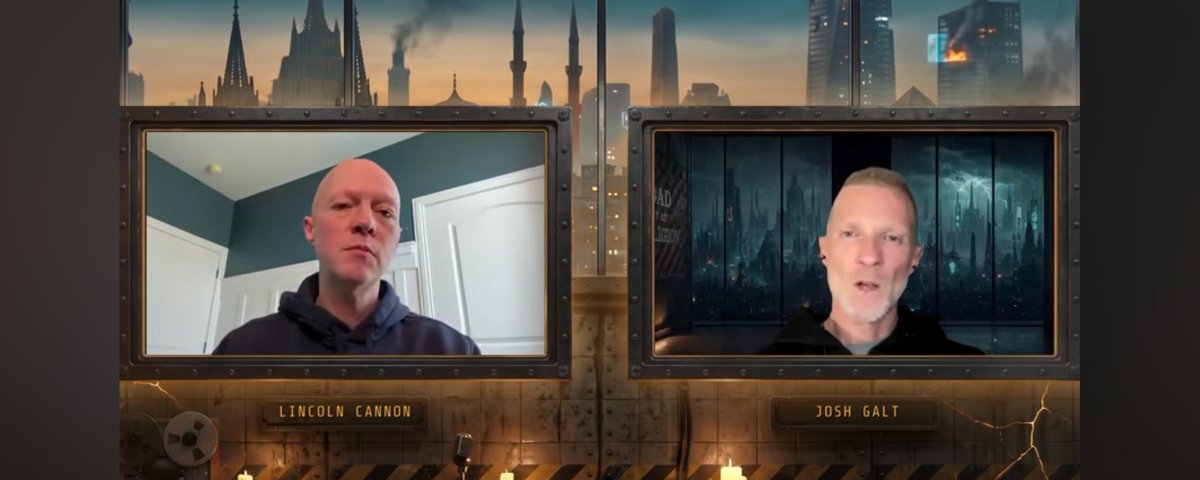
A useful reference is Lincoln Cannons New God Argument v 3.4 It helped clear up my confusion regarding the Orthogonality and Convergence Hypotheses, read it here:
lincoln.metacannon.net/2019/…

1
22


Interesting that human life requires heavier elements such as Co, Ni, Mo, Se, and especially Iodine as they require more complex stellar nucleosynthesis. This would put a lower bound on origin of life timeline?
xitter.gq/i/grok/share/c2hhcmQtN…
@CatAstro_Piyush
Life as we know it couldn't have existed for about 1.5 billion years after the Big Bang
xitter.gq/i/grok/share/c2hhcmQtN…
21
“I'm motivated by curiosity more than anything, and just a desire to think about the future and not be sad”

When Chris Anderson asked Elon Musk what drives him every single day to do everything he does, Elon gave an incredibly deep and powerful answer
“I really want to make sure that there is a good future for humanity, and that we're on a path to understanding the nature of the universe, the meaning of life. Why are we here? How do we get here?”
And then he explained what motivates him more than anything:
“I'm motivated by curiosity more than anything, and just a desire to think about the future and not be sad”
Earth overtakes Mars


For thousands of years astronomers watched Mars crawl eastward against the stars, then stop, turn around and move west for about two months, then stop again and go back to its usual direction.
Ptolemy explained this with circles riding on circles. The real reason is simpler: it is the Earth that moves.
Copernicus used exactly this argument in 1543. In this circular orbit model the backwards stretch lasts 73 days, and the full cycle repeats every 780 days.

Price volatility is not Risk.
A few people will look at the post below, most will run with the herd.
@DilksJay @kejca @insi

Volatility is not risk. Buffett said risk comes from the nature of a business and from not knowing what you are doing. A falling price can make the same asset safer.
youtu.be/wjZECH6hRrM?si=kfBO…

3
66
Do what you love, and you’ll never work a day in your life
ft.com/content/6ab48700-a898…
No Distractions. Warren Buffett
"The wooden shutters on the [office] windows are always closed. You get no sense that a world exists outside, which is what he wants, no distractions. As far as I can tell, he doesn’t need sunlight." Alice Schroeder, The Snowball: Warren Buffett and the Business of Life
SK:
1. Value investing works. Buy bargains.
2. Quality matters, in businesses and in people. Better-quality businesses are more likely to grow and compound cash flow; low-quality businesses often erode and even superior managers, who are difficult to identify, attract, and retain, may not be enough to save them. Always partner with highly capable managers whose interests are aligned with yours.
3. There is no need to overly diversify. Invest like you have a single, lifetime “punch card” with only 20 punches, so make each one count. Look broadly for opportunity, which can be found globally and in unexpected industries and structures.
4. Consistency and patience are crucial. Most investors are their own worst enemies. Endurance enables compounding.
5. Risk is not the same as volatility; risk results from overpaying or overestimating a company’s prospects. Prices fluctuate more than value; price volatility can drive opportunity. Sacrifice some upside as necessary to protect on the downside.
6. Unprecedented events occur with some regularity, so be prepared.
7. You can make some investment mistakes and still thrive.
8. Holding cash in the absence of opportunity makes sense.
9. Favour substance over form. It doesn’t matter if an investment is public or private, fractional or full ownership, or in debt, preferred shares, or common equity.
10. Candour is essential. It’s important to acknowledge mistakes, act decisively, and learn from them. Good writing clarifies your own thinking and that of your fellow shareholders.
11. To the extent possible, find and retain like-minded shareholders (and for investment managers, investors) to liberate yourself from short-term performance pressures.
12. Do what you love, and you’ll never work a day in your life.

Worth reading
"... technology can and should be integrated ever more deeply into our lives in ways that expand rather than diminish agency, both for us and for our creations. "

Humanity+ is dissolving. Is Transhumanism dead? lincoln.metacannon.net/2026/…

1
1
47