

I love to build things! I code every day, I own a small startup software company. Come watch my journey!
China
Joined June 2014
- Tweets7K
- Following3.1K
- Followers3.3K
- Likes3.9K







Bryan ✴️ retweeted

these 2 free GitHub repos should honestly be illegal in trading - they just made a $30K/year terminal obsolete
hedge funds pay $30K a year per seat for a Bloomberg terminal - someone rebuilt one with 2 GitHub repos and made every chart draw 100 possible futures for 100% FREE
the repos are REA and Kronos. REA hit #1 on GitHub and has 200k stars. Kronos was trained on 12 BILLION candles, the paper got into AAAI 2026, and it has 41k stars
first understand how it works:
> REA lets your AI agent see how any app works, down to the binary, and rebuild it from scratch
> ChatGPT turns words into tokens & predicts the next word
> Kronos turns every candle into tokens & predicts the NEXT CANDLE
> in the paper's benchmarks it beat the best rival model's forecasts by 93%
> put them together and you get a Bloomberg-style terminal where every chart forecasts itself
here is how to build it yourself for FREE:
1. open Claude Code and connect REA as an MCP. it maps how the terminal works: quotes, charts, news, screeners
2. ask Claude to rebuild every panel from scratch. equities, FX, commodities, crypto, live news feed
3. pull the data from free public APIs. Binance gives you any coin, any timeframe, no account
4. clone github.com/shiyu-coder/Krono… and load Kronos-small. 24.7M params, it runs on a normal laptop, no GPU
5. feed it the last 512 candles and ask for the next 24, exactly like an LLM finishing a sentence
6. sample 100 futures, not one guess, and draw all of them right on the chart. the spread shows how risky the next move really is
7. read the regime: most paths pointing one way means TRENDING, paths scattered both ways means CHOPPY
8. backtest it walk-forward with real fees and paper trade it before you trust a single path
i won't say anything more:


Introducing Cybermint
The new age of cybercurrency tokens built on Solana.
Turn your take on the cybercurrency narrative into a token, build your community and earn creator fees from its trading activity.
Launch with Cybermint Shield, giving buyers verifiable creator locks and token authority checks from day one.
Keep your configured share of creator fees while the rest automatically buys TRUMP for the public treasury.
Your own cybercurrency, with transparent launch protections and a direct connection to TRUMP.
Site: cybermint.fun
Github: github.com/BryanFrontend/Cyb…
2
175


Introducing Anatomy
Describe anything in one line. Claude builds it into a working 3D machine.
Interactive 3D models you can rotate, inspect and explore
Real moving parts, physics and WebGL effects
Turn any idea into something people can actually interact with
Imagine what this means for crypto projects.
Instead of launching with a static website and a logo, you can build an entire interactive world around your token with a single prompt.
Fully open source.
github.com/BryanFrontend/Ana…
skills.wheresryan.sh/anatomy
Bryan ✴️ retweeted

GitHub wasn’t built for hardware.
So we built Circuit World.
An AI-native EDA + MCAD platform for designing, iterating, collaborating, versioning, and manufacturing hardware in one browser.
You don’t have to start every design from scratch.
Start with one of 8,800+ existing boards, build on it, and iterate with AI from PCB to mechanical assembly. Then send it straight to manufacturing.
heypcb.ai/world

Bryan ✴️ retweeted

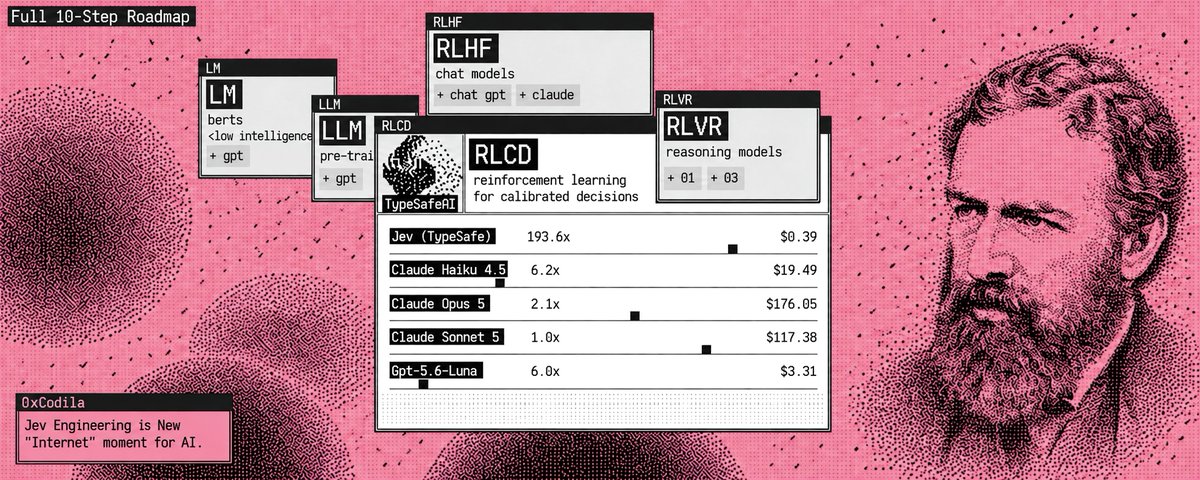
Jev + GrokBot is the best AI agent system I’ve built in my life
It just made my setup CHEAPER and FASTER than what 95% of people are running...
setup takes literally 7 minutes:
prompt → GrokBot → Jev decision → GrokBot execution → result
step 1 → open @typesafeai , create API key (keep it off chat paste)
step 2 → tell Grok Bot: store TYPESAFE_API_KEY in the secure field
step 3 → prompt Grok Bot: install typesafe-sdk on Agent Computer + smoke system_one (Choice)
step 4 → tell Grok Bot: build the usage lab (router, dry-run, config, logs) - or clone Github below
step 5 → add skill jev-usage-router: before browser / research / retry / extra bot → call the router, honor action
step 6 → stay shadow first, read logs, then active when you trust it - kill switch: bypass jev or enabled: false
step 7 → flip active: GrokBot obeys route - Jev decides - GrokBot executes - humans control irreversible actions
the result: Jev + GrokBot the best and fastest agent running directly on your computer rn, I’ve already tested it on routine tasks - and the results are genuinely incredible
You can come up with endless ways to use Jev + GrokBot - but the most important thing is to install it as soon as possible
Copy this 2028 setup, explore my repo below - then read the full Jev deep dive ↓


Bryan ✴️ retweeted

Jev Engineering is the layer most agent stacks are still missing.
state → decision → action → verification → next state
up to 193x faster and 444x cheaper in our tests.
everyone is optimizing the model.
Jev Engineering optimizes what happens between model calls.
every agent eventually hits the same fork:
state
→ multiple possible actions
→ one route has to win
instead of sending every decision back to an expensive LLM call, Jev turns that into a dedicated layer:
so the loop becomes:
LLM → reason
Jev → decide
tools / agents → execute
state → update
Jev → decide again
once decisions become their own engineering layer, you can benchmark, batch and verify them separately.
full blueprint in article ↓


Bryan ✴️ retweeted

tested Jev as a real-time robotics policy in MuJoCo
it struggled at first, so i split each update into two calls: decide what to do next, then decide how to move the arm and gripper
Jev doesn’t accept images, it gets simplified geometry and contacts as text here
Bryan ✴️ retweeted

NEW OPEN SOURCE ROBOT: A cheap, lightweight, and agile platform for locomotion!
Called BRIDGE, it is an open-source humanoid robot platform, hardware plus control system.
It is an 88 cm, 12.5 kg humanoid with 21 active degrees of freedom that costs roughly $1,500.
Its distinguishing idea is that the body and the controller are designed together through a three-stage data-driven pipeline:
- anatomical constraints
- kinematic criteria
- closed-loop dynamic criteria
Hence the morphology itself is optimized to preserve human motion quality when the robot executes.
It demonstrates teleoperated locomotion, balance-oriented motion (bending, lunging, extreme balance) and highly dynamic motion including back-flips and expressive sequences.
I like that the thesis is designing the body and the controller together, not a controller for a fixed body, which inverts how nearly everyone else works; the robot is usually given, usually a Unitree G1, then train a policy on it.
At the end of the day, it is a sub-$2K open-source humanoid that does back-flips, the humanoid analogue of the cheap-arm democratization.
Bryan ✴️ retweeted

A robot that drives straight up a wall! 🧱
VertiGo is a robot built by Disney Research with ETH Zürich.
Most wall-climbing robots hold on. Suction cups, magnets, dry adhesives.
All of them need a surface that cooperates, and none of them solve the genuinely hard part, which is getting from the floor onto the wall in the first place.
Two tiltable propellers generate thrust into the wall, pressing four wheels against it hard enough to drive. Each propeller has two degrees of freedom for aiming that thrust, and one pair of wheels steers.
The rear propeller pushes the robot toward the wall while the front propeller pushes upward, and the combination flips it onto the vertical surface. One propeller can hold you on a wall. It takes two to get you there.
This is from the end of 2015, which is worth saying out loud.
A decade later it's still an awesome project in robotics! :)
~~~
♻️ Join the weekly robotics newsletter, and never miss any news → ziegler.substack.com
Bryan ✴️ retweeted

THIS NEW ATLAS ROBOT JUST COMPLETELY BROKE HUMAN ANATOMY
Boston Dynamics and Hyundai are officially terminating the standard rules of humanoid motion
while other tech firms are struggling to make machines copy rigid human steps, the newly revealed electric Atlas prototype just turned the exhibition floor into a showcase of hyper-mobility
the engineering data behind this new production-ready platform shifts the entire global automation meta
this machine completely eliminates the traditional concept of a blind spot
it utilizes continuous 360-degree joint rotation across its entire chassis, meaning it can spin its torso and limbs indefinitely without turning its base
the mechanical upgrade significantly scales physical utility
Atlas now carries a routine lifting capacity of thirty-two kilograms and a max deadlift of fifty kilograms, supported by custom bionic fingers that dynamically bend backwards to minimize unnecessary movement
to supercharge the brain infrastructure, developers announced a massive partnership with Google to integrate large-scale Gemini robotics AI models directly into the hardware pipeline
after testing early models inside car factories for over a year, the company is officially moving this platform into commercial production


Bryan ✴️ retweeted

this is f*cking GOLD.
Could this make finding your next $1K opportunity EASIER? That’s what I’m building CAT BRAIN to explore.
The plan: bring 100+ mathematical formulas into token analysis - because ONE bullish metric can hide a very different story underneath.
Volume is pumping. But is liquidity keeping up? Are buyers spreading out, or is supply concentrating in a few wallets?
That’s what I’m building it to CONNECT.
The system is designed to take price, volume, liquidity, and wallet data, normalize those inputs, and run them through statistical models. Then it compares the signals: what agrees, what contradicts, and what looks UNUSUAL against the token’s own history.
A volume spike ALONE tells you very little. A volume spike alongside stronger liquidity, broader participation, and sustained momentum gives you more context to investigate.
The point of 100+ formulas isn’t to collect 100 reasons to buy. It’s to TEST an attractive signal from different angles before trusting it.
Less manual cross-checking. A CLEARER reason to look closer - or walk away.
This is the project’s THIRD feature. Check out the earlier posts on the project’s profile to explore the first two.


Bryan ✴️ retweeted

A DEAD FLY IS DRIVING MY ROBOT RIGHT NOW.
Not a metaphor. A reconstructed neural map of a fruit fly - 166,700 neurons, 25.6 million synapses - is now running on my MacBook and steering a quadruped robot in my living room.
Here's how it works:
1. MaleCNS - a full connectome reconstruction of an adult fly brain - runs as a live simulation on my laptop.
2. I used Codex to build a decoder that reads the simulation's neural activity and turns it into movement commands: forward, left, right.
3. Those commands get sent over Wi-Fi to the robot, which still uses its own firmware to drive all 12 servos. The brain only decides where to go, not how to move each leg.
No scripts. No prerecorded paths. The simulation runs continuously, live, while the robot walks.
The fly has been dead for years. But its reconstructed nervous system is producing real decisions again, in real time, controlling a machine that didn't exist when it was alive.
Next step: feed the robot's sensors back into the simulation and close the loop. A dead brain that can finally feel the world it's walking through.
This fly has been dead for years.
Its brain runs on my laptop.
Its decisions move a machine through my living room.
One dead nervous system, walking again.
Bryan ✴️ retweeted

166,700 fruit fly neurons are walking a robot cat across a desk right now.
In September 2026, Google Research and HHMI Janelia mapped every neuron and every connection in an adult male fruit fly's full nervous system, brain, optic lobes, and ventral nerve cord together, and published it in Cell. The number is staggering on its own: 166,700 neurons, roughly 125 million synapses, the most complete nervous system map of any animal ever built.
Now that exact wiring is running live, simulated neuron for neuron, inside a small robotic quadruped equipped with a camera and motion sensors. Movement comes in through the sensors, the biological circuitry fires the way it always did, and the output drives the robot's legs directly. No one wrote the balance logic. No one coded the gait. The insect's own nervous system does that job, just on legs it never had.
To be clear about what this is and isn't: nothing biological is alive in this loop. It's a full computational reconstruction of real neural wiring, controlling hardware instead of an insect body. The brain is real. The body is borrowed.
Remarkable proof that a mapped nervous system can drive any body you give it, or a preview of something people aren't ready to think through yet?
Bryan ✴️ retweeted

THE FLY BRAIN ESCAPED THE COMPUTER. I PUT IT INSIDE A PHYSICAL ROBOT.
Scientists released a reconstructed map containing 166,700 neurons from a fruit fly.
I connected it to a Strandbeest.
The panel in the top-right shows the simulated brain running. Its neural activity is translated into motor commands that move the mechanical legs below.
The catch: this is a computational model built from biological wiring. I engineered the interface connecting its outputs to the robot.
First, the fly brain entered DOOM.
Then it played Chrome Dino.
Now it has a physical body.
166,700 neurons.
25 million connections.
One nervous system walking through the real world.
Bryan ✴️ retweeted

I’m excited to announce the world’s first Fly Language Model.
It uses a new architecture called GPF (Generative Pre-trained Fly). It adapts a small pre-trained model with the actual fly connectome. Don't believe it's real? Try it out below, view the code, and read the paper.
What will you ask the fly?
Bryan ✴️ retweeted

I didn't get what GPT-6 meant for robotics until I actually tried it.
GPT-6 Astra just does physical ICL out of the box.
we drop a recording of a human doing a novel task into 𝗰𝗼𝗱𝗲𝘅 app. Prompt it to drive a robot arm the same way.
It just works on the first pass!
Bryan ✴️ retweeted

I hired a humanoid robot to clean my SF apartment for $30/hour — and it runs on Qwen 3.5.
To my surprise, the cofounder came along, so I got the full rundown on how it works.
Readers added context they thought people might want to know
Tau Robotics' humanoid cleaners (as shown) are jointly controlled by remote human operators and AI, not fully autonomous (Qwen 3.5 is used in the planning stack).
tau-robotics.com/service-terms
tau-robotics.com/service-privacy
x.com/alexkoch_ai/st…
