
Assistant Professor at Imperial College Computing @CogImperial @ICComputing. Previously @TexasChE and @RiceEngineering.
London, England
Joined August 2020
- Tweets86
- Following499
- Followers495
- Likes945


Calvin Tsay retweeted

#NeurIPS2024It is my pleasure to share that our work on Transition Constrained Bayesian Optimization has been accepted to NeurIPS2024. Amazing work by coauthors @ Imperial: @folch_pablo @RuthMisener
@CalvinTsay ETH: @arkrause, Weronica Ormaniec, and amazing scientists from BASF.
Calvin Tsay retweeted

We are thrilled to reveal the newest awardees to the Research Chairs and Senior Research Fellowships scheme. This scheme provides funding and support to mid to senior engineering academics, to aid the progression of their research with an industry partner.
So far, it has successfully supported over 200 academic appointments and established/enhanced internationally renowned centres of excellence. Read our news release to find out who our latest awardees are and learn more about the scheme: raeng.org.uk/news/academy-an… #RAEngResearch

ALT Image text: Research Chairs and Senior Research Fellowships Thirteen new partnerships announced between academia and industry to improve automotive, robotic and medical industries. #RAEngResearch raeng.org.uk/research
Calvin Tsay retweeted

This work has been the result of my visit to @CogImperial at Imperial College London. Outstanding researchers and even better people. Thank you all for the warm welcome!

Calvin Tsay retweeted
Excited to share our new working paper! "A Quantile Neural Network Framework for Two-stage Stochastic Optimization" with @carlos_r84 and @CalvinTsay !
Check it out 👀 arxiv.org/abs/2403.11707
A brief summary in 6 tweets 👇
Calvin Tsay retweeted

Demand side response aims to manage peaks of demand and help balance the power grid.
Using demand side response could make household energy bills cheaper but there are some technical barriers, including how energy information is reported. Find out more: post.parliament.uk/research-…
Calvin Tsay retweeted

Gaussian Processes for Monitoring Air-Quality in Kampala
Join us for our poster tomorrow at the NeurIPS 2023 Climate Change AI workshop. Looking forward to chatting about using Gaussian processes to predict air pollution in sparse sensor settings. arxiv.org/abs/2311.16625


Calvin Tsay retweeted

Congratulations to @RiceCHBE professor and chair @Michael_S_Wong, who has been named a fellow to the Royal Society of Chemistry (@RoySocChem) in recognition of his role in driving “excellence in the chemical sciences.”
Read: bit.ly/3OkpO9z

ALT Michael Wong is the Tina and Sunit Patel Professor in Molecular Nanotechnology, chair and professor of chemical and biomolecular engineering, and a professor of chemistry, materials science and nanotechnology, and civil and environmental engineering at Rice University.
Calvin Tsay retweeted

I am hiring a Postdoc to work on developing algorithms and methods for mixed-integer optimization @KTHuniversity #orms #knightsofmip #postdocposition #postdocjobs
kth.se/en/om/work-at-kth/led…

Calvin Tsay retweeted

Excited to announce that I will be continuing my work on guarantees for trustworthy ML/AI this summer as a Lecturer (Assistant Professor) at Imperial College's Department of Computing! @ICComputing 🎉🎊🥳
Calvin Tsay retweeted

John Goodenough was a critical part of our community and it is with great sadness to hear of his passing. He was a dedicated public servant, a sought-after mentor and a brilliant, yet humble, inventor. I am thankful for all he did for @UTAustin, our students and the world.

ALT Photo of John Goodenough in his office. He is wearing a dark navy blazer, a pink dress shirt and a blue tie.
The Great Exhibition Road Festival is on! If you're attending @ExRdFestival, make sure to stop by our booth with @sargent_centre to learn about carbon capture and molecular design!

Ready to share our passion for science!
Join us @ExRdFestival Saturday and Sunday noon – 6pm @ImperialBiz -LG 19
#MoleculeDesign #CarbonCapture #CCS @CalvinTsay

Calvin Tsay retweeted

Jan Kronqvist's talk at #MIP2023, titled "Strong and computationally efficient formulations of disjunctive constraints," delves into an area of crucial relevance in mixed-integer optimization problems. Disjunctive constraints, which naturally appear in a wide range of problems also appear in AI and ML.
Kronqvist introduces a concept (at least, it is new to me): P-split formulations. This approach seems to align with the “divide and conquer” strategy, aiming to reduce computational effort either directly or indirectly. P-split appears as an exact representation of disjunctive constraints but with fewer variables exploiting the disaggregating leading to stronger relaxation (the “conquer” feature of the method).
I believe that a balance between computational efficiency and formulation strength/tightness (as well as the granularity of decomposition/disjunction) is always a compelling discussion. #optimization #AI #ML #DisjunctiveConstraints

Calvin Tsay retweeted

Congratulations to University Professor Moshe @Vardi who has been elected a Foreign Member of the @royalsociety for his seminal contributions to the development of logic as a unifying foundational framework and a tool for modeling computational systems." https://xitter.gq/t.co/bPwukNC273

Calvin Tsay retweeted

Very proud, and still a bit shocked, to share that I've been elected Fellow of the Royal Society. Thank you to my students and collaborators from Imperial College, Oxford, AIST, Dyson, Slamcore and beyond, and of course to my supportive family and friends!
royalsociety.org/people/andr…


We are very happy to announce the eighty exceptional scientists elected as Fellows of the Royal Society this year, selected for their outstanding contributions to the advancement of science. Meet the new Fellows and find out more about their research: royalsociety.org/news/2023/0…

Calvin Tsay retweeted

Exciting news! 🎉 I am thrilled to announce that I will be joining @MITChemE in Fall 2024 as a tenure-track assistant professor! I am grateful to my research and life mentors, Victor Zavala and Mihai Anitescu, for their invaluable mentorship and support (1/n)

Calvin Tsay retweeted

In case you missed @CalvinTsay's tweet, we have just released a survey along with @gmunoz_m and Joey Huchette on polyhedral theory in deep learning: arxiv.org/abs/2305.00241
This thread covers the main points, why we did this, and why you should care about it. Read along!
#orms

Excited to share our preprint, "When Deep Learning Meets Polyhedral Theory: A Survey" with J Huchette, T Serra @thserra, and G Muñoz @gmunoz_m!
Check it out! arxiv.org/abs/2305.00241
(1/3)

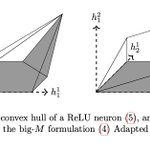
This survey reviews how LP/MIP can be used broadly in NN applications, from training and verification to model embedding and compression. We also illustrate how polyhedral theory can ground the use of LP/MIP and provide understanding of the discriminative ability of NNs.
(2/3)
1
3
480
On a more personal note, I read many papers by Joey, Thiago, and Gonzalo when starting my fellowship at
@CogImperial. It was an honor and pleasure to collaborate with them on this!
(3/3)