
Research Scientist at Xyme interested in Bayesian machine learning for biotechnology applications & causality. Previously a postdoc at Imperial College London.
London
Joined December 2020
- Tweets28
- Following135
- Followers62
- Likes8



Ruby Sedgwick retweeted

Active testing enables label-efficient model evals but can be computationally expensive.
We show how to reduce costs and scale up to LLMs.
arxiv.org/abs/2508.09093
Work led by Gabrielle Berrada. Find her at EurIPS, or @janundnik and me at NeurIPS in San Diego.

Ruby Sedgwick retweeted

Causal inference assumes a known graph, but what if you're unsure about the structure?
In our #NeurIPS2025 work, we show how to compute interventional distributions from (observational) data, taking structural uncertainty into account.
📜Paper: arxiv.org/abs/2507.05526
🧵1/10

Ruby Sedgwick retweeted
There’s a lot of confusion around uncertainty in machine learning.
We argue the "aleatoric vs epistemic" view has contributed to this and present a rigorous alternative.
#ICML2025 with @janundnik @eleanortrollope @markvanderwilk @adamefoster @tom_rainforth
1/5

Excited to be presenting this work at ICML!
Our Bayesian method allows for causal discovery using more flexible assumptions that better reflect real-world data.
Come chat to us: Tues 4:30pm East Exhibition Hall A-B E-1912
Paper: arxiv.org/abs/2411.10154


📢New #ICML2025 paper: "Continuous Bayesian Model Selection for Multivariate Causal Discovery".
We propose a Bayesian causal model that allows for scalable causal discovery without restrictive model assumptions.
Paper: arxiv.org/abs/2411.10154
Code: github.com/Anish144/Continuo…
🧵1/14

2
144
New paper at #AISTATS2025:
Weighted-Sum of Gaussian Process Latent Variable Models (WS-GPLVM)
We tackle a core challenge in signal separation where pure components vary nonlinearly across samples using latent variable Gaussian processes.

1
2
48
We demonstrate this approach on a synthetic test case, a spectroscopy dataset and oil flow data. Compared to baselines like inverse linear model of coregionalisation, classical least squares and partial least squares, WS-GPLVM achieves competitive or better performance.
1
31
Check out the paper here: arxiv.org/abs/2402.09122
Was a pleasure working with @james_ac_odgers, Chrysoula Kappatou, Ruth Misener, and Sarah Filippi on this project! If you are interested in knowing more, we’d love to hear from you.
27
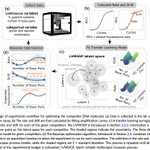
Excited to announce my PhD research is now out in Biotechnology and Bioengineering! We use transfer learning Bayesian optimisation to design DNA Molecules. This has the potential to accelerate the development of more effective diagnostic devices🧵👇(1/10) doi.org/10.1002/bit.28854

1
11
542
Our method isn't just for DNA design; it could also apply to other bioengineering challenges where data is limited but tasks are related. (9/10)
1
72
We're excited about how transfer learning can reshape experimental workflows in biotech, cutting costs and time. Big thanks to Prof Dame Molly Stevens, @RuthMisener, @markvanderwilk, and @BioGoertz. Interested? Drop me a message or read here: doi.org/10.1002/bit.28854 (10/10)

1
98