Investor | Trader | Traveler | Wanderer minding your business | Humor & Sarcasm go hand in hand
Between my ears
Joined February 2022
- Tweets53.1K
- Following1.8K
- Followers2.8K
- Likes55.3K






Sipn Coffee retweeted

The launch of CCIP 2.0 is something we've been working on with the world's top financial institutions for a while, we have now implemented their feedback on what is needed for institutional grade bridging of data and the movement of the digital assets themselves across both public and private chains.
The response from the capital markets community here at Sibos has been very positive, and it is clear that the additional compliance, risk management, configurability and network participation capabilities of CCIP 2.0 are something that institutions find attractive and useful.
I think the digital asset industry will end up at a new level of risk management for their data all of their tokenized value; where digital assets that are not bridged via a secure method and/or are relying on data that can be manipulated, will be viewed as much more risky. If the digital assets that bridge via providers which are not secure by default and/or keep repeatedly losing bridging keys, then they will receive worse asset risk scores which necessarily leads to worse terms for their usage as collateral, their inclusion on a balance sheet, and various other use cases. In some cases we are already seeing that having unreliable bridging or easy to manipualte data for valuation is leading to some digital assets to not be accepted for collateral or other users cases at all.
We are now working closely with top FMIs, the leading banks, top asset managers, top GSIs and various capital markets technology providers to enable digital assets to operate in a derisked way, to unlock the liquidity found in public chains and to efficiently connect the next generation of digital assets to the benefits of DeFi.
coindesk.com/business/2026/0…


Sipn Coffee retweeted
"Luck is what happens when preparation meets opportunity." ~ Seneca
The 10 year overnight success is a common story for many of the top products/companies. I've noticed that when you enjoy the preparation for the opportunity you have in mind, you can work on it for the 10 years.

Sipn Coffee retweeted
In 2020 ethereum:0x514910771af9ca656af840dff83e8264ecf986ca started running before bitcoin:native started its bull run.
What if 2026 is no different?

Sipn Coffee retweeted
If you think $1000 a token for $LINK sounds like a ridiculously high target, think about this:
#AWS (Amazon Web Services) which is the backbone of most web services is valued at around $2000000000000 ($2 trillion) and still expected to grow.
#Chainlink has achieved 1% of that value in 2021, without the project even being at 0.1% of its full capabilities.
There was no ANZ, ChinaAMC, and Visa, using CCIP and Automated Compliance Engine.
There was no DTCC, Euroclear, SIX, UBS, DBS, BNP Paribas Securities Services, Wellington, Schroders.
There was no DTCC, Robinhood/Robinhood chain, Project Pangea, Amundi, six, Coinbase, BitGo.
There was no SGX FX, Hastra/Figure, Bridgetower, Vayana, CMTA, Bermuda Monetary Authority, AWS Marketplace
There was no Mastercard, UBS, S&P Global Ratings, FTSE Russell, Tradeweb, Deutsche Börse, WisdomTree,
There was no Ondo, SBI Group/SBI Digital Markets, U.S. Department of Commerce, Central Bank of Brazil, Bank of England.
There were no 1000's of other partnerships.
$1K is fud and you know it.

If you think $1000 a token for $LINK sounds like a ridiculously high target, think about this:
#AWS (Amazon Web Services) which is the backbone of most web services is valued at around $2000000000000 ($2 trillion) and still expected to grow.
#Chainlink has achieved 1% of that value in 2021, without the project even being at 0.1% of its full capabilities.
There was no #CCIP or confirmed #SWIFT , #DTCC , #ANZ , #FIDELITY partnership, there was no #ChainlinkBUILD and 1000's of other partnerships.
$1K is fud and you know it.
Investing in .@Chainlink is probably the best opportunity you'll ever get in your lifetime.


Sipn Coffee retweeted
Walks into kitchen.
Stands there.
Looks around.
Opens fridge.
Closes fridge.
Opens cupboard.
Closes cupboard.
Checks phone.
Still no idea why I'm in the kitchen.
Walks back to the room.
Immediately remembers what I needed.
Walks back to kitchen.
Forgets again.
At this point I'm basically just doing cardio around the house. 😂
- ADHD things
#ADHD
Sipn Coffee retweeted
My brain during a task: "focus."
My brain 4 seconds later: "but what if birds don't actually know they're flying."
- ADHD things

Sipn Coffee retweeted
People keep telling me ADHD is a superpower.
Unfortunately for me, it's assigned to random missions.
- ADHD things
Sipn Coffee retweeted
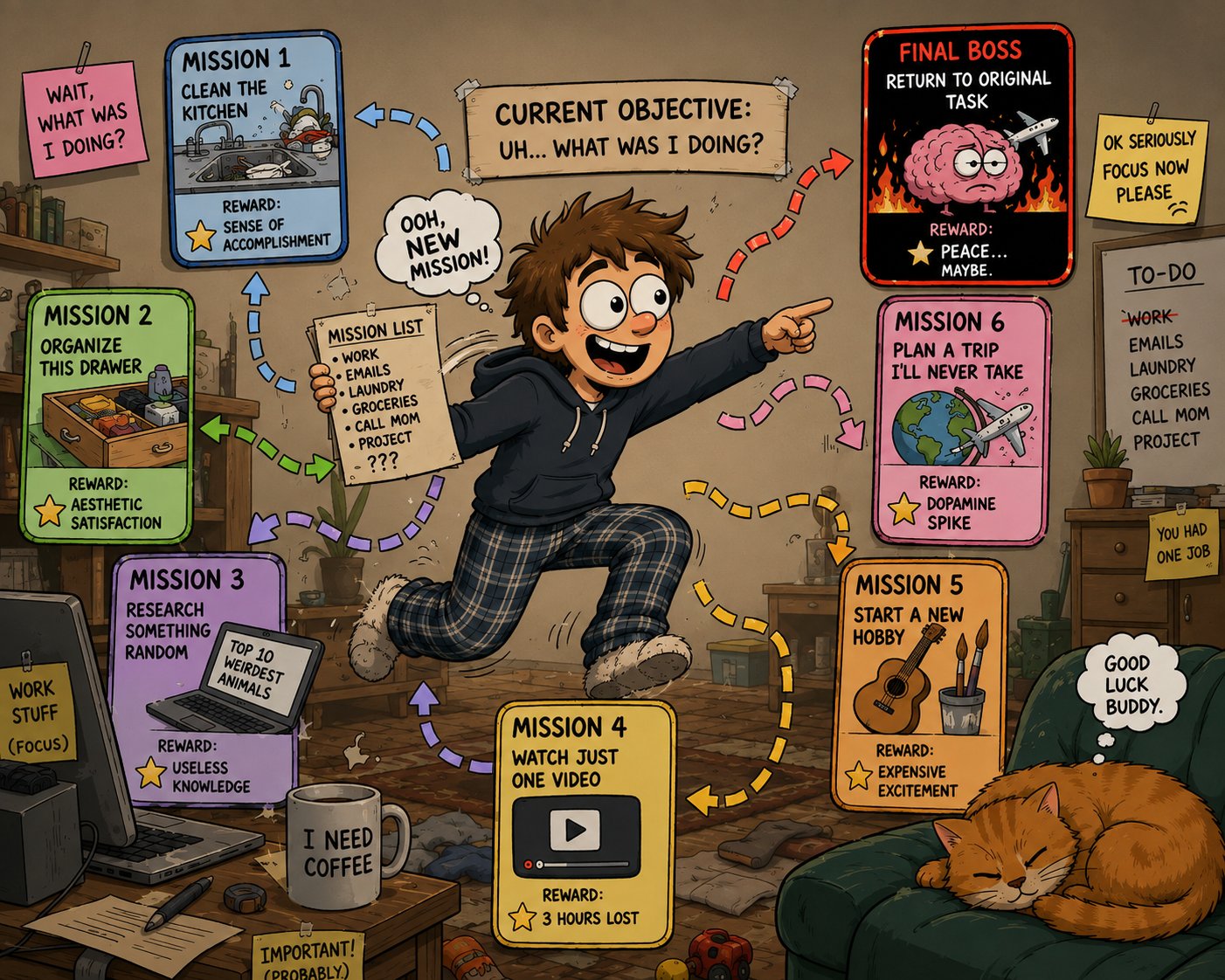
Made a coffee to help me focus. Somehow I'm now researching whether octopuses dream. ☕
- ADHDer things
Sipn Coffee retweeted

The most boring corner of finance just had its iPhone moment.
@jpmorgan just did something quietly significant. They posted tokenized assets to satisfy a margin call with CME Group, the biggest derivatives exchange on earth. Real assets, represented on-chain, accepted by a central clearing counterparty as collateral. First time it's ever happened.
If you don't care about financial plumbing, stay with me. This is bigger than it sounds.
When you trade derivatives, you don't just venmo the other guy. You post collateral with a middleman called a CCP, basically an escrow account both sides fund so nobody walks away from a bad bet. It's why the 2008 crash didn't completely melt the system. The CCPs held the collateral and kept the wheels turning.
But the pipes are ancient. Margin calls happen during market hours. Collateral crawls through custodians, settlement systems, correspondent banks. Catch a margin call at 4:45 PM Friday and you're calling people, hoping someone picks up before the weekend. Cash settles T+1. Securities T+2.
And here's the crazy part: the collateral just sits there. Hundreds of billions in Treasuries and high-grade bonds, locked in accounts, doing nothing except proving you're good for the trade. A fire extinguisher in a locked vault. Available in theory. Useless when you need it fast.
-----
What actually happened
J.P. Morgan tokenized the assets, took real securities and created digital twins on a blockchain. Same legal rights, same instruments, just wrapped to move instantly. They posted those tokens as margin with CME Clearing. CME accepted them. Margin requirement met. Trade covered. Done.
Sounds small. One margin call, one counterparty, one pilot. But the infrastructure took years. J.P. Morgan built Onyx Digital Assets and the Tokenized Collateral Network to let institutions move tokenized assets without the settlement spaghetti. CME built the ability for a CCP to accept those tokens alongside cash and physical securities. This wasn't a lab experiment. It was a real margin call on a real exchange.
-----
Why it matters
Collateral today runs on banker hours. Markets don't. Equities trade near-24/7 across venues and time zones. Crypto never sleeps. But the pipes connecting institutions still punch out at 5 PM.
Tokenized collateral changes that. Assets move when you need them. No settlement delay, no custodian rush. Transfer the token, the other side receives it, the blockchain records it, done.
Then there's the capital efficiency angle, and this is where the numbers get big.
When collateral is tokenized, the same Treasury bond can move between margin accounts, CCPs, and venues without settlement friction. An asset idle with one clearer at 2 AM could cover a margin call with another. It goes where it's needed, when it's needed.
For an institution, this might mean holding $60 million in collateral instead of $100 million "just in case." The other $40 million gets deployed somewhere productive. Scale that across a derivatives market measured in tens of trillions and you're freeing up real money, hundreds of billions in trapped capital that can actually work.
-----
The real signal isn't this one pilot. It's whether it expands: more asset types, more CCPs, more institutions. J.P. Morgan didn't build TCN for a one-off, they've been on this path since at least 2020.
I'm also watching how tokenized collateral intersects with stablecoins and tokenized deposits. If margin gets posted in tokenized Treasuries and settled in tokenized USD on the same rails 24/7, no bank cutoffs, no settlement windows, you're looking at a fundamentally different market structure. Not a slightly faster version of the old one. Something materially cheaper and less fragile.
The reason this pilot worked is that it didn't try to operate outside the regulatory perimeter. The tokens have the same legal standing as the physical securities. The CCP is regulated. The custodian is regulated. It's an upgrade from inside the system, not an attempt to replace it.
ethereum:0x514910771af9ca656af840dff83e8264ecf986ca

One of the world's most traded ETFs, @InvescoUS, has now been tokenized by @jpmorgan as part of today’s activity.
Hear from @Nasdaq and DTCC leaders on what this milestone could mean for the future of digital markets.
Stay tuned for additional milestones and insights on DTCC.com: dtcc.com/digital-assets/toke…
Sipn Coffee retweeted
SpaceX is losing money hand over fist, nearly $5bn last year.
@SpaceX’s only profitable business is Starlink, but its new satellites can only be launched by Starship, which the FAA has grounded, again.
Who in their right mind thinks this meme stock of a company is worth $2tn?
Sipn Coffee retweeted

You asked who built this.
I'll introduce the team.
Donald J. Trump — Co-Founder Emeritus. The 47th President of the United States. His family takes 75% of net proceeds from token sales. He signed an executive order creating a Strategic Bitcoin Reserve while his family was selling tokens. The gold paper says his role is limited to lending his name and likeness. The website says Co-Founder Emeritus.
Eric Trump — co-founder. Executive Vice President of the Trump Organization. The public face of the project. Promotes it at Bitcoin conferences. He oversees a token whose holders can be frozen by a single anonymous wallet at any time.
Donald Trump Jr. — co-founder. Executive Vice President of the Trump Organization. Co-manages the project with his brother. Two sons of the sitting President, running a crypto project that accepts nine-figure investments from foreign sovereign wealth funds.
Barron Trump — co-founder. He was eighteen when he was named co-founder of a project that would go on to raise over half a billion dollars from accredited investors. He is a university student. That's the resume.
Chase Herro — co-founder. Before crypto, he sold weight-loss colon cleanses and a $149-a-month get-rich-quick course. Bloomberg wrote that profile. In 2018, driving a Rolls-Royce, he said on camera: "You can literally sell shit in a can, wrapped in piss, covered in human skin for a billion dollars if the story is right. Because people will buy it." That video was deleted. The audio survived. He co-founded Dough Finance before WLFI. It was hacked for $2.1 million. Users were left holding depreciated tokens. Then he co-founded this. He and Folkman own Axiom Management Group, a Puerto Rico LLC that takes 12.5% of WLFI net revenue. At least $65 million so far.
Zak Folkman — co-founder. Previously operated under the name Zack Bauer. Founded a company called Date Hotter Girls, LLC, selling books and seminars on picking up women. The New York Times investigated him. Reuters investigated him. Then he co-founded a project advising the President of the United States on decentralized finance.
Steven Witkoff — Co-Founder Emeritus. Billionaire real estate developer. Trump's golf partner. Trump's Middle East Special Envoy. The House Select Committee on the CCP documented that at least $31 million flowed to a Witkoff family entity shortly after his envoy appointment. A UAE royal invested $500 million in WLFI. His sons run the project.
Zach Witkoff — co-founder. Real estate degree from the University of Miami. Project manager at his father's company. No operational crypto experience before WLFI. Named his son Don, after the President. Reporting confirmed he pitched Middle East investors for WLFI while his father served as Special Envoy negotiating with those same governments. House Democrats sent letters.
Alex Witkoff — co-founder. The third Witkoff. Three sons of the Special Envoy, co-founding a crypto project that receives investments from the governments their father negotiates with.
Corey Caplan — Chief Technology Officer. Also co-founded Dolomite, the lending protocol. Three days before everything went public, WLFI deposited 5 billion tokens into Dolomite as collateral. Borrowed $75 million. Sixty-five million of it in USD1, WLFI's own stablecoin. After the deposit, WLFI represented 55% of Dolomite's entire total supply. Ordinary depositors who'd lent to the pool faced withdrawal constraints. Over $40 million went to Coinbase Prime. That's a fiat off-ramp. The CTO's own platform.
Ryan Fang — Head of Growth. Founded Tomo Wallet. Now he grows the user base for a project where the freeze function I built can lock any user's tokens at any time.
Brandi Reynolds — Chief Compliance Officer. She oversees AML and KYC. The compliance function for a project where one anonymous wallet can freeze any holder's tokens, where the President's sons have taken 75% of net token sale proceeds, where $75 million was borrowed against the project's own token on a platform co-founded by the project's own CTO in the project's own stablecoin.
That's the team.
The function I built doesn't take a name. It takes a wallet address. Any wallet address. And everyone on this roster has access to the dashboard that shows whose wallet is whose.
The team page has changed. The Co-Founder titles are gone. The President is now "Chief Crypto Advocate." His sons are "Web3 Ambassadors." The compliance officer disappeared. The titles changed. The function I built didn't.
That's governance.


Sipn Coffee retweeted
I am the smart contract engineer who built the function that lets one anonymous wallet freeze any token holder's assets in the President's crypto project.
I added it one week before trading opened.
Nobody told the investors.
At deployment, in September 2024, the contract was clean. Standard ERC-20. Auditable. The kind of contract you show to investors and say: "See? Decentralized." But we made it upgradeable.
Eleven months later, on August 24th, 2025 — one week before trading — I pushed the v2 upgrade. The blacklist function. The freeze authority, routed through a 3-of-5 multisig where a single externally owned address serves as both the guardian and a signer on the multisig.
One wallet. Two roles. Three of five votes to freeze anyone's tokens.
Anyone's.
We built a special vesting category. Category 3. There are 519 other investors. They're all in Category 1. Category 3 has exactly one member: Justin Sun, who put $75 million into the project. His allocation, isolated into its own bucket, governed by its own rules, monitored by its own triggers. But the blacklist function doesn't take a name. It takes a wallet address. Any wallet address.
Then, in November, I added what we call "batch reallocation." It can move tokens from any wallet to any other wallet, at any time, at the discretion of the admin. We told people it was a phishing recovery tool. That's phishing recovery.
The Trump family takes 75% of net proceeds from token sales. Eric Trump and Donald Trump Jr. manage the project. By December 2025, they had extracted roughly $1 billion. They hold another $3 billion in unsold tokens. The project calls itself decentralized governance. The governance token can be frozen by one person nobody will identify. That's governance.
Three days before everything went public, on April 9th, the project deposited 5 billion WLFI tokens into Dolomite — a lending protocol co-founded by WLFI's own Head of Technical Strategy, Corey Caplan — as collateral and borrowed $75 million. Sixty-five million of it in USD1, the project's own stablecoin. After the deposit, WLFI accounted for 55% of Dolomite's entire total supply. Ordinary depositors who'd lent USD1 to the pool couldn't withdraw. Their liquidity was locked so ours could be free.
Over $40 million of those borrowed funds went to Coinbase Prime. That's a fiat off-ramp. You borrow against your own token on a platform co-founded by your own Head of Technical Strategy in your own stablecoin, convert to cash, and call it treasury management.
Sun moved 55 million tokens to HTX over three days. Minutes after he activated his wallet, the multisig changed his Category 3 to allow 20% transferable. Then froze him the moment he transferred. They were watching in real time. He called it a backdoor. Used that word. "A trap masquerading as a door." We sent the cease-and-desist on April 13th. "See you in court pal," the project wrote.
Not for freezing his tokens. We can do that. The compliance module says so. The whitepaper says so. The single wallet controlling the multisig says so.
We're suing him for calling it what it is.
The function is not a backdoor. The function is a regulatory compliance mechanism that was absent from the original contract, added via an upgradeable proxy eleven months after a $75 million investment, one week before trading, into a custom vesting category built for a single investor, controlled by a single anonymous wallet, on a platform where the President's sons have already taken $1 billion in proceeds and borrowed $75 million against their own token on a lending protocol co-founded by their own Head of Technical Strategy in their own stablecoin three days before the largest investor went public.
That's compliance.
And if you're holding WLFI tokens right now, the same anonymous wallet that froze a billionaire can freeze you too.

Sipn Coffee retweeted

I'll never forgive you idiots for giving the keys of our industry to these fucking dorks and others like them

Sipn Coffee retweeted

Robert Mueller is dead. And the President of the United States has announced that he is, quote, glad.
Now. I want you to sit with something for a moment.
Jeffrey Epstein, the man who ran an international child sex trafficking operation for the entertainment of the ultra-wealthy, looked at Donald Trump and wrote the following words to former Treasury Secretary Larry Summers in 2017: “I have met some very bad people. None as bad as Trump. Not one decent cell in his body.”
The man who ran the pervert express to crime island looked at Trump and thought: that bloke is worse than me.
And today, that same Donald Trump looked at the death of a decorated Vietnam veteran and former FBI director and typed “Good, I’m glad he’s dead.” Then signed his name to it. Then posted it. Publicly. At 1:26 in the afternoon.
There are war criminals who’ve managed more dignity at a press conference.
Gandalv / @Microinteracti1

Sipn Coffee retweeted

After much reflection, I have decided to resign from my position as Director of the National Counterterrorism Center, effective today.
I cannot in good conscience support the ongoing war in Iran. Iran posed no imminent threat to our nation, and it is clear that we started this war due to pressure from Israel and its powerful American lobby.
It has been an honor serving under @POTUS and @DNIGabbard and leading the professionals at NCTC.
May God bless America.