

Personal Investment Memos 📈 | Tweeting to get pushbacks on ideas
Joined April 2023
- Tweets164
- Following199
- Followers64
- Likes506



Fully exited $ABR position due to the Fed probe. My first sale since starting this account
Looking to get back in again once things calm
Initial entry date= April 2023
Avg. cost = 10.60
Avg. exit = 13.54
Price appreciation = +27.7%
Dividend collected = +20.2%
Total PnL = +47.9%

I picked up $ABR (Arbor Realty Trust) at $10.43 a few days ago.
I believe there is a high likelihood that the market has overreacted to macro-economic news, the short report, and the Houston foreclosure.
I think $ABR could regain 30-50% from here.
🧵...

1
569


Gonna have to go read Spruce Point’s previous short report on $MSCI purely cuz of this. I think I just found a new stock discovery process
126

9/.. is not giving $JD a fair valuation.
Subtracting its Mcap by net cash, we get a "risked" EQ of $10.6bn. With its Normalized FCF of $3.9bn, we get an "at risked" holding yield of 36.5%. Much above my conservative hurdle which gives me comfort that there is a margin of safety.
1
3
271
4/.. to make losses in JD Logistics despite closing in on its operating leverage.
Hence, the assumption here is that $JD is a mature company which will no longer invest for growth CAPEX nor receive FCF benefits via changes in NWC (which has been in the billions in recent years).
1
1
245
1/ I have no formal background in economics or macro investing but there has been a tremendous amount of negative comments around $JD and China.
Some of these comments are even from people I highly respect. But comments such as ADRs are worth an absolute $0 is no longer rational
1
1
240
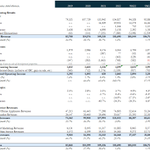
3/ Yes, topline has been essentially flat since 2022. So let's play along with exactly that. The "Normalized" Year is from the view that $JD no longer grows anymore.
The Normalized Year reflects no material growth in JD Retail (core biz) and overall continues..

1
1
246
2/ When the Chinese market is as depressed as it is now, I have to ask - "How much more?" What other negative news has the market not heard/priced at this point?
I could go on but my point is - much has been priced in and $JD, at this level, I think offers sufficient risk premia
1
1
219
Compact Perspectives retweeted

BEAT THE PODS: A 7-POINT RECIPE FOR SINGLE MANAGERS
There has been some fun discussion here recently about the trend from single manager hedge funds (SMs) to multi-manager hedge funds (MMs or "pods"). Which is very sensical after a year like 2022 where there was a big performance differential between most pods and most SMs. With many SMs well below high-water marks, a year like '22 can also accelerate talent flow to MMs.
In my career, I had the really educational experience of both working at a very well run single-manager fund as well as three well run & well known multi-PM funds. In my role now at Fundamental Edge, I have the pleasure to work both with many top multi-PM funds and single-PM funds. Nothing here will be specific to any of these funds, but simply my high level observations & personal opinions.
I had a friend at a SM fund a couple weeks ago ask me "Brett, you've worked at both, what advice would you give to SM's to compete against MM's?". I also listened to Vinny & Porter's podcast talking about using their learnings from Citadel to accelerate their family office investing returns. Both got me thinking, and I'm in the process of developing a 100+ page deck with some structured thoughts to do some consulting with funds working through this change in the investment ecosystem.
The way I usually use twitter (X) is as a "first draft" of my thoughts. These is my napkin scratch, and I will refine this over time - in that vein I highly welcome your feedback since it helps me improve the thinking.
So, here we go, a recipe for single manager hedge funds to compete when "pods are eating the world".
1) KEEP YOUR TALENT.
Be honest, you expected point 1 to be "leverage time arbitrage" right? I'll get to that point. But in the SM vs. MM market share game, the foundational job as a SM GP/CIO is to keep your team.
The hedge fund world is unique in that even large, well-known single managers might only have investment teams of 6-15 people. And if you've lived in the world, you know that there are often 3-5 truly special investment professionals in that group who have that "nose for money" and are consistent money-makers.
I've seen plenty of SM funds gutted by losing talent to MMs. If the firm has a good culture & internal training & development, a "next person up" approach can work. But turnover of your A+ talent in the ultimate human capital endeavor - investing - is costly & risky.
My advice? Practice preventative maintenance with your talent. The old paradigm of "you should be lucky to work here and I'll pay you whatever I decide to pay you" for a talented 4-7+ year proven money maker just doesn't work anymore. The pods will give that person a $500m-$1bn+ portfolio, 15%+ payout, usually some nice up-front money and the autonomy and alignment that money maker desires. The pitch is compelling, and lots of the top SM talent is biting. (what shines is not always gold, but we will get to that part).
How do you compete?
Money is an obvious vector here. But very few SMs will compete with the bull case for a PM at a MM (i.e. if you build a portfolio to $2bn and make 5% on that you are consistently taking home $10m+ as the PM). And by the time that person has accepted the MM seat, more money isn't likely to sway them (and can set a bad precedent).
What I think matters more is alignment, visibility & a sense of partnership & shared mission. If you have an investment team of 12, who are the 3-4 on that team you absolutely don't want to lose (CIOs, you know who those are). Maybe make them a partner in the fund. Give them a contractual share in the management fee. Give them a 3-year comp plan with P&L contingencies. Your job is to try to create more visibility & confidence in compensation outlook so that the analyst view the SM seat as a higher multiple, more durable comp stream that that person can build a nice life around, even if that comp level falls short of the MM bull case (which it will).
Also, the soft stuff is the big stuff. Celebrate your team's life events, encourage them to bring their kids to the office, do off-sites & outings. Make it a "special" place to work and bring humanity into the day to day.
Understand burnout is a common thing in the 4-7 year range and sometimes burnout leads to exploring new pastures. Consider a sabbatical offering. I honestly loved the part of moving jobs where I got to take 1-2 months off between seats. Build that into your talent development plan.
Work to really articulate the pros & cons of the SM vs. MM seat. Tactfully walk through the risk of the MM seat - drawdowns, risk model constraints, top-line cost flow throughs, high turnover, etc (this is where I think our content will hopefully be helpful to our clients as we break down the MM approach in excruciating detail).
And if all else fails, and you really lose a star, keep an open door. If it were me, I'd let them know they have a seat when they want it. The grass looks greener for them right now, but when they get caught in a 200bps drawdown for positioning reasons and get a capital cut and 2 analysts quit...the grass doesn't look so green. Make it easy for them to come back. And, by the way, the pressure cooker of understanding that way to invest is likely to make them a monster upon return.
2) TIME ARBITRAGE.
This one isn't surprising, but it's true. In my MM teams, I always felt like we had a really good sense of the 9-18 month winners, but it is very hard to express those trades and stick with them. I can't just be long UNH, short WBA and wait it out - particularly if UNH is going to have a 10% pullback and WBA is going to beat a quarter & squeeze.
I run through this math in my deck, but a 20% drawdown on a 15% of LMV (long market value) position in a $50 vol, $1.5bn GMV book ALONE will hit my 150bps drawdown trigger and give me a capital cut. I simply cannot bear that risk as a MM PM - it is existential, as I then need a full 3% / 1-sharpe performance on my 50% book size just to get back to even.
What does that mean in simplistic terms? If I think there is a chance a stock goes down 15-25% before it goes up, I either can't own it or I can't own it in size. With more capital flowing to MMs, and that mathematical constraint true across the board, this behavior starts to create distortions to the price discovery mechanism in the markets.
How does that manifest? Via big over-reactions to near-term squishiness. Maybe a good company with a good 3-year story is going to miss a quarter, and due to that overhang the company has underperformed by 15-20%. Have a bias to lean into those trades.
The hero MM PM makes money 9-10 out of 12 months and limits losing months to under 100bps. That is done via a very sharp process around identifying inflections, revisions, and catalyst driven narrative shifts.
Find the "cheap but no catalyst" stories. Or sometimes the play might just to figure out when pods might want to buy the story and be there 3-6 months before. I came to LOVE situations where there was an obvious catalyst, but the catalyst wasn't coming for 4-6 months. Believe it or not, many traders won't wait that long, but the IRR of waiting can be really superb.
3) CONCENTRATE.
I am bearish on single-manager portfolios of yesteryear with 150+ positions. That is too many, in my mind. Markets are growing inescapably more efficient with alpha windows tighter and alpha pools more shallow. How wide is the alpha load on position 150 in that portfolio? I would submit not wide at all.
If 75% of stocks were fairly valued a decade ago, my guess is that is 90% today. There will always be anomalies & inefficiencies in markets, but the ecology of players has shifted.
The quotient of "dumb money" has decreased due to the secular trend of indexing.
Between quants arbitraging systematic, observable anomalies and pods arbitraging inflections & revisions applying their data & corporate access driven approach, anomalies are smaller.
So the bar should be higher for ideas in your portfolio. Concentration, to me, is the only way for SMs to survive. Find your great ideas and act decisively.
I strongly believe the days of the 40 person, 7-sector single manager 2 & 20 hedge fund are over. Markets won't allow that model to work anymore. The future for SM are smaller, nimbler teams with concentrated portfolios & low latency decisive decision making. It's the only way.
4) WHERE POSSIBLE, ALPHA ISOLATE.
Limited Partners (investors in hedge funds) have become much more sophisticated over the last decade. Particularly around factor attribution.
The MM's are true "alpha factories" in that the return stream is primarily idiosyncratic vs. systematic. That might seem academic, but in a year like 2022 when beta, investor overlay & LT momentum smashed returns at Tiger cubs, it becomes not so academic. MM's performed well last year by using market volatility to exploit idiosyncratic mispricings. If I'm an LP, that's EXACTLY why I'm paying 2 & 20.
I don't want to pay 2 & 20 for a HF portfolio to give me beta & exposure being long LT Mo and short residual volatility. I can do that now with factor baskets. I can buy the Goldman VIP ETF.
You have to give me something I can't get somewhere else for cheaper.
My advice - get a risk model. There are now some vendors who offer off-the-shelf risk models that are as good or better than exist at MMs (Equity Data Science is one of our speakers in Academy). Learn to understand the risk decomposition in your portfolio, learn to do an attribution analysis for your LPs. The good ones will ask for this.
And my advice would be, if possible, to use a portfolio construction approach with a 60-65%+ beta-neutralized idiosyncratic bar with as low a possible correlation to the S&P 500 and GS VIP. If I'm an LP building a portfolio of hedge funds, that's what I want in my stable.
5) RECONTEXTUALIZE EARNINGS.
Given the desire to be a 9+/12 month positive P&L generator and given the drawdown risk characteristics inherent in the 400-600% gross leverage wrapper, earnings season becomes a critical catalyst event for MM portfolios. And not just print day, but the run-up and post-print mis-pricings.
As a MM PMs live for earnings season. The print to print activity was all with an eye towards the next earnings catalyst. The modeling, channel checks, calls w/ sell-side, 2-4 interactions with corporates each quarter, and the end of quarter structured and exhaustive earnings preview process was all done with an eye towards monetizing the volatility inherent in earnings season (print days are 2% of a year's trading days but generate ~20% of idio volatility).
What does that detailed process mean for SMs? Well, earning prints are the ultimate moving bar, the ultimate expectations gap game. There is simply a low chance you are going to compete & win this game consistently in today's market - even if you wanted to, the massive sell-side wallet at MM firms gets them top priority in corporate access & sell-side access. Throw in multi-million dollar alt data budgets and it is an arms race that very few SMs can compete in.
My advice would be to try to re-contextualize earnings as a primarily defensive minded period where the understanding is the SM team might not have the full context of expectations. That seems disempowering, but the alternative of spending ~50% of your research time on the earnings cycle seems like a bad decision too. Listen, will a huge NVDA-like Q1 beat & raise still move stocks? Yes, obviously. Certainly find the inflection in your thesis & understand the catalyst path.
But know that if, increasingly, you don't understand price movement in your space on print day - that's ok. Use earnings as thesis check in. Perhaps do some positioning work (via MM PM friends or spec sales) and look for counter-positioning moves to fade. Company misses MM whisper and get's hate-sold? Take advantage of those counter-positioning moves to leg into positions you like. More react than predict, would be my advice.
6) GO WHERE THEY AIN'T.
Try to understand where pods play to better understand the ecology & alpha pools. Pods generally will really like three things.
1) highly liquid stocks
2) catalyst-rich situations, particularly latent revision potential
3) tangible/reliable downside
The life-blood of the MM model is liquidity. I need liquidity for a couple reasons.
1) I need to risk manage my book in a kerfuffle so I don't get my capital cut. I can't do that if I am 5 days of volume.
2) I am turning over my book 5-10x per year, so with shorter trades I need to get in and out quickly.
Generally my experience trading large portfolios is that anything north of 2-3% of daily volume (outside of a natural cross) starts to create slippage, i.e. I'm pushing a stock up or down. For a 10% LMV position on a $1.5bn book ($75m position), even if that stock trades $100m ADV, that is taking me 33 days to enter, 33 days to exit with minimal slippage.
What does that mean? It means that I might cover 250 stocks on my team, but I REALLY want to cover the most liquid 50. That is really where my P&L is coming from. I will still cover $25-$75m names, but anything under $50m and certainly anything under $25m starts to become very difficult to enter & exit, particularly if I am wrong on a trade and get stuck.
My belief is that the trend toward MM HF's will hollow out the $5-50m ADV competitive set and paradoxically make this a reliable alpha opportunity for the remaining single manager funds.
On revisions, understand that in most sectors the forward trajectory of EPS revisions is deterministic to stock price returns, with some exceptions. A more creative, value driven mindset can surface ideas where the revisions and stock price might diverge.
6) FADE VOLATILITY.
My sense is that there is now over $1tn of gross capital deployed in "short part of the alpha curve" volatility budgeted market neutral HF strategies.
What are the implications?
Well, when a volatility event happens and I have a 1.5-3% drawdown, i.e. my longs go down and my shorts go up, I more likely than now will have to exit that trade after it has gone against me.
In a MM wrapper gross capital effectively becomes pro-cyclical with returns. From the Tiger perspective on things (i.e. "if I like a stock and it goes down for a stupid reason I like i more"), this is non-sensical. If my longs go down 3% and my shorts go up 3% I should take gross exposure higher.
But...LEVERAGE. It is generally believed that MM funds will run with 400-600% gross exposure. Basically a MM hedge fund is like your typical 20% down buyer on a house - if the house value goes down 10%, I'm not down 10%, I'm down 50%. Leverage accelerates outcomes, and in a MM context turns 3% returns on gross into 15 returns on equity via the acceleration dynamics of leverage.
What does this mean in practice? Well, if leveraged players have a drawdown, their reaction to that drawdown is likely to actually ACCELERATE that drawdown via de-grossing of portfolios. If you've spent any time trading the last decade, you know the intensity & frequency of these de-grossing kerfuffles is only increasing.
This is just a math problem. If I run a big book at a pod and I have a 3% drawdown and the pod doubled my book from $2bn to $4bn to try to take advantage of that drawdown and I'm down ANOTHER 3%, it's a huge problem. A risk these funds can't and generally won't take. So there is a systemic risk approach to limit left tail outcomes by truncating your PMs who are underperforming. And it's worked at the GP level beautifully, so I wouldn't expect that to change (if anything, more replicators will come).
What does that mean for you, dear single manager?
These kerfuffles are your friend. Learn to identify them and monetize them. You are the only player at the table who has the capital to step into this kerfuffle. Do the work, but don't be afraid to fade a kerfuffle. Preferably on a beta-limited way, looking for blown out spreads. There are different ways I've monitored for kerfuffle and spread-blow outs and I am building that into my content.
7) UNDERSTAND THE ECOLOGY.
Don't have your head in the sand with regards to the other players in the market.
Great poker players study their opponents more than they study the cards - their approach to the game changes based on who is at the table. Annie Duke was a guest speaker at at analyst training and told us to "run the nuts" against retail investors, play the obvious hand when presented (that's worked beautifully on AMC & GME).
But the poker game changes when you are at a 12-top full of pros. Their tendencies & tells are harder to glean.
The same is true in markets in 2023.
When Buffett started investing professionally in 1956, there were virtually no investors doing fundamental analysis. Reading a 10-K was an alpha generator.
When Julian Robertson started investing professionally in 1980 the fundamental investing hedge fund industry was a cottage industry. You could have a massive informational edge simply with some effort.
The ecology is different in 2023. The hedge fund industry is $4.5tn+ with over 12,000 funds in the US alone. Information is distributed more uniformly. Quants have eaten the alpha on Buffett's favorite factors & turned those factors into beta. And thousands and thousands of sharks are out their looking for any sign of an edge.
My advice, study the players at the table. Understand the incremental buyer of your position - who are you selling it to. Work to understand when the MM, when the SM, when the LO might want to get involved.
And, importantly, spend time trying to understand how the shifting capital players create new anomalies in market. For example, the indexing wave has created a large alpha opportunity for index-rebalance.
It is my belief that 1) the shift to MM biz models in the HF industry is secular not cyclical. Shared overheads, risk diffusion (P&L is additive & risk is sum of squares), the challenges of a SM launch all align to support the view that the MM model is here to stay.
But out of that trend, I also believe that new alpha opportunities will emerge for the enterprising, adaptive single manager.
If you've read to this point, damn that ended up being a LOT longer than I expected it to be. I'd love your thoughts & feedback.
If you are a SM or MM who thought any of this is helpful, please DM me or e-mail me at [email protected]. As I said, I am working on a lengthy deck and some deeper sessions from clients on this front both delivered via zoom & in-person. I will have some capacity for consulting on this front.
Have a great Friday & weekend all!


Compact Perspectives retweeted

Long Northeast Bank $NBN. $300m market cap specialty bank w/mgmt that plays way above their pay grade. Tangible book value is $38. Price is roughly the same. 3-year avg ROE is 24%. 1/n
Compact Perspectives retweeted
ANALYST EVALUATION, A 6-PART FRAMEWORK
Over the course of my 13-year buy-side career I had the challenge & honor of managing a total of 9 analysts, not including 3 on an in-house team in India and not including 6 interns.
First, I found managing a team as a PM to be HARD.

