

Manufacturer | Systems nerd | Euro$ student | Bitcoin fallibilist
Norway
Joined August 2021
- Tweets15.4K
- Following753
- Followers667
- Likes5.3K



DeadHedge ⚡️| Sapper 👌 retweeted

NBP NEWS: I missed this earlier today but Tusk has finally approved 4 crucial NBP monetary board appointments that were otherwise threatening deadlock at the central bank.
Failure to approve these could have spooked Polish financial markets and had an impact on the zloty.
AI-generated context (but verified by me):
🤖“The urgency was that Deputy NBP President Adam Lipiński’s term was ending on November 4. Without appointments, the board risked dropping below its legal minimum, creating uncertainty over its decisions and ability to carry out its duties. The board handles the bank’s operations; interest-rate decisions are made by the separate Monetary Policy Council (RPP). Three nominees—Kotecki, Litwiniuk and Zarzecki—were RPP members, so moving them to the board would also create three RPP vacancies for the Senate and president to fill.
The delay was bound up with the wider Tusk–Glapiński–Nawrocki conflict. The four nominations had been sent for countersignature in February; Tusk returned them unsigned in May.”
👉According to Polish news reports, the deadlock was connected to Nawrocki and NBP chief Glapiński’s proposal to pay for defence through profits linked to the rising value of Poland’s gold reserves. They called this “SAFE 0%,” presenting it as an alternative to borrowing through the EU’s SAFE defence-loan programme. But the proposal’s feasibility was disputed. News reports say it damaged the trust between Tusk’s government and Glapiński, causing an earlier agreement on NBP appointments to fall apart, though Tusk did not publicly confirm this was why he withheld his signature. Meanwhile, Tusk’s government has continued to pursue a separate case that could bring Glapiński before Poland’s State Tribunal, a special court dealing with constitutional responsibility, adding to the wider political conflict.
The NBP’s two-day monetary council meeting concludes on Wednesday.
rmf24.pl/fakty/polityka/news…

DeadHedge ⚡️| Sapper 👌 retweeted
Check out my chat with @ButlerGoldRevo about the Polish Constitutional Crisis and the ramifications for Polish gold and the zloty - plus why Aesopian traditions may be making a comeback. Link to full vid in reply.
DeadHedge ⚡️| Sapper 👌 retweeted
🇵🇱 For a comprehensive and NEUTRAL overview of the Polish Constitutional Crisis, see below.
I've put it outside the paywall. It's based on the X spaces I held earlier this morning. For transparency, the intro is human-written; the rest is an AI-assisted summary of our discussion. 👇🇵🇱
mindtheblindspot.substack.co…
DeadHedge ⚡️| Sapper 👌 retweeted

I spent 35 years building banking systems for banks worldwide, including central banks. I know how banks decide where their money goes.
When you build systems, you have to make them work, so you have to know how they work.
The Basel Committee de-industrialised the countries that adopted its rules. It's that simple: I explain the whole complicated mechanism in my essay. They simply regulated it away because that was the most profitable thing to do. It was implemented in such a systemic global way, and nobody seemed to notice
Capital is what a bank must hold before it can lend, the way a manufacturer or miner must hold supplies before it can sell. No miner doubles their costs to serve one group of customers. But that's what the banking system does to miners and manufacturers. Since 1988, the Basel rules have required banks to hold twice the capital against a factory loan as against a home loan, and under Basel III the gap reaches five times. So banks lend less to industry and more against houses. It should be stopped tomorrow.
Manufacturing's share of GDP fell in ten of the eleven countries I examined. In Australia it fell from 13.7% to 5.4%. Every other country that followed fell as well. The only truly crafty ones were the Koreans, who did a good job of offsetting it.
Regulators were warned in writing that the rule would steer credit, and they adopted it anyway. No parliament voted for it, and it's simply too dumb to keep doing, but we do . Not today; there is no justification. Yet from India, across Europe, across the US, including Australia, sanctions against industrial capacity. Financialization has gone too far it needs to be reviewed .
The charge is manslaughter by gross negligence. The mechanism is proven.
Same Rules, Different Ruins:ctindale.substack.com/p/same…
DeadHedge ⚡️| Sapper 👌 retweeted

Store nyheter ‼️
I lys av min internasjonale satsing (samt mild psykose grunnet at bitcoin har dødd og solstikk) er jeg nå kjent som Young Unc
DeadHedge ⚡️| Sapper 👌 retweeted

The dollar goes up when global dollar funding tightens.
That happens when banks and dealers pull back their balance sheets. That is the big one. Volatility rises. Collateral gets more expensive. Swap markets strain. Repo gets harder. Central banks start selling reserves. Risk appetite falls, and borrowers scramble for dollars.
The dollar goes down when all of that relaxes.
Funding calms. Volatility fades. Dealers expand balance sheets again. The pressure on foreign currencies eases, money flows improve, investors move back into risk, and the urgent demand for dollars dies down.
Rates matter. Geopolitics matter. Trade matters. But the one factor that overrides them all is Eurodollar liquidity.
So next time someone says the dollar is rising and America must be strong, be careful.
A rising dollar means the opposite. Global liquidity is tightening, foreign central banks are defending their currencies, and the offshore dollar system is under pressure.
And next time someone says the dollar is falling so the dollar must be dying, be just as careful.
A falling dollar means the shortage premium is fading. The system is getting a reprieve. If it keeps falling, that is a good thing.
The dollar is not a morality play. It is not a vote on America. It is not the Fed, money printing, or some petrodollar collapse.
It is mechanical. Balance sheets and funding. Collateral and swaps. Repo and dealer balance sheets. It is the Eurodollar system.
Once you see that, it all makes sense. The dollar goes up when the world is forced to chase it, and down when the chase relaxes.
DeadHedge ⚡️| Sapper 👌 retweeted

First of all, more credit creation does not mean a weaker dollar.
Credit creation used to sustain an unproductive economic model does. Credit directed toward productive investment strengthens currency/economy
Credit used to maintain structural imbalances undermines it.
The reset is not about a new currency coming online. It is about a new trade regime that prioritizes productive trade over inefficient /unproductive trade.
We have never developed a monetary system capable of correcting persistent trade imbalances; so no new currency will be layered on top of a dysfunctional global economy.
China is externalizing its internal economic dysfunction fuels asset bubbles in the West. These are two sides of the same coin.
None of this means the dollar is dead. It does means that the imbalances supporting the current system are being forced into reversal.

DeadHedge ⚡️| Sapper 👌 retweeted

Global FX Reset: Thoughts going into the Long Wknd
The new AI world mandates reshoring of manufacturing. That cannot be done under the current fiat petrodollar GRC regime, where the USD is perpetually bid up by foreign nations who must procure dollars to buy oil.
The US must end the petrodollar regime and devalue the USD in the end, big time. But that can only be achieved without triggering mass capital flight if the US exerts leverage that the RoW cannot refuse.
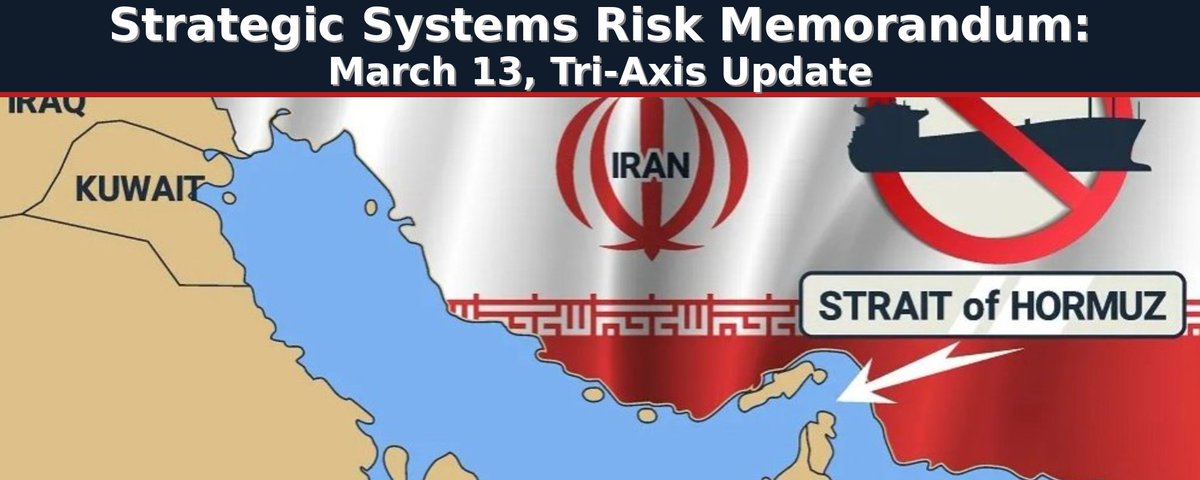
This is where the SoH closure comes in. Iran is a Kabuki theater, a distraction. The real targets are Europe and Asia.
They will accept a major haircut on their dollar holdings. In return, (1) they will receive dollar liquidity access to orderly restructure financial systems devastated by incoming losses from USD devaluation, and (2) they will gain access to oil from the US which effectively controls Canada’s oil physically (it cannot go elsewhere) and Mexico/Venezuela’s politically.
Refusal to cooperate will be met with the biggest dollar squeeze in modern history without dollar swap line, and the threat if delivered will cause DMs to face an FX crisis that makes the Asian Financial Crisis look like a child’s play. The petrodollar itself will be transformed into the very weapon that destroys it.
Hence the pathway calls for massive dollar squeeze, then epic crash. What is coming is not Bretton Woods 3.0, but Plaza Accord 2.0.
Every day without a peace deal increases the odds of this global currency reset. We are already too pregnant with the SoH closure and oil flow disruption to return to pre-2/27 world. The genie is out of the bottle.
The only way out is through.
And this reset will be the macro trade of our lifetime, far bigger than the current AI trade. Exactly when, not sure, but it will most likely happen before we run out of oil. The pathway is anyone’s guess, but the end destination is clear.
And I do not intend to miss it.

오일 가격 상승은 아시아에서 원유를
수입하는 국가들이 오일을 구입하기 위해서 더 많은 달러가 필요하다는 뜻 입니다.
전쟁이 길어질수록 외환보유고는 줄어들고 인플레는 증가하는 동시에 수요파괴가 일어나서 디스인플레가 발생합니다.
하지만 메모리칩 수출로 GDP는 상승한 것처럼 보여지나 국민다수는 가난해지는 K자 경제구조가 발생합니다.
아시아 fx 마켓에서 달러가 부족하면 외환위기에 빠질수 있고 그들은 이것을 막기 위해 보유한 금과 비트코인을 팔고 있습니다. AI제조국가는 버티고 있지만 그렇지 못한 인도네시아와 필리핀 등은 외환보유고가 급격히 줄고 있습니다.
한국, 일본, 대만도 자유롭지 못할 것입니다.
AI 칩을 제조하는 아시아 국가들은 수출을
통해 달러를 많이 축척했고, 잉여 달러로 미국채와 금, 비트코인, 미증시에 투자했습니다.
이제 미국은 그들의 목줄을 조이고 있습니다. 왜 일까요?
아시아 국가들의 반도체 공장은 미국에 있어야 하는게 아닐까요?
아니면 태평양 넘어 작은 나라들의 화폐가치를 소각시켜 달러가치를 높이려는 잔인한 방법을 선택한걸까요?
메모리칩 가격 상승이 만든 인플레로
화폐가치 하락과 높은금리를 감당해야하는
국민들은 멍하게 대기업 성과급 잔치를 바라볼 수 밖에 없습니다.
그들이 고급자동차 매장에 갈때 우리는 자동차 할부 이자가 높아져 고통받습니다.
왜 국민들에게 알리지 않습니까!

DeadHedge ⚡️| Sapper 👌 retweeted
From time to time, I revisit the $80 trillion+ in short-term offshore dollar obligations (FX swaps and forwards) that the BIS highlighted back in 2022, and it 's larger now.
I once assumed global balance sheets were homogeneous and FX conversions were clean. They are not. (it's what that 80+T represents).
In surplus economies like China, there is no frictionless way to convert accumulated dollars into productive domestic RMB. Their export-led growth model (which, by design, suppresses domestic demand) forces onshore banks to create new RMB ex nihilo to pay exporters receiving dollars.
Those dollars can fund imports (energy, commodities), but the excess is mostly recycled into U.S. Treasuries, agency debt, or other dollar assets.
This dynamic contributes to RMB weakness and helps explain why China continues to struggle with weak domestic demand.
For countries like Japan, selling dollar assets to support the yen may generate nominal accounting “profits,” but the real economic gains are far less obvious.
The global dollar shortage is very real, and it functions as a trap for chronic surplus economies. Without rebalancing trade, they never fully realize the benefits of being an exporting powerhouse.
These same distortions also weigh on deficit countries like the U.S., where persistent trade deficits are financed through large government borrowing. Even with $34+ trillion in public debt, the supply of safe dollar assets struggles to keep up with global demand.
The result is that these chronic imbalaces constrain real growth in the global economy.
BIS paper:
bis.org/publ/qtrpdf/r_qt2212…

DeadHedge ⚡️| Sapper 👌 retweeted
1/4
Brad Setser explains why China didn’t truly de-dollarize—it just shifted its dollar holdings from official reserves at SAFE to less transparent state entities like banks and investment funds.
@Brad_Setser
cfr.org/articles/chinas-fake…

DeadHedge ⚡️| Sapper 👌 retweeted

What I Found After Digging Into the Real Research on Deflation
After working through the most serious research on deflation and the frameworks central bankers actually rely on, one thing becomes impossible to ignore…deflation isn’t about CPI going down. It’s about balance sheets cracking under the weight of debt. Once you shift from prices to debt versus debtor incomes, the U.S. and global picture makes far more sense.
Deflation Starts When Debt And Debtor Prices Diverge
The research from Banco Bilbao Vizcaya Argentaria rebuilds Irving Fisher’s old idea for the modern world…deflation begins when the prices that support debt like wages, asset values, and broad output prices stall while nominal debt stays fixed. When these debtor prices flatten or fall, the real burden rises. Defaults pick up, banks tighten lending, collateral softens, spending slows, and the loop reinforces itself.
Their index blends debtor inflation with the health of bank credit. When the combined index rises, the system is sliding toward a deflationary setup. Japan’s lost decade fits this perfectly. After 2008, the United States pulled the index down with aggressive bond buying programs, while the European Monetary Union did not,
so its index remained elevated.
The takeaway was you don’t get deflation just because consumer prices cool. You get it when debtor prices weaken while leverage stays high.
Whether The Spiral Breaks Or Explodes Depends On How Deleveraging Unfolds
The paper I read from the Bank for International Settlements shows the mechanics. A financial shock alone doesn’t guarantee collapse. If households and businesses can refinance and if investors with clean balance sheets step in to buy cheap assets, the system stabilizes. Losses occur, but the loop doesn’t turn catastrophic.
It becomes dangerous when everyone tries to reduce leverage at the same time or when banks respond to losses by cutting credit. That’s when you get forced selling with falling prices, more losses, credit tightening and more forced selling. It’s the Irving Fisher and Hyman Minsky spiral in real time. Faster price declines actually make matters worse because they instantly raise real debt burdens.
The policy conclusion is either reflate and refinance with bond buying, lower real rates, yield caps or you risk years of balance sheet contraction and stagnation.
How This Maps Onto The United States And The World Right Now
Seen through this lens, the United States is drifting toward similar dynamics of a 1930s style collapse…
• Very high public debt and vulnerable pockets of private debt (commercial real estate, corporate credit).
• High interest rates sitting on top of debt issued in a low rate era.
• Early signs of the exact stress these models warn about: rising delinquencies, asset price softness, slowing wage momentum.
• A massive refinancing wall coming in 2026–2027.
If policymakers keep real rates too high into this backdrop, the system starts looking less like the United States after 2015 and more like the European Monetary Union around 2012 with weak lending, fragile collateral, and nominal growth too soft to support the debt load.
Globally, you can already see different stages of this same pattern: Japan has lived inside it for decades, the European Monetary Union slips toward it whenever growth slows, and China is entering it through property deflation and tightening credit.
My Read
The next phase of the cycle isn’t about whether inflation lands at 2% or 3%. It’s about how countries manage too much debt in a world of weak nominal growth. Modern deflation doesn’t announce itself with a dramatic crash, it shows up as sluggish demand, suppressed yields, repeated credit accidents, and slow motion financial repression.
The United States and much of the world are already on this road. The real question now is whether policymakers move toward reflation early or wait until the spiral tightens.
DeadHedge ⚡️| Sapper 👌 retweeted
I saw your last video, and I think you're on solid ground.
As president, I don't know that I would have made a different choice. There are other ways to achieve what he's trying to do, but the office has limited powers and Congress has little interest in doing what's right.
As Milton Friedman pointed out, you can't have social safety nets and open borders. The same holds true for "free trade" for the same reason. Our social safety nets are what's causing the public debt to rise in order to accommodate other countries' overproduction and excess savings.
So as a nation, we have to make a choice between these things. You can't have both.
How Democrats reason this out, wanting all three, is lost on me. Some suggest they're engaged in the Cloward-Piven Strategy, and maybe there's some truth to that. Or perhaps they think the government need only print money to paper over the inconsistent policies.
I don't know that they're thinking at that level. It seems to me they've devolved into a reactionary party.
The Republicans, on the other hand, are pure neoliberals. They're following the playbook of the postwar order. I'd argue that Rand Paul is a neoliberal rather than a libertarian in this regard.
There are no "free markets" by which to engage in free trade, as these chronic imbalances illustrate.
The thirty-year timeline sounds a bit much.
Japan's ability to carry so much debt is unique to Japan. What they're doing doesn't scale or iterate across the globe. It certainly won't work in the US, and I have serious reservations that it will work in China.
I don't believe the wars, whether kinetic or trade policy, are wars of choice. In hindsight, the only way to have avoided this was to have chosen a different path in the 1990s. The Uruguay Round of GATT/WTO sealed our fate.
I don't like war, but there are few other options.
As far as "boots on the ground," it may have never been the initial plan, but it's the plan now.
As far as 'good and evil', that's a real thing.
Truth is better than a lie, living is better than dieing, and folliwing the golden rule is better than the alternatives.
These things by defition are good,
I think what the US is doing in Iran is easily justified regardless of the overarching grand chess board. A nation engaged in democide is no longer a soverign nation.


DeadHedge ⚡️| Sapper 👌 retweeted

Fordi jeg opplever at markedet for rørlegging er tøft om dagen, så ønsker jeg å slå av 200kr pr time til de som måtte ha behov for rørlegger.
Jeg dekker Oslo og Romerike.
Setter pris på dersom du deler videre 🤝🏻



DeadHedge ⚡️| Sapper 👌 retweeted

Remember this scene in The Big Short?
Jamie Shipley and Charlie Geller have bet everything against the housing market.
They've been bleeding for months, wondering if they're wrong.
Then they flip on CNN and see it: New Century Financial - the second-largest subprime lender in America - has filed for bankruptcy.
"It's starting."
That was April 2, 2007. New Century wasn't the crisis. It was 1% of the problem. But it was the first domino.
4 months later, BNP Paribas froze 3 funds citing "complete evaporation of liquidity." 18 months after that, Lehman was dead.
I'd encourage you to watch that scene today. Because we JUST got our New Century moment in private credit:
Blue Owl Capital - $307 billion in assets under management - just permanently halted investor redemptions at its retail private credit fund, OBDC II.
Investors will NEVER AGAIN redeem shares from this fund.
On January 25th, I wrote that private credit was showing cracks at the exact moment Wall Street wanted to open it up to your 401(k).
3 weeks later, here we are.
The timeline follows a pattern anyone who's been around markets long enough recognizes:
Through the first 9 months of 2025, OBDC II investors withdrew $150 million - up 20% year over year.
Meanwhile, Blue Owl execs publicly assured investors there was "no meaningful pressure" on their asset base.
But there was. And they're now facing a federal class-action lawsuit for saying otherwise.
In November, they attempted a merger that would have forced OBDC II investors into a publicly traded fund trading at a 20% discount to NAV. Effectively confiscating a fifth of their capital.
Blue Owl's own CFO conceded investors "could take a potential haircut." The stock dropped 11% in 8 days. They killed the deal.
Now they've abandoned the pretense entirely. PERMANENT halt. Fire-selling $1.4 billion in loans across three funds.
Investors get roughly 30% of NAV back through quarterly distributions - on Blue Owl's schedule, not theirs.
One delightful detail:
Blue Owl's co-CEOs have pledged $1.9 billion of their OWN company shares as collateral for personal loans - proceeds used, in part, to acquire the Tampa Bay Lightning.
The stock is down 33% this year. That collateral has literally shed $260 million since January.
Founders leveraging company stock for hockey teams while retail investors queue up for their own money. Wall Street's version of noblesse oblige.
But here's what matters:
This isn't about Blue Owl.
Blue Owl is a symptom.
The disease is a $3.4 TRILLION private credit industry built on opacity, conflicts of interest, and the polite fiction that illiquid assets can offer liquid redemptions.
Morningstar DBRS reports the trailing default rate has risen to 4%, up from 2.8% a year ago.
Downgrades outpacing upgrades. Outlook negative. UBS warns defaults could reach 13% if AI disrupts the software companies making up 17% of BDC loan portfolios.
Payment-in-kind loans (where borrowers can't pay cash interest and simply pile it onto the debt) have surged past 11% of BDC income.
When your borrowers are paying you with IOUs, the word "income" deserves quotation marks.
And the government's response?
Open YOUR 401(k) to private credit.
Trump's executive order directed regulators to do exactly that.
They want to "democratize" an asset class whose flagship retail product just permanently locked investors out.
The KKRs. The Blackstones. The Apollos. Everyone loaded up on private credit is exposed.
When the tide goes out, you find out who's swimming naked.
In April 2007, New Century went bankrupt.
Most of the financial world shrugged. 17 months later, Lehman made the point impossible to ignore.
And Blue Owl permanently halted redemptions TODAY.
AVOID PRIVATE CREDIT
AVOID PRIVATE EQUITY
Because it's starting...

In August, President Trump signed an executive order titled "Democratizing Access to Alternative Assets for 401(k) Investors."
The order directs regulators to make it easier for your retirement savings to flow into private credit, private equity, and other "alternative" assets.
The Department of Labor quickly rescinded Biden-era guidance that had discouraged these investments in retirement plans.
Apollo. Blackstone. Goldman Sachs. State Street.
They're all racing to launch private credit products for your 401(k).
But here's the problem:
Private credit is showing cracks at the exact moment they want to open it up to retail investors.
Just this week, BlackRock TCP Capital - one of the largest publicly traded private credit funds - plunged 17% after disclosing a 19% writedown on its net asset value.
The biggest drop in almost six years.
This is BlackRock. The world's largest asset manager. $14T in assets.
If they're taking hits like this, what chance does your 401k have?
Let me walk you through what's actually happening in this market...
Private credit has ballooned to over $2T in assets.
For years, it was the domain of sophisticated institutional investors - pension funds, endowments, insurance companies.
These investors have teams of analysts, lawyers, and risk managers to evaluate complex deals.
Your average 401k participant doesn't have any of that.
And the timing couldn't be worse.
The IMF's 2025 Financial Stability Report found that 40% of private credit borrowers now have NEGATIVE free cash flow.
That's up from 25% in 2021.
Goldman Sachs data shows 15% of borrowers can no longer generate enough cash to fully cover their interest payments.
UBS forecasts that private credit defaults could climb by 3 percentage points in 2026 - outpacing leveraged loans and high-yield bonds.
Meanwhile, payment-in-kind loans - where struggling borrowers defer interest by adding it to their debt balance - have surged from 7.4% in 2021 to over 11% today.
When a company can't pay interest in cash, that's not a sign of health.
It's a sign of stress being disguised.
Then came September's wake-up call:
Auto parts maker First Brands collapsed with $8B in off-balance-sheet financing that wasn't properly disclosed to lenders.
Subprime auto lender Tricolor imploded amid allegations it pledged the same loans as collateral to multiple creditors.
Both received clean audits shortly before they cratered.
First Brands' term loans went from 90 cents on the dollar to under 15 cents in weeks.
JPMorgan's Jamie Dimon put it bluntly: "When you see one cockroach, there are probably more."
Here's what makes this dangerous:
Private credit is lightly regulated, less transparent, and difficult to value accurately.
The managers making the loans are often the same ones valuing them.
They have every incentive to delay recognizing problems.
The DOJ has already issued warnings about "creative" marks and questionable valuation practices.
Banks aren't insulated either. They've lent over $2.2T to non-bank financial institutions.
When problems surface in private credit, banks feel it too.
And now they want to put this in YOUR retirement account.
The pitch is that private credit offers "higher returns" and "diversification."
But the data doesn't support the sales pitch:
Recent research shows pension funds increasing exposure to private markets have actually seen depressed returns compared to simple stock and bond portfolios.
The 50 largest US pension funds averaged just 7.4% returns over the past decade.
A basic 60/40 portfolio beat many of them.
The real beneficiaries are fund managers charging 2% fees on assets that can't be easily valued or sold.
My view really hasn't changed:
AVOID PRIVATE CREDIT
When sophisticated institutional investors start pulling back - and they are - the last thing you want to do is rush in.
Stay in liquid, transparent, low-cost investments for your retirement.
Don't be the exit liquidity.