

Solutions Architect · Senior Python & AI Engineer · AI Audits · Helping teams fix what they shipped too fast
Netherlands
Joined July 2021
- Tweets6K
- Following639
- Followers542
- Likes1.4K




I'm Nuno Bispo, a Senior Software Engineer and Solutions Architect with 15+ years building Python systems, AI integrations, and production backends.
I write for Real Python and Unstract. I build and ship hardware. I've seen what breaks in production and what doesn't.
I take on a small number of advisory engagements with teams that are serious about getting their Python and AI stack right.
4
410
Your CI shouldn’t spend minutes on pip install.
I’ve been using Astral’s uv in CI pipelines for a while, and I put everything I’ve learned into a practical PDF booklet:
uv for CI: fast, reproducible Python pipelines
Inside:
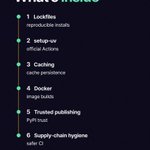
→ Lockfiles that act as the source of truth (uv sync --locked)
→ GitHub Actions with setup-uv and cache persistence
→ GitLab CI, CircleCI, Azure Pipelines and Jenkins patterns
→ Caching deep dive: keys, UV_LINK_MODE, safe sharing
→ Trusted publishing from GitHub Actions
→ Supply-chain hygiene: pin uv, SHA-pin actions, exclude-newer
→ Migrating from pip, pip-tools and Poetry
Written for teams tired of slow installs, drifting dependencies, and “passes locally, fails in CI”.
Covers uv 0.13.x and setup-uv v10.x (November 2026 edition). $19, instant PDF download.
👉 uv-for-ci.developer-service.…
#Python #uv #CICD #GitHubActions #DevOps

1
1
13
Five Python problems. Five short PDFs. One problem per guide.
01 Works on my machine. Not in prod. (free)
02 Code review is for logic. Not commas.
03 Logs that answer why. Not print().
04 Config that fails at start, not at 2 a.m.
05 Flaky tests teach your team to ignore red.
Start with #01 free: python-field-guides.develope…
#Python #pip #uv #logging #config #tests

2
17
Going to PyCon Ireland 2026? 🇮🇪
Bad data getting too deep into your Python app is the bug that never goes away.
Practical Pydantic shows you how to stop it at the edges, with real examples instead of toy ones.
👉 $16.24 with code 2026pyconie
📅 November 17 to 28 only
🔗 leanpub.com/practical-pydant…
#PyConIE2026 #Python #Pydantic #Leanpub

17
There’s a quiet difference between teams that document what their system does and teams that document why it does it.
The first kind of documentation goes stale the moment the code changes.
The second kind stays useful for years, because it explains the reasoning, and reasoning is what someone needs when they’re deciding whether it’s safe to change something.
AI features make the “why” more valuable than usual. A prompt is full of decisions that look arbitrary on the page: why this phrasing, why this example, why this instruction comes last.
Without a note explaining what problem each one solved, the next person tidies it up and reintroduces a bug that was fixed months ago, with no way of knowing it had ever existed.
The habit costs almost nothing: one sentence beside every non-obvious choice saying what it was for. It’s the cheapest insurance a team can buy against its own future forgetfulness.
#SoftwareEngineering #AI #TechLeadership #CTO #Python
19
One Pydantic habit that saves me from config bugs: never read environment variables directly. Put them in a settings model instead.
If a required value like the database URL is missing, the app fails right at startup with a clear error. If a number is set to “ten” instead of 10, same thing. No more discovering a typo in production at 2am.
The idea is simple: check your data at the edges, so the rest of your code can trust it.
That’s one small example from Practical Pydantic, my hands-on guide to validating data, managing settings, and modeling your domain in Python.
If you’re heading to PyCon Ireland 2026, there’s a coupon for you:
👉 Practical Pydantic for $16.24 with code 2026pyconie
📅 November 17 to 28, 2026 only
🔗 leanpub.com/practical-pydant…
After November 28, the price goes back up.
#PyConIE2026 #Python #Pydantic #Leanpub #PythonDev
28
uv for CI contents: lockfiles → setup-uv → cache → Docker → trusted publishing → supply chain.
uv-for-ci.developer-service.…
🤖 Made with AI

17
Next time someone opens a pull request that touches an AI agent, try asking these four questions in the review.
What does a valid output look like, and where is that enforced? If the answer is “the prompt asks nicely”, that’s a gap. What eval would have failed if this change made things worse? If there isn’t one, the change is being merged on faith. What does this do to cost and latency per request? A small prompt edit can quietly double both. And if this goes wrong tomorrow, how do we roll it back?
None of these questions is hard, and none requires special tooling to ask. But a team that asks them consistently ends up with agents that behave like the rest of its software: predictable, reviewable, and boring in the best way.
Production AI Agents with PydanticAI is about building the machinery that makes those four questions easy to answer, so the answers live in the repo instead of in someone’s head.
Free sample chapters: leanpub.com/production-ai-ag…
#PydanticAI #LLMOps #AIEngineering #PythonEngineering
2
1
59
pip CI: slow installs, flaky wheels, cold caches.
uv CI: lockfile + cache + setup-uv.
PDF of the recipes I use:
uv-for-ci.developer-service.…
22
Works on my machine" has cost me more hours than any bug I've actually had to debug.
Most production failures aren't clever. They're drift, logs that never say why, config that explodes too late, and tests nobody trusts anymore. After 15+ years across insurance, banking, and aviation, I kept hitting the same ones, so I wrote down the fixes that actually stuck.
The result is five short Python Field Guides, about five pages each, one problem and one solution per guide.
The first one is free: how to kill dependency drift with uv, a lockfile, and CI that refuses anything else.
The other four cover quality gates, logging, config, and flaky tests, at $9 each or $29 for the lot.
Start with the free one 👉 python-field-guides.develope…
#Python #uv #SoftwareEngineering #DevOps #PythonDevelopers #Logging #BackendDevelopment #Programming
1
18
I’ve been writing Python for over 5 years, and the bug I see most often hasn’t changed: bad data getting too deep into the system.
An API sends a string where you expected an int. A config value is missing and nobody notices until production. An LLM returns JSON that is almost right.
Pydantic is the tool that fixed this for me, so I wrote Practical Pydantic: a hands-on guide to validating data, managing settings, and modeling your domain, with real examples instead of toy ones.
If you’re heading to PyCon Ireland 2026, I made a coupon for you:
👉 Practical Pydantic for $16.24 with code 2026pyconie
📅 November 17 to 28, 2026 only
🔗 leanpub.com/practical-pydant…
After November 28, the price goes back up.
If you’re not attending, the coupon works for you as well. And if you read it, tell me which chapter was most useful. I read every reply.
#PyConIE2026 #Python #Pydantic #Leanpub #PythonDev
1
27
A common source of confusion in Python AI integrations is streaming responses.
Streaming makes an app feel faster because users see text appear immediately, but it quietly changes how you handle everything around the call. Validation can’t run until the full response has arrived; token counts and costs are only known at the end, and a connection that drops halfway leaves you with a partial answer that looks perfectly plausible.
The practical fix is to treat a stream as a sequence of events with a defined ending, not as a string that happens to arrive slowly. Buffer the chunks, mark the response as complete only when the final event arrives, and run your validation and logging on the assembled result.
If the stream breaks early, discard or clearly flag the partial output instead of passing it downstream as if it were finished.
It’s worth deciding in advance which parts of your product can show unvalidated text as it arrives and which must wait for the full response.
A chat bubble can usually stream freely. Anything that triggers an action or writes to your database shouldn’t.
#Python #AI #FastAPI #LLM #SoftwareEngineering
2
39
Heading to PyCon Ireland this year? 🇮🇪
If your Python app trusts every input it receives, sooner or later it will bite you. Bad API payloads, missing config values, malformed data from an LLM: it all ends up as bugs in production.
That’s exactly why I wrote Practical Pydantic. It’s about learning Pydantic by building real things, not toy examples: validating data, managing settings, and modeling your domain so problems get caught at the edges instead of deep in your code.
To celebrate PyCon Ireland 2026, I set up a special coupon:
💸 Practical Pydantic for $16.24
📅 Valid from November 17 to November 28, 2026
🔗 leanpub.com/practical-pydant…
The coupon is only on for a limited time, and once November 28 passes, the price goes back up.
If you’re going to the conference, grab it before you travel and read it on the plane. If you’re not going, the coupon works for you too.
And if you pick it up, I’d love to hear what you build with it.
#PyConIE2026 #Python #Pydantic #Leanpub #PythonDev
16
If you have switched a project from pip to uv, you know the feeling: you run the command, blink, and it is already done.
The usual explanation is “it’s written in Rust”.
That is true, but it is not the interesting part.
Plenty of Rust tools are slow, and plenty of Python tools are fast enough.
developer-service.blog/how-u…
#Python #uv #pip #Rust
19
Adding validation to a two-year-old codebase costs ten times what it would have cost in week one.
The code you'd write is about the same. What changes is everything around it. In a young system, a validation rule is one definition and a few tests. In an older one, you first have to find out what the data looks like today, and nobody knows.
Production holds values that were never supposed to exist: a status field with eleven spellings, dates stored as strings, nulls in columns everyone assumed were required.
Now every rule you add risks rejecting data that real customers depend on. So the work becomes archaeology. Engineers pull samples, argue about which variant is correct, write migrations, and run the new checks in log-only mode for weeks before anyone dares to enforce them. A task that would have taken an afternoon takes a quarter.
The practical advice is to put the boundary in early, even if it's loose. A model with the right field names and types is enough to start. You can tighten it as you learn, and every tightening is a small, reversible change, not a migration project.
If you're already past that point, start with the edges that matter most: payments, auth, and anything customers upload. Validate those first and leave the rest.
Practical Pydantic covers both paths, building validation in from the start and retrofitting it into a system that's already running.
👉 leanpub.com/practical-pydant…
#EngineeringLeadership #TechnicalDebt #SoftwareArchitecture #TechStrategy #Python

23
One of the more useful questions a CTO can ask about an AI feature is who would notice first if it started giving worse answers.
Not crashing, just quietly getting worse: a model update changes tone, retrieval starts returning older documents, a prompt that suited last quarter’s inputs no longer fits this quarter’s.
In many teams, the honest answer is a customer, or nobody at all.
That’s a measurement gap more than an engineering failure. Conventional monitoring tells you the service is up and responding quickly, but it says nothing about whether the answers are still good.
Closing that gap usually takes something modest: a small set of reference questions run on a schedule, a sample of real outputs reviewed each week, and one person who owns the result.
If you couldn’t tell me today whether your AI feature is better or worse than it was three months ago, that’s the place to start => developer-service.blog/work-…
#AI #CTO #TechLeadership #SoftwareEngineering #Python

24
A useful test of any engineering team is how they talk about the last thing that went wrong.
Some teams describe it as an unlucky event: a strange input, a provider hiccup, a one-off.
Others describe it as information, a view into an assumption that turned out to be false.
The second group almost always ends up with the more reliable systems, and it has little to do with talent.
AI features make this distinction more important, because the failures are often quiet and the lessons are easy to miss. An odd output gets shrugged off, a user complaint gets patched, and the underlying assumption stays untouched until it fails again somewhere more expensive.
Teams that write down what each incident revealed, even in two sentences, build a memory the system itself doesn’t have.
It’s a small habit, and it doesn’t need tooling. It just needs someone to ask “what did this teach us?” before moving on to the next ticket.
#SoftwareEngineering #AI #TechLeadership #CTO #Python
1
63