The cheapest debugging tool in software squeaks.
The Pragmatic Programmer (1999) made it famous: explain your code, line by line, to a rubber duck. Halfway through, you hear the bug yourself.
It works on apps before they exist, too. Before I build, I talk the workflow through out loud: who starts it, what they click, where it waits.
Somewhere around "and then they just..." I find the step nobody actually owns.
The duck never interrupts. It also never asks for equity.
3
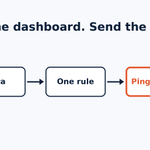
Most teams that ask me for a dashboard actually need a tap on the shoulder.
Week one, everyone opens the dashboard. Week three, it's a very nice tab nobody clicks.
So I ask one question: what would make you stop what you're doing and act?
That answer becomes a rule. The rule sends one message to one owner, only when it matters.
Dashboards are great for looking back. Nudges move the work today.
4
Eric Protic retweeted
Apply now for OpenWorks — to become a partner, or to get support for your business:
openai.com/openworks/
Selling OutboundPro® taught me the person who signs is rarely the person who clicks.
The buyer wants the big picture: pipeline, cost, timeline.
The rep who opens it every morning wants one thing: fewer tabs.
Win the buyer, lose the rep, and the login quietly goes stale by spring.
So now I ask for ten minutes with whoever will live in it. They tell you what the deal really hinges on.
@MonteOSIntel
8
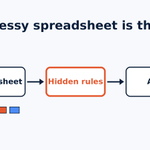
The best spec a team ever hands me is the spreadsheet they're embarrassed to show me.
The color coding. The column called "notes2." The tab named DO NOT TOUCH.
Each one is a rule the official system never learned, so somebody taught it to a spreadsheet.
Before I build anything, I ask what every color means. The answers are usually the requirements doc nobody wrote.
Don't hide the messy sheet. It's the blueprint.
8
Every app I build starts the same way: with "hello, world."
Brian Kernighan used it in a 1972 programming tutorial, and it has been every coder's first handshake ever since.
My version is a little longer. Before any real feature, I push one fake record through the whole thing: form, database, email, report.
It does nothing useful. It also finds the broken login, the missing permission, and the email that lands in spam on day one instead of launch day.
Say hello first. Then build.
6
Most slow processes aren't slow at the work. They're slow at the waiting.
When I map a team's flow, I watch two things: how long someone actually touches a request, and how long it sits in an inbox.
The touching is usually minutes. The sitting is usually days.
Nobody's lazy. The request is just napping between people.
So the fix is rarely "work faster." It's a clear owner, a nudge, and a default when nobody answers.
Speed up the handoff, not the hands.
6
Selling OutboundPro® taught me the most useful words on a sales call are "not yet."
Every call has a "can it also do…?" moment. It's tempting to say yes to all of them.
Say yes to enough and the roadmap stops being yours. It belongs to whoever asked last.
So I write each ask down, say "not yet," and watch which ones come back from different people.
Heard once, it's a note. Heard three times, it's a feature.
@MonteOSIntel
4
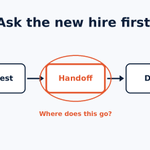
When I map how a team works, I start with the newest person, not the manager.
The manager shows me how the work is supposed to flow. The new hire shows me where they got lost last Tuesday.
Veterans stopped seeing the friction years ago. Like stepping over the same loose floorboard every morning.
Every "wait, where does this go?" marks a rule that lives in someone's head instead of the system.
Fix those spots first. Week one gets smoother, and the veterans stop being the help desk.
4
The first version of an app is a question with buttons.
Fred Brooks said it in 1975: "Plan to throw one away; you will, anyhow."
When I build around a team's bottleneck, v1 is cheap on purpose. One rough screen, one path, real data.
Then I watch them use it. Every spot where they pause writes v2 for me.
Build the question first. Then build the answer.
3
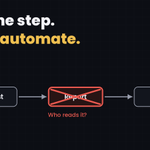
The fastest automation I build is sometimes the delete key.
Before I automate a step, I ask one question: who uses what this step produces?
More often than you'd think, the answer is a long pause. A weekly report nobody opens. A second approval nobody remembers adding.
Automate that step and you just get waste, faster.
Peter Drucker put it well: "There is surely nothing quite so useless as doing with great efficiency what should not be done at all."
Cut first. Then build.
7
Accurate or no?
Getting very close to people doing bank runs before holidays….. if that does indeed happen, we will see the biggest psychological phenomenon paradigm shift about “ Money” ever.
7
Selling OutboundPro® taught me the best demo starts with the app closed.
It's tempting to open it and tour every screen. You get polite nods and very few next steps.
So I start with one question: "Walk me through your Monday morning."
People tell you exactly where the hours go. Then the demo is just the two screens that fix that part.
Nobody buys a tour. They buy their Monday back.
@MonteOSIntel
6
Most rework I see on teams traces back to one missing sentence: what does "done" mean?
A task moves along. Someone marks it complete. Then it bounces back, because the next person had a different finish line.
So before I automate a single step, I write its done-check. A few plain lines: who signs off, what gets attached, what happens next.
Funny thing. That one page often fixes more than the app does.
Define done. Then build.
9
The hardest part of building an app for a team is not the code. It's agreeing on what to call things.
Phil Karlton, a Netscape engineer, famously said there are only two hard things in computer science: cache invalidation and naming things.
He was joking. He was also right.
Ask three people on a team what a "lead" is and you can get three answers. Build on that, and the app inherits the argument.
So before the first screen, I write a one-page glossary. Least exciting doc in the project. Usually the one that saves the most rework.
Name it once. Build it once.
9
Every workflow works perfectly on the whiteboard. Then a real customer shows up.
When I map a team's process, the happy path takes five minutes to draw. The interesting part is the next question: "What happens when it goes sideways?"
Wrong address. Missing approval. A customer replying to an email from two years ago.
That's where the sticky notes and side spreadsheets live. It's also where the real build starts.
Design for the weird case. The happy path can take care of itself.
12
Selling OutboundPro® taught me the worst question in sales: "Would you use this?"
Everyone says yes. Nobody means it.
Better: "Walk me through the last time you did this." That is where the real tool shows up. Usually a spreadsheet and a sigh.
Rob Fitzpatrick wrote a whole book on this, The Mom Test (2013). Your mom loves your idea. Your mom is not your buyer.
Ask about last Tuesday, not someday. @MonteOSIntel
3
19
Selling OutboundPro® taught me the worst question in sales: "Would you use this?"
Everyone says yes. Nobody means it.
Better: "Walk me through the last time you did this." That is where the real tool shows up. Usually a spreadsheet and a sigh.
Rob Fitzpatrick wrote a whole book on this, The Mom Test (2013). Your mom loves your idea. Your mom is not your buyer.
Ask about last Tuesday, not someday. @MonteOSIntel
12
The most popular integration I find on teams isn't an API. It's copy and paste.
Most teams I sit with type the same customer into three places. The CRM, the invoice tool, the scheduler.
Every copy is a fresh chance to fat-finger a phone number. Soon the three versions start arguing with each other.
The fix is rarely a new platform. Pick one front door for the data and let the other systems read from it.
Type it once. Let it flow.
1
18