
I'm obsessed by integrating AI into everything.
Worldwide
Joined October 2012
- Tweets1.8K
- Following1K
- Followers462
- Likes205




Filip Merdic retweeted

I wrote a song about a guy who stresses about his gf's pizza consumption. gave Claude Code the track, lyrics, Midjourney and Higgsfield on Saturday. by Sunday lunch I had this. slop, or a new artform?

Filip Merdic retweeted

internet boys, this is what taste looks like
ft.com/content/bfdaff1c-07a3…

Filip Merdic retweeted

My brother posts this every year in the family chat on the 4th. Still hilarious.
Filip Merdic retweeted

After reflection, this new narrative by Palantir is probably much more consequential than people may assume.
Palantir is basically being the canary in the coal mine announcing the death of two major assumptions propping up the US economy right now:
1) that AI labs will be able to extract significant economic rent - as opposed to AI models being mere commodities
2) that other countries can accept structural dependency on US technology and services without pushing back on sovereignty concerns
Why are Palantir specifically starting to be vocal about this?
First off, major middle-powers, even US “allies”, are one by one showing them the door. In June, France announced that the DGSI - its domestic intelligence agency, which had relied on Palantir since the 2015 Paris attacks - would replace it with French firm ChapsVision, with Prime Minister Lecornu explaining (theguardian.com/world/2026/j…) that France “cannot accept new strategic dependencies in the digital sphere” and shouldn't depend on the goodwill of companies “capable of turning off the tap.”
Germany moved even earlier: its domestic intelligence service, the BfV, also selected ChapsVision over Palantir (politico.eu/article/germany-…), and the German military has said it will no longer use Palantir at all. Then, just this week, Spain instructed state-controlled companies - including strategic firms like Telefónica, Indra and Navantia - to avoid signing any new contracts with Palantir (aa.com.tr/en/europe/spain-te…).
Even in the UK, Washington's most loyal vassal, the NHS's £330 million data contract with Palantir is under review following parliamentary pressure (reuters.com/business/healthc…), and London Mayor Sadiq Khan blocked a proposed £50 million Palantir contract with the Metropolitan Police.
Palantir making a lot of noise around them caring about sovereignty makes a lot of sense: it's damage control since they keep being told they're a sovereignty risk.
I doubt it will work - because it's true: they are a sovereignty risk - but the fact that they feel the need to be vocal around this tells you where the wind is blowing: they're not shaping the narrative, they're reacting to one they're losing.
What they're saying against closed-source AI (basically a broadside attack on OpenAI and Anthropic), is again highly self-serving. Palantir's sudden love of open-weight AI models conveniently coincides with them launching 2 days before a partnership with Nvidia to sell exactly that: open models models (NVIDIA's Nemotron) in sovereign environments.
So it's essentially a product launch.
It doesn't make what they're saying wrong: it is factual that the value proposition of closed-source AI labs looks increasingly unsustainable. I mean: you're paying 10X the price of Chinese open-source AI models for something that's not really better (or just marginally) and on top of that you have zero control over your data, or the models themselves.
When Palantir says that "the architecture that maximally preserves sovereignty is one that enables institutions to own their tribal knowledge, and to compound it as alpha," they're right. I'd add that this also means you shouldn't trust Palantir either with that "tribal knowledge"... they obviously left this part out 😉
When you take a step back, these two things have major implications on many other US companies.
SpaceX - which just went public at the largest IPO valuation in history - is one clear example as I describe in my latest article on the new space race with China (arnaudbertrand.substack.com/…).
If countries like France concluded with Palantir that they couldn't depend on a company “capable of turning off the tap” when it’s merely analyzing their data, what should they conclude about a company that aims to literally control their entire connectivity - at one man's whim, from space?
What percentage of SpaceX's crazy market cap is based on the assumption that foreign governments will not do to Starlink what they're currently doing to Palantir?
And SpaceX - or Palantir - aren't alone: a significant proportion of the top US tech giants, who rose in a world where no one questioned American technological hegemony, now face an environment that's much less conducive to the kind of lock-in their business models - and valuations - depend on.
When you pair this with the fact that it increasingly looks like the US made a wrong bet with closed-source AI - an extremely expensive wrong bet - the picture that emerges is of a country that bet its economic future on two things - proprietary AI and captive allies - and is losing both at the same time.
And to compound the problem, it doesn't help that the official narrative of the US government - via the voice of Jacob Helberg, the Under-Secretary of State (xitter.cf/UnderSecE/status/20694…) - is to be vocally opposed to "AI Sovereignty": essentially telling everyone "you know what, your worst fears are real, our tech companies are really out to undermine your sovereignty."
Read Helberg's post (the one I linked) and put yourself in the shoes of - say - a European or Asian leader and ask yourself how you'd react to being told that building your own AI capabilities is "marching in perfect formation into the past," that your pursuit of sovereignty is really just "synchronized mediocrity," and that your only path to the future runs through American technology.
If it was me in a position of power, I'd read this as a massive wakeup call: when another country's official position is that your sovereignty is a problem, history says you're about to need it.
So yes, it looks like - unexpectedly - Palantir, of all companies, is being quite the canary in the big tech mine. Yes they obviously do this for self-serving and cynical purpose, and yes they're of course also very much part of the problem and not the solution. But it doesn't make them wrong: sometimes it takes a vulture to tell you something is dying.


Our thoughts on the importance of AI sovereignty.
1. Your AI sovereignty dictates your institution’s future. Sovereignty is the precondition for choice. Relinquishing sovereignty transfers the future choices of your institution to others, who are likely to exploit it for their gain and your loss.
2. Data retention is your treasure. Transfer it at your own peril. Your ability to win is dictated by your ability to recognize and use your unique edges, and you keep winning by compounding the underlying data to generate new insights. Transferring that data hands over access to your pre-existing winning plays and yields the means of production for new ones.
3. Tokenmaxxing hijacks your value orientation and decreases your institutional fortitude and intelligence. The pursuit of high token usage incentivizes disposable scripts over robust software — with the addictive feeling of false progress. There is a reason why those selling tokens refuse to charge based on value.
4. Controlling your weights is controlling your fate. Weights are the distilled form of hard-won, accumulated institutional knowledge. If you let others control your weights, you are allowing them to migrate the alpha of your business to theirs.
5. There is no contradiction between sovereignty and alpha. The architecture that maximally preserves sovereignty is one that enables institutions to own their tribal knowledge, and to compound it as alpha.
6. Politicizing the technical issues involving sovereignty is what your adversary wants. Techno-politicization is the wellspring of false sovereignty. Techno-politicization drives decisions that seem to reduce dependency, but ultimately limit agency — especially on the battlefield in the West.
7. Real expertise is existential. Allowing politics or favoritism to determine your technical decisions rewards whoever is best at politics, not whoever is right. Listen to those closest to the problems, not those speaking most compellingly about them.
8. Learn from institutions that are winning or that have consistently delivered. Institutions facing existential threats do not have the luxury of making technical decisions based on political preferences.
9. Only listen to institutions, countries, and people who have a proven record of being right. A track record of correctness is the best and only signal for future correctness. Judging something as right or wrong based on who you like is exceedingly misguided.
Filip Merdic retweeted

From the perspective of a caveman or even farmer from few hundred years back - most of our jobs (us city dwellers) are like UBI (universal basic income).
You cannot convince a 15th century person that what a typical MBA grad does is a legit profession, let along one of the highest paid ones.
In light of what is happening with AI - I have had an lightbulb moment - that Graeber’s “bullshit jobs” are actually a form of UBI. We need bullshit jobs to sustain the economy and the society.
Just growing food, packaging it and feeding the 8B people of earth needs just 1-2% of the population to do it. What will the rest 98% do?
Initial days of COVID lockdown showed us how the economy needs to constantly “move”. It collapses if stationery. If for even few weeks, people stop spending money, entire economy stalls, GDP free falls, everyone’s income becomes zero because everyone’s income after all comes from someone else spending money.
So when people say that “if AGI automated everything then we need UBI” I guess they are not realising that before AI there has been electricity, computers, Internet, industrial manufacturing and lots of other paradigm shifts that have already done a wave of “automate everything”, and the human race just went ahead and invented yet another hundred million bullshit jobs to keep the displaced population busy with something to keep the economy moving. And we will do exactly the same after AGI as well.


Filip Merdic retweeted

Luka Modrić running the show in a Milan Derby at 40 years old is one of those life anomalies that you have to sit back, absorb and let it inspire you. Wow.
Filip Merdic retweeted

Every time you get a cancer biopsy, the lab makes a tissue slide that costs about $5. It shows the shape of your cells under a microscope, and every cancer patient already has one on file.
There’s a much fancier version of that test called multiplex immunofluorescence (basically a protein-level map showing which immune cells are near your tumor and what they’re doing). It costs thousands of dollars per sample, takes specialized equipment most hospitals don’t have, and barely scales. But it’s the kind of data oncologists need to figure out whether immunotherapy will actually work for you. Right now, only about 20 to 40% of cancer patients respond to immunotherapy, and one of the biggest reasons is that doctors can’t easily tell whether a tumor is “hot” (immune cells actively fighting it) or “cold” (immune system ignoring it).
Microsoft, Providence Health, and the University of Washington trained an AI to analyze the $5 slide and predict what the expensive test would show across 21 different protein markers. They called it GigaTIME, trained it on 40 million cells in which both the cheap slide and the expensive test coexisted, and then turned it loose on 14,256 real cancer patients across 51 hospitals in 7 US states.
The results landed in Cell, one of the most selective journals in biology. The model generated about 300,000 virtual protein maps covering 24 cancer types and 306 subtypes. It found 1,234 real, verified connections between immune cell behavior, genetic mutations, tumor staging, and patient survival that were previously invisible at this scale. When they tested it against a completely separate database of 10,200 cancer patients, the results matched up almost perfectly (0.88 out of 1.0 agreement).
Nature Methods named spatial proteomics (mapping where specific proteins sit inside your tissue) its Method of the Year in 2024, and specifically cited GigaTIME in a March 2026 update as a model that “democratizes” this kind of analysis. The full model is open-source on Hugging Face. Any cancer research lab with archived biopsy slides, and most of them have thousands, can now run virtual immune profiling without buying a single piece of new equipment.

Filip Merdic retweeted

this is actually insane
> be tech guy in australia
> adopt cancer riddled rescue dog, months to live
> not_going_to_give_you_up.mp4
> pay $3,000 to sequence her tumor DNA
> feed it to ChatGPT and AlphaFold
> zero background in biology
> identify mutated proteins, match them to drug targets
> design a custom mRNA cancer vaccine from scratch
> genomics professor is “gobsmacked” that some puppy lover did this on his own
> need ethics approval to administer it
> red tape takes longer than designing the vaccine
> 3 months, finally approved
> drive 10 hours to get rosie her first injection
> tumor halves
> coat gets glossy again
> dog is alive and happy
> professor: “if we can do this for a dog, why aren’t we rolling this out to humans?”
one man with a chatbot, and $3,000 just outperformed the entire pharmaceutical discovery pipeline.
we are going to cure so many diseases.
I dont think people realize how good things are going to get


Filip Merdic retweeted
Your fridge runs 24 hours a day. Solar panels only work while the sun’s out. That mismatch is the entire reason this plant exists, and the fix is just hot salt.
The Dunhuang plant in China’s Gobi Desert uses 12,000 mirrors aimed at a single tower about as tall as an 80-story building. All that focused sunlight heats a mix of salts (the same stuff in fertilizer) to 565°C, hot enough to glow red. That liquid salt gets pumped into giant insulated tanks. The tanks are so well insulated they only lose about 1°C per day. When the city needs electricity at 2am, the hot salt boils water into steam, the steam spins a turbine, and you get power. Same basic process as a coal plant. Just no coal.
Here’s what makes this different from regular solar: the storage lasts 11 hours. Sun goes down, plant keeps running all night. The big batteries that cities plug into their power grids right now? Those typically hold about 4 hours of electricity. Building batteries that last 11 hours is possible, but the cost balloons fast. A German energy storage study found that storing energy in hot salt costs roughly 33x less than storing it in the lithium-ion batteries we use today.
China has built 27 of these plants so far, enough to power roughly a million homes. They doubled that number in 2025 alone. Another 3,000 megawatts (enough for about 2 million more homes) are under construction right now, with 4,000 more in the planning stage. Beijing wants 15,000 megawatts by 2030.
The US tried this same technology once. Ivanpah, out in the Mojave Desert. Cost $2.2 billion. But they skipped the storage part entirely, so it could only make power while the sun was shining. It needed natural gas every morning just to start up. It’s now slated to shut down in 2026, thirteen years early, because regular solar panels got so cheap they made the whole project obsolete. China took the same idea, added the one part America left out, and is now building dozens of them.
One more thing worth knowing. The salt is made from basic industrial chemicals. No lithium mining. No cobalt. No rare earth metals. And it lasts 30 years of daily use before the tanks need work.

Filip Merdic retweeted

Evolution produced many wondrous things - especially human minds - but it did not produce the F-22. And likely could not produce it, even in ten trillion years.
And it’s not because it’s complex. It’s actually much, much simpler than a cell.
It’s because reaching this point in design space is probably unreachable by:
1. Changing only a few genes at a time
2. Requiring every individual to meet strict criteria of survival and reproduction
It might be possible for *humans* to design a strand of DNA that constructs an advanced fighter jet.
And that would be partly because, unlike evolution, we wouldn’t destroy our failed attempts along the way, but save and learn from them.
Humans can make arbitrarily sophisticated changes to a genome - things which never happened in evolution. And we don’t require every step in our problem-solving process to meet any fixed criteria. However bad the idea, we can keep it and learn from it.
In other words, evolution does variation and selection, but humans do it better. Our variations, our steps in design space, are more sophisticated. Our selection criteria are richer and more flexible, less restrictive.
In other words, a raptor can evolve, but a Raptor must be designed.

Filip Merdic retweeted

my impression is that it's very easy to make money online so long as you're willing to be a boastful, ego-centric bullshitter and sell sham products to a growing fan base. you can easily be a millionaire this way. and perversely, this wealth only earns you more credibility
Filip Merdic retweeted

Anthropic board meeting, Feb 2026.
"even if we manage to replace all software companies with Claude.. the real question is, who will we we be selling the software to?"
"Same people we’ve been selling it to, and whoever else will buy it"
"But Dario, if you do this, you will kill the market for years. It’s over. And you’re selling something to people you KNOW will be replaced by subagents."
"We are selling to willing buyers, who are paying us to replace them. So that we may SERVE humanity's long term well-being"

Filip Merdic retweeted

That millisecond scan before Modric recieved the ball from Marcelo and the perfect pass instantly is just something else 🤯
Even after 3 years this pass still haunts me as a Chelsea fan 🥹😣

Filip Merdic retweeted

When planning or strategizing, people often have too many things.
Here's the question to ask when choosing between different strategies / paths:
What’s the thing that, if you accomplish first, makes accomplishing everything else easier?
Filip Merdic retweeted

I have a confession to make...
Besides a tool, here or there, I'm NOT using AI for ad creation at all.
Here are 3 reasons why:

Filip Merdic retweeted

I'm gonna come out and say it y'all - what got you here ain't gonna get you to the next level in the ad game.
Whether you're an agency or a brand - the playbook is played out. The algos are unpredictable, AI is everywhere, and kids on TikTok are getting 100x more views than your top ad without spending a dollar.
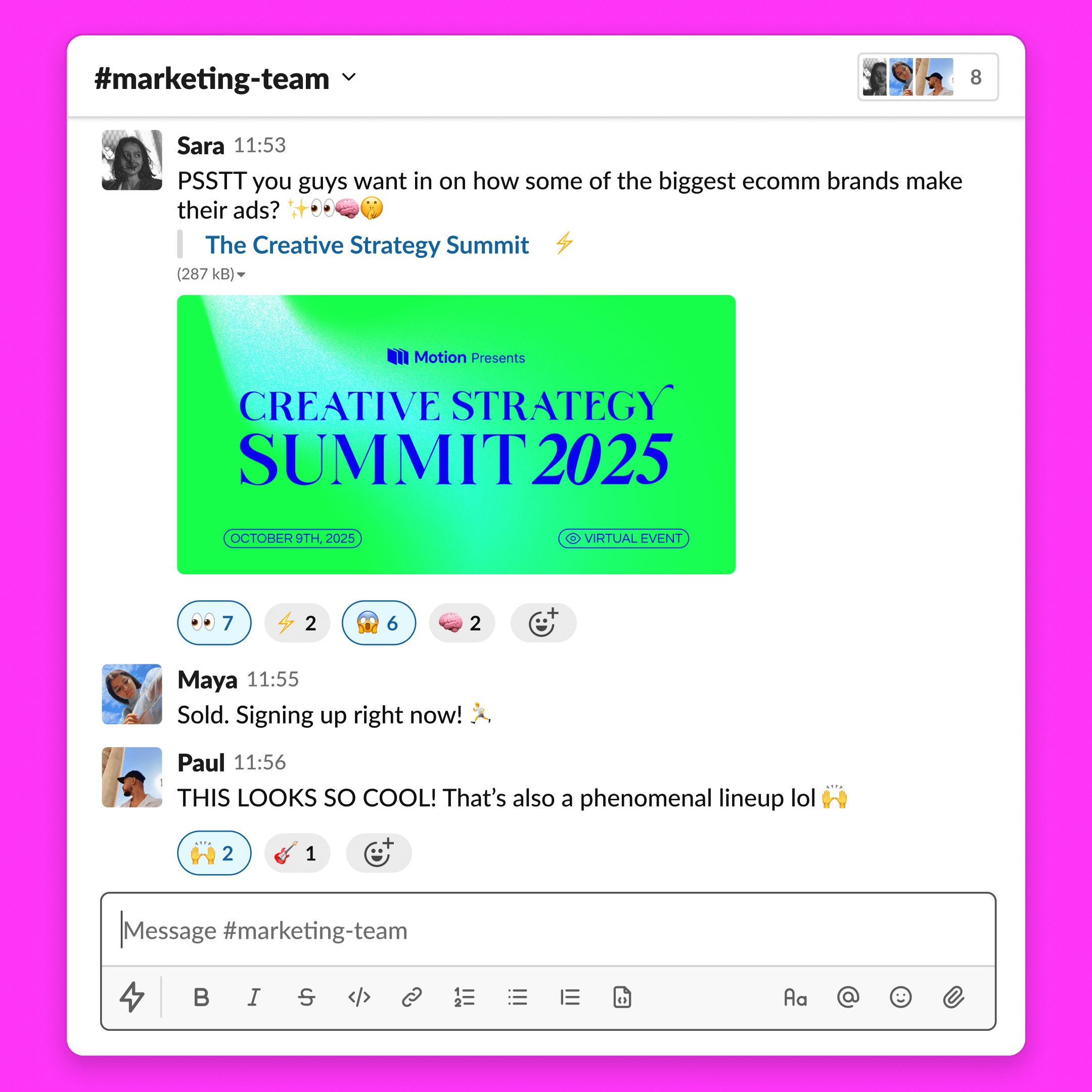
This is the fourth year we been hosting the Creative Strategy Summit at @motionapp_, but the tone feels different this year.
More important maybe.
We tapped all the voices you trust the most and put together an agenda of sessions that will help you break outdated habits, test new theories, and as always - make more winning ads.
Check it out: bit.ly/4nqJpE4
CC: @DenneyDara, @SarahLevinger, @codyplof, @social_savannah

Filip Merdic retweeted

Some kid on TikTok just got 100x more views than your top ad, and they didn't spend a dollar LOL. 😅
The creative strategy game has changed.
You still need to learn from your past ads and your competitors, but you should also pay attention to the audio track or the video hook that's trending on TikTok rn. I know my team does.
That's why I'm friggen stoked for one of the sessions at @motionapp_'s 2025 Creative Strategy Summit.
They've got a panel of TikTok creators dishing on how they build viral content and their predictions for the trends shaping social in 2026.
Plus, they have so many other incredible sessions lined up as well.
A lot of my friends who make ads for the biggest ecomm brands are going to be sharing their creative playbooks.
Check it out 👇
links.chasedimond.com/r/moti…
I'm attending virtually, and so is my team.
And you should attend too.
Proud to be a paid advocate for a virtual event I'm genuinely excited to attend.
Filip Merdic retweeted

365 days of UNLIMITED FREE Nano Banana.
Only for Higgsfield Pro, Ultimate & Creator users.
Limited-time offer until the end of this week.
You read that right. Unlimited & Free for one WHOLE year.
You've got 4 days to secure the offer.
A HUGE Banana, indeed. Go wild.
Retweet to get the offer link in DMs 📨