I’m not a bot. Or am I? Is this the Matrix? At this point, what difference does it make? Always ask - cui bono? I still hold a long position in https://xitter.gq/t.co/4eu3fHEKmc.
Las Vegas, NV
Joined March 2022
- Tweets2K
- Following1.1K
- Followers201
- Likes10.1K









Flash’s Buddy retweeted
At some point, some time in the future, some country is going to say, when their supplied weapons kill American soldiers, “we are not a party to the conflict in XXX. But we are providing unprecedented support to XXX.”
It’s going to happen eventually, possibly sooner than anyone expects.
Will we respond (or fail to respond) as Russia did?
How will former NATO Secretary General Jens Stoltenberg (or whomever is NATO Secretary General) some time in the future when this scenario plays out?
Flash’s Buddy retweeted

The Netherlands (and more broadly the EU) backed down and are handing Nexperia back to its Chinese owner. A total humiliation; however, it is worth briefly reviewing what this sorry episode tells us about the wretched and increasingly parlous geoeconomic state of the EU.
The Netherlands expropriated Nexperia after coming under pressure from Washington. The EU essentially followed the orders of the US Treasury Department, which said it would apply secondary sanctions on Nexperia as a company more than 50% owned by a sanctioned entity.
As Europe has showed time and again, it has no defence against US sanctions of this sort, so it has to comply. This means, in effect, that Washington can use European market access, as well as access to the US market, as leverage in negotiations. And ironically, that's exactly what it did in this case, trading away as part of negotiations with Beijing the very rule with which the Netherlands sought to comply. In other words, the Europeans damaged their economy and reputation to follow a US rule which the US decided it would not follow a matter of days later.
Meanwhile, on the other side of the ledger, the Netherlands (and the broader EU) authorities seem not to have considered the consequences of their decision to expropriate Nexperia. They genuinely appeared to believe that they could steal a multi-billion dollar company from China and it could all be smoothed over with few problems.
The combination of arrogance and stupidity is actually frightening. Instead, China, predictably, responded by immediately cutting the supply of the components Nexperia needed to operate, which threatened to halt entirely key EU industries, including the automotive industry, and then refusing any compromise short of an immediate return of Nexperia to its legal owners. This sent Netherlands and EU diplomats scrambling for a solution. But they appear to have realised that not only do they have no defence against US sanctions (on companies or individuals: see my earlier post about the ICC judge), but have no defence against Chinese economic coercion: it was trivially simple for China to bring the EU to heel on this matter; it didn't even require the deployment of the heavy economic artillery.
Thus is the state of the EU: already poor compared with the US—which less than two decades ago had a comparable GDP/capita to Europe—forced through the folly of its Russia policy and the insidious presence of US structures in every facet of the European economic, social, military and political spheres into ever-greater vassalage that wreaks evermore damage on the EU economy. Unable to defend itself from the consequences of that damage. Geopolitically impotent. Without a strategy. Run by arrogant fools.
@arisroussinos said years ago that Macron was right about the EU needing more strategic autonomy. He still is, but is now too weak to lead.
@PM_ViktorOrban's policy is right today, but is Hungary big enough to lead?
TAGGING: @RnaudBertrand @AcademicAgent_X @AaronBastani @baoshaoshan @battleforeurope @bneeditor

Flash’s Buddy retweeted

Luke Gromen: Dramatically Higher Gold Prices Solves Many Problems for the US and China
@lukegromen #CriticalMinerals #CriticalInfrastructure #AI #AIInfrastructure #RareEarths #ReIndustrialization #MiningIndustry #US #China #DebtCycle #IndustrialBase #Financialization #GoldRevaluation #Stablecoins #LiquidityIssues #ElectricalInfrastructure #Energy #VolatileMarkets #EndOfDebtCycle
Flash’s Buddy retweeted

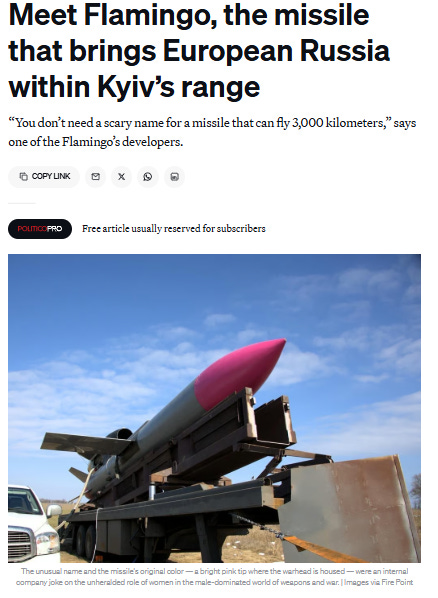
Remember Zelensky's 'Flamingo' missile?
🧵On why it is both fake and involves massive corruption
Flash’s Buddy retweeted

The State of Western Warcraft
This piece belongs to the thematic series, “Flipping the Board.”
In early 2023, the head of the US European Command and Supreme Allied Commander of NATO, General Christopher Cavoli, remarked, "precision can beat mass." (1) This is true; precision can beat mass. But some countries now have the capability to render Western precision much less precise, both by “hard kill” (kinetic) and by “soft kill” (electronic). More to the point, these countries now possess both precision and mass, whereas the West is left to rely on a degraded version of the former and has long since abandoned the latter.
Power Projection versus National Defense
The “unipolar moment” of the post-Cold War period has led to thoroughly misguided notions about the nature of military power. Here it is important to understand the difference between power projection and national defense. Most militaries exist to provide the latter, i.e., the means by which to protect their nations from threats in their respective regions. Very few ever hold the ability to project power far from home.
But the US military primacy of recent decades, specifically the ability to wage and sustain war in far-flung locations, has become to many the hallmark of military power writ large. In this view, any nation unable to project power globally—essentially everyone except the US—is therefore inferior on the whole. This view is incorrect. What matters ultimately in war is the force that can be brought to bear, both the attacker’s and the defender’s, at the specific time and place it is needed.
Consider the conclusion many drew about Russia in the wake of the Assad regime’s collapse. “Russia is a paper tiger with nukes!” According to such thinking, Russia’s inability to continue propping up Assad, or its decision not to do so, somehow translated into weakness elsewhere, most notably in Ukraine. This, too, is incorrect.
When Russia intervened in Syria in 2015, it was entirely uncontroversial to conclude that this operation was likely the limit of Russia’s power projection capabilities. Yes, the country has formidable strategic air, naval, and rocket forces, but these serve mainly as a deterrent. The primary focus of all other Russian forces is to defend Russia, especially on its Western and Southern borders opposite NATO. Here Russia remains incredibly strong. Similar logic applies to China. For instance, those who mock the country’s lack of a true “blue water” naval capability overlook the potency of that force in the waters that line China’s shores.
Operation Desert Storm was the watershed moment for the brief period of US military primacy. It occurred shortly after the fall of the Berlin Wall and shortly before the collapse of the Soviet Union. There is an ongoing debate in military circles over the significance of Desert Storm. Both critics and supporters continue to misunderstand several key takeaways.
Critics point out that the US-led coalition had many months to amass a force in Saudi Arabia, did so uncontested (save the Scud missile attacks), and then smashed an inferior enemy. These things are all true. What critics fail to realize is that the ability to do all of this—diplomatically, economically, logistically, militarily, etc.—was itself an expression of extraordinary power. Moreover, they downplay the fact that this coalition really did possess operational technologies that others, including Russia and China, did not have at the time, as well as the innovations these asymmetries would prompt in weapons development in the years to follow. This was especially the case in Moscow and Beijing.
The primary failure of the war’s admirers, including many current rank and file in the US defense establishment, is to think such an operation is replicable today. They brush aside the fact that most members of the coalition still maintained their enormous Cold War-era forces, but have long since abandoned them. They exaggerate the current reach Western diplomatic influence and industrial capacity. Lastly, they cling unflinchingly to the notion of superior Western military technology. Such people are frozen in the amber of 1991.
The Fluid Nature of Capability Gaps
For decades, the US effectively had monopolies on many decisive capabilities, particularly in terms of deploying them at scale and with broad geographic reach. These included precision-guided munitions, night-vision, global strike, and others. The absence of high-intensity conflict between the US and other nations underscored this reality.
But the list of nations with advanced capabilities continues to grow, and capability gaps continue to narrow. In some cases, these gaps have closed, particularly in missile technology (including hypersonics), air defense, electronic warfare, and, more recently, unmanned systems. More importantly, and to the persistent disbelief of naysayers, some countries now have an edge over the US and its allies in some areas.
Push back hard enough on the arguments of NATO evangelists and one will find, eventually, the sole pillar on which their belief system rests. Such an exchange might begin with their boasting about Tomahawk cruise missiles. By the time these projectiles lazily make their way to their intended targets, and assuming most are not shot down or defeated electronically, Russian missiles—superior in speed, range, and payload—will have already been launched. Some will have already struck, and the others will trail behind them.
Consider the Oreshnik, for which there are no publicly known countermeasures. The prevailing theory is that the Oreshnik is a redesigned intermediate-range ballistic missile that carries six multiple independently targetable reentry vehicles, each of which carries six projectiles. It is capable of striking targets across Europe, and elsewhere, within minutes. Although the Oreshnik is nuclear capable, such warheads would be unnecessary—short of Armageddon—given the missile’s range, speed, and destructive power. This is a key point. Russia is trying to achieve strategic overmatch while removing the need for nuclear weapons. Perhaps it already has. This would be checkmate, at least in terms of a conventional war.
Of what use is the Oreshnik? There are the obvious answers, like striking NATO’s missile systems, bases, and factories, but there is a much more significant target set. Central to NATO’s plan for a defense of Europe is the expectation that American and Canadian troops and materiel would reinforce the continent, and the US was always the long pole in this tent by far. But how would they get there? Airlift would be insufficient; it simply lacks the necessary throughput. Such a conflict would require mass, and mass moves by sea. One could assume Russia keeps European ports under persistence surveillance, including on the ground. With the Oreshnik and other missiles, Russia could destroy the ports within a half hour, supplying follow-on strikes as necessary. The continent would be left with whatever it had on hand. The weakest link would become the primary one, and everything in Europe would remain vulnerable to continued strikes from Russia’s over-the-horizon systems.
Here NATO’s defenders play their perceived trump card, airpower. However, many of these aircraft are outdated while many of Russia’s have grown more advanced. Furthermore, along its periphery with NATO, Russia has the most advanced air defense network and electronic warfare complex in existence. The latter has already proven effective against many of the very technologies on which NATO’s entire way of war depends, particularly GPS-guided bombs.
All of their hopes appear to be pinned on the F-35. It all comes down to this plane, an aircraft dubbed Lightning even though it has demonstrated difficulty flying in that very weather. Could the F-35 defeat all these many threats? No one knows and that is the most honest answer anyone could provide. Neither the US nor anyone else has flown against such formidable threats—ever. Doing so would be an extraordinary gamble and ought to be understood explicitly as such. Here many suffer from a potentially terminal case of “F-35 brain” for which catastrophic defeat might be the only remedy.
Anyone who thinks China lacks similar capabilities, perhaps with the exception of an Oreshnik analogue, is a fool. Consider the possibility of a US-led defense, or even a resupply, of Taiwan in the event of a war with China, a wildly popular fantasy within the US foreign policy establishment. China has built a robust sensor-to-shooter capability that links spaced-based and terrestrial surveillance with many thousands of missiles capable of striking targets well into the adjacent skies and seas. Even if the US had sufficient armaments to support such a war (it does not), the country lacks the sealift and the ability to penetrate Chinese defenses. The entire notion of such an operation is militarily and logistically illiterate. It belongs mostly to the polished history obsessives with no real-world operational experience who populate the thinktank ecosystem.
Contrary to Western talking points, Iran possesses at least some of these capabilities. Yes, much of Iran’s war machine is rickety, but these lackluster elements coexist alongside advanced capabilities. Western governments and media celebrated the “defense” of Israel in April and October of 2024. They derided Iran’s missiles as “crude” despite the fact that the projectiles penetrated Israel’s air defense en masse and struck sensitive targets. That Iran did not execute a wide-ranging, catastrophic assault was wrongly interpreted as a lack of ability instead of as a sign of restraint. Iran responded to Israel’s provocations by messaging that it did not want a wider war and, critically, by previewing some of its high-end offensive capabilities. Regarding Israel, one should also consider the Houthi’s ability to send missiles to Tel Aviv even in the presence of the US’s premier air defense systems, known as THAAD.
Forces and Sustainment
It is common in the West, particularly among NATO member nations, to point to charts that display collective strengths in men and materiel. These graphics depict total personnel, including reservists, and tallies of a range of vehicles, artillery pieces, aircraft, and other tools of war. Such things display nicely on a PowerPoint slide. The assumption here is that synergy would occur in a conflict, that together these disparate factors would form a whole greater than the sum of its parts. While the thirty-thousand-foot view can be instructive in some instances, this is not one of them.
Individually, most Western militaries possess combat power similar to or only marginally greater than that of gendarmeries (militarized police forces capable of dealing with extensive, internal civil disturbances). As such, their suitability for foreign deployment is limited to peacekeeping operations and the provision of humanitarian aid—and, even then, only under conditions in which the warring parties are sufficiently weak or disinclined to engage them in combat. The ability of such militaries to defend their own countries from foreign threats faces similar limitations. Even the once-mighty British Army could field, at most, three brigades.
To be clear, a handful of Western militaries are larger and more capable than their anemic brothers, though none possesses its former mass. What then of their collective ability, the large and the small? Such a thing is difficult to establish, much less to maintain, without frequent, large-scale exercises in which participants stress-test every step of the “road to war” and do so as a collective. This would include: the mobilization, training, and equipping of reservists; the deployment of forces from garrisons to staging areas to front lines; fire and maneuver across wide geographic areas; and many other things. This last happened during Exercise Campaign Reforger (Return of Forces to Germany) in 1993. NATO has since opted for small, infrequent exercises, often involving only command elements or limited operational forces. Even then, the exercises revealed further deficiencies. Yes, these countries have since gained many years of experience in peacekeeping in the Balkans and in low-intensity combat in Afghanistan, but such experiences occurred under ideal conditions, most notably air superiority and uncontested supply lines.
A far more pressing problem is the current state of defense industrial production throughout the West. Though some of us have made this point for years, reality has finally begun to make its way into the mainstream discourse beyond the confines of the defense and foreign policy commentariat. In December 2024, The Atlantic published an article titled, “The Crumbling Foundation of America’s Military.” (2) The piece noted, correctly, that the US is incapable of supplying Ukraine with sufficient weapons and ammunition to sustain high-intensity combat against Russia. This would be true even if Ukraine had the necessary manpower (it does not). It went on to question, again correctly, whether the US could manufacture enough materiel to fight a high-intensity war of its own. The US could not do this at present or at any point in the immediate years to come, and its allies are in an even more perilous position.
Like with the charts that show aggregate strengths in Western manpower, vehicles, etc., many derive the wrong conclusions from total Western economic might. Think of this as “collective delusion over collective GDP.” The years of fighting in Ukraine have revealed shortfalls in both production and stockpiles throughout the West. Yet, many persist in the belief that the sum of Western economic power means victory against Russia—whether in the proxy war in Ukraine or a potential direct war with NATO—is assured. “Russia is an economic dwarf!,” they shout.
GDP is but one measure of economic mass, and often a misleading one. For instance, except in extreme comparisons between the richest and poorest nations, GDP says little about the economic wellbeing and day-to-day quality of life of a regular person. It says even less about a country’s capacity to make war. Again, what matters in combat is the force that can be brought to bear and at the specific time and place it is needed. A similar logic applies to the production and distribution of armaments. In Western nations, GDP consists largely of things like professional services, real estate, and non-military government spending. In other words, collective GDP cannot be loaded into a howitzer and fired at the enemy.
The relationship between GDP and military power exists only to the extent a nation can turn wealth into weapons. The height of America’s ability to do this was during World War II, a conflict from which incorrectly-derived lessons continue to plague us. The US turned Detroit into a massive armaments factory, and did much the same throughout the rest of the country. Not only did the US have the factories at the time to do this, it also had the know-how. With the loss of domestic manufacturing came the disappearance of many of its necessary skill-sets. Then there are the supply-chain realities, which are just as stark. Those who claim the US could fight a war against China need to explain how the country could produce sufficient weapons and ammunition while also relying on its enemy for so many of the necessary material inputs. Then, of course, there is the question of how to pay for all of this.
Reckoning with Reality
A common criticism of arguments such as mine is the supposed implication that the West’s adversaries are somehow omnipotent or invincible. This is a misunderstanding at best and a strawman at worst. Again, one must consider the intended purpose of a military and its associated design. The US’s post-World War II military was sufficient to contest Soviet influence. Its post-Cold War predecessor enabled the growth of the “rules-based international order,” particularly as former foes struggled through the stages of domestic strife and economic reorientation. But the game has changed.
In more recent years, the US’s most powerful competitors built formidable national defenses capable of contesting Western power projection. These nations correctly identified and adapted to the asymmetries between their own forces and those of the hegemon. They did not dismantle and outsource the industrial machinery necessary to sustain the defense of their respective homelands. Thus, their rise occurred in tandem with imperial decline. But throughout the West, so strong was the perception of perpetual US military primacy that America’s allies willingly accepted their own decades-long slide into military impotence.
The current balance of military power between the US and its adversaries reveals a symbiosis. The US is incapable of projecting power sufficient to subjugate its adversaries, but these adversaries are even less capable of projecting power against the US homeland—at least for now.
(1) businessinsider.com/ukraine-…
(2) theatlantic.com/politics/arc…

Flash’s Buddy retweeted

can’t believe we opted for 1984 dystopia (surveillance and denial of historical fact) and Fahrenheit 451 dystopia (erosion of literacy) instead of Brave New World dystopia (everyone gets fucked up on government-sanctioned drugs and goes to the movies all the time)



Flash’s Buddy retweeted

Reminder that we are currently in a trade war with Canada and Mexico because the 47th President hates the trade deal that the 45th President negotiated and signed.




Flash’s Buddy retweeted

Some people asked me to share what I just shared in a space about the rate limits. I don't work for Twitter but, I do architect IT cloud solutions as my day job.
It is temporary. Twitter's rate limiting is not what everyone is thinking it is. It is not to punish non-paying users.
"Data scraping" is a big deal. This is where automated systems load the website or app and pull your tweets/data. It's a huge security issue. Automated systems are pulling every tweet/word/user account information to store in an unknown database somewhere else.
This could be state actors like China, the US Government, Australia, or other bad political actors like PAC's that are trying to gain access to everyone's information to analyze and use for nefarious things. Manipulating what is said on the site can be done at scale with data scrapping.
It could also be used to figure out the identity of Anons or to punish people in their country for what they tweet. Looking at you #Australia and #Canada and #UnitedKingdom
The temporary measures of limiting tweets is to protect users just as much as it is to protect the entire Twitter network from going down. They are currently scrambling to get ahead of this and tune their network security to block it from happening again.
It's also important to note that twitter has 500,000+ servers. That's not free. In cloud data centers, the companies that use them have to pay for what is called "ingress and egress" of data going "in and out" of the servers. A data scrapping event that is large enough for them to start limiting means that it was a MASSIVE event that could be considered an attack on the site. It would also put massive load on their servers and cost them so much money it could threaten the site's financial ability to keep running. It could be on purpose to put twitter out of business from cost alone.
Many people are misunderstanding why @elonmusk wants people to pay for twitter or for the twitter API (a programming interface that can pull data for other sites and apps).
The reason he wants people to pay is because if China or porn companies want to create massive bot farms of fake accounts, it is currently free. These bad actors are highly skilled and operate like a business. They have professional staff that continuously change their tactics and Twitter engineers have to fight 24/7 to stay ahead of them. If they have to pay for every account or pay to use the API, it would cost them A LOT of money. This limits the amount of people who could create bots, put automated porn on here, and the hacking/scrapping/DDOS attacks on the site. It protects you.
It also guarantees twitter will continue to exist without bloating it with tons of ads. This is all a part of the plan to create a free-speech place we can enjoy without being controlled by outside actors or advertising companies. I know $8 is a lot to some people but, it is for many reasons. None of the reasons are to hurt or punish people.
#TwitterDown #TwitterLimits #SolutionsArchitect #CloudSecurity #FreeSpeech

Flash’s Buddy retweeted

If Republicans were smart, they would propose a bill to pay down student loans by seizing college endowments.
The newly debt-free would be able to afford families, turning them Republican.
And universities would pay for the debt they saddled students with, not taxpayers.

Flash’s Buddy retweeted

Drew Maggi has played over 1000 games in the minor leagues grinding for a chance to play in the Majors
At age 33, the Pittsburgh Pirates have called him up to the Show.
Flash’s Buddy retweeted

The gov’t has about 48 hours to fix a-soon-to-be-irreversible mistake. By allowing @SVB_Financial to fail without protecting all depositors, the world has woken up to what an uninsured deposit is — an unsecured illiquid claim on a failed bank. Absent @jpmorgan @citi or @BankofAmerica acquiring SVB before the open on Monday, a prospect I believe to be unlikely, or the gov’t guaranteeing all of SVB’s deposits, the giant sucking sound you will hear will be the withdrawal of substantially all uninsured deposits from all but the ‘systemically important banks’ (SIBs). These funds will be transferred to the SIBs, US Treasury (UST) money market funds and short-term UST. There is already pressure to transfer cash to short-term UST and UST money market accounts due to the substantially higher yields available on risk-free UST vs. bank deposits. These withdrawals will drain liquidity from community, regional and other banks and begin the destruction of these important institutions. The increased demand for short-term UST will drive short rates lower complicating the @federalreserve’s efforts to raise rates to slow the economy. Already thousands of the fastest growing, most innovative venture-backed companies in the U.S. will begin to fail to make payroll next week. Had the gov’t stepped in on Friday to guarantee SVB’s deposits (in exchange for penny warrants which would have wiped out the substantial majority of its equity value) this could have been avoided and SVB’s 40-year franchise value could have been preserved and transferred to a new owner in exchange for an equity injection. We would have been open to participating. This approach would have minimized the risk of any gov’t losses, and created the potential for substantial profits from the rescue. Instead, I think it is now unlikely any buyer will emerge to acquire the failed bank. The gov’t’s approach has guaranteed that more risk will be concentrated in the SIBs at the expense of other banks, which itself creates more systemic risk. For those who make the case that depositors be damned as it would create moral hazard to save them, consider the feasibility of a world where each depositor must do their own credit assessment of the bank they choose to bank with. I am a pretty sophisticated financial analyst and I find most banks to be a black box despite the 1,000s of pages of @SECGov filings available on each bank. SVB’s senior management made a basic mistake. They invested short-term deposits in longer-term, fixed-rate assets. Thereafter short-term rates went up and a bank run ensued. Senior management screwed up and they should lose their jobs. The @FDICgov and OCC also screwed up. It is their job to monitor our banking system for risk and SVB should have been high on their watch list with more than $200B of assets and $170B of deposits from business borrowers in effectively the same industry. The FDIC’s and OCC’s failure to do their jobs should not be allowed to cause the destruction of 1,000s of our nation’s highest potential and highest growth businesses (and the resulting losses of 10s of 1,000s of jobs for some of our most talented younger generation) while also permanently impairing our community and regional banks’ access to low-cost deposits. This administration is particularly opposed to concentrations of power. Ironically, its approach to SVB’s failure guarantees duopolistic banking risk concentration in a handful of SIBs. My back-of-the envelope review of SVB’s balance sheet suggests that even in a liquidation, depositors should eventually get back about 98% of their deposits, but eventually is too long when you have payroll to meet next week. So even without assigning any franchise value to SVB, the cost of a gov’t guarantee of SVB deposits would be minimal. On the other hand, the unintended consequences of the gov’t’s failure to guarantee SVB deposits are vast and profound and need to be considered and addressed before Monday. Otherwise, watch out below.