

Symposium on Global Maritime Cooperation and Ocean Governance | Co-organized by Huayang Center, operational entity of CSARC
Hainan, China
Joined May 2025
- Tweets200
- Following94
- Followers46
- Likes115




GMCOG retweeted

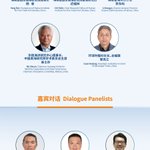
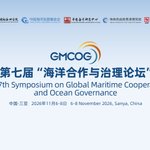
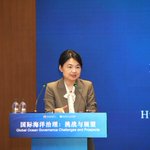
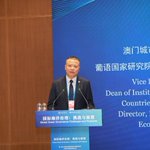
🌊 Coming to Sanya this week!
The 7th Symposium on Global Maritime Cooperation and Ocean Governance will take place Nov. 6–8, bringing together nearly 400 representatives from government, business and academia across 30+ countries and regions.
Follow the discussions on maritime cooperation, ocean governance and regional challenges — live throughout the symposium on:
📺 WeChat Channels: 华阳海洋研究
▶️ YouTube: Huayang Ocean Observation
𝕏 @SCSHuayang | @GMCOG_
Stay tuned!

🌊 Coming to Sanya this week!
The 7th Symposium on Global Maritime Cooperation and Ocean Governance will take place Nov. 6–8, bringing together nearly 400 representatives from government, business and academia across 30+ countries and regions.
Follow the discussions on maritime cooperation, ocean governance and regional challenges — live throughout the symposium on:
📺 WeChat Channels: 华阳海洋研究
▶️ YouTube: Huayang Ocean Observation
𝕏 @GMCOG_ | @SCSHuayang
Stay tuned!


GMCOG retweeted
Manila’s version of “de-escalation”: more patrols around Scarborough, more military aircraft in the air—and no mil-mil communication with Beijing. 🤗abs-cbn.com/news/nation/2026…

GMCOG retweeted
🎓 Upcoming 25th Huayang Talk!
Colin Dodds, President Emeritus of Saint Mary’s University (@smuhalifax ), will discuss Hainan’s opportunities in cross-border higher education in the context of its Free Trade Port development.
📅 10:00-12:00, October 20, 2026 (Beijing Time)
Follow us for more updates!

GMCOG retweeted
Reading Notes #4 | Why is the South China Sea called a “treasure trove of resources”?
From rich coral ecosystems and strategic minerals to renewable energy and maritime infrastructure, the South China Sea holds enormous economic and strategic potential.
📖 Explore more in the 2026 edition of What One Needs to Know About the South China Sea.
🤖 Made with AI

GMCOG retweeted
📘 Reading Notes #3, Part IV | What One Needs to Know About the South China Sea
How did China articulate its position on the Nanhai Zhudao in the early years of the PRC?
This installment of our reading notes series revisits Zhou Enlai’s 1951 statement on the U.S.-British Draft Peace Treaty with Japan and the San Francisco Conference, in which the Chinese government reaffirmed its sovereignty claims over the Xisha, Nansha, Zhongsha and Dongsha Islands.
📖 Explore more in the 2026 edition of What One Needs to Know About the South China Sea.

GMCOG retweeted
Today marks the 95th anniversary of the September 18 Incident of 1931 - the beginning of the 14 years of Japanese invasion against China.
The diplomatic telegram shown here, sent as events unfolded in Mukden (today's Shenyang), preserves a contemporary record of that night and the violence that followed. (Source: Office of the Historian, U.S. Department of State)
Remember history. Cherish peace. Look to the future.


GMCOG retweeted
Who do the South China Sea Islands belong to-and how should sovereignty be established?
This short animated explainer traces the historical records, maps, treaties, and post-war arrangements cited in support of China's sovereignty over the SouthChina Sea Islands.
Watch the video for a quick look at the historical and legal context behind one of the region's most enduring questions.
GMCOG retweeted
📘 Reading Notes #3 | What One Needs to Know About the South China Sea
Why are the Nanhai Zhudao considered China’s inherent territory? Our fifth installment looks at China’s postwar recovery of the Xisha and Nansha Qundao, including the 1946 takeover and restoration of administration.
🔎 Read more in What One Needs to Know About the South China Sea (2026 ed.).

GMCOG retweeted
Commenting on the recent controversy over an alleged note from a Chinese military attaché, Wu Shicun, Chairman of the Huayang Center, said the episode was essentially a “political show” by certain Philippine politicians.
He noted that such rhetoric should not be allowed to overshadow the broader China-Philippines relationship or become a yardstick for judging its future trajectory. Such action might attract some attention for the Philippines, but it does little to help manage differences or maintaining long-term stability in the South China Sea.

GMCOG retweeted
📘 Reading Notes #3 | What One Needs to Know About the South China Sea
Why are the Nanhai Zhudao considered China’s inherent territory?
From China’s response to the 1933 French occupation to official surveys, map reviews, and the continued activities of Chinese fishermen, the historical record tells a longer story.
🔎 Read more in What One Needs to Know About the South China Sea (2026 ed.).

GMCOG retweeted
Look at the letter itself. It is handwritten on Lotte Hotels stationery.
No signature, no name, no title, no Embassy identification, no letterhead, no seal, no salutation and no indication that the writer was speaking on behalf of the Chinese government. On its face, there is nothing establishing either who wrote it or in what capacity it was written.
Mr. Teodoro said himself: The thing speaks for itself.
What does it say?
It says that the Philippine Secretary of National Defense publicly treats a note without any signature, name, title, Embassy letterhead, seal and attribution as evidence of Chinese “coercion, bullying and aggression.”
Mr. Teodoro, have some common sense. Why do you take the international pulic for fools who can be manipulated by your clumsy performance?
Either you are so astonishingly credulous that you’ll believe whatever anonymous piece of paper happens to be handed to you - or you knew perfectly well what you were doing, and this was a performance from the very start.
So which was it, Mr. Teodoro: extraordinary gullibility, or political theater?


MAHIYA NAMAN KAYO | Secretary of National Defense Gilberto C. Teodoro, Jr. responded to a note from the Chinese side during the Seoul Defense Dialogue (SDD) 2026 in Seoul, Republic of Korea.
#DNDPHL #DiKaPasisiil #SDD2026
GMCOG retweeted
📘 Reading Notes #3 | What One Needs to Know About the South China Sea
Why are the Nanhai Zhudao considered China's inherent territory?
Part I looks at the historical dimension—from early Chinese navigation and fishing activities in the South China Sea to successive forms of governmental jurisdiction, as reflected in historical records, local chronicles, and official maps.
📖 Read more in the 2026 edition of What One Needs to Know About the South China Sea.

GMCOG retweeted
📘 Reading Notes #1 | What One Needs to Know About the South China Sea
How well do you know the South China Sea?
Our new Reading Notes series introduces key questions explored in the latest 2026 edition of What One Needs to Know About the South China Sea, edited by Wu Shicun, Chairman of the Huayang Center for Maritime Cooperation and Ocean Governance, and officially published in July 2026.
We begin with a basic but essential question: Where is the South China Sea, and what is its geographic scope?
📖 Follow the series to learn more about the South China Sea—one question at a time.


GMCOG retweeted
Inaugural Session of the Hai-Eu Dialogue Coming Up!
How can European ports and the Hainan Free Trade Port learn from each other?
Join us on September 3, 10:00-11:00 (CEST)/16:00-17:00(Beijing Time) online for the inaugural session of the Hai-Eu Dialogue Series to discuss institutional opening-up, port governance, hinterland connectivity and opportunities for closer maritime cooperation.
Speakers include:
Dr. Joost Hintjens, Lecturer and Researcher, Department of Transport and Regional Economics, University of Antwerp
Guo Wenqin, Deputy Dean, Hainan Free Trade Port Research Institute
Dr. Daniel Balazs, Senior Research Analyst, Institute for China-Europe Studies
To register, please visit: us02web.zoom.us/webinar/regi…

GMCOG retweeted
💡Now Available: The 2026 Edition of What One Needs to Know About the South China Sea.
First published in 2011, this widely read introduction to the South China Sea has been revised and updated for its 2026 edition, returning in a new Chinese-English bilingual edition for readers in China and around the world.
Presented in a question-and-answer format, the book examines 20 key questions in accessible yet professional language and with rigorous academic reasoning. Drawing on history, geography, international law, politics, diplomacy and military affairs, it explores the historical origins and underlying causes of the SouthChina Sea issue, the evolution of the regional situation,China's policies and positions, and the new dynamics shaping the South China Sea today.
Edited by Professor Wu Shicun, a leading Chinese scholar who has studied the South China Sea for more than three decades, the book seeks to provide general readers with a systematic and accessible guide to understanding one of the most complex maritime issues in the world today.
Read more👇
huayangmaritime.com/news/133
