

Official account of Huayang Center for Maritime Cooperation and Ocean Governance. Follows, RTs≠endorsement.
Haikou, China
Joined April 2023
- Tweets402
- Following65
- Followers101
- Likes252




Pinned Tweet
1. The Philippines cites the 1734 Velarde map (p1)("Panacot") to argue that Panacot = Huangyan Dao (Scarborough Shoal). In the map, Panacot is located in middle of the three shoals off the west coast of Luzon.
2. The English name "Scarborough Shoal" comes from the British East Indiaman Scarborough grounding there on 12 Sept 1748—after the Velarde map was published.
3. In 1775, French hydrographer Jean-Baptiste Nicolas Denis d'Après de Mannevillette published the expanded 2nd ed. of Le Neptune Oriental, including "A Chart of the China Sea"(p2) originally drawn by British cartographer Alexander Dalrymple, the first map to precisely mark the location of the "Scarboro," the island named after the English commercial ship, and the "Scarboro Shoal" is placed to the west of the "three shoals".
That means: "Scarboro" should not be wrongly confused with the "middle shoal" of that three-shoal group; it is hence distinct from the "Panacot" featured on the earlier Velarde map.
4. So if someone insists "Panacot is Huangyan Dao,” they must explain why the first explicit "Scarboro" plotting (1775) shows Scarboro separately—west of that three-shoal cluster.
5. Equating Panacot with Huangyan Dao is not a settled historical "fact," but a groundless interpretation that later charts directly refute.


SCS Comment retweeted

🌊 Coming to Sanya this week!
The 7th Symposium on Global Maritime Cooperation and Ocean Governance will take place Nov. 6–8, bringing together nearly 400 representatives from government, business and academia across 30+ countries and regions.
Follow the discussions on maritime cooperation, ocean governance and regional challenges — live throughout the symposium on:
📺 WeChat Channels: 华阳海洋研究
▶️ YouTube: Huayang Ocean Observation
𝕏 @GMCOG_ | @SCSHuayang
Stay tuned!

🌊 Coming to Sanya this week!
The 7th Symposium on Global Maritime Cooperation and Ocean Governance will take place Nov. 6–8, bringing together nearly 400 representatives from government, business and academia across 30+ countries and regions.
Follow the discussions on maritime cooperation, ocean governance and regional challenges — live throughout the symposium on:
📺 WeChat Channels: 华阳海洋研究
▶️ YouTube: Huayang Ocean Observation
𝕏 @SCSHuayang | @GMCOG_
Stay tuned!


SCS Comment retweeted

Ungrateful🇵🇭
1. During the Russia-Ukraine war, China generously provided energy and fertilizer aid to the Philippines, yet this fool and his master Teodoro slandered it as politically motivated and hypocritical.
2. As for the oil and gas resources in the South China Sea—even if China didn't obstruct them—does the Philippines actually have the capability to exploit them? It's laughable. The Philippines would simply sell them cheaply to its master, the United States, just like Alaska was sold so cheaply in the past.
3. A country as corrupt as the Philippines, if it ever gained control of the South China Sea, would turn it into a tool for domestic corruption networks. A nation that even embezzles funds meant for drainage and flood prevention systems would only make the ocean a new playground for dirty deals—just like the black hole currently devouring the Philippines' defense budget.

Reading Notes #6, Part II
This installment looks at two arguments often raised in the South China Sea disputes—geographical proximity and maritime entitlements under UNCLOS—and explains why neither, by itself, establishes territorial sovereignty.
It also revisits the principle that “the land dominates the sea”, and the distinction between territorial sovereignty and maritime rights.
📖 Explore more in the 2026 edition of What One Needs to Know About the South China Sea.

SCS Comment retweeted

The Chinese Embassy appreciates the reiteration of the one-China policy by the DFA of the Philippines. Under current circumstances, this public statement is timely and necessary in preventing certain forces from sabotaging China-Philippines relations by playing with the Taiwan question.
In the mean time, the Embassy doesn’t accept the DFA public statements in relation to the Embassy’s pushing back against attacks and smears on China. The Embassy is always committed to managing differences with the Philippines through diplomatic channel. Meanwhile the Chinese Embassy will not remain silent when China’s interests and dignity are undermined. This is the duty that diplomatic mission must perform.
Manila’s version of “de-escalation”: more patrols around Scarborough, more military aircraft in the air—and no mil-mil communication with Beijing. 🤗abs-cbn.com/news/nation/2026…

Reading Notes #5 | What lies at the heart of today’s South China Sea disputes?
The disputes are not one single issue. They involve both territorial sovereignty over islands and reefs and overlapping maritime claims shaped by the development of the modern law of the sea.
This installment looks back at how these disputes evolved—from competing claims over Nansha Qundao (Spratly Islands) to questions of EEZs, continental shelves, maritime boundaries, and resource development.
📖 Explore more in the 2026 edition of What One Needs to Know About the South China Sea.

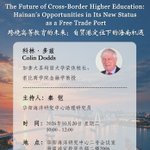
🎓 Upcoming 25th Huayang Talk!
Colin Dodds, President Emeritus of Saint Mary’s University (@smuhalifax ), will discuss Hainan’s opportunities in cross-border higher education in the context of its Free Trade Port development.
📅 10:00-12:00, October 20, 2026 (Beijing Time)
Follow us for more updates!

SCS Comment retweeted
Some Philippine politicians and reporters have very limited comprehension about facts.
But they are good at exaggeration, taking things out of context, and creating hype.
SCS Comment retweeted
Some Philippine politicians just love taking things out of context, whipping up hostility, and provoking confrontation. This is their usual ugly anti-China playbook.


SCS Comment retweeted
Some senators and house representatives are talking about declaring the Chinese ambassador persona non grata. Is this threat or coercion? But anyway, just do it. Otherwise, STOP BLUFFING.
Reading Notes #4 | Why is the South China Sea called a “treasure trove of resources”?
From rich coral ecosystems and strategic minerals to renewable energy and maritime infrastructure, the South China Sea holds enormous economic and strategic potential.
📖 Explore more in the 2026 edition of What One Needs to Know About the South China Sea.
🤖 Made with AI

SCS Comment retweeted
The defense chief of the Philippines, one minute he’s detaining unarmed Chinese workers, and the next he’s going after innocent Chinese teachers and local Chinese communities. Is this what a defense secretary is supposed to be doing? And does this knee-jerk anti-China obsession really make the Philippines any safer?
One does wonder: must every such incident be turned into another dramatic confrontation with China, complete with carefully curated footage, emotional appeals, and the inevitable accusations?
If the PCG is genuinely concerned about the welfare of its personnel, perhaps it should begin by reconsidering Manila's decision to station soldiers aboard a rusting WWII-era warship deliberately grounded in China's territory.
You enter someone else's property uninvited, provoke a confrontation, and then blame the owner for defending it. Apparently, even the consequences of one's own decisions must somehow be China's fault.

PCG COMPLETES MEDEVAC OF NAVY PERSONNEL FROM AYUNGIN SHOAL DESPITE CCG WATER CANNON AND DANGEROUS MANEUVERS
On 08 October 2026, the Philippine Coast Guard (PCG) completed the emergency medical evacuation (MEDEVAC) of a Philippine Navy personnel stationed aboard BRP Sierra Madre (LS-57) at Ayungin Shoal. China Coast Guard (CCG) vessels obstructed the mission and delayed it by nearly ten hours.
The PCG deployed BRP Cabra (MRRV-4409) from Lawak Island. At around 7:30 AM, the vessel reached a position about 9 nautical miles north of Ayungin Shoal. CCG vessel 5306, which had been making dangerous maneuvers near BRP Cabra, then activated its water cannon. It kept the water cannon running as it closed in from about 1.3 nautical miles to roughly 400 yards of the PCG vessel, apparently to drive BRP Cabra away from the shoal. BRP Cabra was not hit. To keep the vessel and its crew safe, BRP Cabra moved away from Ayungin Shoal and kept radio contact with the CCG while coordinating with LS-57.
The PCG had planned a rendezvous point about 2.5 nautical miles northeast of LS-57. Persistent harassment and blocking by CCG vessels made it difficult for BRP Cabra to approach, so the vessel had to stay about 13 nautical miles north of the shoal for several hours. At 12:52 PM, CCG 5306 again radio-challenged BRP Cabra. To protect the patient and the personnel involved, the PCG moved the transfer to a safer rendezvous point farther from LS-57. The AFP and PCG carried out the MEDEVAC under Philippine authority.
At 1:46 PM, BRP Cabra launched its rigid-hull inflatable boat (RHIB) with PCG crew, a Maritime Security Team member, and Coast Guard medical personnel aboard. Within a minute, the CCG deployed its own RHIB, which made dangerous maneuvers against the PCG RHIB throughout the 9.2-nautical-mile transit. LS-57 launched two rubber boats toward the rendezvous point, one of them carrying the patient.
At around 3:15 PM, the patient and his companion were safely transferred to the PCG RHIB. On the way back, CCG vessel 21585 made dangerous maneuvers about 500 yards off the PCG RHIB's starboard quarter, while CCG 5306 positioned itself about 600 yards off its port quarter. The PCG RHIB reached BRP Cabra shortly before 5:00 PM with no further incident. A PCG medical officer immediately examined the patient, checked his vital signs, and started intravenous fluids. He is now stable and is being transported to port of Buliluyan for further treatment.
The PCG also monitored the following vessels in the area during the operation: CCG vessels 5306, 5009, and 21585, Chinese maritime militia vessel Qiongsanshayu 00119, and People's Liberation Army Navy warship 628.
A transfer like this would normally take only a few hours. It took nearly ten because of the CCG's water cannon use, its persistent harassment and blocking, and its dangerous maneuvers against PCG assets. Ayungin Shoal lies within the Philippines' exclusive economic zone, as affirmed by the 1982 UNCLOS and the final and binding 2016 Arbitral Award. Giving medical care to Filipino personnel stationed there is the government's sovereign responsibility, not a privilege granted by any foreign power. Using a water cannon during a humanitarian mission is dangerous and unlawful. It puts lives at sea at risk and violates basic standards of maritime conduct.
PCG Commandant Admiral Ronnie Gil Gavan called on the CCG to respect the humanitarian nature of medical evacuation missions in the future. "When a life is at stake, there should be no water cannon, no obstruction, and no delay. Saving a sick or injured person at sea is a basic obligation that every coast guard in the world is expected to uphold. We call on the CCG to value and respect humanitarian missions moving forward, and to act in a manner consistent with international law and the professional standards expected of any coast guard," Admiral Gavan said.


SCS Comment retweeted
Mr. Tarriela seems to have mistaken a contested ruling for settled law, speculation for evidence, and mere distance for sovereign rights. Such rhetoric may serve domestic political purposes, but it hardly stands up to scrutiny under international law. Perhaps he would do well to read more, study more, and acquaint himself with the basic facts and principles at issue.
1. The relevant Chinese vessel is operating within waters under China’s jurisdiction. China and the Philippines have overlapping maritime claims in the relevant waters. In accordance with the provisions of Articles 74 and 83 of UNCLOS, as well as the consensus reached between China and the Philippines, such issues should be properly resolved through negotiations.
2. China’s territorial sovereignty and relevant rights and interests in the South China Sea have been formed over the course of a long history and are reflected in relevant maps depicting the dotted line in the South China Sea. At the core of the maritime disputes between China and the Philippines is the territorial issue arising from the Philippines’ illegal occupation of certain islands and reefs of China’s Nansha Qundao since the 1970s. China firmly opposes the Philippines’ illegal occupation of Chinese islands and reefs, and firmly opposes the Philippines taking acts of infringement in waters under China’s jurisdiction based on its unilateral claims.
3. China’s position on the “South China Sea Arbitration” is consistent and clear. China neither accepts nor recognizes the award, and does not accept any claims or actions thereon based. Under no circumstances does the award affect China’s territorial sovereignty or maritime rights and interests in the South China Sea.
