

Associate Prof @MITChemE ; mom^4 + wife; enjoys building cell-fate circuits, exploring dna topology, reprogramming the living world, and soccer; soli gloria deo
Joined June 2019
- Tweets5.2K
- Following2.1K
- Followers8.6K
- Likes14.5K


Katie Galloway retweeted

Massively parallel assays using oligopools, barcoding, & deep sequencing follows the same story.
Replaces 100s of microtiter plates (one assay per well) with 10000s of experiments run in one pooled assay.
Work your 🧠, not just more 🤖.


Katie Galloway retweeted

We have two faculty positions open in synthetic biology (one experimental and one computational), both very broadly defined. Deadline is Oct 31. The Dept of Bioengineering in the Knight Campus at UOregon is a great place to work. Come join us! Link below.

Katie Galloway retweeted

The main preprint from my postdoc is live!
biorxiv.org/content/10.64898…
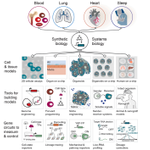
The core idea is to try to make synthetic biology much more systematic and precise, akin to more mature fields of engineering.
This was an ambitious project, it started all the way back in February of 2020 and is only just now wrapping up! Thankfully there were no events in that timeframe, either around the world or specifically here at Harvard, that made things any more difficult than they needed to be.
The fundamental dilemma is that we are often forced to do one of two things when designing a synthetic circuits: either we can navigate a laborious design-build-test cycle where we iteratively optimize a circuit's performance tuning one parameter at a time, or we can screen a huge array of variants using techniques like directed evolution and pick the winners and have little insight into the molecular details of why one design worked better than the others.
Our idea was to try to get the best of both worlds, to combine precise mechanistic insights with extremely high throughput in such a way that we could systematically study the whole design space of a given circuit architecture.

Katie Galloway retweeted

Our new paper is out @J_Cell_Sci 🧬 doi.org/10.1242/jcs.265367 @NagataY51868 et al combined single-nucleosome imaging + Fucci probes. H2B-Halo motion stays nearly constant from G1 to G2. H3.3-Halo euchromatin nucleosomes are more mobile, but their motion also stays nearly constant.

Katie Galloway retweeted
This work from @VinayA116 is one of my favorite papers from our lab. Not only does it point to heterogeneity as being important in development, but it also points to division of labor: clones divvy up tasks in the organism based on their relative ability to perform well at a given fate! I like to think of it as "embryo economics".

..and have a look at the highly related paper from @arjunrajlab biorxiv.org/content/10.1101/… with complementary experiments that reinforce the point and reveal multicellular #memory


Katie Galloway retweeted

Excited that "Power-Seek" - identifying inheritable "memory" genes from a single snapshot scRNA-seq dataset using power laws, is finally out! @NCBS_Bangalore @NCBStheory Link (free for only 50 days!): authors.elsevier.com/a/1nfiF…


Inheritable 'memory' genes drive #cancer drug tolerance, but their discovery in clinical samples is a major challenge. Our new theory, moving away from Luria-Delbruck, detects them from a *single* scRNA-seq dataset! With #ArchishmanRaju led by @suvranil_1 tinyurl.com/4pef8scy
Katie Galloway retweeted

big news for asimov today: we're partnering with lonza on in vivo lentiviral vector manufacturing. i'm pretty excited about this one for a lot of reasons.
ex vivo CAR-T has now treated tens of thousands of patients, and many of them have been cured of their cancer. but it requires extracting and engineering human cells outside the body, which means every dose is its own batch. it's an impressive manufacturing effort, but it's hard to scale.
in vivo approaches skip the cell extraction step. you dose the gene delivery vector directly into the patient, and it engineers the target cells inside their body. this means one drug product can serve many patients, but the catch is that the vector is now the actual drug, not just a reagent, so consistency and a well-defined product profile matter a lot more.
traditionally, lentiviral vectors are made by large-scale transient transfection of a production host cell line, which is plagued by scalability and consistency problems. every cell in the bioreactor can receive a different number of plasmids, anywhere from zero to thousands.
stable producer cell lines take a different approach. they're clonal engineered lines with the production genetics integrated into the genome, so no transfection is needed during manufacturing. the whole process starts to look more like antibody manufacturing, which is highly controllable and scalable.
(as an aside, refactoring the lentivirus genome to gain tight control over the multi-step molecular process it encodes is one of the most technically impressive feats i've seen since starting asimov)
we're seeing order of magnitude higher titers and infectivity with our stable producer systems compared to transient transfection. with lonza, we're pairing that with their process development, analytics, and GMP manufacturing expertise to support drug developers.
we think in vivo cell and gene therapies are the future, and that they'll bring many more drugs to patients in the years to come.

Today we are announcing a strategic collaboration with @LonzaGroup to advance in vivo lentiviral vector manufacturing.
In vivo lentiviral therapies turn the vector from a manufacturing reagent into the drug itself, raising the bar for titer, product quality, and scale. While traditional transient production systems limit scalability and consistency, stable cell lines have the potential to enable scalable, reproducible and controlled product profiles for lentiviral vectors.
To provide developers with a scalable path from sequence to clinic, we’re bringing together Asimov’s LV Edge stable cell lines with Lonza’s expertise in process development, scale-up, analytics and GMP manufacturing. By connecting early design decisions with development and manufacturing considerations, we are creating a stronger foundation for clinical and commercial production.
Learn more here: asimov.com/news/lonza-and-as…

Katie Galloway retweeted

Self-amplifying RNA enables rapid, durable, integration-free programming of hiPSCs @CellRepMethods @GallowayLabMIT @LaurieBoyer1221 @DeonPloessl @MITChemE
cell.com/cell-reports-method…

Katie Galloway retweeted

Faculty search now open! BCS and @mcgovernmit seeking candidates at any level (pref. tenure-track assistant professor) including but not limited to cell/molecular and/or systems neuroscience, with a focus on translational neuroscience in nonhuman animals. academicjobsonline.org/ajo/j…
Katie Galloway retweeted

Excited to share a preprint of my main PhD work in @nickpolizzi_'s lab - introducing LUCI-tag, a new orthogonal self-labeling protein tag based on K-Ras(G12C) and its covalent inhibitors! biorxiv.org/content/10.64898… (1/16)

Katie Galloway retweeted

DIAL designs synthetic promoters for generation of heritable setpoints of gene expression across a range of cell types go.nature.com/4h9wlR1
rdcu.be/ruJgZuhLT6ra


Katie Galloway retweeted

We are excited to announce a new faculty position in AI for Biology at UC Berkeley, jointly between @Berkeley_EECS and @CCBBerkeley.
Please repost & share this opportunity with outstanding early-career researchers in your networks.
Apply by Nov 9, 2026: aprecruit.berkeley.edu/JPF05…

Katie Galloway retweeted

We're searching for an assistant/associate professor in Bioengineering at Stanford!
If you're using cutting-edge engineering approaches to understand or control biological systems in useful ways (medical, environmental, etc), we'd love to hear from you!
facultypositions.stanford.ed…

Katie Galloway retweeted

🌴 Present your research at Winter qBio 2027! 🧬
We're accepting abstracts for contributed talks and poster presentations, due November 20th 🎤📊
Submit → w-qbio.org/present
🤖 Made with AI

Katie Galloway retweeted

The University of California was for so long a transformative force for social mobility because it had the highest standards and inspired people from all walks of California to aspire to them. Dumping the SAT, whatever you think of the motivations for doing so, was a retreat from this role, and has had cascading disastrous effects on secondary education in the state. Reinstating it will not solve all of these problems, but it is an absolutely essential first step.


Katie Galloway retweeted

Thrilled to announce that the Savinov lab is now live at @UTAustin! Our lab @UT_MBS employs massively parallel experimental and AI methods to discover and design protein fragments as universal regulators of protein interactions in health and disease. savinovlab.com/ (1/n)

Katie Galloway retweeted

Stanford Bioengineering faculty search: Apply by Sept 30!
Bioengineering is defined broadly: if you are engineering at the level of biomolecules, cells, tissues, organisms, or using/developing advanced engineering techniques to study these systems - please apply!
facultypositions.stanford.ed…