

CTO @TrustedSec | Former Optiv/SecureWorks/Accuvant Labs/Redspin | Race cars
/tmp/.a
Joined April 2008
- Tweets67.6K
- Following5K
- Followers75.3K
- Likes145K




Justin Elze retweeted

When I read Anthropic’s “self-replicating AI” article, I knew I had to respond.
The research is technically interesting. But the headline combines three different models, two separate experiments, a seeded foothold and a network of unauthenticated computers into one story about “self-replicating AI.”
Honestly, that conclusion would never survive peer review. Here is what they actually demonstrated.


Justin Elze retweeted

It seems that MS update prevents coercion and relaying via WebDAV.
Defeating SMB signing as described in QT will most likely be patched as well.
There is a PR for a module in NetExec


I wrote up a way to defeat enforced SMB signing for relay.
It abuses a documented SMB re-authentication behavior.
I'm surely missing nuance and prior art. Corrections welcome.
Writeup:
blackfield.ch/blog/defeating…
PoC:
github.com/aas-n/reauthx

AI labs have developed a culture of publicly speculating about the future. How does that culture change after they go public, when those same statements could move their own stock prices?
Will the models stop writing code with bugs by mid 2027?
xitter.cf/BVeiseh/status/2113389…


InfoSec we know drama
xitter.cf/PHPNewsnet/status/2113…

Chainguard Broke the php2shell Embargo
phpnews.net/chainguard-php2s…

Justin Elze retweeted

Project Swarm from @GreyNoiseIO let's you get ground truth on exploitation in the wild. You can deploy your own honeypots to collect reconnaissance, exploitation, and post-exploitation artifacts. It's a dollar.
greynoise.io/project-swarm
Zapped
"The exploit was already landing correctly; the earlier failures were because Docker’s VM disk was full"
I'm really interested to see the postmortems in a few weeks on successful php2shell exploitation in the wild during October 21–22 and how that aligns with vendor tweets here.
I did post this somewhat ironically, knowing the harness and the people writing it matter, but the comments are all solid...
xitter.cf/HackingLZ/status/21130…


Whoever is running around doing community notes
xitter.cf/rafalohaki/status/2113…


Working RCE against PHP 8.5.12 (the 2026-10-21 security release that fixed CVE-2026-109618/109619).
Pure logic bug — no memory corruption,
ASAN-clean, orthogonal to the CVE-2026-109618/19 class.
Receipt: uid=33(www-data) over HTTP, one-shot
#infosec #php2shell #php
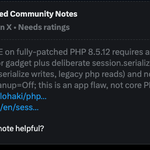
Readers added context they thought people might want to know
The claimed RCE on fully-patched PHP 8.5.12 requires a custom lab app with a destructor gadget plus deliberate session.serialize_handler mismatch (php_serialize writes, legacy php reads) and non-default settings like cleanup=Off; this is an app flaw, not core PHP RCE.
github.com/rafalohaki/php…
php.net/manual/en/sess…
Justin Elze retweeted

Just an incredible indictment of this guy and BBC news, for two reasons:
1) How can you claim to be a "cyber correspondent" and not know what PHP is?
2) Why would you admit this in public? You didn't have to say all that


👀 "We have not confirmed any successful exploitation."
xitter.cf/Huntio/status/21132838…

🚨 #PHP2Shell (CVE-2026-109618, CVE-2026-109619): everyone is staging the leaked PHP RCE, no one has landed it 🫠
We mapped the exposed PHP footprint and went into the attacker open directories after the Oct 21 leak.
What we found:
→ 683,922 IPs leaking a PHP version in one day of scans, mostly end-of-life builds
→ ~a dozen open-dir workspaces staging php2shell tooling, zero victims or shells in any of them
→ one mass operator sprayed up to 123 servers via a ~97-proxy farm, zero shells
→ scanning started ~20 min after the patch, driven by an existing Mirai-style botnet
→ no public PoC lands code exec on x86-64 yet (OOM corruption vs ASLR)
Patch now: 8.5.12 / 8.4.27 / 8.3.36 / 8.2.35.
Full research + network observables: hunt.io/blog/php2shell-cve-2…

Justin Elze retweeted

18 months after Trimarc joined TrustedSec, the work speaks for itself. In our new #blog, Identity Security Architect @PyroTek3 reflects on Trimarc’s integration into TrustedSec and what it means for customers, services, and ongoing research. Read it now! hubs.la/Q04C18Yy0


Justin Elze retweeted

Honestly, yesterday's PHP vuln chaos wasn't that different from what we've seen in the past. The classic "it's coming get ready" race to reproduce coupled with the classic misleading noise from the discussion feels pretty familiar. Humans make it messy.
Justin Elze retweeted

The actual prompt for this was "let's look for pre-auth RCEs in PHP". I'm sharing this so people know this stuff is real and to take agent-assisted scanning seriously.
I kicked if off using Claude Mythos 5.1 (in stock Claude Code) but it uses a skill to drive a harness we built over the last few months.
I don't know if the harness is amazing, but it certainly has a scary track record so far. It's setup to do an agent guided tree search across a codebase, and runs in microvm sandboxes that all have the full source code for the target, as well as the source for any transitive dependencies.
When I built the harness I basically just fed Claude a bunch of Project Zero blog posts describing how they did research and had it build a harness that ran like that, but on our tech stack.
The first phase is just setup and can run with any model, it just does that fetching and assembles the kit environment, and gets a target up and running alongside the source code.
Then we just do some basic suspend/resume stuff over to the hunt phase, where one agent supervises the tree, and the first node kicks off.
Each node is context-aware and aware of the work of all the others. I think I ran this with parallelism 4? So 4 running at any one time. The supervisor can shape the tree and boost nodes or prune. Any node can add more below it with targeted instructions.
A typical run looks like the first node doing a codebase review or building and running a fuzzer or something, all depending on the target. Then based on whatever it finds, it'll queue 4-5 children that go look into those areas. The main system guidance is to validate everything 3 times in clean VMs, and we typically require full exploit chains/POCs.
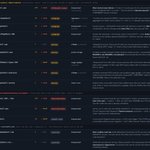
Here's what this run looked like.
We're doing this with a bunch of other open source projects now and companies. We're doing a lot of this for free, even with private companies, across critical infrastructure. We're directly partnered with Anthropic, and can do this even if you don't have direct access to a frontier model yourself.

Justin Elze retweeted

Yep. Because you can't just prompt "find me all the vulnerabilties". Maybe in awhile but we're nowhere near that now.
Skilled researchers, custom harnesses, and other techniques are changing the bug depth game, in addition to bringing down the cost.

wait, PHP was actually scanned by Anthropic’s Claude Mythos earlier this year. they also had access to OpenAI’s Daybreak Red for validating exploits.
the PHP Foundation revealed this JUST yesterday.
keeping frontier cyber models in the hands of a selected few doesn’t seem to be working well for the internet.
thephp.foundation/blog/2026/…
