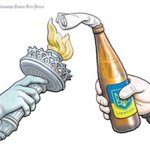
Those who do not study their history are doomed to repeat it... #IStandWithUkraine #ArmUkraineNow!
USA
Joined May 2012
- Tweets3.1K
- Following836
- Followers73
- Likes789





Pinned Tweet
Ukraine needs the world's help! If you are not helping, you are part of the problem. Defending freedom requires sacrifices. Donate and you'll feel better about yourself. Any amount helps. Go direct: u24.gov.ua/ (official site) #HelpUkraine
John G. retweeted

To zdarzenie sprzed 4 lat, ale ciągle do mnie wraca:
To tylko Ukrainki
Jechałem do sklepu w Nysie. Nagle wybiegły mi na drogę dwie młode dziewczyny. Wymachiwały rękami, jakby chciały mnie za wszelką cenę zatrzymać. Tak postępują tylko ludzie w potrzebie, więc otwierając szybę, hamowałem. Obie podbiegły do okna. Usłyszałem zdecydowane – Pomóżcie! Pomóżcie, proszę was.
Zacząłem się rozglądać, czy ktoś je goni, czy co?
Musiałem mieć minę nietęgą, ale akceptującą, bo nagle znalazły się w moim samochodzie na tylnym siedzeniu.
Obie cały czas usiłowały mi coś wyjaśnić. Jedna po angielsku, druga po ukraińsku.
- Zaraz, zaraz, stop! Jesteście Rosjankami? - Zapytałem przekornie.
- Nie, Ukrainkami i musisz nam pomóc, bo nikt nie chce! Jesteś już naszą jedyną nadzieją! Zawracaj, proszę, błagam, pomóż!
Dziewczyny uciekały z Zaporoża do znajomych we Francji. W Krakowie wykupiły bilet autobusowy do Lyonu. Podczas jazdy, po kilku godzinach podróży poprosiły kierowcę, aby na postoju poczekał na nie, bo muszą do ubikacji. Kiedy tylko weszły do dworcowej toalety, autobus odjechał.
Zostały tylko z torebkami na kobiece manele, nawet bez okryć wierzchnich.
Skończyły opowiadać w dwóch językach na zmianę, kiedy byłem już 20 kilometrów na trasie. Trudne czekało mnie zadanie, bo wyszło, że mam 30 minut spóźnienia. Pokazały mi rozkład jazdy i wiedziałem, że autokar ma trzy przystanki w Kłodzku, Polanicy i Kudowie.
Jechałem bardzo szybko, za szybko, ale jeśli miałem im pomóc, tak musiałem jechać. Dały mi telefony do ładowania w samochodzie. Wtyczki się zgadzały i jedna z nich zapytała.
- Dlaczego nam pomagasz?
- Bo mogę – odpowiedziałem. Ponadto, chociaż na emeryturze, ale jestem oficerem polskiej armii, żołnierzem i chciałbym coś dla Was...
Kiedy wypowiedziałem słowo - żołnierz, jedna z nich buchnęła płaczem. W zasadzie to było wycie z bólu! Druga przytuliła ją do siebie.
- Nie trzeba, Nadia, już jesteśmy bezpieczne. Nie trzeba. Spokojnie.
Zamilkłem.
Wiedziałem, że odżyły jej tragiczne wspomnienia. O nic więcej nie pytałem.
Za Polanicą dogoniłem autokar i zajechałem mu drogę. Dziewczyny prawie w biegu wyskoczyły i podbiegły do drzwi. Kierowca wyzywał na mnie, że zaraz mnie staranuje. Drzwi się otworzyły i stanął w nich drugi kierowca. Wściekłość rysowała się na jego twarzy, a pod nią spoczywał na szyi katolicki krzyżyk.
- Dlaczego zostawiliście te kobiety na trasie? - Zapytałem zdecydowanie.
- Spier*alaj dupku, przecież to tylko Ukrainki! – Wrzasnął!
Chciałem im coś wykrzyczeć, ale drzwi się zamknęły za moimi pasażerkami i autokar ruszył.
Po chwili ruszyłem za nim. Chciałem sprawdzić, czy na pewno w tym autokarze są bezpieczne? Kiedy zobaczyłem w nim wielu pasażerów, ich uśmiechnięte miny i machające ręce, uspokoiłem się i zawróciłem do domu.
Przez kilka dni męczyły mnie myśli. Dlaczego nie wziąłem numeru telefonu, nie zapytałem o nazwiska?
Czy na pewno pomogłem skutecznie?
Co jeszcze mogą wymyślić ci katoliccy faszyści, potomkowie szmalcowników i wychowankowie Jędraszewskiego z Krakowa?
Czy Kraków już zostanie stolicą pedofilstwa Dziwisza, przestępstw Ziobry, bezmyślnego długopisu Dudy i otępienia Mularczyka? Sam mam rodzinę pod Krakowem i wiem, że są w sobie tak bardzo zakochani, jak nieżyczliwi ludziom innym niż oni. Za to kościół i PiS przysłania im realny świat. Wiem, że nie mogę uogólniać.
Jednak ciągle brzmi w moich uszach, to: „Sper*alaj dupku, to tylko Ukrainki”.
Adam Mazguła

John G. retweeted

Once every ten days, a bright canary-yellow bullet train glides into Tokyo Station at full speed, yet not a single passenger is allowed to step on board.
Its windows are mostly covered from the inside, its timetable is never published for the public, and there are no ticketed seats in any of its seven cars.
In Japan, every child and every commuter knows this train by two English words: Doctor Yellow.
Since the Tokaido Shinkansen began running between Tokyo and Osaka in October 1964, Japanese bullet trains have carried more than seven billion passengers at speeds up to one hundred and eighty-five miles per hour with zero passenger fatalities from derailments or collisions.
Critics sometimes assume that kind of sixty-year safety record is a miracle of luck.
It is not luck; it is what happens when a nation builds a high-speed hospital train whose only patient is the steel track itself.
Why does Japan run a seven-car bullet train painted bright yellow with zero paying customers on board?
In the early days of high-speed rail, engineers realized that checking hundreds of miles of track on foot at night with hand gauges was too slow, and that tracks behave differently when a three-hundred-ton train slams over them at one hundred and sixty-eight miles per hour.
So Japanese railway engineers took a seven-car Class 923 Shinkansen trainset and packed every car from nose to tail with laser-optical sensors, gyroscopes, accelerometers, and high-speed cameras.
Running in the middle of the regular passenger schedule at a full one hundred and sixty-eight miles per hour, Doctor Yellow fires laser beams onto the left and right rails to measure track width, vertical dip, and curvature alignment down to one-tenth of a millimeter, about the thickness of a single human hair.
At the same time, two special observation domes built into the roof and laser pantographs check the overhead high-voltage copper wire for microscopic wear before a single spark can cause a power outage.
The instant Doctor Yellow detects a rail that has shifted by even a fraction of an inch, it beams the exact GPS coordinates to maintenance crews waiting along the line so they can fix the spot that very night after the last passenger train goes to sleep.
Because its schedule is kept secret so crowds do not pack the platforms, Japanese commuters treat spotting Doctor Yellow by chance as a genuine good-luck charm that brings happiness for the rest of the week.
Safety is never an accident when engineers check their work down to the width of a hair.
(Note: Every photograph-style illustration on my feed is created by AI.)
🤖 Made with AI

John G. retweeted

For nine years, almost nobody in Japan has looked at my neighbor's daughter.
Not because they're cruel. Because they're polite.
Sana is nine. She uses a wheelchair. In Japan, when people see a child like her, they do the kind thing. The thing we're taught. They look away. They don't stare. They give her space.
So for nine years, Sana has gone everywhere being carefully not seen.
And her mother, Megumi, learned to help. At school events, at festivals, at the park, she always sat them in the same place. The very edge. The very back. Where they wouldn't be in anyone's way.
Last summer, Megumi's husband had to work for two weeks at a plant in a small town in Iowa. The whole family went. Megumi told me she dreaded it. New country. New stares. Or worse, new ways of not being looked at.
On the first morning, they went to a diner.
The waitress came over, looked at the table, and did something nobody in Japan had ever done.
She crouched down next to the wheelchair, eye level with Sana, and asked her what she wanted.
Not her mother. Her.
In Japan, waiters ask Megumi what Sana wants. Sana is nine. She knows what she wants. She wanted pancakes.
The waitress said, "Pancakes for the boss," and wrote it down. When the pancakes came, there was a mountain of whipped cream on top. The waitress pointed at the wheelchair and winked. "Extra for the driver."
Sana laughed so hard she got syrup in her hair.
Megumi tried to pay. An old man at the counter had already paid. She tried to pay the next day. A different old man. By the third day, she was sneaking up to the register before they even sat down, and the waitress just shook her head and said, "Honey, you're not gonna win this one."
A lady from the church down the road showed up at the motel with a whole pie. Megumi asked why. The lady said, "Y'all looked tired." They had been in town for three days. Nobody had told her they existed.
And then there was Tucker.
Tucker was seven. He lived next to the motel. On the fourth day, he walked straight up to Sana in the parking lot, looked at the wheelchair, and said, loudly:
"Why do you have wheels?"
Megumi froze. In Japan, a parent would have grabbed that boy and apologized for ten minutes.
Sana looked at him and said, in the English she'd learned at school, "My legs don't work."
Tucker thought about this for one second.
"Cool. Can I push?"
And then they were gone. Down the sidewalk. Way too fast. Tucker's mom was yelling, "TUCKER, SLOW DOWN!" Tucker was yelling, "SHE SAID FASTER!" Sana was screaming in Japanese, "もっと速く! もっと速く!" Faster. Faster.
Tucker didn't speak a word of Japanese.
He understood perfectly.
That night, after Sana fell asleep, Megumi locked herself in the motel bathroom and cried for an hour.
She told me it took her a long time to understand why.
It was because for nine years, without ever deciding to, she had been apologizing. For the wheelchair. For the ramp. For the space they took up. For being there at all.
And in four days, a whole town had made it very clear that nobody needed her to.
On the Fourth of July, there was a parade down Main Street.
Out of habit, Megumi found them a spot at the very edge. At the very back. Behind everybody.
A fire truck came down the street. Red, shining, lights going, kids running alongside it.
It stopped.
Right in front of them.
A firefighter climbed down. A huge man with a gray mustache and forearms like fence posts. Everyone in town called him Bud. Nobody, possibly including Bud, knew his real name.
He walked over, knelt down on the asphalt in front of Sana, and said:
"Ma'am, we're short a co-pilot today. You interested?"
Sana looked at her mother.
Megumi couldn't say a word. She just nodded.
Bud lifted Sana into the front seat like she weighed nothing. Two other firefighters lifted her chair onto the back of the truck. Bud took off his own helmet and put it on her head. It came down over her whole face. She pushed it up with both hands so she could see.
Then he leaned out the window and asked her name.
And he shouted it.
"EVERYBODY SAY HI TO SANA!"
And they did.
All the way down Main Street. People on both sides. Grandmas in lawn chairs. Teenagers on the curb. Men holding babies on their shoulders. Strangers who had never seen her before in their lives.
"HI, SANA!"
"HI, SANA!"
Sana waved with both arms. The helmet kept falling down. She kept pushing it back up. She did not stop waving for one second.
And running next to the truck, the entire length of Main Street, red in the face, out of breath, was a seven-year-old boy screaming at the top of his lungs:
"THAT'S MY FRIEND! THAT'S MY FRIEND!"
Megumi was standing at the back of the crowd, crying so hard she couldn't see.
An old woman next to her, a complete stranger, handed her a tissue. Then she squeezed her arm and said:
"Honey. That girl belongs up there."
They've been home in Japan for over a year now.
Some things changed.
This fall, at Sana's school sports day, Megumi did something she had never done in nine years. She pushed Sana's chair all the way to the very front row.
A few parents looked away, the polite way.
Sana waved at them anyway. With both arms.
Megumi told me something I keep thinking about.
"In Japan, I was taught that kindness means not looking. A little town in Iowa taught my daughter that kindness means looking right at her, and saying her name."
On a shelf in Sana's room, there's a plastic firefighter helmet. The kind you get at a dollar store. Bud sent it a week after they got home.
On the back, in black marker, it says:
"CO-PILOT. ANYTIME."
John G. retweeted

There’s no water or power in Kyiv because russia is trying to cause Europe’s biggest humanitarian disaster. Millions of people live in Kyiv.
And Putin’s envoy Dmitriev is standing at a podium in the White House describing russia as a great humanitarian nation.
John G. retweeted

President Zelenskyy:
Russians have taken thousands of Ukrainian children from our land. Now, we see something even worse.
Russia has already started sending some of these children, children they stole from us, who have grown up during this war, grown up over these years, into the Russian army. And this is horrible, and it must stop.


Thanks for this. These are my fellow Americans whom I'd like the world to know about. And it inspires me to do similar things. ✌️

My wife's college friend Naoko spent three years in Kansas as an agricultural researcher.
She came home with 3,000 photos.
Four of them are the Grand Canyon.
Two thousand one hundred are handwritten signs.
I asked her why.
"In Japan, signs tell you what you can't do. No parking. No entry. No food. No talking.
In America, people take a piece of cardboard and a marker, and they write something kind to a stranger they will never meet. Then they tape it to a mailbox. I couldn't stop taking pictures."
She let me go through them. These are her favorites, with her notes.
"FRESH EGGS $3. HONOR SYSTEM. CASH BOX BELOW."
(Ohio. No camera. No lock. There was $46 in the box. I counted. I put in $5 and felt watched by God.)
"LOST CAT. His name is Moose. He is fat and mean. We love him. Please call."
(I did not find Moose. I think about Moose often.)
"FREE FIREWOOD. STAY WARM."
(Vermont. Two words from a stranger. In Japan, a sign has never once told me to stay warm.)
"CH__CH. WHAT'S MISSING? U R."
(I read it three times. Then I understood. Then I went in.)
"SNOW SHOVELING. FREE FOR SENIORS AND VETERANS. CALL TYLER (AGE 13)."
(Tyler is 13. Tyler is in business. Tyler is not making any money. Tyler is a great businessman.)
"SLOW DOWN. GRANDKIDS PLAYING. GRANDMA HAS YOUR LICENSE PLATE."
(I drove 9 miles per hour. Grandma was on the porch. She waved. I do not think it was a friendly wave.)
"WELCOME HOME DADDY. 287 DAYS."
(Painted on a bedsheet, hanging from a garage in Kansas. Three different handwritings. One of them very small. I don't know this family. I pulled over and cried for a man I will never meet.)
"FREE COFFEE FOR TRUCKERS. YOU KEEP THIS COUNTRY RUNNING."
(A rest stop in Iowa. Two old men behind a folding table. One of them told me I was not a trucker. Then he gave me coffee anyway.)
"CAN'T AFFORD TO WASH YOUR CLOTHES? ASK FOR LINDA. NO QUESTIONS."
(A laundromat in Missouri. I didn't need Linda. I just stood there and loved her for a minute.)
And then there's one photo that isn't very good. It's dark. It's blurry. She took it with shaking hands.
A paper taped to the door of a closed gas station on a two-lane road in western Kansas.
"CLOSED. IF YOU'RE STUCK, CALL EARL. I'M JUST UP THE ROAD."
It was 11:40 at night. Naoko had a flat tire. No signal for most of the drive. One bar, right there by the door.
She called.
Earl was 81. He came in his truck in slippers and a bathrobe. His wife June came too, because, as Earl explained, "She don't let me go out at night alone anymore."
Earl changed the tire with a flashlight in his mouth.
June sat in the truck with the heater running, poured coffee from a thermos, and handed it through the window. "You're shaking, honey. Drink this."
When it was done, Naoko tried to give him money. He wouldn't touch it.
She said, "In Japan, I could never repay something like this."
Earl said, "Then don't."
"Just leave your porch light on for somebody."
Naoko has been back in Japan for two years.
In front of her house, there is a wooden box. Every week she fills it with tangerines from her garden. On the box is a handwritten sign, in Japanese and English.
"FREE. TAKE WHAT YOU NEED."
The first week, nobody touched it. The neighbors thought it was a trap.
The second week, an old man took two and left a note. "Thank you."
The third week, someone she has never met left a bag of persimmons.
It has been two years. That box has never once been empty.
America, the world watches your news and thinks it knows you.
It doesn't.
You're not in the headlines.
You're on a piece of cardboard. In marker. Taped to a mailbox. Leaning on a fence post in the rain.
"Stay warm."
"Take what you need."
"I'm just up the road."
If you've been wondering where your country went, it didn't go anywhere.
Go for a drive.
It's still taped to the mailboxes.
John G. retweeted

Please don't stop shouting about Ukraine.
Look at Kherson today.
russians burned people's homes. Pure terror.
John G. retweeted

Francine Joy Drescher, an American actress, comedian, writer, producer, and trade union leader best known for creating and starring in the 1990s hit sitcom The Nanny...
In 1985, Drescher and a friend were raped at gunpoint in her home by an armed intruder who was out on parole, while her husband was tied and blindfolded. Using her photographic memory, she helped police create an artist sketch that led to the attacker's arrest and a 150-year prison sentence.
In 1999, Drescher was diagnosed with uterine cancer after a prolonged struggle to get a correct diagnosis. Following a radical hysterectomy, she wrote the best-selling book Cancer Schmancer and founded the Cancer Schmancer Movement to advocate for early detection and women's health legislation.
Drescher married high school sweetheart Peter Marc Jacobson in 1978. They divorced in 1999 after Jacobson realized he was gay, though the two remained close friends and later co-created the TV series Happily Divorced.
. . .
Millions knew Fran Drescher for her outrageous clothes, unmistakable voice, and infectious laugh on The Nanny. Few knew what she had survived before becoming a television star.
In 1985, Fran was at home with her husband, Peter Marc Jacobson, and a female friend when two armed men broke in.
Peter was tied up and blindfolded. Fran and her friend were r*ped at gunpoint.
Fran was just 27 years old.
The assault left her terrified. Sudden noises could make her scream. She struggled with the fear that the attacker might return. She and Peter stayed with friends Dan and Donna Aykroyd for months while they tried to recover.
But Fran had studied the attacker's face. Her description helped police identify him, and he was imprisoned.
She later admitted that she tried to be the strong one, suppressing her pain rather than allowing herself to grieve. Therapy helped, but recovery took years.
Then, in 1993, the woman who had endured that nightmare introduced America to Fran Fine.
Drescher and Jacobson created The Nanny together. Its brash, funny, working-class heroine turned the actress from Queens into an international star. The sitcom ran for six seasons.
Behind the success, however, life remained complicated. Her marriage to Jacobson ended after more than two decades together. He later came out as gay, and in time the two rebuilt a close friendship.
In 2000, another blow arrived. After two years of medical appointments and missed diagnoses, Fran learned she had uterine cancer. She underwent a hysterectomy and survived.
She later founded Cancer Schmancer, advocating for earlier diagnosis and greater attention to women's health. She also spoke openly about se*ual violence, explaining how long it had taken her to ask for help.
In 2023, as president of SAG-AFTRA, she became a prominent voice during Hollywood's actors' strike.
The woman whose laugh once filled living rooms had learned that strength did not mean pretending nothing hurt.
Fran Drescher never erased what happened to her. She built a life beyond it, and eventually made room for other women to speak about their own pain.

John G. retweeted

I wonder if this little message from Ukraine can reach someone thousands of miles away.
If it reached you, hello, my friend💙💛


John G. retweeted
Can I get one little hello from someone who still stands with Ukraine?
It would mean more than you know❤️🇺🇦
#ukraine #ukrainian #ukrainians #ukrainiangirl #war

John G. retweeted

Dear MAGA, let me explain something.
You have been taught that anything with the word social in it is communism. It isn’t. Social Security isn’t communism. Medicare isn’t communism. And neither is the public school your children attend or the fire department that saves your house.
Norway and Denmark are capitalist countries. People own businesses, buy houses, make fortunes, invest in stocks and own guns. The difference is that their governments make capitalism work for ordinary people, not just billionaires.
Here is what that means in everyday life. You get cancer. You receive treatment without facing a ruinous hospital bill. Your wife has a baby. She gets months of paid parental leave. Your child wants to attend university. Tuition is free at public universities for eligible students.
You work hard. You get five weeks of paid vacation. You lose your job. There is a safety net to help you get back on your feet And none of this requires giving up your house, your truck, your religion or your freedom.
Now here is the part you really need to understand.
You are already paying taxes. The question is what you get back.
In Europe, more of that money comes back to ordinary families through healthcare, education and financial security.
In America, politicians have convinced millions of working people that asking for those things is socialism, while demanding lower taxes for billionaires is freedom.
You have been persuaded to fight against benefits you would personally enjoy, in order to protect fortunes you will never possess.
Elon Musk does not need you to defend his wallet. Your family needs you to defend yours.

John G. retweeted

🇺🇦 Zelensky delivers a clear message to Washington and Moscow:
Neither the United States nor Russia gets to decide Ukraine’s future in the European Union. That decision belongs to Ukraine and the EU member states.
And I have one question: Since when does a country invading its neighbor get a vote on that neighbor’s future?
John G. retweeted

At this rate, the newly unrestrained Ukraine's long range drone program will completely destroy Russia's oil industry in 45 days time.


John G. retweeted
Since my first time in Ukraine, I’ve always loved Ukrainian Railways and the incredible people who keep this country moving, even through the darkest days.
So when they asked me to be part of their beautiful film celebrating their workers, I didn’t hesitate for a second. ❤️🇺🇦

John G. retweeted
My dear American friends,
I wish I could hug every single one of you right now! 😭💙
I woke up in Ukraine, checked the election news and couldn’t stop smiling.
After so many mornings filled with fear and terrible news, you gave me a morning filled with hope.
Thank you to everyone who voted.
You have no idea how much this means to me🇺🇦🇺🇸💙
John G. retweeted
russian bots keep telling me Ukraine was killing russian speakers in Donbas.
Interesting.
I was born in Donbas. In Stakhanov.
I grew up speaking both Ukrainian and russian.
Nobody persecuted me for my language.
Then russia arrived with tanks, bombs, and promises to “save” us.
I lost my home.
But please, random internet expert,
Explain my childhood to me.
I’m sure you know better.

John G. retweeted

Breaks my heart to know we lost #SirPatrickStewart. I didn’t know him well but Trek family is forever family. Thank you for sharing your exceptional talents with the world. Thank you for your brilliance. Rest in Paradise. Prayers of peace and blessings to his family.🙏🏾