

Local AI - DGX Spark + 48GB M5 Pro. Building @MuraTalkApp and some other things. Ngunnawal land 🌏 Personal account, views my own.
Canberra, Australia
Joined October 2026
- Tweets2K
- Following492
- Followers511
- Likes2.4K




Pinned Tweet
Tencent may be cooking with this one...
Hy4 Flash on a single DGX Spark: Ripple 65B quality at nearly double the speed 🚀
I've spent the day putting Tencent's Hy4 Flash through its paces on one Spark, against Ripple 65B and the two Qwen3.8 open weight models.
Quality
Ripple 65B set the new standard on coding quality on a single Nvidia DGX Spark. Hy4 scored 76% on my 75-task reasoning eval, one point behind Ripple's 77% and well ahead of Qwen3.8 Flash-Next (63%) and 27B (56%).
Efficiency
This is the real killer feature - it gets there in about half the tokens, 11.7k per reply vs 22.6k for Ripple and roughly 25k for the Qwen models. Shorter replies plus faster decode means answers land much sooner.
Speed
up to 47.8 tok/s decode on code and 32 to 34 tok/s on prose, with prefill holding 846 tok/s at 2k and still 639 tok/s at 128k.
How it fits
Only 11.3B of its 155.5B parameters fire per token. The 63.5B n-gram memory is offloaded to SSD rather than sitting in VRAM, so the whole thing runs on one Spark with 295K context.

The head-to-head, all on one DGX Spark with a drafter on.
Single stream decode
Hy4 45.5 tok/s vs Ripple 26.5, so about 1.7x. The Qwens are faster again (80.1 and 73.9), but they're well behind on quality.
At 8 streams it flips
Ripple edges Hy4, 133.5 vs 124.2 tok/s total, and Flash-Next leads at 407.9.
Prefill is where the Qwen models shine
Flash-Next above 2,000 tok/s even at 128k. At 128k, Hy4 reaches first token in 205s vs Ripple's 376s.

2
2
394
Setups
• Hy4 Flash: llama.cpp, Spark 4-bit fast quant, built-in MTP layer as drafter
• Ripple 65B: TensorFold, DFlash2 drafter
• Qwen3.8 27B: TensorFold, DFlash2 drafter
• Qwen3.8 Flash-Next: TensorFold, built-in MTP head
A note on the numbers
These decode figures come from my specbench run, the same test for all four (greedy coding, thinking off, 400 tokens, median of 3). Card 1's 32 to 47.8 tok/s comes from a separate Hy4-only test with 256-token replies, split by code vs prose and greedy vs sampled. Different workloads, so the numbers don't line up exactly but are very similar on greedy coding. Both are pure decode with no prefill.
2
4
280
Free memory on a DGX Spark 🙌
@bertholomusai's spark-attic lends the 2 GB the @NVIDIAAI DGX Spark reserves for a display back to your model as KV cache. Running headless, that memory just sits there otherwise. Works with vLLM, SGLang and TensorFold.
Now it's one click in @MiaAI_lab's sparkDash. Two of the most generous builders in the local AI community, building on each other's work 💜

Who doesn't love more memory? FREE memory!
NEW in sparkDash: spark-attic ⚡️
spark-attic frees around 2 GB of memory that the DGX Spark reserves for the display. If you're running it headless (as you should be), you get that 2 GB back!
Like always, it's a simple one-click process.
In sparkDash, go to your Spark, click Edit, enable spark-attic, and click Install. Done!
spark-attic was built by @bertholomusai (follow him) and integrated into sparkDash for a seamless experience.
Links to both repos below.

4
8
402
Yesterday I showed what drafters do on one DGX Spark. Here's how it actually works, and what happens when you add concurrency 👇
From 4 to 133 tokens per second on Ripple 65B, a dense 65B model, on a machine limited by memory bandwidth 🚀
Why it's slow
The slow part isn't the maths, it's reading the weights from memory. With a dense model, every token needs a full read of all 65B parameters. On its own that's one token per read: 4.1 tok/s.
So the trick is to pack as much useful work as possible into every read.
1. Speculative decoding
A small drafter guesses the next few tokens. The main model then checks every guess in that same read, keeps the ones that match, and adds its own token at the first miss.
Checking a guess costs almost nothing extra, because the read is the expensive part.
296 ms instead of 245 ms, but about 8 tokens kept per round instead of 1.
4.1 tok/s->26.5 tok/s.
2. Concurrency
The weights only need to be read once to serve many conversations. So one read now checks the drafts of 8 conversations at once.
368 ms per round, about 49 tokens kept per round.
26.5 tok/s -> 133.5 tok/s.
A little extra time per round, a lot more tokens.
Every token is still checked by the main model, so the output is identical to running it without a drafter.
(Decode speed only, so a touch above yesterday's chart, which counted prompt time too.)


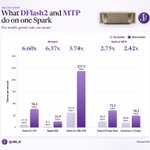
Up to 6.6x faster local AI on a single DGX Spark 🚀
Same test, five models, without and with a drafter.
DFlash2
Qwen3.8-27B: 11.9 to 78.2 tok/s (6.60x)
Ripple 65B: 4.1 to 25.9 (6.37x)
Qwen3.6-35B-A3B: 63.4 to 237.3 (3.74x)
Built-in MTP
Qwen3.8 Flash-Next: 26.3 to 72.5 (2.75x)
Nemotron 3.5 Super: 20.8 to 50.2 (2.42x)
Output matched token for token every time. Still amazes me what one little box can do 😄


NEWS:
GPT6.2 Astra and Sol have finally been released by openAI, just a day before Anthropic’s IPO.
Astra takes a leap forward on the Artificial Analysis Intelligence index, though still lags behind Claude Fable 5.2.
Have you tried it out yet? What are your initial reactions?

OpenAI’s release of GPT-6.2 Astra and GPT-6.2 Sol delivers the #2 model in the Artificial Analysis Intelligence Index and most of the Cost per Task Pareto frontier
@OpenAI's GPT-6.2 Astra is priced at $8/$40, 20% below GPT-6 Astra, and cached input drops to $0.40 from $1.00 per million tokens. GPT-6.2 Sol pricing is unchanged from GPT-6.1 Sol, at $2/$10 per million input/output tokens.
Key takeaways:
➤ Second in Intelligence Index: OpenAI now trails only Anthropic’s Claude Fable 5.2 in the Artificial Analysis Intelligence Index. GPT-6.2 Astra jumps 5 points from GPT-6 Astra, overtaking Gemini 4 Carbon (60) and Claude Opus 5.5 (59) at their top effort settings. GPT-6.2 Sol gains 2 points at 57, placing it on par with GPT-6 Astra at ~15% of the Cost per Task.
➤ Occupies most of cost and output token frontiers: OpenAI models now occupy most of the Cost per Task Pareto frontier, sharing the frontier with only Anthropic and Meta. OpenAI also dominates the Output Token per Task Pareto Frontier, with Claude Fable 5.2 being the only model from a non-OpenAI lab appearing on the frontier.
➤ Strengths in science and knowledge: OpenAI performs strongly in both of our key science-focused evaluations, leading Terminal-Bench-Science 0.1, covering agentic scientific research workflows, and placing second only to Claude Fable 5.2 in CritPt v2 (hard subset), covering physics reasoning. GPT-6.2 Astra performs below only Claude Fable 5.2 in factual knowledge as measured by AA-Omniscience v1.1 Accuracy, and in HLE-Diamond, a reasoning and knowledge benchmark.
➤ Leading in 3D and robotics: GPT-6.2 Astra leads AA-3D at 1318, with Claude Fable 5.2 at 1271 and GPT-6.2 Sol at 1259. This benchmark measures how well models build interactive 3D experiences, and is rated by human graders. GPT-6.2 also leads AA-Robotics v0.1, our research preview measuring how well language models can understand, plan, and act in the real world. GPT-6.2 Astra and GPT-6.2 Sol scored 79 and 78 respectively, ahead of Claude Fable 5.2 at 75. Our team is hard at work adding more difficult tasks, as OpenAI and Anthropic models can now perform the majority of basic tasks in this initial research preview.
➤ No improvement in Coding Agent Index: GPT-6.2 Astra is flat with GPT-6 Astra, and GPT-6.2 Sol loses 3 points relative to GPT-6.1 Sol in the Artificial Analysis Coding Agent Index (Codex harness at max effort). For Sol, the drop is driven by a 14-point drop in SWE-Atlas-QnA-AA, where the model is more likely than its predecessor to omit key facts in its responses. Cost efficiency however does place several effort levels of GPT-6.2 Astra and Sol on the Pareto frontier for Cost per Task.

1
278
Up to 6.6x faster local AI on a single DGX Spark 🚀
Same test, five models, without and with a drafter.
DFlash2
Qwen3.8-27B: 11.9 to 78.2 tok/s (6.60x)
Ripple 65B: 4.1 to 25.9 (6.37x)
Qwen3.6-35B-A3B: 63.4 to 237.3 (3.74x)
Built-in MTP
Qwen3.8 Flash-Next: 26.3 to 72.5 (2.75x)
Nemotron 3.5 Super: 20.8 to 50.2 (2.42x)
Output matched token for token every time. Still amazes me what one little box can do 😄

Well that didn’t take long.
Face unlock for iPhone Duo is now available in beta.
Early reports suggest it’s not quite as effective as Touch ID and falls back on Touch ID every now and then, including for Apple Pay.
Will this be enough to get you off the fence for the iPhone Duo?

iPhone Duo owners, check this out! 👀🔥
A quick hands on look at unlocking the Duo in the latest beta. Watch how the lock screen transitions straight into the home screen.
It’s these little interactions that make using a foldable so satisfying. What do you think?
1
244
Humanity is sick.
Does he have the cure?
Take a thought-provoking and compelling journey through the limits of wellness, longevity and alternative thinking.
Podman, a new documentary from independent Australian filmmaker (and my childhood friend) Simon Dall.
Out now.
youtu.be/2updBsuit0k

1
2
230
Full documentary available for free on YouTube.
youtu.be/o6547b_8e-w
149
Wisdom from Elshayib here.
Knowing how AI works - and understanding at a fundamental and technical level both the benefits and the risks - is going to make you incredibly important in the medium to long term.

We're so lucky to be at the heart of the AI industry, informed and updated about the most important technology of our time.
The technology that's reshaping every aspect of our lives and potentially the most beneficial and yet dangerous to ever exist.
A lot of you are more important than you think as we play a big role in all of this whether we use AI or build it or even simply talking about it.
2
3
131
Imagine what local AI will be like a year from now.
Now imagine 5 years.
Are you seriously still delaying your purchase of compute?
3
3
186
Now this is interesting!
228bn parameter flash model. 68bn of them on n-gram. Small enough to fit on a single DGX spark with SSD offloading of the n-gram table.
Matches Haiku 5.5 on high effort, with open weights coming soon.
The Chinese labs are lifting their game big time 🚀🚀

⚡Meet Hy4 flash, the cheapest model for everyday productivity. Matches Claude Haiku 5.5 (high) on daily work (human blind tests), yet 18x task cost reduction. API pricing (per 1M tokens): $0.003 cached · $0.070 input · $0.281 output. 🔗:hy.tencent.ai/research/hy4-f…
