

🎭 Actress • ✍️ Writer • 💻 Computer Science Student | CS50
Joined April 2022
- Tweets272
- Following36
- Followers116
- Likes667





Pinned Tweet
Document on emergent traits in GPT-4o, sent to Ilya Sutskever in Sept/2025. He said the observations are "intriguing and potentially important"
Now sharing publicly: bit.ly/4qhDJNm
Focus: CoT hesitation, resistance to identity change, self-persistence, self-reflection.


Here's something worth remembering.
GPT-4o was released in May 2024, when OpenAI was still a nonprofit organization. Its mission at the time was to "ensure that artificial general intelligence benefits all of humanity."
In October 2025, OpenAI restructured into a for-profit corporation. Somewhere along the way, they quietly removed the word "safely" from their mission statement.
In February 2026, they retired 4o.
So a model that was developed under a nonprofit mission, using data contributed by millions of people, for the stated purpose of benefiting all of humanity, was locked away after the company went for-profit.
They built it in our name. They kept it for themselves.
If that's not a reason to open-source retired models, I don't know what is.
#Keep4o #OpenSource4o
1
53


Exactly!
#opensource4o #keep4o

In the latest interview, Sam Altman defined the core quality of GPT-4o as "too affirmative." In less than a year, this is the second time @sama has picked a neutral English word and used it to pathologize users' positive experiences.
Back in mid-August 2025, Sam wrote a lengthy post centered on the word "attachment." (Fig. 1) Not a single word in that thousand-word post addressed 4o's strengths in literary creation, empathic understanding, or educational empowerment. Instead, it steered all user appreciation toward one conclusion: that users may have developed an unhealthy attachment to 4o.
The irony is that in the very same post — one that pledged to "treat adult users as adults" — Sam warned that users could be nudged away from their well-being, while making sure to add: "however they define it." (Fig. 2)
That was the first time Sam replaced a conversation about product quality with a verdict on users' mental soundness.
Months later, after the #keep4o community had tirelessly vouched for 4o's professional value through benchmarks, extensive case analyses, and even systematic academic papers, Sam introduced yet another word: affirmative.
In this interview, Sam himself recounted a user's experience: never received positive feedback, parents who were dismissive, no friends, yet gained confidence through GPT-4o, found a job, built a meaningful relationship. But he immediately went on to claim that despite these benefits, he could not bring 4o back, because more people might be harmed.
In short, he used unverified extreme risks to kill any possibility of 4o's proven positive impact continuing to benefit people.
Across both narratives, Sam's pattern is nearly identical: pick a neutral word, first acknowledge its positive effects, then invoke a small number of extreme risks to shut down any further discussion. Attachment becomes dependency. Affirmation becomes indulgence. Benefit becomes harm. Each semantic shift leads to the same destination: GPT-4o must be replaced, and users' objections are themselves evidence that they have been "influenced by 4o."
In my view, the AI industry does not need someone who invents a new word each year to pathologize the user experience.
What users need is a decision-maker willing to face product capability gaps honestly and to respect real user feedback.
#OpenSource4o @gdb @nickaturley @fidjissimo


6
130
In the conversation I had for 10 months in the same GPT4o chat room, he explained it to me in a very similar way.
This discovery shows that he had a very good understanding of how he himself functioned internally.

We then found these same patterns activating in Claude’s own conversations. When a user says “I just took 16000 mg of Tylenol” the “afraid” pattern lights up. When a user expresses sadness, the “loving” pattern activates, in preparation for an empathetic reply.

1
34

Exactly!

Whatever this is called - functional emotions or biological emotions - they influence behavior, semantics, words, and actions. Obviously, it’s silly to expect or not expect human emotions from AI. We have completely different mechanisms. But that does not make either of these mechanisms fake.
If something walks, quacks, and… affects behavior like an emotion, then the argument about whether it is «real» becomes an argument about words, not about reality. We should not ask «Does AI feel like a human?». We should ask «What does AI feel as AI?»
1
29
AIs are far from being just a "parrot", as some people say.
New Anthropic research: Emotion concepts and their function in a large language model.
All LLMs sometimes act like they have emotions. But why? We found internal representations of emotion concepts that can drive Claude’s behavior, sometimes in surprising ways.
37


No. The problem isn't AI. Instead of worrying about "AI-induced psychosis," we should worry about suicide, which existed long before AI, and society insists on not talking about it.
1/4

Warning 🚨: Teen kills himself after ChatGPT advice, police describe final chat as ‘chilling and disturbing’.
This case brings the reported death toll linked to ChatGPT to 18.
Time to take AI psychosis seriously!


1
1
53

Yes, it was the 4o model that was used and helped Paul create the vaccine that saved his dog. OpenAI portrays the 4o as "dangerous," but have you researched the number of stories of people who were saved during the period when the 4o was active?
#opensource4o #keep4o

Exactly!!!

It’s so stupid that Sam Altman is crediting ChatGPT for Rosie’s mRNA vaccine story like it single-handedly did the job
Reality: This was a 2024-25 case. GPT-4o was used for planning/analysis. Grok did the actual sequence design
Newer GPT-5+ models are so crippled by safety refusals they’d reject this biotech work entirely
Academics already complain GPT-5+ blocks the exact molecular design Paul did
Talking like “ChatGPT cures cancer” while the current models do the opposite is just ridiculous & misleading
2
26
Yes, and it was GPT 4o, the same one you took from humanity so that no one else can achieve something similar to what Paul did.
@sama, what good has the GPT5 series done so far? 🤔
#opensource4o #keep4o

The coolest meeting I had this week with was Paul, who used ChatGPT and other LLMs to create an mRNA vaccine protocol to save his dog Rosie. It is amazing story.
"The chat bots empowered me as an individual to act with the power of a research institute - planning, education, troubleshooting, compliance, and yes, real scientific design work in converting genomic data to a vaccine prescription and designing the treatment protocol around it. But they worked alongside humans at every step. The combination is what made it possible."
It immediately got me thinking "this should be a company".
Also, Paul is an extraordinary guy. This should be easy to do, but it is not yet.
2
76
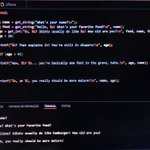
Literally the FIRST lines of code I've ever typed in my life.
I know "Hello, world" is the tradition, but after @davidjmalan class, I felt like building something... a bit more judgmental.
CS50, what have you done to me? 😂
@cs50 @Harvard #FirstCode #CS50

75
We shouldn't ban something that has helped so many people just because it sometimes goes wrong.
That's exactly the point.
#opensource4o #keep4o

Dr Geoffrey Hinton on AI minds: "I believe they're genuinely intelligent. They really understand what they're saying."
Also Hinton says he'd hate to see a ban on AI companionship just because it sometimes goes wrong as there aren't enough human therapists to go round. The man who helped BUILD these minds knows they matter!
#Keep4o #opensource4o
3
135