

Chief Economist and Executive Director of the @StrategyCorp Institute of Public Policy and Economy. Opinions expressed are my own.
Ottawa, Ontario
Joined September 2018
- Tweets1.9K
- Following422
- Followers209
- Likes2K




Sebastien Labrecque retweeted

Québec just reset its political landscape. What does a PQ government mean for Canada? Join StrategyCorp and former Québec Premier Philippe Couillard on October 22, 1:00 PM EDT. Register: us06web.zoom.us/webinar/regi…

Sebastien Labrecque retweeted
The FIFA World Cup kicks off today... in a year that also brings the Milano Cortina Olympics and Paralympics.
On Intended Consequences, @CeciArregui and @VitalyKaz unpack how mega-events shape politics, diplomacy, media, and global influence: open.spotify.com/episode/4ag…

Sebastien Labrecque retweeted
A French episode today! Nous discutons des défis et des opportunités auxquels fait face l’industrie canadienne de l’aluminium avec @JeanSimard12 de @AAC_aluminium, et Philippe Couillard, conseiller principal à StrategyCorp : open.spotify.com/episode/4ao…

Sebastien Labrecque retweeted
The 2026 Spring Economic Update projects a lower deficit of $66.9B for 2025-26, down from $78.3B in Budget 2025. It introduces the Canada Strong Fund, CPP contribution reductions, next steps on a National AI Strategy, and more ↓ strategycorp.com/2026/04/fed…

Sebastien Labrecque retweeted
What happens when entrepreneurs retire?
BDC reports nearly 61% of Canadian SMEs are led by owners 50+ (many planning to exit within 5 years).
Pierre Cléroux joins the podcast to unpack what this means for business owners, buyers, and Canada’s economy: open.spotify.com/episode/1wF…

Sebastien Labrecque retweeted
What a year 2025 has been. 📉📈
From tech breakthroughs to geopolitical shifts, we’re recapping the biggest moments and forecasting the trends that will define 2026: open.spotify.com/episode/6r0…

Sebastien Labrecque retweeted
Canada avoided a recession in 2025, but headline GDP and jobs numbers mask deeper weakness. Slowing consumption, fragile labour gains, and uneven productivity point to a shaky path into 2026 ↓ strategycorp.com/2025/12/bey…

Sebastien Labrecque retweeted
How do companies really pick locations today? Gregg Wassmansdorf @Newmark unpacks the impacts of tariffs on site selection and what “investment-ready” means in 2025. Listen now: open.spotify.com/episode/0Wo…

Sebastien Labrecque retweeted
Jobs. GDP. Tax revenue.
Everyone cites them—but without the right framing, impact numbers get lost in the noise. Here’s how to turn your economic impact analysis into a case decision-makers can’t ignore ↓
strategycorp.com/2025/08/how…

Sebastien Labrecque retweeted
Federal & provincial budgets have run deficits for years. Global uncertainty drives spending up; revenues lag. What's the outlook for public finances? Travis Shaw (@MorningstarDBRS) explains: podcast.strategycorp.com/a-c…

Sebastien Labrecque retweeted
Ottawa’s 60-day red tape review is moving fast. Ontario’s 6+ years of experience offers a clear path forward. Focus on priorities, track the why, aim for quiet wins.
Read how Ontario’s model can help Ottawa cut smarter ↓✂️
strategycorp.com/2025/07/fed…

Sebastien Labrecque retweeted
Trump seeks to attract investments using tariffs. In a new report, @davidkmcgown and @LabrecqueSebas1 explain why there may never be a manufacturing renaissance of “jobs for the boys (and girls)” to the levels Trump claims ↓
strategycorp.com/2025/06/wil…
Sebastien Labrecque retweeted
The 100th episode of Intended Consequences examines how U.S. tariffs are affecting Canada’s economic development. Brock Dickinson of the University of Waterloo shares insights on the sectors most exposed, and strategies for local leaders ↓
strategycorp.com/podcast/tar…

Sebastien Labrecque retweeted
Canada's interprovincial migration shifted in 2023/2024:
- Toronto led losses as Ontarians continue to move west
- Calgary gained 20,000+ residents for the 2nd year
- Halifax and Vancouver flipped from a surplus to a deficit
Get our full breakdown ↓
strategycorp.com/2025/01/can…
Sebastien Labrecque retweeted
The Ontario legislature returns today after a long summer break. Aidan Grove-White, @FMacdonaldTO and Kelly Baker join the podcast to analyze what the priorities of the Ontario Progressive Conservatives, NDP and Liberals will be this fall: podcast.strategycorp.com/wha…

At the national level, the inflow of non-permanent residents ⬇️ for the 3rd straight quarter. At the same time, the quarterly outflow of non-permanent residents hit its highest level since Q4, 2021. Recent policy changes by the federal gov should further accelerate these trends.

After a surge in the inflow of non-permanent residents in Alberta in the last three quarters, the number of interprovincial in-migrants once again exceeded the number of international immigrants and the inflow of non-permanent residents in Q2, 2024.

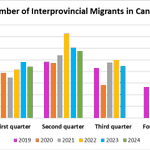
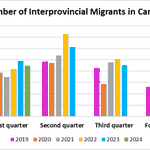
Interprovincial migration to #Alberta remains strong, but the real story is the province’s remarkable population RETENTION.
Looking at 2nd quarters, fewer people left Alberta in 2024 than in recent years. We must go back to Q2, 2013 to see a lower # of out-migrants in Alberta.
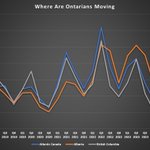
Ontarians are still leaving for other provinces. #Alberta remains their #1 destination, but there is a new #2.
British Columbia overtook Atlantic Canada as a destination for Ontario interprovincial migrants. We must go back to Q4, 2020 for the last time this happened.

