


👨💻 MRTISTER🃏🎲 retweeted

Learn robotics by playing video games
10 games on Steam that quietly teach you what robot engineers do all day
1. Turing Complete: start from one logic gate, end up designing your own CPU
store.steampowered.com/app/1…
2. SHENZHEN I/O: build circuits and program microcontrollers
store.steampowered.com/app/5…
3. Opus Magnum: program machine arms to assemble things
store.steampowered.com/app/5…
4. while True: learn(): machine learning puzzles, from decision trees to neural networks
store.steampowered.com/app/6…
5. Besiege: build physics machines that roll, fly and fall apart
store.steampowered.com/app/3…
6. Poly Bridge 3: bridges that hold the load, or snap
store.steampowered.com/app/1…
7. Factorio: automate a whole factory with arms, belts and robots
store.steampowered.com/app/4…
8. Kerbal Space Program: build rockets and learn orbits the hard way
store.steampowered.com/app/2…
9. Stormworks: design programmable vehicles and fly them into storms
store.steampowered.com/app/5…
10. Human Resource Machine: programming basics, by programming tiny office workers
store.steampowered.com/app/3…
P.S. in #1 you go from a single NAND gate to a full CPU, then design your own assembly language for it
the free path from playing to building real robots is in the article below


👨💻 MRTISTER🃏🎲 retweeted

Till date, the best hands-on tutorial for
"Attention Is All You Need" that ever existed, tbh. It's certainly tedious, I won't lie but it's certainly worth it.
Link : deep-ml.com/projects/attenti…

👨💻 MRTISTER🃏🎲 retweeted

AWS just made it possible to run AWS services on your laptop for free, without an AWS account.
It’s called AWS Emulator, and it’s open source. You can use the AWS CLI or SDKs to test your app locally or in CI.
AWS says autonomous AI agents wrote every line of the emulator’s code.
Repo: github.com/aws/aws-emulator

👨💻 MRTISTER🃏🎲 retweeted

Excited to share what we've been working on since this summer- started in my internship at @MSFTResearch!
Modern DNNs predict neural activity surprisingly well, but are black boxes. We introduce interpretable weight-space programming (iWSP) and ask: can LLM agents build predictive models of the brain directly in code, with no training or pretrained weights, so every feature stays transparent? 🧵 (1/6)
👨💻 MRTISTER🃏🎲 retweeted
Learn robotics for free directly from the companies building robots.
1 - NVIDIA:
docs.nvidia.com/learning/phy…
2 - Hugging Face:
huggingface.co/learn/robotic…
3 - Google DeepMind (MuJoCo):
mujoco.readthedocs.io
4 - Google (Gemini Robotics):
aistudio.google.com/docs/rob…
5 - Physical Intelligence:
github.com/Physical-Intellig…
6 - Universal Robots:
academy.universal-robots.com
7 - Boston Dynamics:
dev.bostondynamics.com
8 - Unitree:
github.com/unitreerobotics/u…
9 - Open Robotics (ROS 2):
docs.ros.org/en/jazzy/Tutori…
10 - The Robot Studio:
github.com/TheRobotStudio/SO…
P.S. start with #1. NVIDIA's free courses include training a Unitree G1 humanoid and an SO-101 arm, the same $230 arm from #10
👨💻 MRTISTER🃏🎲 retweeted

Neo4j が発表した組み込みグラフDBらしい。エージェントがインメモリでグラフDBやオントロジを使うきとを想定してるっぽい。
relatedb.ai/

👨💻 MRTISTER🃏🎲 retweeted

Physics Travel Guide
是一个专为自主学习者设计的开源(采用 CC 许可证)阐释性物理百科网站
我们知道要真正理解一个概念或理论,需要弄清它与其他概念之间的关联
网站最大特色是将每一个物理概念按照由浅入深的逻辑,拆分为直觉(Intuitive)、具体(Concrete)和抽象(Abstract)三个难度层次进行讲解,并给出了先决条件(Prerequisites)和完整路径(Path)
帮助学习研究者在物理学的广袤迷宫中,摸索出属于自己的路径
整个网站内容组织的非常完整且深入,值得收藏
physicstravelguide.com/


👨💻 MRTISTER🃏🎲 retweeted

OntoSmith: 𝗧𝘂𝗿𝗻𝗶𝗻𝗴 𝗬𝗼𝘂𝗿 𝗔𝗜-𝗕𝘂𝗶𝗹𝘁 𝗞𝗻𝗼𝘄𝗹𝗲𝗱𝗴𝗲 𝗚𝗿𝗮𝗽𝗵 𝗙𝗿𝗼𝗺 𝗮 𝗚𝘂𝗲𝘀𝘀𝗶𝗻𝗴 𝗚𝗮𝗺𝗲 𝗜𝗻𝘁𝗼 𝗣𝗿𝗼𝗼𝗳.
You point an LLM at a pile of documents and ask for a knowledge graph.
It gives you one. Nodes, edges, it looks great.
But how many of those edges are actually true?
Most tools never tell you.
Can We Trust AI to Build Our Knowledge?
Companies want AI to read their contracts, reports and papers and turn them into a map of facts: who signed what, which gene links to which disease.
The big question isn't whether AI can draw that map. It's how many of the roads on it are fake.
That's where LLM-to-knowledge-graph builders are right now. The first phase was "look, a graph!" The next phase is proving the edges are true.
Been reading through OntoSmith, a new open-source knowledge-graph builder that starts from exactly that question.
How It Works
Most LLM graph pipelines let one model do everything:
read the text,
find the facts,
and decide they're true.
Its confidence is the only gate.
OntoSmith splits that job into three seats:
• Proposer: a cheap model (Claude Haiku 5.5 by default) suggests facts, each with the sentence it came from
• Gate: plain code checks the quote really appears in the document, word for word, and that the fact fits the schema
• Judge: a separate model, TypeSafe's Jev, decides what actually gets written
And the schema comes first.
You define the types of things and relationships, with definitions and examples, and a human approves it before anything gets built.
Neo4j stores the result, and every fact keeps its evidence sentence.
The analogy I keep coming back to is code review. The author of a pull request doesn't merge it.
Someone else does, against a written standard.
Or think of a newsroom:
• A junior reporter pitches stories: a cheap AI model suggests facts
• A fact-checker confirms every quote is real: plain code
• An editor decides what runs: a separate AI judge, Jev
• The style guide comes first: written and approved by a human
Before You Trust Your Knowledge Graph, Measure It
A score that goes down after an outside check is easier to trust than one that only goes up.
It's also early days: v0.1.9, first released on 24 Oct, MIT licensed.
The "ontology" is a flat list of types, not a formal OWL ontology. And the published numbers only hold with Jev as the judge.
The Landscape
• Microsoft GraphRAG: LLM extraction plus community summaries; you can list entity types
• Neo4j LLM Graph Builder / neo4j-graphrag: schema-guided extraction into Neo4j; by default the schema guides rather than strictly constrains
• LightRAG: simple, fast graph-augmented retrieval
• Graphiti, Cognee: graphs as memory for agents
• OntoSmith (new): schema first, models propose, a separate judge decides, measurement in the box
Where OntoSmith Fits
The "this graph has to be audited" corner. Its own README says that if you want emergent structure and a fast demo, the GraphRAG family will get you there sooner.
If You Try It, Do This
1. Write 50 test facts by hand from your own documents.
2. Baseline: one strong model, one prompt, extract everything.
3. Run OntoSmith on the same documents.
4. Compare precision and recall on your 50, not on a benchmark.
5. Read the traces: open the rejected and review-band candidates and see why they didn't make it.
How i See this :
"Generator + judge" is becoming the default shape wherever errors cost money.
Code got there first: the agent writes, the tests decide.
Graphs look like they're next.
A graph you can't audit is just a confident guess with arrows.
Links in reply 👇
👨💻 MRTISTER🃏🎲 retweeted

Deep learning terms can be a bit confusing when you're first learning them.
In this article, @Roland_Sankara explains CNNs, RNNs, and Transformers with beginner-friendly mental models.
You'll learn how neural networks work, why CNNs focus on spatial patterns, how Keras helps you build models, and lots more.
freecodecamp.org/news/cnns-r…

👨💻 MRTISTER🃏🎲 retweeted

Deeptutor绝对是付费级的开源产品
套壳卖绝对大有可为(不提倡,但肯定有人这么做了。。。)
github.com/HKUDS/DeepTutor


以后再也不用请家教了!这三个顶级开源AI学习神器,能辅助你学习任何想学的科目,更重要的是全免费!👇
1️⃣DeepTutor(港大,56k⭐)
终身个性化家教:聊天/测验/研究/掌握路径全打通,记得你的进度和薄弱点。
最新桌面版正式上线,Mac + Windows 开箱即用!
🔗github.com/HKUDS/DeepTutor
2️⃣book-to-skill(37k⭐)
把任何技术书/PDF一键变成 Agent Skill,按需加载框架和章节,token 省 20-50 倍。
适合边工作边查书、边学边用。
🔗github.com/virgiliojr94/book…
3️⃣OpenMAIC(清华,43k⭐)
输入主题或文档,直接生成完整互动教室:AI老师讲课、AI同学讨论、随堂测验、模拟实验。
可导出PPT,真 · 一键上课。
🔗github.com/THU-MAIC/OpenMAIC
长期记忆家教 × 书本变技能 × 一键教室,自学者直接开冲!


👨💻 MRTISTER🃏🎲 retweeted

Chat with video using EmbeddingGemma 2 (100% local):
EmbeddingGemma 2 by @GoogleDeepMind maps text, images, video, and audio into a shared vector space. This makes it possible to search video frames with natural language.
Devs have already built native Rust implementations for local inference.
Unsloth also provides a 176 MB, 4-bit GGUF checkpoint for text embeddings, although that version doesn't include the full multimodal pipeline.
I tested the video-search use case by building a chat interface that finds matching frames and jumps to their timestamps.
On my Apple M3 Pro, using the CPU:
- Indexing took 29s for a 60s video
- Search took 25 ms on average across 9 queries
- The saved frame vectors occupied 180 KiB.
The video is indexed once. Each new search embeds the query and compares it with the saved frame vectors. Processing stays entirely on the laptop.
The video below depicts the entire flow in action.
That said, model quantization reduces the memory needed for the weights. The retrieval index has its own storage cost, which grows as you add videos.
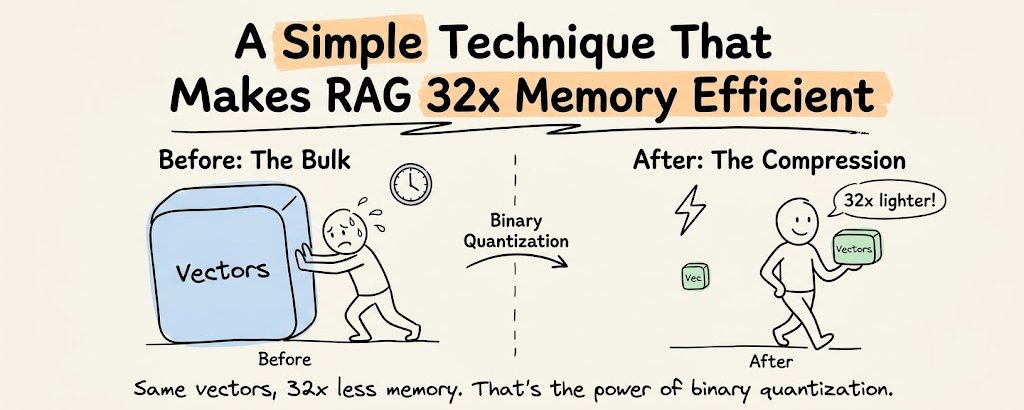
To dive deeper into reducing that cost, I wrote a full article on binary quantization.
It explains how storing vectors with one bit per dimension reduces their raw storage by 32x compared with float32, and includes a working retrieval implementation.
Read it below.

👨💻 MRTISTER🃏🎲 retweeted

A series for anyone interested in embedded systems
embedded.fm/blog/ese101


"Embedded System Design" by Peter Marwedel
An awesome, open access book
link.springer.com/book/10.10…

👨💻 MRTISTER🃏🎲 retweeted

you can now implement Google's EmbeddingGemma2 research paper from scratch in PyTorch
tensortonic.com


👨💻 MRTISTER🃏🎲 retweeted

Added this to the blog post list right away! 🤗


📖 The Ultimate MoE Training Handbook 📖
We spent 1/2M GPUh to optimize MoE training and wrote the most comprehensive blog about it. With 30k words and 50+ interactive figures it covers everything from profiling to large cluster training.
huggingface.co/spaces/huggin…
👨💻 MRTISTER🃏🎲 retweeted

this takes a few days to read, so if you're unemployed it'd be a great use of your time. the rest of the hugging face blog too actually, they always put out great playbooks!!

18 of the 20 best open models today are Mixture-of-Experts. Dense is basically over.
And yet the know-how to train a good MoE still lives mostly in the heads of a handful of teams.
So we spent 800k GPU hours running the experiments ourselves and wrote everything down. Super happy to finally release "The Ultimate MoE Training Handbook", free and open, organized around the questions training teams hit:
- how many experts, how big, shared or not?
- why is half my step spent in all-to-all, and how do I hide it?
- why is my run 25x slower with no error in the logs?
- softmax, sigmoid or sqrt(softplus) router, and why keep it in fp32?
- aux loss or DeepSeek's loss-free bias?
- upcycle a dense checkpoint or train from scratch?
- can I serve with fewer experts per token than I trained with?
⚠️ Warning: it's long (~70k words, budget a few days, sorry) but with 55 interactive figures, code you can run and numbers from our own runs.
Read it here: huggingface.co/spaces/huggin…
👨💻 MRTISTER🃏🎲 retweeted

excited if 10-411.com isn't parody, will be a great addition to book.mlc.ai/
the goal of sitp.ai/ is to play the role of a nice bridge the same way sicp's little compiler is :D
—i.e, no crazy ssa/son irs, no graph coloring register allocation, etc


Course website is live. Assignments will be posted on here, lectures won't be. Come to class! 10-411.com/


