

Twitter account for Mattias Mannervik lab at Stockholm University. Transcription and epigenetics in Drosophila.
- Tweets61
- Following50
- Followers198
- Likes15








ALT Epigenetic landscapes for the Krüppel gene locus in wild-type embryos and embryos with a mesoderm-specific knockdown of Polycomb catalytic subunit E(z), which deposits H3K27me3. After knockdown, the repressive "hill" diminishes along the muscle (M) trajectory, and Krüppel is ectopically expressed in muscles.

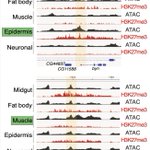
ALT On the top, epidermal (hindgut) TF byn is expressed and accessible exclusively in the epidermal lineage, and Polycomb-repressed only in the same lineage. However, TF so, expressed at this stage only in muscles, is accessible in all cell types, and repressed everywhere, except muscles. We conclude that Polycomb-mediated repression silences genes with accessible promoters, which probably receive activation cues. When nucleosomes occlude a gene promoter, Polycomb repression is often not necessary.

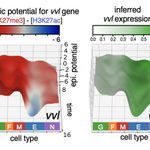
ALT We can add the third dimension, which subtracts the active (H3K27ac) signal from the repressive (H3K27me3) signal for a particular gene locus (e.g., epidermal TF vvl). It creates "valleys" permissive for transcription, surrounded by the repressive "hills". The permissiveness increased in the epidermal trajectory, as well as the repressive mark accumulated in endomesodermal trajectories during development. On the right, we project the vvl expression level inferred from the scRNA-seq dataset. Therefore, our visualization can show levels of expression, H3K27-acetylation and -methylation across cell types and along the developmental time

ALT On the left, the UMAP visualization of nanoCUT&Tag Drosophila nuclei from 8 to 16 hours of development. On the right, cell-time embedding, where cells are placed according to their developmental cell age (y-axis) and cell lineage (x-axis). We have distinguished five main fly embryo cell types: epidermis, fat body, muscle, midgut and neuronal


