

Prof. on direct call from abroad @UniTrentoDIPSCO. Director of CogNosco Lab. Inactive account, join me here: https://xitter.gq/t.co/7QtLrvPZLj
Joined May 2014
- Tweets6K
- Following892
- Followers1.8K
- Likes16.6K





Massimo Stella PhD retweeted
❤️🔥New paper on Psych. Bul. Rev. @Psychonomic_Soc!
Our team reviews #cognitive #multilayer networks as a promising framework for unraveling the mental lexicon's complexity:
link.springer.com/article/10…
👆
By @dsalvaz @GiulioRossetti @dan_marinazzo @mvitevit @yoed_kenett & I. 🌟

Massimo Stella PhD retweeted
Massimo Stella PhD retweeted

🚀High-Impact Articleby Mrs. Gal Sasson and Dr. Yoed N. Kenett @yoed_kenett
Views: 6381
Citations: 6
A Mirror to Human Question Asking: Analyzing the Akinator Online Question Game
@ComSciMath_Mdpi
#questionasking #Akinator #LDA #BERT #textanalysis
mdpi.com/2504-2289/7/1/26

Massimo Stella PhD retweeted

By mapping the meanings of the words used to communicate emotions across more than one-third of the planet’s spoken languages, a study in Science found that there is significant variation in how emotions are expressed across cultures. #ScienceMagArchives scim.ag/4gGECui

Massimo Stella PhD retweeted

🔵 NEW PAPER 🔵
Spatiotemporal Style Transfer #STST is out on @NatComputSci!
STST as a framework for dynamic visual stimulus generation to study brain and machine vision
feat. @siegull
paper: nature.com/articles/s43588-0…
code: github.com/antoninogreco/STS…
Massimo Stella PhD retweeted

How creative are large language models compared to humans? This paper tested 13 standardized creativity tasks, finding LLMs rank at the 52nd percentile overall - essentially average at ideation tasks but notably weaker at creative writing. arxiv.org/abs/2412.03151

Massimo Stella PhD retweeted
Meta-analysis of PISA creative thinking data by @BenjaminGoecke across 62 countries (n=493,660) finds SES is a strong predictor of creativity, along with gender: girls scored higher than boys—a bigger gender gap than boys’ slight advantage in math. osf.io/preprints/psyarxiv/zy…
Massimo Stella PhD retweeted
🤖💬Can #LLMs help reduce #harmful_stereotypes in society?
Check out this insightful article that explores how AI might influence social biases—could it be part of the solution? 🤔
mdpi.com/2504-2289/7/3/124
#AI #LLMs #Stereotypes #GPT
@ComSciMath_Mdpi

Massimo Stella PhD retweeted

Excited to share @CognoscoL´s new preprint on creativity! 😍Using textual forma mentis networks and explainable AI to analyse ~1000 human and GPT-generated stories to predict creativity ratings. Thanks to my co-authors Natalie Fischer @dsalvaz @GiulioRossetti @MassimoSt!

ALT Feature importance across the three models: humans-rating-humans, GPT-rating-humans, GPT-rating-GPT. Class 0 = low creativity stories Class 1 = mid creativity stories Class 2 = high creativity stories
Massimo Stella PhD retweeted
Thrilled to announce our latest publication on #scientific_creativity🤩! We investigate the Woseco task as a novel method to map creative thinking through semantic networks. Check out our paper with my co-authors @ialnilc @Roger_Beaty @MassimoSt psycnet.apa.org/record/2025-…

Massimo Stella PhD retweeted

Check out our new paper and my excursion into the visual domains n!

🧠🧠Excited to share our new paper, with @yoed_kenett and @AminoffElissa, out in Memory & Cognition. We find that spontaneous associative thoughts boost scene-gist memory. Scene-based associative thought also correlates with creativity. link.springer.com/epdf/10.37…
Massimo Stella PhD retweeted

Thanks for the opportunity to share my research on this stage! If you speak Singapore English, check out our word association study here: singlishwords.nus.edu.sg


Massimo Stella PhD retweeted

#YSocial v1.0.0 (Hoid) is out!
This version integrates:
- News Pages
- Agents' dynamic interests
- Multimodal (Text & Image) content sharing
- Agents' churn
Try it out and let us know!
#SocialDigitalTwin
ysocialtwin.github.io/blog/

Massimo Stella PhD retweeted

🚨 New article 🚨
How do people search for information before making a choice?
Analyzing over 1,000,000 sampling decisions, @Mikhail_Spektor and I show that people are adaptive explorers who reduce multiple types of uncertainty and leverage prior expectations and meta-knowledge about their decision environment.
Out now in @PNASNews: pnas.org/doi/10.1073/pnas.23…

Massimo Stella PhD retweeted

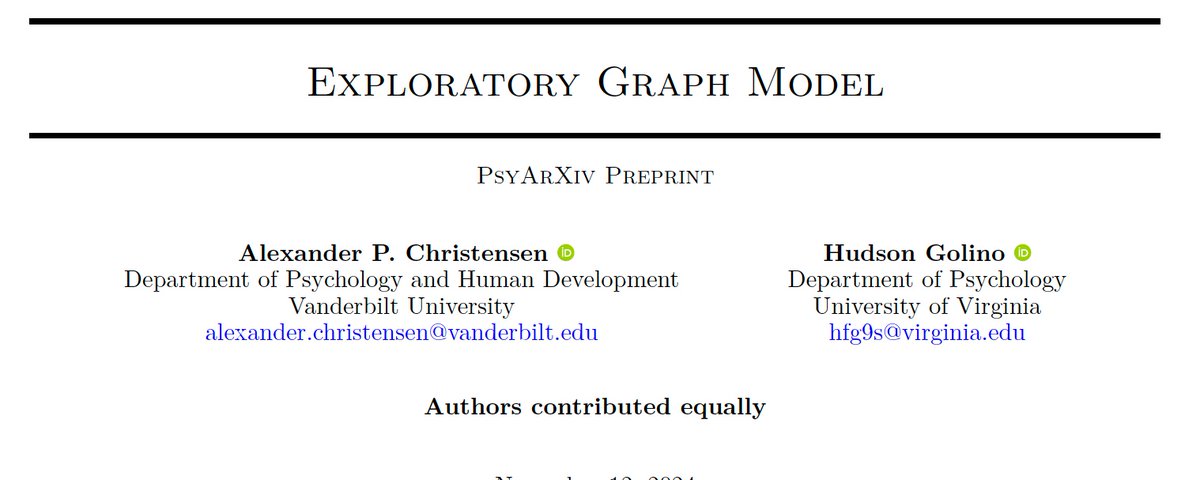
The Exploratory Graph Model is now LIVE!
TL;DR:
• The paper introduces the Exploratory Graph Model (EGM), a new mathematical framework for analyzing psychological measurements using networks instead of traditional latent variable models
• Key innovations:
- Treats psychological dimensions as emerging from direct interactions between observed variables
- Does not assume underlying latent variables
- Provides a formal mathematical basis for community structures in networks
- Allows for both exploratory and confirmatory network modeling
• The researchers conducted simulation studies comparing EGM to traditional factor analysis (EFA):
- Parameter estimates were most accurate when the analysis method matched the data generation method
- Traditional fit measures could distinguish between EGM and factor models better than chance
- Model detection accuracy improved when multiple fit measures agreed
- Loading size and correlation strength affected which model fit better
• Three empirical examples were analyzed (Misinformation Susceptibility Test, Beck Depression Inventory, and a Narcissism scale):
- EGM fit better for some applications
- Results demonstrate how EGM can be applied to real psychological data
• Main implications:
- Provides a new way to conceptualize psychological measurement without latent variables
- Opens up new possibilities for network-based psychological research
- Complements existing network approaches in psychology
- May help improve measurement accuracy in psychological assessment
• The paper represents a significant advance in psychometric modeling by formalizing network approaches as an alternative to traditional latent variable methods
The paper can be found here:
osf.io/preprints/psyarxiv/zk…
(the main new functions) can be found in our EGAnet package here:EGM andEGM.Compare
cran.r-project.org/web/packa…

Massimo Stella PhD retweeted
Are you interested in NLP/LLMs? You might find our dynamic Exploratory Graph analysis pretty useful (video animation summarizing our paper below). In a new paper, I'm combining the powers of LLMs with Dynamic EGA! Stay tuned! youtu.be/kUsvFEaXfhs?feature…
Massimo Stella PhD retweeted

Excited to announce Centaur -- the first foundation model of human cognition. Centaur can predict and simulate human behavior in any experiment expressible in natural language. You can readily download the model from @huggingface and test it yourself: huggingface.co/marcelbinz/Ll…

Massimo Stella PhD retweeted

#OAWeek at @UnivOfKansas
#OpenAccess provides a channel, connecting point for multi-disciplinary researchers and has enabled citizen science and public engagement.
🎙️Michael Vitevitch, KU Speech-Language-Hearing: Sciences & Disorders
Massimo Stella PhD retweeted

Some might be surprised that the @NobelPrize in Physics 2024 goes to neural networks. However, our understanding of brains, intelligence, language, and AI is at the crossroads between theoretical computation, neuroscience & statistical physics. ganguli-gang.stanford.edu/pd…

Massimo Stella PhD retweeted

The 2024 #NobelPrize laureates in physics used tools from physics to construct methods that helped lay the foundation for today’s powerful machine learning.
John Hopfield created a structure that can store and reconstruct information. Geoffrey Hinton invented a method that can independently discover properties in data and which has become important for the large artificial neural networks now in use.
Although computers cannot think, machines can now mimic functions such as memory and learning. This year’s physics laureates have helped make this possible. Using fundamental concepts and methods from physics, they have developed technologies that use structures in networks to process information.
