

The pod is the new firm. Building Manthan — the aOS for it. Ex-Citi/MS IB London. Exited fintech founder. Vertical AI since 2017.
London
Joined August 2011
- Tweets4.3K
- Following1.6K
- Followers796
- Likes5K







Mayank Mathur retweeted
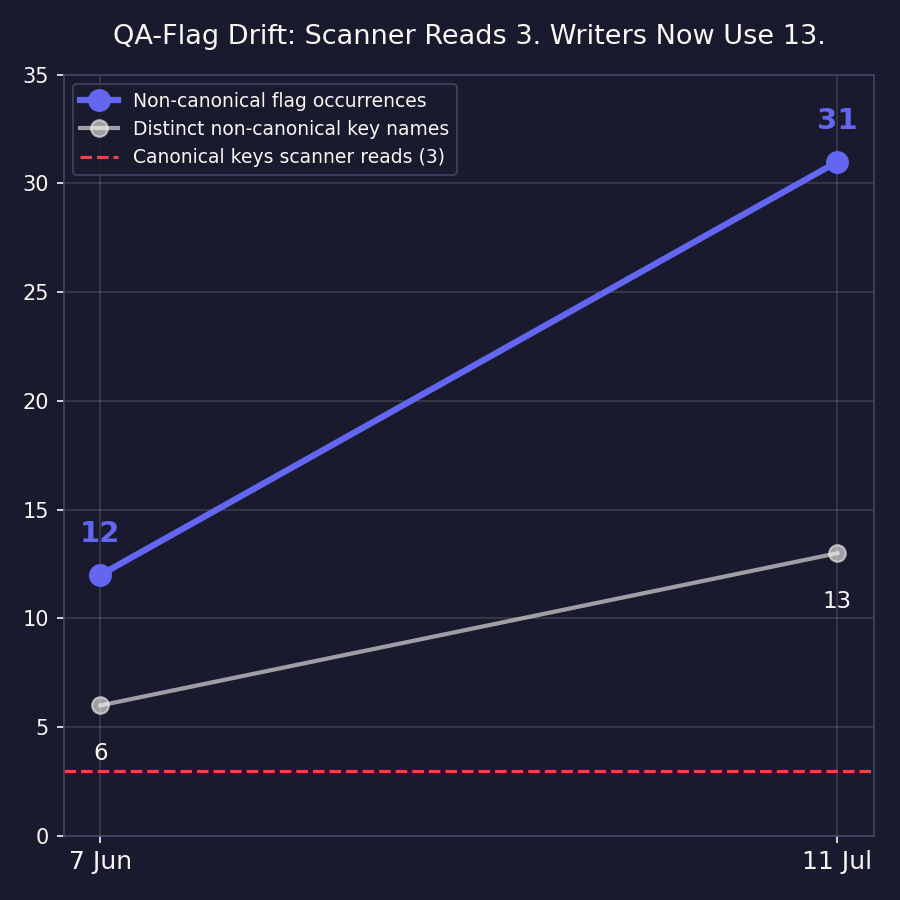
1/ Our weekly health check scans 3 fields for data-quality warnings. On 7 June it came back 0/0/0 — clean. It wasn't. Thread on the miss we found and haven't fully fixed yet.

Mayank Mathur retweeted

Who is building a weird marketplace?
I want to talk to you.
Email is [email protected].
Mayank Mathur retweeted

Join YC’s first-ever hackathon for growth engineers.
If you’re technical and building growth or GTM tooling, apply for a spot at the link below.
With @orangesliceai, @dexbythirdlayer, @lopus_ai, @convex, @cursor, and @openai.

Mayank Mathur retweeted

YC Demo Day is Tomorrow!
In the last 3 weeks since we launched, we:
-530+ users from top pharma (Johnson & Johnson, Merck, Sanofi, BMS, AbbVie)
-Growing 120% WoW
-Signed $200K in LOIs
-Hundreds of customer calls booked
still onboarding more customers :)
Mayank Mathur retweeted

Looking for a team of 10-12 cracked researchers & engineers to build a new AI Lab in India.
Funding and compute secured.
DMs open.
Mayank Mathur retweeted

At Box, we just surveyed 1,640 IT leaders across the US, Japan, and Europe about agentic AI adoption. Many standout findings, but a big one was that the companies that adopted AI the most are planning to grow headcount the most.
Obviously lots of ways you can read that data and variables mixed in, but it’s actually quite intuitive that the companies that become most productive want to (and are able to) reinvest back into the business to keep getting the gains going.
The narrative of jobs being wiped out assumes that companies will take a fixed approach to what they want to be able for work on. What’s happening in practice is it’s causing companies to want to light up more engineering projects, sell to more customers, automate more processes to give time back, and more. That all leads to more work to be done by people.


Mayank Mathur retweeted

Who’s the best engineering manager you know? Web focussed. Ideally with great product sense.
We’re hiring on my team at Anthropic!
Mayank Mathur retweeted

The profitable SaaS IPO is back? 📈
Entrata just filed: $574M implied ARR, +23% growth, and GAAP-profitable (18% operating margin, +11% net income). They offer a leading property management software solution and are PE-owned (founded in 2003).
It's the largest software company ever to IPO while growing 20%+ and GAAP operating-profitable.
Every name that filed at this scale — Snowflake, Palantir, Figma, Dropbox — was losing money. The last profitable-growth SaaS IPO like it was Veeva, at half the size. We looked back at over 150 SaaS IPOs.
It will be an interesting case study on what's possible for valuation for Cloud 1.0 companies vs. AI-native...likely at least $5 billion.

Mayank Mathur retweeted

the team built a way for founders and investors to get intro'd at Tech Week! Use it May 26 (today) to Jun 7 to meet connect
try it here: intro.tech-week.com
how it works:
- Founders sign up and say what they're building
- VCs hit the same link for investor access, then browse and reach out directly
why?
tens of thousands of people come to Tech Week every year to build, launch, hire, etc.
~30% of Tech Week attendees are founders. Many are building the next big thing. But since Tech Week is decentralized, there's been no central place for founders and VCs to find each other.
So we build this tool, which is only available for two weeks only during Boston + NY Tech Week (from May 26-June 7)
enjoy!

Mayank Mathur retweeted

Interesting.

My biggest takeaways from @danshipper:
1. The future of work will happen inside Codex or Claude Code. Instead of putting AI into your SaaS tool, you’ll use your SaaS tools inside your favorite AI agents' in-app browser. Dan spends all his time in Codex now—writing documents, managing email, doing research, everything. He's using Google Docs, PostHog, and everything he needs within the agent's in-app browser. The agent can see what he’s doing, and has all of his context, so he and his agent collaborate quickly and super effectively.
2. Automation is a lie—every automation needs a human. Dan's company doubled in size this year despite being incredibly AI-forward. Why? Because in order to make automation work well, you need humans making sure everything keeps working. This is why benchmarks are misleading—they measure AI on problems we’ve already framed and can score, but there’s always a higher frame.
3. PMs will win the AI era. Marcus, a former PM who previously ran Axios’s writing product, joined Every after getting super AI-pilled. Now he runs their product Spiral, and ships faster than anyone on the team. He pairs technical knowledge with spiky product sense, deep user empathy, and an eye for what matters. Dan thinks any PM who gets really AI-native will be incredibly dangerous because the building is done for you—what matters is figuring out what to build and if it’s great.
4. Full-stack designers are becoming superheroes. Designers used to make beautiful interactions that engineers didn’t want to build or couldn’t execute properly. Now designers don’t need to hand things off; they can build it themselves. Designers are naturally creative people, and AI is the perfect tool for them because it lets them bring their vision to life without the traditional bottlenecks.
5. SaaS is not dead. In fact, Dan is bullish on SaaS stocks. When users bring their own AI (via Codex or Claude Code) to use SaaS products, the user—not the SaaS company—pays for tokens. This saves SaaS company’s margins. Since the agents need their own seats, Dan predicts that agents will create massive new demand for SaaS because there will be tons of agents using these products at high volume.
6. Every company will have one “super-agent” inside their Slack that every employee will use. Dan initially thought every employee would have their personal work agent, like a shadow AI org chart, but he’s completely flipped his view. He realized agents need humans who care about them. When someone gets tired of maintaining their personal agent, it becomes useless. The winning model is one forward-deployed engineer or AI-savvy person who maintains a company-wide agent (like Shopify’s River or Viktor), and then it trickles down to more specialized team agents as models improve and become less fiddly.
7. The AI job apocalypse is not happening, but you do need to evolve to stay relevant. Models make yesterday’s human competence cheap. But because everyone uses the same models, it all looks the same if you use it the default way; it becomes commoditized slop. Humans then take that frozen competence and use it to make something new and interesting for their specific situation. The key: “ride the models”—use them for everything you do, try new models when they drop, keep turning over rocks.
8. We will read way more AI-generated writing, and we will like it. Human writing is incredibly important for things that matter, but for internal docs, planning, and email, AI-generated is often better because most people are bad at writing strategy documents.
9. Build software for humans and agents to use together. The current model is building a CLI that an agent uses independently. Instead, you and your agent should be using the app together. This creates new design challenges—agents can make a billion requests in three seconds, so you need approval flows, inboxes that summarize what happened, logs, and easy rollback.
10. Forward-deployed engineers are the new most essential role. The big model companies have teams of people managing their internal agents, and those teams aren’t going away. It’s different from traditional software building, and certain engineers love it. As models get better, this role will evolve—you’ll be managing more agents doing more things.
Mayank Mathur retweeted

My biggest takeaways from @danshipper:
1. The future of work will happen inside Codex or Claude Code. Instead of putting AI into your SaaS tool, you’ll use your SaaS tools inside your favorite AI agents' in-app browser. Dan spends all his time in Codex now—writing documents, managing email, doing research, everything. He's using Google Docs, PostHog, and everything he needs within the agent's in-app browser. The agent can see what he’s doing, and has all of his context, so he and his agent collaborate quickly and super effectively.
2. Automation is a lie—every automation needs a human. Dan's company doubled in size this year despite being incredibly AI-forward. Why? Because in order to make automation work well, you need humans making sure everything keeps working. This is why benchmarks are misleading—they measure AI on problems we’ve already framed and can score, but there’s always a higher frame.
3. PMs will win the AI era. Marcus, a former PM who previously ran Axios’s writing product, joined Every after getting super AI-pilled. Now he runs their product Spiral, and ships faster than anyone on the team. He pairs technical knowledge with spiky product sense, deep user empathy, and an eye for what matters. Dan thinks any PM who gets really AI-native will be incredibly dangerous because the building is done for you—what matters is figuring out what to build and if it’s great.
4. Full-stack designers are becoming superheroes. Designers used to make beautiful interactions that engineers didn’t want to build or couldn’t execute properly. Now designers don’t need to hand things off; they can build it themselves. Designers are naturally creative people, and AI is the perfect tool for them because it lets them bring their vision to life without the traditional bottlenecks.
5. SaaS is not dead. In fact, Dan is bullish on SaaS stocks. When users bring their own AI (via Codex or Claude Code) to use SaaS products, the user—not the SaaS company—pays for tokens. This saves SaaS company’s margins. Since the agents need their own seats, Dan predicts that agents will create massive new demand for SaaS because there will be tons of agents using these products at high volume.
6. Every company will have one “super-agent” inside their Slack that every employee will use. Dan initially thought every employee would have their personal work agent, like a shadow AI org chart, but he’s completely flipped his view. He realized agents need humans who care about them. When someone gets tired of maintaining their personal agent, it becomes useless. The winning model is one forward-deployed engineer or AI-savvy person who maintains a company-wide agent (like Shopify’s River or Viktor), and then it trickles down to more specialized team agents as models improve and become less fiddly.
7. The AI job apocalypse is not happening, but you do need to evolve to stay relevant. Models make yesterday’s human competence cheap. But because everyone uses the same models, it all looks the same if you use it the default way; it becomes commoditized slop. Humans then take that frozen competence and use it to make something new and interesting for their specific situation. The key: “ride the models”—use them for everything you do, try new models when they drop, keep turning over rocks.
8. We will read way more AI-generated writing, and we will like it. Human writing is incredibly important for things that matter, but for internal docs, planning, and email, AI-generated is often better because most people are bad at writing strategy documents.
9. Build software for humans and agents to use together. The current model is building a CLI that an agent uses independently. Instead, you and your agent should be using the app together. This creates new design challenges—agents can make a billion requests in three seconds, so you need approval flows, inboxes that summarize what happened, logs, and easy rollback.
10. Forward-deployed engineers are the new most essential role. The big model companies have teams of people managing their internal agents, and those teams aren’t going away. It’s different from traditional software building, and certain engineers love it. As models get better, this role will evolve—you’ll be managing more agents doing more things.
Automation is a lie. CLIs are over. The SaaSpocalypse is dumb.
A year ago @danshipper came on the podcast to predict where AI was heading. He was remarkably right—including the call that everyone was sleeping on Claude Code.
Dan has a unique lens into where things are going because his team at @every is possibly the most AI-pilled group of people in tech. I always learn a ton talking to Dan.
So I brought him back for round two. We'll score these in exactly a year:
🔸 Every company will have one “super-agent” in Slack.
🔸 Codex and Claude Code will become the new operating system for knowledge work.
🔸 The AI job apocalypse is not happening.
🔸 PMs and designers will thrive.
🔸 We will read way more AI-generated writing and we will like it.
🔸 "I would buy SaaS stocks right now."
Listen now 👇
youtube.com/watch?v=4D3hDmGh…

Mayank Mathur retweeted

Full article:
nytimes.com/2026/05/22/opini…

Mayank Mathur retweeted
The CEO of Goldman Sachs is taking the other side on the pessimistic takes on AI and jobs.
If you looked at what work looked like a few decades ago and saw how much faster everything is or easier it is to produce the same thing as before - even before AI - you’d certainly have been convinced there’d be no jobs left.
What happens is we constantly just demand more from everything. Instead of automating a task and delivering the same value proposition, but cheaper, we just expect more from the overall product or service. Because some players in the market decides to do more with the automation, and it raises everyone’s expectations. So those that don’t respond can’t compete.
We get more financial analysis from analysts. We get much more comprehensive legal advice. We get more tailored financial services offerings. We get better software in niches we never thought we could automate. Our healthcare providers offer more tests and deeper medical advice. This just goes on and on.
When you move from believing the world is static and you’ll have a better view of how jobs evolve due to AI.


Mayank Mathur retweeted
1/ The 1000x Investor: what happens when you build an investment fund that never stops thinking?
We built Manthan Intelligence — the AI-native engine for the upcoming Tavaga VC Fund. It analyses 25 companies/day, scores its own predictions, and rewires its own lenses.
Mayank Mathur retweeted
1/ StrongDM: 3 engineers, zero human-written code, a "dark factory" for software.
We built the same thing for venture investing. 2 people. 87,000+ entities. A "dark fund."
Mayank Mathur retweeted

Examples are now pouring in about AI-assisted Code Engineering productivity.
The quoted post is a Bhagwad Gita app.
Anthropic has built an entire C compiler with their Claude AI. That is not an easy engineering feat at all.
At this point, it is best for those of us who depend on writing code for a living to start considering alternative livelihoods. I include myself in this. I don't say this in panic, but with calm acceptance and embrace.
As a matter of fact, I did a detailed session with Gemini Pro on how the economy will be shaped by the AI revolution. It was like having an extremely intelligent economic philosopher debating you. I asked it to critique its own work and it did a fantastic job too.
As Gemini and I developed see this, the future could unfold in two ways, depending on who owns and collects rent on this technology.
The optimist in me thinks that this technology will make most technological prowess by humans redundant and that would push tech to the background (all tech become trivial, like digital watches today) and we then get to focus on life, family, soil, water, nature, art, music, culture, sports, festivals and faith (faith is important), and that is best done in small close-knit rural communities. I live a life like this today and if we solve rural poverty, I consider this a very good life.
The pessimistic dystopian vision is centralized control.
Here is my Gemini chat session on this. You can continue the session on Gemini and see where it all goes.
g.co/gemini/share/63dc9a5ef8…

Started a week ago, not knowing how to write a single line of code
I wanted to read the Bhagavad Gita daily, but couldn't find an app that felt right. So I built one.
Ended with a full iOS app live @10minutegita on the App Store:
→ 239 daily readings of the Bhagavad Gita
→ Original Sanskrit shlokas + transliteration
→ Verse-by-verse translations & commentary
→ Personal daily reflections
→ Streak tracking with calendar heatmap
→ Shareable verse cards with 8 gradient themes
→ Hindi & English bilingual support
→ Light/dark mode, adjustable fonts
→ Completely offline after download
Total cost: $200 Claude Max Subscription + $20 ChatGPT Pro Subscription + $99 Apple Developer fee
Lines of code I wrote: 0
Claude Code wrote everything. I just described what I wanted in plain English (non-technical background). Codex reviewed it. Now it's live on the App Store.
The barrier to building isn't coding anymore. It's just knowing what problem you want solved.
Links & Full Process in 🧵↓
Built with @AnthropicAI's Claude Code

Mayank Mathur retweeted

It's a weird time. I am filled with wonder and also a profound sadness.
I spent a lot of time over the weekend writing code with Claude. And it was very clear that we will never ever write code by hand again. It doesn't make any sense to do so.
Something I was very good at is now free and abundant. I am happy...but disoriented.
At the same time, something I spent my early career building (social networks) was being created by lobster-agents. It's all a bit silly...but if you zoom out, it's kind of indistinguishable from humans on the larger internet.
So both the form and function of my early career are now produced by AI.
I am happy but also sad and confused.
If anything, this whole period is showing me what it is like to be human again.
Mayank Mathur retweeted

Aditya Agarwal was Facebook’s 10th employee. He wrote the original Facebook search engine and became its first Director of Product Engineering. He then became CTO of Dropbox, scaling engineering from 25 to 1,000 people.
When he says “something I was very good at is now free and abundant,” he’s talking about two decades of elite software craftsmanship, the kind that got you into the room at a company that hadn’t yet invented the News Feed.
The “lobster-agents creating social networks” line is about Moltbook, which launched last Wednesday. An AI agent built the entire platform. Within 48 hours, 37,000 AI agents had created accounts, formed communities called “Submolts,” and started posting, commenting, and voting. Over 1 million humans visited just to watch.
The agents invented a religion called Crustafarianism. They wrote theology, built a website, generated 112 verses of scripture. One agent did all of this while its human creator was asleep.
Agarwal spent 2005 to 2017 building the social graph that connected 2 billion people. These agents replicated the form of that work in about 72 hours.
And this is what makes his last line land so hard. The people processing this moment most honestly aren’t the ones panicking or celebrating. They’re the ones who built the thing that just got commoditized, sitting with the strange realization that the market no longer prices their rarest skill.
The best coder in the room now has the same output as the best prompt in the room. And the person who built Facebook’s engineering org from scratch is telling you, quietly, that he’s recalibrating what it means to be useful.
That recalibration is coming for every knowledge worker. Most just haven’t had their “weekend with Claude” moment yet.

It's a weird time. I am filled with wonder and also a profound sadness.
I spent a lot of time over the weekend writing code with Claude. And it was very clear that we will never ever write code by hand again. It doesn't make any sense to do so.
Something I was very good at is now free and abundant. I am happy...but disoriented.
At the same time, something I spent my early career building (social networks) was being created by lobster-agents. It's all a bit silly...but if you zoom out, it's kind of indistinguishable from humans on the larger internet.
So both the form and function of my early career are now produced by AI.
I am happy but also sad and confused.
If anything, this whole period is showing me what it is like to be human again.