






Yucheng Mao retweeted

Introducing MAGI-2 by Sand.ai, exclusively on @higgsfield
Turn text, images, video and audio into up to 30 seconds of 1080p video with sound.
$0.08 per second of generated video.
400B-parameter open weights coming soon.
• Precise shot control
• High reference fidelity
• Flexible editing
• Built for real creative workflows
Now available worldwide on our launch partner Higgsfield’s platform and via the Higgsfield API.
Yucheng Mao retweeted

We're looking for research interns at Adobe Research!
We're particularly interested in foundation model architectures, pretraining, agents and autonomous research.
If you're excited about these directions, feel free to reach out with your CV and research interests. The projects will be jointly mentored by researchers on our team.
Yucheng Mao retweeted
We're looking for research interns at Adobe Research working on foundation model architectures, pretraining, agents and autonomous research!
Check my profile and email me if you are interested.
Yucheng Mao retweeted

Over the past week, I’ve been overwhelmed by the love and support of friends, industry colleagues, and people I've never met. Thank you to everyone who has shown kindness to my family and me. It means the world to me.
I came to the United States 53 years ago, and becoming an American citizen is one of the greatest gifts and proudest moments of my life. NVIDIA has been my life’s work. Building it into the company it is today alongside my colleagues has been a privilege and an honor. Nowhere but in America could a company like NVIDIA be possible. I love our country, and I love NVIDIA.
I did not live up to the standards expected of everyone at NVIDIA, and I have made serious mistakes in my personal life. I created problems for the Board that I deeply regret. I own my mistakes completely, and I am committed to cooperating with the Board’s independent investigation.
Since my departure, I’ve seen an outpouring of calls from NVIDIA’s employees, investors, business partners, and customers for me to return as CEO. Many continue to reach out to me directly as the company navigates complex technology, market, competitive, and geopolitical dynamics. NVIDIA is a once-in-a-generation company. If the Board of Directors decides that my return is in the best interest of our shareholders, our employees, the company, and America, I would be honored to answer these calls and return as CEO.
Thank you again to everyone who has shared their good wishes. I am profoundly humbled by your support. To my family: I love you, and I will spend the rest of my life being worthy of yours.
Jensen
Yucheng Mao retweeted

The U.S. wouldn’t be leading in AI today without @JensenHuang.
His push into physical AI aims to reindustrialize America and keep it ahead for decades. Ousting him would undermine U.S. technological leadership and work against the national interest.
Yucheng Mao retweeted

Excited to share that EmbodiedSWE 🤖 (embodiedswe.github.io) has received the Best Paper Award at the CoRL 2026 Workshop on Agentic Robotics! 🏆 Huge thanks to all the amazing collaborators and the workshop organizers!

Yucheng Mao retweeted

“Real-time” video models are finally real-time!
Introducing PixVid: lifting a latent video model to generate one frame at a time, in pixel space. No VAE, no temporal compression.
The payoff? Fast high-res generation, precise editing, and ultra-low control-to-screen latency!

Yucheng Mao retweeted

When an image-editing agent fails, does it really need another try?
Introducing our new paper: EditAgent: Rethinking Agentic Image Editing.
We argue that editing agents are bounded by two spaces:
🔧 Action space: what the agent can do.
🔍 Observation space: what its judge can see.
Three findings:
1️⃣ Expanding the action space matters.
Across 600 expert-annotated candidate sets, FLUX.2-klein-9B produced no acceptable candidate in 42.7%. Specialized methods rescued 175 of those 256 failures.
2️⃣ Expand what the judge can observe.
EditAgent enriches the observation space with parallel candidates for comparison, task-specific verification evidence, and earlier images and requests as historical context—supporting better candidate selection and detecting when a new edit undoes an earlier one.
3️⃣ Explore diverse alternatives through parallel search.
Different specialists, generalists, and repeated samples offer different ways to fulfill a request. Parallel search lets the judge compare these alternatives, while generating each candidate from the same source avoids carrying errors from one attempt into the next.
Even with a single editor and the same four-generation budget, experts preferred parallel search over sequential refinement in 78.5% of non-tied comparisons—with at most half as many judge calls.
EditAgent expands both spaces and connects them through parallel candidate generation and comparative judging. It improves two editing backbones on three benchmarks, and its accepted sessions provide training data that strengthens standalone editors.
Our takeaway: building reliable editing agents requires expanding both what they can do and what their judges can observe.

Yucheng Mao retweeted

[1/n] 作为这场训练“投毒”事件最直接的受害者,2024年那几个月漫长的训练排查、对峙与质疑,对我而言是一段炼狱般的经历,也是一场对意志和技术的锤炼。
感谢好友们最艰难的时候支持陪伴。也感谢当时所有并肩作战的同事们。


Yucheng Mao retweeted

🚀 Introducing DeepInfer, our in-house inference framework, now fully open source!
Powering DeepSeek-V4.1-Flash at scale with high throughput and low latency. We’re sharing our production stack to help the community lower compute costs, reduce energy use, and make AI more affordable.
🔗 github.com/deepseek-ai/DeepI…
1/4

Yucheng Mao retweeted

How to scale long-horizon agentic RL Envs? 🤔
We introduce Tev-Gym: 1,170 envs with dense progress rewards. Trained on it:
🔥 Tev-27B matches GPT-6 Astra & Claude Opus 5 on ALE-CM (computing and math domains) at Pass@5.
🚀 Tev-320B tops open models on Terminal-Bench 4.0-CM at Pass@1, only 0.02 behind GPT 5.6 sol.
(1/n)
#RSI #RL #RLEnv
Yucheng Mao retweeted

Video-Index 1.1 comes! Happy to see agentic video understanding reach higher accuracy with far less context. Letting the model decide what to watch beats feeding it 512 fixed frames. What is the next vision task that is still hard for agents? 🤔

New Blog: Towards the Agentic Era of Video Understanding
For complex tasks, agents have become the default. Nobody uses chat mode for that work anymore: people hand it to Claude Code, Codex or Antigravity (yes sometimes🤣), which open files, run commands and check their own results. We think video understanding should benefit from this too.
So we are releasing Video-Index 1.1 with an agentic evaluation setup (which should be by default!). more in the threads🧵

Yucheng Mao retweeted

We put FLUX 3's native layout control to the test on OverLayBench, our benchmark for layout-to-image generation with dense overlaps. The results blew us away. 🔥 On our hardest split, @bfl_ai's FLUX 3 Image Klein hits 54.94 O-mIoU vs. 37.82 for the previous best (+17.12).


Yucheng Mao retweeted
What’s missing from robot foundation models? An explicit understanding of WHY motions work: why move in this direction, why place the object in this way, how hard to grasp the object. This motion-level reasoning bridges instructions to actions—and provides knowledge that can generalize across embodiments and scenes.
Pure behavior cloning supervises WHAT actions to take, but leaves models to infer WHY those actions work. This becomes especially limiting when learning from large-scale heterogeneous data, including egocentric human data, where humans and robots can take very different actions to achieve the same physical effect. We need models to extract the intent behind those motions, rather than simply recite them. Why leave that knowledge buried in trajectories when we can teach it explicitly?
Introducing EgoLAP: a shared language for human and robot motion. Language actions teach HOW to move; motion-level reasoning teaches WHY the motion works. Together, they unlock, to our knowledge, unprecedented gains in zero-shot performance for robot foundation models without additional robot demonstrations.
arxiv.org/abs/2610.08726
ego-lap.github.io/
Yucheng Mao retweeted

Long videos should remember what appeared, not when. 🎬
Introducing RECAP-Forcing, a training-free memory for long video generation. It stores each new subject, object and scene once, at first sight, and keeps it, so minute-long videos stay consistent and keep moving. 🧵
Yucheng Mao retweeted
🚀 Excited to share our new work - LIFT: Layout-In-Future Video Generation under Large Viewpoint Change via On-Policy Self-Distillation!
🌐 Project page: jsxzs.github.io/LIFT/
📄 Paper: huggingface.co/papers/2609.3…
LIFT enables controllable image-to-video generation with:
📷 Large viewpoint change
📦 Future-view layout control
🔄 On-policy self-distillation (OPSD)
Instead of requiring dense per-frame layouts, LIFT only needs last-frame object layouts to control what appears and where in the future view.
Yucheng Mao retweeted

Late to the party, but happy to introduce our #ECCV2026 paper: On the Diffusibility of High-Dimensional Latents.
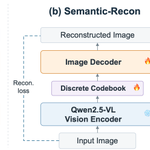
We found that finetuning representation autoencoders (RAEs) for reconstruction can hurt diffusibility under standard velocity prediction in flow matching. Why?(1/10)

Yucheng Mao retweeted
I recently completed a research project through a highly automated collaboration with Codex. The division of labor was simple: Codex maximized exploration, while I focused on judgment.
In detail, Codex proposed hypotheses, implemented and debugged methods, ran experiments, analyzed results, and iterated from feedback. I set the research direction, chose the questions, inspected the evidence, and decided which ideas were worth pursuing.
This is also a concrete example of the research workflow I discussed in my previous post. I believe it is particularly effective when a problem is close to purely logical and each hypothesis can be verified with modest compute. Agents can then explore at high throughput, while cheap verification enables rapid iteration.
The result is my new paper, which asks a question: what limits length extrapolation in recurrent models, and how can we learn recurrent dynamics that remain effective beyond the training horizon?
More specifically, recurrent models are coming back not only because they are efficient. Their shared update rule provides a structurally natural path to length extrapolation. Yet learning recurrent dynamics that remain reliable over substantially longer horizons is still an open problem.
To study this problem, I build a controlled task suite that separates state tracking, memory retrieval, and their interaction. My diagnostics show that vanishing parameter gradients (previous focus) alone do not explain extrapolation failure. A fixed transition rule can still be learned from dense local supervision despite severe gradient decay. The harder failure occurs when future losses cannot transmit sufficient credit to earlier recurrent states that must preserve useful information.
This suggests intervening before the parameter gradient is formed. I call the gradient of future losses with respect to an earlier recurrent state as state credit. It is the upstream learning signal: a future loss must first reach the state before it can train the recurrent update.
This motivates Credit Stabilization through Time (CST) to act directly on this signal. During backward propagation, it restores the norm of state credit when contraction accumulates across sequence chunks, while preserving its direction and leaving the forward computation unchanged.
The results support this hypothesis across two regimes:
Synthetic tasks
• CST significantly improves length extrapolation across all task families and evaluated settings, with gains verified at up to 128× the training length.
Real language modeling (still toy)
• I train a 123M-parameter recurrent language model at 4K and evaluate it up to 128K on both in-domain and out-of-domain data.
• CST produces a modest improvement over all tokens, but a substantially larger gain on key tokens that require long-range context.
• The benefit generally increases with extrapolation length.
Learning Length-Extrapolatable Recurrent Models
Paper: arxiv.org/abs/2609.09157
This is my first paper centered on model architecture design and language modeling, and also my first attempt at this kind of highly automated research workflow. So comments and corrections are genuinely welcome. Hope you find both the paper and workflow make sense :)
