

Curating the latest in AI, semiconductors, EVs & global tech breakthroughs | Not affiliated with any brand
Earth
Joined January 2022
- Tweets13.8K
- Following70
- Followers27.5K
- Likes7.1K




Taiwan Power Company plans to invest NT$109.6 billion in transmission and substation improvements serving Greater Tainan Science Park, according to Taiwan’s Economic Daily News.
Projects include a new 345-kilovolt transmission line and additional substations to support power-intensive semiconductor manufacturing.
Taipower estimates electricity demand across the broader park network could reach 8 gigawatts.
Taiwan is preparing space for future 1-nanometer chip facilities, although TSMC has not confirmed plans to operate one there.
The upgrades underscore how dependable electricity infrastructure is becoming essential to Taiwan’s advanced chipmaking ambitions and AI supply chains. $TSM

1
399
SK hynix's third-quarter dividend now works out to a yield of roughly 1.9%, a byproduct of a steep share-price slide in Seoul.
The chipmaker will pay ₩20,000 per share, split evenly between an earnings-linked payout and a special distribution tied to its Kioxia investment.
Shareholders of record on November 30 qualify, with the stock expected to trade ex-dividend on November 27.
At about ₩1.05 million intraday Monday, shares still sit roughly 25% below their November 4 close, as a global AI-spending sell-off dragged the Kospi down more than 5% midday. $SKHY

329
Japanese manufacturers are struggling to secure chips, according to a Resilire survey. Overall, 86% have lost orders after rival buyers or other industries locked up supply slots and inventory first, and just 12.7% receive every chip they need.
Timing is the bigger risk: over half hold under two months of stock, while 75% need three months or more to test and approve substitutes.
Among low-stock firms, 78% can't switch in time. Meanwhile, 94.3% have faced sudden end-of-life notices in three years, triggering emergency bulk buying, excess inventory, or product redesigns.

Surviving 70% drawdowns in memory stocks takes more stomach than most people actually have.
It’s easy to look at a 27x chart in hindsight, but holding through years of collapsing DRAM prices and massive losses is brutal.
Most investors panic-sell at the bottom of cycle one, never sticking around to see the HBM boom pay off.


An unverified social media rumor claims Tesla reduced its upcoming AI4.5 autonomous driving computer’s memory from 32GB to 24GB due to high RAM costs, arguing memory bandwidth limits prevent utilizing the full capacity anyway.
The post also alleges Samsung manufactures the chip. Because no official documentation or credible leak confirms these specifications, readers should treat these details strictly as speculation.

South Korea convened 24 domestic and international semiconductor and AI companies, including AMD, NVIDIA and Intel, to strengthen cooperation with local chip developers and address supply disruptions.
The November 23 meeting included FuriosaAI, Rebellions and DEEPX, with officials seeking to turn existing partnerships into commercial deployments.
Participants flagged rising demand for high-bandwidth memory, low-power DRAM and packaging substrates as a growing challenge for smaller chipmakers.
Seoul plans to expand supply-and-demand information sharing, support joint demonstrations and hold regular industry discussions as shifting U.S. policies and investment strategies add further uncertainty.

President Donald Trump has publicly urged Nvidia to rehire former CEO Jensen Huang, stating that his return would benefit both the chipmaker and the United States.
Huang resigned earlier this month following reports of extramarital affairs.

3
451
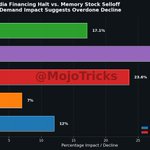
Citi argues the sharp selloff in memory stocks is significantly overdone. The bank estimates that even a complete halt to Nvidia-linked financing initiatives would cut global DRAM demand by only about 12% and NAND demand by 7%.
Those figures rest on assumptions that such financing equals roughly 14% of hyperscaler capex and that Chinese customers represent about 7% of Nvidia’s sales.
Memory names have fallen harder than the broader chip sector this week, with Sandisk down 28.4% and Micron off 23.6%, versus a 17.1% drop in a key chip index and an 8.6% decline in the S&P 500.
Citi maintains that structural AI demand and constrained supply-partly from tighter U.S. equipment export rules on China-should support a recovery. The brokerage views near-term financing worries as manageable relative to longer-term AI-driven growth. $NVDA

The U.S. is moving to close a loophole in its AI chip controls. On Monday, Nov. 16, the Bureau of Industry and Security issued an interim rule requiring licenses to export advanced chips to Indonesia, Malaysia, Singapore, Thailand and Brazil, citing diversion risk.
The Institute for Progress estimates Chinese firms will access about 1 million H100-equivalents remotely overseas by year-end, roughly 75% in Southeast Asia.
ByteDance relies on operators such as DayOne and Bridge Data Centres, while Megaspeed, linked to the scandal behind Jensen Huang's Nvidia exit, reportedly serves Alibaba. $BABA $NVDA

1
437
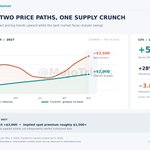
Prices for 64GB DDR5 registered server memory could remain elevated through 2027, with one market scenario placing contract pricing near $2,000 per module by year-end.
The same outlook sketches a more volatile spot market, including a retreat before a rebound above $3,500 by November.
These specific price targets remain unverified. Citi, meanwhile, expects the DRAM market to stay undersupplied in 2027, forecasting 28% demand growth against 24% supply growth.
Server DRAM demand could jump 53%, keeping pressure on data-center procurement budgets for major cloud providers despite a narrower overall shortfall.

An unattributed market commentary suggests the ongoing equity sell-off may be nearing a tactical inflection point, driven by record gamma positioning set to partially expire at the market close.
The note-which lacks a named institutional source and cannot be independently verified-frames the downturn as an "AI bubble" flush while signaling a pivot from selling rallies to buying dips.
Despite anticipating choppy trading and unconfirmed bottoming timelines, the commentary advises covering shorts, buying equities, and shifting toward quality and value assets.

"It’s time to act. Roll down puts, cover shorts, buy stocks, and buy Fed funds futures."
"The AI bubble has burst, and the flush appears to be underway."
Not very reassuring eh?
258
During a recent broadcast interview with host Margaret Brennan, Treasury Secretary Scott Bessent dismissed controversy surrounding a rumored personal relationship involving former Nvidia CEO Jensen Huang and Alice Huang, an individual reportedly linked to Chinese intelligence.
Calling the alleged affair a "canard," Bessent stated he assumes Jensen Huang was unaware of any purported espionage ties.
Instead, Bessent emphasized investigating Nvidia's broader culture of compliance and identifying lower-level actors responsible for potential corporate noncompliance, while declining to endorse Huang's return to leadership. $NVDA

Scott Bessent says the Alice Huang affair is a canard next to Nvidia's culture of compliance, and he assumes Jensen didn't know she was an alleged spy
BRENNAN: "I understand Mr. Huang's no longer at the helm, but are you saying that you think it would be a good idea for him to go back and run the company?"
BESSENT: "I think we have to see where the buck stops. You know, what were these malicious actors down at the bottom of the company who were responsible for the noncompliance?"
BRENNAN: "Okay. So you see that as almost separate and apart from the relationship with Alice Huang, who's reportedly linked to Chinese security?"
BESSENT: "Yeah. I think that is kind of a canard, that the, you know, what's their culture of compliance versus the one person's foibles."
BRENNAN: "With a Chinese spy, allegedly."
BESSENT: "Well, I assume he didn't know that she was an alleged spy."
Apple is recruiting a senior engineering manager to lead the development of an autonomous AI agent capable of operating a computer like a human, according to a recently removed job listing spotted by Bloomberg’s Mark Gurman.
The posting sought leadership for a "proactive, agentic AI assistant" designed to browse the web, execute multi-step workflows across apps, write and debug code, and select appropriate software tools independently.
While Apple has not officially announced the product, Gurman estimates any public release is unlikely before late 2027. $AAPL

4
5
653
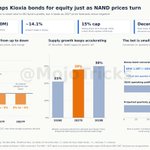
SK Hynix is converting ¥129 billion ($810 million) of Kioxia-linked convertible bonds into equity, giving up downside protection as the NAND outlook cools.
TrendForce expects contract prices to slip 0-5% in the first quarter of 2027, with every category declining from the second, while GF Securities projects 28% NAND supply growth next year.
If enterprise SSD orders soften, the stake could see mark-to-market swings. The cost is modest: about 1% of a single quarter's operating profit, which analysts project near 102 trillion won, for an indirect 14.1% stake in Kioxia.

1
6
1,352
OpenAI’s third-quarter 2026 revenue climbed nearly 50% sequentially to $10 billion, but its adjusted operating loss widened to $10.9 billion, according to investor documents reported by The Wall Street Journal. Its adjusted margin improved to negative 109% from negative 150% in Q2.
Newly listed Anthropic reported $16.96 billion in quarterly revenue and a $567 million GAAP operating loss in its IPO filings.
However, different partner-revenue accounting and operating-profit definitions complicate direct comparisons.
OpenAI’s two-quarter adjusted operating losses totaled $21 billion, underscoring mounting pressure to convert AI demand into sustainable profits.

309
Bank of America disputes reports suggesting Samsung is preparing to withdraw foundry services from Chinese AI chip designers.
The bank believes Samsung has already ended most foundry services for China-based developers of graphics processors and custom AI chips, rather than planning a new cutoff.
Separately, the Financial Times reported that Samsung and TSMC suspended some shipments to Chinese customers after Washington tightened semiconductor export rules.
These are distinct developments: BofA describes earlier business decisions, while the latest shipment suspensions reflect new licensing requirements. Samsung has not confirmed the bank’s assessment. $TSM

An industry analysis highlights a sharp divide in U.S. AI infrastructure execution. While Amazon holds the largest development pipeline, an estimated 80% of its unstarted AWS capacity sits in restrictive jurisdictions, risking permitting delays and higher power costs.
Conversely, Meta and Google have 15 GW and 13 GW under construction, compared to 6 GW and 7 GW active. Oracle builds 6 GW against 1 GW active, with minimal long-term plans. Ultimately, securing grid connections will decide 2027's winner. $GOOG $META

296
SK hynix is pushing back against concerns that AI memory demand lacks visibility beyond 2028.
During its third-quarter earnings call, the company said contracts and customer negotiations effectively account for DRAM and high-bandwidth memory volumes through 2029.
Long-term agreements with 14 customers cover more than half of 2027-2028 capacity, with deposits supporting purchase commitments. Management expects memory supply to remain tight through 2030.
SK hynix outlined approximately 100 trillion won in 2026 shareholder returns, including at least 30 trillion won in dividends and 60 trillion won in buybacks and cancellations. $SKHY

U.S. restrictions on advanced AI chips are straining Washington’s trade truce with Beijing after allegations involving Nvidia’s former CEO and a suspected Chinese intelligence operative. The espionage claims remain unproven.
New Commerce Department rules limit certain Chinese companies’ access to powerful computing systems hosted overseas and tighten chip exports through diversion-risk countries.
Beijing has condemned the measures and could retaliate with restrictions on critical minerals.
With the current trade truce expiring January 10, 2027, further negotiations between Presidents Donald Trump and Xi Jinping will be crucial to avoiding renewed escalation. $NVDA

1
444
Google Quantum AI says its Willow processor outperformed the best classical strategy in the Mermin-Peres magic square game, a cooperative puzzle.
Using four qubits, the chip won 98.3% of rounds; no classical approach can exceed 88.9%. The study, published Thursday on the cover of Science, also covered a GHZ game up to 71 qubits, where the advantage narrowed with size, and a 105-qubit task.
Google pitches the tests as a sensitive way to catch subtle hardware errors, a possible route toward chemistry and materials applications, though the experiments simulated neither. $GOOG

332