

1️⃣Currently: Deploying and scaling robot company 2️⃣Recently: Chief of Staff at a robotics startup 3️⃣Long ago: Army helicopter pilot
Joined May 2023
- Tweets840
- Following513
- Followers3.8K
- Likes1.4K
Pinned Tweet
Thank you to all who followed me based upon a comment I made about my experience as a helicopter pilot!
To intro myself a bit more, I flew UH-60s and was in the Army for 7 years with a combat deployment to Afghanistan. My last UH-60 flight was almost 10 years ago!
Now I’m much more focused on my lovely wife, daughter, and son on the way!
I don’t tweet often, but it will most likely involve faith, aviation, or robots!
Ambi is a great system!

I've enjoyed getting to know Jeff because I love his balanced approach to building and deploying Physical AI systems.
On one hand, he is a pragmatic technologist. @AmbiRobotics has deployed 100+ robots that do real work for some of the world's biggest logistics operations.
On the other, he's a PhD from @UCBerkeley, and his team's academic roots mean they're constantly pushing the frontier of end-to-end models.
The result is a harmony of both rapid deployments and rapid progress on Ambi's autonomy stack.
More companies and leaders should operate like this, and I'd encourage you to check out this episode with Jeff, out now.
Jobs I’ve held:
Little league umpire
Cart boy at a country club
Busboy
Helicopter pilot
Army instructor
Consultant
Customer Success Program Manager
Head of Product
Ops Director in robotics
Most important: dad

Matt Leitch retweeted

These are my favorite ideas from my conversation with @MrStand_Fast.
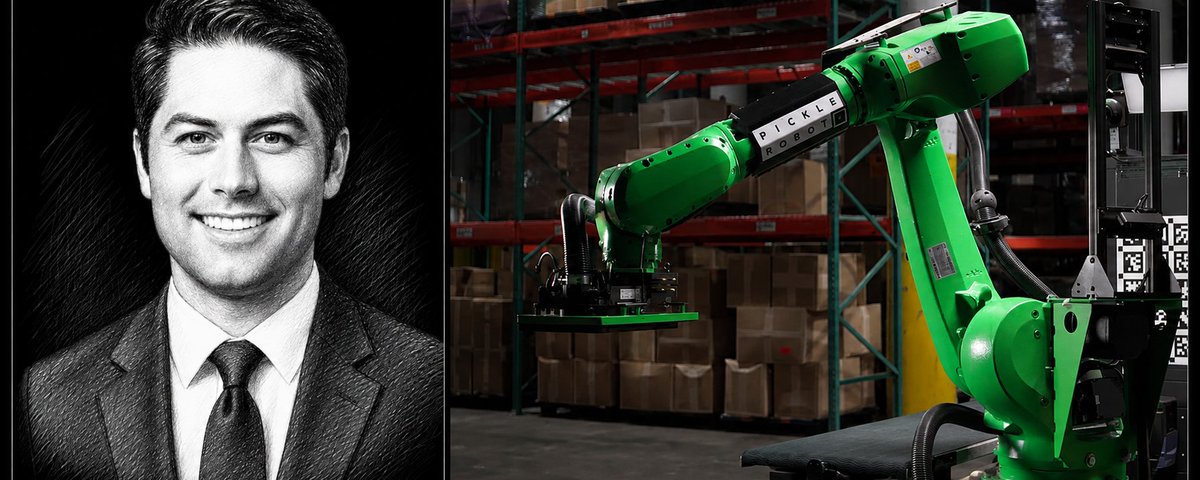
Matthew leads Product Operations at Pickle Robot, where his team deploys and sustains robots that unload freight from shipping containers.
Before Pickle, he scaled fleets at Ocado and Six River Systems. Before robotics, he served as a helicopter pilot in the US military.
-> Product Operations is everything after the contract is signed.
Deployment, support, maintenance, training, and customer success all determine whether the customer gets real value from the robot. For example, Pickle has reduced deployments to as little as six hours from arrival to the first pickl. Excellent Product Operations is what gets you the renewal.
-> A Robot Operations Center (ROC) commands the fleet at three levels.
At the robot level, it diagnoses individual failures. At the site level, it identifies environmental or operational problems. At the fleet level, it finds structural patterns that engineering needs to fix. The ROC is a remote command center that helps product operations scale!
-> Optimize for repair time over failure rate
To Matthew, a component that fails slightly more often but takes two minutes to replace can be better than one that takes 20 minutes. Pickle has maniacally focused on this: they standardize tools and bolts, make consumables easy to swap, and even rehearse failures at HQ before technicians ever reach the site.
-> Utilization is the metric that matters most.
Response time, resolution time, training numbers, and peak performance are useful, but they can easily become vanity metrics. When customers consistently use products and reliably achieve performance, you know it has become a key part of their operations.
That utilization is what drives renewals, expansions, and referrals!

I'll never fill out a "contact us" form on a website again.
Claude just researched service providers, drafted emails to the top rated providers in the area, and all I had to do was talk to Claude for 30 seconds.
Home services providers need to take note.
If you’re passionate about solving problems in your domain, software will remain a great path.
Pursue with violence of action when opportunities present.

STOP BUILDING SOFTWARE. I’ve talked to so many startups trying to do some kind of software tool for robotics and it’s very hard for me to believe in any of them. If you want to sell picks and shovels to robotics, build a hardware company instead. Better edge compute, better sensors, better actuators, better manufacturing equipment, even just operating better machine shops. We will happily onboard new hardware vendors and take a bet on you because that is the bottleneck right now for all robotics companies.


My X feed was just:
-Middle East war getting worse
-$100 oil coming again
-market getting hammered
-Ebola outbreak in Africa
But no doomer news can stop the joy of seeing my little girl excited to go feed 🐓
I hope all of you can find that joy

DeleteMe and Incogni have to be scams, right?
I haven’t dug into it but wouldn’t surprise me in the least if they were somehow owned by the data brokers they claim to protect you from.
You could be a doomer.
Or you could try getting a quote for home services and realize that all of those pricey private equity roll-ups will be under tremendous pressure from AI-powered private businesses.
Untold opportunity, and a win-win for the consumer and business owner

The DAE is built out of experience on production sites, not demos.
Another example of what Physical AI looks like in production:
@Pickle_Robot released the Dill Autonomy Engine (DAE), their hybrid autonomy architecture for deploying Physical AI. It combines classical controls, generative AI, and human teleoperation. And they're licensing it to other Physical AI companies!
Think of the framework as a sandwich. The outer layers are classical controls that harness the robot policy in the middle.
1) Guidance Agent (classical) -> Plans the robot's motion. Generates paths that adhere to customer workflows and safety constraints.
2) Skills Agent (AI) -> A diffusion policy trained on production data. It takes the Guidance plan and adapts it for the messy real-world.
3) Guardrails (classical) -> An independent safety layer between the Skills Agent and actuation. It blocks any unsafe outputs from the policy.
The harness allows Pickle to confidently deploy their Physical AI into production use cases. Inputs from sensors, cameras, and the Observer Agent allow the Skills Agent to perform inference. And when things go wrong and a human teleoperator needs to step in, those corrections become training data.
According to Pickle, this approach needs less training data than a pure VLA, delivers more reliable autonomy, and is designed to eventually run across different embodiments.
This, plus @nomagicAI's announcement last week, indicates a pattern. The companies that deploy Physical AI the fastest will use a "harness" of classical controls to provide safety and reliability to their powerful robot policies.


Pleasure to talk with @vedantnair__ about scaling robotics! Please excuse the bare walls…I was in the middle of a move!
Every scaled robotics fleet needs a Robot Operations Center (ROC). @MrStand_Fast , Director of Product Operations at @Pickle_robot , runs one of the best.
You can think of the ROC as a remote support engineering center. It's the nerve center of the fleet: monitoring every robot, fixing issues fast, and keeping customers running.
They operate on three levels:
1️⃣ The robot. Is something wrong with this specific machine? Swap a part, run scheduled maintenance, and get it back to its task.
2️⃣ The site. Is there a trend with this customer? Maybe the freight mix changed, and workflows need to adjust.
3️⃣ The fleet. What patterns show up across every robot? Shortcomings in software or autonomy loop back into the product roadmap.
The ROC is the engine that keeps customers happy and using robots. It is the mouthpiece from the warehouse floor to engineering and sales. An effective ROC detects trends early, ensuring the product is always improving.
If you're thinking about scaling a fleet of robots, this conversation with Matt is a great primer for building your operations muscle.