

Researcher at Hôpitaux Universitaires de Genève (HUG). Using Bayesian data analysis to extract personal parameters from wearable device data.
Lausanne, Switzerland
Joined April 2012
- Tweets120
- Following410
- Followers141
- Likes224





Nick Phillips retweeted

Our new arXiv paper: We built a generative AI model of blood glucose levels from 10 million continuous glucose monitoring measurements of 11,000 people from the Human Phenotype Project
We show that our model can predict clinical parameters such as liver-related parameters, blood lipids, and sleep-related indices. The model can also predict onset of future health outcomes even 4 years in advance, as well as outcomes of randomized clinical trials
We also integrated dietary data into the models and show that the enhanced model can accurately generate blood glucose levels using only dietary intake data, simulate outcomes of dietary interventions, and predict individual responses to specific foods.
The model also performs well on 15 different external datasets from 5 different geographical regions and 6 different continuous glucose monitoring devices
Paper: arxiv.org/abs/2408.11876
Data: humanphenotypeproject.org/
Great work led by @GLutsker, Gal Sapir, @nastya_godneva, @smadarshilo, @H_Rossman in collaboration with @SamochaBonetD and @nvidia researchers @GalChechik @MannorShie @eli_meirom

Nick Phillips retweeted

Are there universal laws driving complex systems dynamics across scales? What kind of general theory connects fluctuations in microbiomes, rainforests or economic and urban systems? Check this @PNASNews paper by ashish george & @Jp_odwyer @sfiscience pnas.org/doi/abs/10.1073/pna…

Nick Phillips retweeted

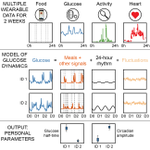
Uncovering personalized glucose responses and circadian rhythms from multiple wearable biosensors with Bayesian dynamical modeling dlvr.it/St16Cg

Very happy that our article "Uncovering personalized glucose responses and circadian rhythms from multiple wearable biosensors with Bayesian dynamical modeling" is now online in Cell Reports Methods! (doi.org/10.1016/j.crmeth.202…) A brief overview... (1/5)
We also found that some participants seem to display relatively large 24-hour oscillations in the underlying baseline glucose levels. (4/5)
A few years ago we published a method on detecting oscillations in single-cell time series with @MagnusRattray @PapalopuluLab. We now have a basic implementation using Python and @GPflowProject ... Jupyter Notebook tutorial here -> nbviewer.org/github/Manchest…
Nick Phillips retweeted

How precise are noisy #morphogen gradients in #tissue #patterning?
It turns out that the positional information they convey to #cells in the #neuraltube is much more accurate than previously estimated!
Our new #devbio paper is out in @NatureComms: rdcu.be/cH8Fx

Nick Phillips retweeted

🥳 Just awarded a Synapsis foundation grant !
➡️Open PhD student position
🔬🧠Protein homeostasis in live single human neurons in healthy/ND disease.
If you feel 🤩 tell me and apply at @epfl_edcb or EDMS PhD program. Thx for RT
Nick Phillips retweeted

We're gearing up for the final #PeakEnsemble of the year!
Join us next month to hear from @NPSysBio of @Hopitaux_unige! 🇨🇭
#AI #datascience #datacommunity
I've written a tutorial on Bayesian inference for single-cell gene expression data using STAN @mcmc_stan. We see how the Poisson, negative binomial and beta-Poisson mixture distributions emerge from simple stochastic models of gene expression dynamics. nbviewer.jupyter.org/github/…
Nick Phillips retweeted

Analyses of the #CircadianOscillator at the single-transcript level --> bit.ly/3qMJt2P from @Naefelix @EPFL_en
#SingleCell #CircadianClock #QBio #transcription

smFISH of circadian clock genes + mixture models shows that circadian time constitutes only a small fraction of the total variability in mRNA number between cells. Our new pre-print @Naefelix @jakeyeung

The circadian oscillator analysed at the single-transcript level biorxiv.org/cgi/content/shor… #biorxiv_sysbio


Nick Phillips retweeted

OscoNet: Inferring oscillatory gene networks @MagnusRattray @Boukouva1Alexis biorxiv.org/content/10.1101/…

Nick Phillips retweeted
Our tightly collaborative work with @Naefelix and @NPSysBio is out - Transcriptional memory varies widely between genes and scales with expression variability - may play a role in tissue patterning
nature.com/articles/s41467-0…

Pleased to announce that I'll be starting a 2 year @PHRT_CH fellowship. We'll use Bayesian modelling, app data and transcriptomics to investigate the relationship between the time at which we eat, our circadian clock and metabolic disorders.
