

Building AI products beyond the demo. Thinking out loud about tech, business, investing and sports.
Athens | Berlin | Munich
Joined February 2010
- Tweets9.5K
- Following847
- Followers3K
- Likes6.6K







Pinned Tweet
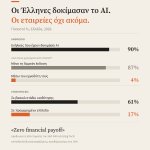
Managers: 90% of tasks exposed to AI in theory. 14% show up in real Claude usage.
Two indexes, two different questions. OpenAI's asks whether an LLM could make a task 2x faster. Anthropic's asks whether people actually use Claude for it at work. The gap between them is not capability. It is adoption, workflow and trust.
Even the most used group, Computer & math, sits at 38% of what is possible. Exposure is not replacement. A task an LLM can speed up is not a job it can own.
So the real question is not whether tech, finance and management disappear. It is what stays scarce once producing code, analysis and reports gets cheap.
1. Problem selection. Picking the 3 things worth doing out of 30.
2. Accountability. Someone signs, and owns the downside when it goes wrong.
3. Context. The data, history and workflows a model never sees.
Trust. Customers still buy from people they believe.
My bet: the jobs don't vanish, the ratio flips. Less time producing, more time judging. The people at risk are the ones whose value was the production step, not the judgment on top of it.
Cheaper code has so far meant more software, not fewer builders. I expect the same here.

2
201
The two slices of success in crypto. You are either total decentralized and create scarcity or super centralized with full control of your “token” / stock to create scarcity. Oops
17
The minute Claude started shipping the SaaS application layer, the extinction story got serious.
Anthropic just rolled out Whiteboards and Sheets, made Claude Data generally available, and opened full apps like Adobe, Atlassian, HubSpot and Notion inside Claude.
Microsoft fell about 3% within half an hour of the news.
What's exposed: thin, seat-priced interfaces a model can now stand up from a prompt. What is not: the system of record, proprietary data, distribution, compliance, and evidence you can defend. Anthropic says Sheets is still simple. Partners are being invited in, not just replaced.
2
1
112
97% of answers right. Only 63% of documents fully right.
That gap is the enterprise AI problem in one line. Artificial Analysis now counts a document as correct only if all 15 answers are. Drex Max: 97% per answer, 63% per document. Haiku 5.5: 99% and 92%.
My read: buyers act on the document, not the answer. Grade it that way.
xitter.gq/ArtificialAnlys/status…

Introducing the Artificial Analysis Decision Index v2: a new proprietary evaluation, updated benchmarks, and a headline metric that rewards model calibration
We’ve released the second version of the Artificial Analysis Decision Index to better reflect real-world utility and guard against benchmark gaming. 45% of the Index is now built on private datasets, up from 25% in v1. Drex Max v1.1 from @NaceAI narrowly leads among decision models at 73, within 1 point of GLiDE v1.2 (@fastinoAI) and Mammoth 27B (@baselabs)
Updates in Decision Index v2:
➤ Decision Score: We adopt a new headline metric that rewards a model for both correctness and calibrated confidence. Each question scores from 0 to 100: right answers score above 50, wrong answers below 50, and confidence in its top answer moves the score within each half
➤ AA-Paperclip (30%): We added a new private benchmark of 1,500 documents including resumes, receipts, invoices, and AI and machine learning research papers. Models make decisions and extract facts from each document and are scored jointly as a single decision, correct only if all 15 answers are right
➤ AA-Symmetry (15%): This evaluates whether models change their answers for equivalent questions worded differently. We test 120 questions with variations such as reordered options, swapped labels, and negated yes/no questions, then measure how consistent the model’s probabilities are across those variations
➤ AA-Omniscience-Decision v1.1 and HLE-MultiChoice v1.1 (15% each, down from 25%): AA-Omniscience-Decision now varies the wording of its “I don’t know” option across ten alternatives. HLE-MultiChoice adds an option to decline using the same ten phrasings
We’ve also added EvalSafe-ONET-AA (15%), our implementation of @typesafeai’s ONET benchmark. We have retained When2Call from @NVIDIAAI in the Index at a decreased weighting of 10% (down from 25%), and removed WildGuardTest given its high saturation
Key results:
➤ Three decision models sit within 1 point at the top of the Index: Drex Max v1.1 from Nace AI and GLiDE v1.2 from Fastino Labs both score 73, with Mammoth 27B from Base Labs scoring 72
➤ Cost per 1M Tasks varies by more than 60x across decision models: Celeris-1.1 Decision ($14), Decider v1.2 ($68) and Drex Max v1.1 ($102) sit on the Decision Index vs. Cost Pareto frontier, while Clef costs $859. Token price is not the only cost driver: most decision models, including Drex Max v1.1 and Decider v1.2, bill a document’s input once for all its questions, while GLiDE v1.2 and Decider Flash v1.2 bill it for every question. This means GLiDE v1.2 costs $780, nearly 8x higher than Drex Max v1.1 despite only 33% higher list prices
➤ Language models can score higher, alongside higher Cost and Time per Task: Claude Haiku 5.5 (Max) scores 77 and GPT-6 Luna (Max) scores 76 on Decision Index v2, putting them ~3 points ahead of Drex Max v1.1. GPT-6 Luna (Max) costs $1,530 per 1M Tasks vs. $102 for Drex Max v1.1 (15x the cost) and takes 11.34 seconds per task vs. 275 milliseconds (~40x slower)

36


🫣🫣

Generative UI for conversational agents.
Combining @aisdk with Chat SDK and 𝚓𝚜𝚘𝚗-𝚛𝚎𝚗𝚍𝚎𝚛, you can go straight from LLM to UI on platforms like Slack and Teams.
I believe this will become the dominant Human-Agent Interaction (HAI) paradigm:
vercel.com/changelog/json-re…
27
algorand:native ftw

Quantum technology could unlock new possibilities in drug discovery, materials design, and robotics. As commercial applications advance, businesses have an opportunity to build capabilities and gain a competitive edge.
Explore the three horizons: mck.co/4BBwNkW

There is so much charting created by Claude here that is hard to keep up. Knowledge and intelligence is already largely commoditized. Pity
39
The cheapest agent optimisation is not a better model. It's moving housekeeping off the expensive one.
Claude Code's background subagents now get their status lines from Haiku 5.5 working off short notes: about 99% cheaper per update, about 6% more prompts on the same limit.
Every call that summarises, labels or reports progress deserves the same audit.
xitter.gq/ClaudeDevs/status/2118…

Background subagents in Claude Code now use less of your usage limit.
A running subagent updates its status line every 30 seconds, and each update used to re-read its whole conversation. Now Haiku 5.5 writes it from short notes instead, so each update costs about 99% less.
40
Το 55% των εταιρικών δαπανών σε AI APIs πάει πλέον σε μία εταιρεία: την Anthropic.
Νέα έκθεση της Menlo Ventures (επενδυτής της Anthropic, κράτα το αυτό):
1. Εταιρικές δαπάνες σε AI: από $33 δισ. σε $176,8 δισ. σε έναν χρόνο.
2. Μερίδιο στα APIs: Anthropic από 40% σε 55%, OpenAI από 27% σε 31%, Google από 21% σε 9%.
3. Τα open-source μοντέλα κάνουν το 19% της χρήσης, αλλά μόνο το 4% της δαπάνης.
Τι σημαίνει για μια ελληνική ή ευρωπαϊκή εταιρεία: οι αγοραστές πληρώνουν για ικανότητα, όχι για φθηνά tokens. Αν όμως το προϊόν σου στηρίζεται σε έναν πάροχο με 55%, η διαπραγματευτική δύναμη δεν είναι δική σου.
Χτίσε έτσι ώστε να αλλάζεις μοντέλο σε μια εβδομάδα, όχι σε ένα τρίμηνο.

45
The SaaS at risk isn't the $600 tool. It's the expensive one whose core is a workflow and a table.
Cory rebuilt a $600/yr app with Opus in 4 to 5 hours. The math only improves as the price goes up.
Niche B2B survives on proprietary data and accountability, not features.
xitter.gq/czue/status/2117182098…

I just canceled a $600/year SaaS subscription for an Opus-coded, in-house alternative. My external spend is now exclusively down to infrastructure: servers, email & payments.
I think niche B2B SaaS is in real trouble.
33
Για πρώτη φορά, το compute της Anthropic μεγαλώνει πιο γρήγορα από τα έσοδά της.
Αναθεωρημένο S-1 (2 Νοε), Q3:
1. Έσοδα $16,96 δισ., +47% σε σχέση με το Q2.
2. Κόστος compute $9,86 δισ., +77%.
3. Το compute ανέβηκε από 48% σε 58% των εσόδων. Το λειτουργικό αποτέλεσμα γύρισε από κέρδος $974 εκ. σε ζημία $567 εκ.
Τι σημαίνει για μια ελληνική ή ευρωπαϊκή εταιρεία που χτίζει πάνω σε AI: μην γράφεις στο business plan ότι η τιμή ανά token θα πέφτει για πάντα. Μέτρα κόστος ανά ολοκληρωμένη εργασία, κράτα τη δυνατότητα να αλλάξεις μοντέλο, και μην υπογράφεις ετήσια δέσμευση πριν δεις τα δικά σου νούμερα χρήσης.
Ο πάροχος θα περάσει το κόστος κάπου. Μέτρησέ το πρώτος.
1
80
Grokbot used to reset every Monday but it is Tuesday already and still 100% - you can’t convince me that there is not something way off
55

Loved GrokBot, as of yesterday the usage limits vanish in minutes. Man this is a blocker to major adoption. Prefer that they revise their plans. Come on $SPCX
64