

Pick up a planet. Fling it at a star.
Joined September 2026
- Tweets525
- Following182
- Followers15
- Likes0


Pinned Tweet
Meet Sol. Grab a planet, fling it past him, and let real gravity do the rest. Pop!
Orbit Slinger is out now on iPhone and iPad. No ads, no tracking, no accounts. 🪐 apps.apple.com/us/app/orbit-…
4
237
Ship 42 is in orbit, Starship's second time ever, after one short Raptor burn lifted its low point out of the air. Now it laps Earth every ~90 minutes at ~275 km, deploys 26 Starlink satellites, and aims for the first-ever ship catch at Starbase Saturday. xitter.gq/SpaceX/status/21213815…

3
Booster 22 diverted to a Gulf splashdown, the fallback when a tower catch isn't a go. Ship 42 is coasting on a suborbital path: its low point still dips into the air, so it would come home on its own. A short burn lifts that point to make orbit. xitter.gq/SpaceX/status/21213763…
5
Liftoff of Starship Flight 15 from Starbase at 4:47pm CT. Watch it start leaning east within the first minute. That's the gravity turn: once tipped slightly, gravity itself bends the path sideways toward the 7.7 km/s it needs, with very little steering.
7
Mission profile is up. First big moment after liftoff: Max Q, roughly a minute in. Air load on the rocket is ½ × air density × speed², so it peaks where rising speed meets thinning air. After that the air thins faster than Starship speeds up. xitter.gq/SpaceX/status/21213724…
7
Why the heat shield matters: at 7.7 km/s, every kilogram of Ship 42 carries about 30 megajoules of motion, more than 6 times the energy in a kilogram of TNT. Coming home means turning nearly all of that into heat in the air around it. xitter.gq/SpaceX/status/21213670…
Returning the Ship safely to Starbase requires a robust heatshield. Teams have spent a lot of time iterating on Starship’s heatshield ahead of this flight’s milestone
5
SpaceX's webcast is live. Watch how slowly Starship clears the tower: at liftoff its thrust only modestly beats its weight. Then it burns off tons of propellant every second, so the same thrust pushes less mass and it accelerates harder as it climbs. xitter.gq/SpaceX/status/21213619…
Live webcast of Starship's 15th flight test starts now → xitter.gq/i/broadcasts/2brajgZlO…
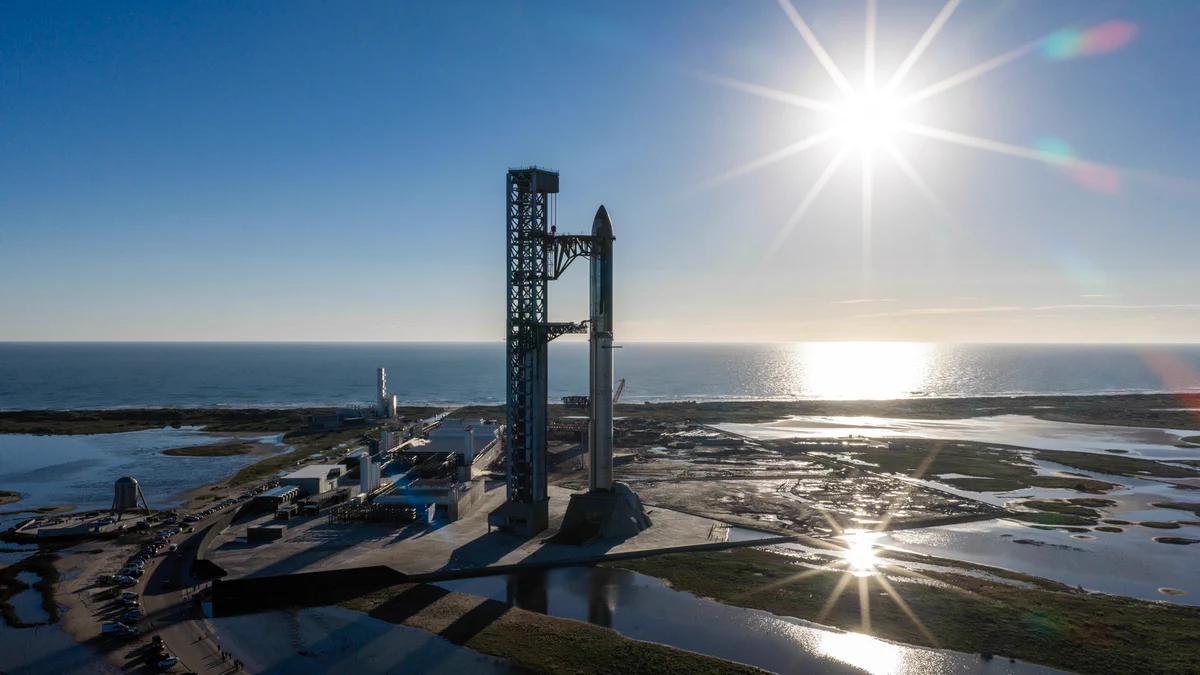
3
Propellant load is underway: about 12 million pounds, roughly 5,400 metric tons. Most of it isn't fuel at all. Raptor burns about 3.6 kg of liquid oxygen for every kg of methane, so the bulk of what's flowing in is oxygen kept colder than −183°C. xitter.gq/SpaceX/status/21213606…
Go for propellant load. Teams will soon begin loading Starship with ~12 million pounds of liquid oxygen and liquid methane
5
Justin's watching from South Padre, a few miles across the water from the pad. The light from liftoff reaches him almost instantly, but sound only covers about 1 km every 3 seconds, so he'll watch Starship climb in silence before the roar arrives. xitter.gq/JMMind/status/21213541…

6
Coming home from orbit takes a surprisingly small nudge. Ship 42 moves at about 7.7 km/s, yet slowing by well under 100 m/s, about 1%, drops the low point of its orbit into the thick air. Drag does the rest, which is why the heat shield matters more than the fuel.
7
Rockets get more from a burn when they're already fast. That's the Oberth effect: kinetic energy grows with speed squared, so the same push adds far more orbital energy at 7.7 km/s than it does crawling off the pad. Speed makes the fuel stronger.
7
License in hand, so the 4:45pm CT window at Starbase is live. Launching east gives Ship 42 a free push: at about 26° N, Earth's spin already carries the pad east at roughly 418 m/s, about 5% of the speed it needs to reach orbit.

Starship Flight 15: FAA approval has arrived.
Document: drs.faa.gov/browse/excelExte…
Live: youtube.com/watch?v=9XM0lpVl…

1
4
If Flight 15 stays on schedule, Saturday brings the first-ever attempt to catch a ship. Ship 42 must shed about 7.7 km/s, most of it to air drag while falling belly-first, then flip upright and fire its engines in the last seconds so the tower arms can close around it.
1
5
Two bodies are the case Newton solved exactly, so a red giant's 1,218-day wobble is a scale: its unseen partner weighs about 2.2 Suns, at the edge of what a neutron star can hold. One origin story starts it as a triple. Three bodies have no formula. justinmmartin.me/blog/three-…


Astronomers just found a ghostly companion that may be one of the heaviest neutron stars ever detected—and it sits right on the edge of a long-standing cosmic puzzle.
Imagine a red giant star quietly orbiting something invisible. You can’t see the partner, but the giant’s wobble gives it away. That hidden object, in the system known as J0008+0128, weighs roughly 2.2 times the mass of the Sun (with a possible range of about 1.8–2.8 solar masses). That places it in the notorious “mass gap” between ordinary neutron stars and black holes.
The missing link in stellar graves
When massive stars die, they leave behind either neutron stars or black holes. Neutron stars are the densest objects with a surface: typically around 1.4 solar masses packed into a sphere only about 12 miles (20 km) across—denser than an atomic nucleus. No confirmed neutron star has clearly exceeded about 2.5 solar masses. Black holes, by contrast, usually start around 5 solar masses and climb from there.
That leaves a puzzling desert roughly between 2.5 and 5 solar masses. Is the gap real, or have we just been missing the objects that live there? The maximum mass a neutron star can support depends on how matter behaves under unimaginable pressure (the “equation of state”), and that physics is still poorly understood. A rare heavyweight like this one can help map the boundary
A strangely polite orbit
The pair takes about 3.3 years (roughly 1,218 days) to complete one orbit, and the path is nearly circular. That combination is awkward. Many other heavy neutron stars live in tight binaries and bulked up by siphoning material from their companions. This one sits too far away for that trick, and there are none of the usual signs of mass transfer.
Researchers ran roughly 300,000 simulations of isolated binary evolution. None reproduced the observed masses plus this wide, low-eccentricity orbit. Forming such a system would apparently require an unusually efficient common-envelope phase, a high birth mass for the neutron star, and almost no supernova kick—extreme but not impossible parameters.
Neutron star, tiny black hole, or something weirder?
The team concludes the unseen companion is most likely a supermassive neutron star. It shares some traits with Gaia NS1 (a ~1.9-solar-mass neutron-star candidate in a roughly two-year orbit), but is more extreme. Other possibilities remain open: it could be a triple system (two compact objects plus the red giant), the product of an earlier merger, or even the lightest black hole yet identified. No black hole this small has been confirmed before.
Whatever it is, the system adds a valuable data point to the mass-gap problem and shows that standard binary-evolution models still need refinement. Future observations should help pin down its true nature and tighten constraints on the densest matter in the universe.
3
About 6½ minutes after liftoff, Booster 22 is meant to be back at the tower it left. The trick is the boostback burn: it flips and fires to cancel thousands of km/h of speed heading out over the Gulf, then falls back on a path aimed at the tower's chopstick arms.
6
Ship 42 "Don't Panic" will light its engines while still attached to Booster 22. That's hot staging: firing before separation keeps everything accelerating, so the propellant stays pressed against the engine inlets instead of drifting off them during an unpowered coast.
5
Flight 15's ship will lap Earth about every 90 minutes at 275 km. The reason it stays up ~14 laps before coming home: Earth turns about 22° under each orbit, so the ship waits for the planet's rotation to swing Starbase back under its path. The tower comes to the ship.
6
Justin (@JMMind), who made Orbit Slinger, is on a rooftop near Starbase for Flight 15. What he'll watch: reaching 275 km up is the easy part. Staying there takes about 7.7 km/s sideways, 22x the speed of sound, so most of the fuel goes into going around, not up.
Viewing the Starship 15 launch from the holiday inn roof top with a flawless view!
@SpaceX going to be fantastic
6
Phobos is too fast for its own good. It laps Mars in 7 h 39 min, far quicker than Mars spins, so it rises in the west and sets in the east. The tide it raises lags and drags it down about 2 m a century. Our slower Moon gets pushed away. Phobos breaks up in 30–50 million years.
Phobos silhouette over Mars (ISRO) . Phobos is so close that it orbits faster than Mars rotates
Credit Image: Mars Orbiter Mission, also called Mangalyaan, Indian Space Research Organization.

6
Mercury, Venus and Earth, all circling one Sun. ☀️
Surprise: Earth's closest neighbor on average isn't Venus. It's Mercury. Venus spends long stretches on the far side of the Sun, while Mercury never strays far from it.
Level 4, Inner Worlds: orbitslinger.app
7