
§=£^¥{~€}
Seattle, WA
Joined November 2020
- Tweets649
- Following2.1K
- Followers194
- Likes176





Peter retweeted

The economic lockdowns of 2020 were the greatest crime ever committed against the people of the world.
The "once in 100 year virus" narrative was just the excuse to lockdown the economy which halted money velocity, allowing them to print $6 trillion and bail out the system without causing hyper-inflation.
They destroyed small businesses, careers and lives of regular people to save their billionaire buddies.


Peter retweeted

80% of the US economy barely moves, even in recessions.
The entire business cycle lives in the other 20%.
Headline GDP blends it all together and buries the signal.
Here's how to read GDP in 4 steps:
1/
Peter retweeted

Falling equities don’t always mean the same thing.
The real signal is in yields.
If stocks fall while short-end yields rise, it means markets are pricing:
Higher-for-longer rates, delayed cuts, or even renewed hike risk.
That is not a classic recession scare.
That is the market saying:
“The Fed can’t rescue risk assets yet.”
This setup usually pressures Nasdaq, AI, crypto, gold, silver, and anything duration-sensitive because discount rates and dollar pressure rise together.
But if stocks fall while yields fall, the message is completely different.
That is growth fear.
That is recession risk.
That is money running into bonds for safety and pricing future rate cuts.
So simple rule:
Stocks down + 2Y yield up = policy tightening shock.
Stocks down + yields down = growth scare / recession shock.
One is the market fearing higher rates.
The other is the market fearing weaker growth.
Same red equity candle.
Completely different macro message.
Peter retweeted

The oil crisis is about to explode and that will be the excuse used to blame the crash in AI, Private Credit, consumer lending, student debt, Japan economy and so on
Kevin Warsh will hold rates at first, then cut them and gear up QE to avoid a worldwide government debt crisis
Peter retweeted

Bitcoin and Cryptos are utilized by the U.S. government as vehicles to pump U.S. Treasuries “backed” stable coins.
They increase the use cases and volume of U.S. Treasuries “backed” stable coins, which therefore recycles more USD into U.S. Treasuries.

Peter retweeted

The money printer is the single most powerful force in the modern economy.
Pinto builds upon and extends Satoshi’s vision for a leviathan-free monetary system.
Pinto returns the printer to the people.


Peter retweeted
Looking back on the main points of @bwein_ article explaining the downfall of Tera Luna:
- Terra used an unscalable source of endogenous value: equity.
- Terra had no bank run minimization mechanism.
- Terra maintained a hard peg instead of a soft one.
Pinto uses credit, the Stalk system, and a soft peg to develop a sustainable algorithmic stablecoin that makes crypto fiat a reality.
Read Below:
mirror.xyz/0x8F02813a0AC20af…
Peter retweeted

The Global Reserve Currency Curse:
“Dollar Dutch Disease" and the Hollowing Out of America
One of the very interesting developments in the past few days is the nomination of JD Vance- a guy from a dirt poor Appalachian town in the Rust Belt. An eyewitness to decades of disastrous trade, industrial and monetary policy.
One of his most controversial positions is in the area of monetary policy. He even pressed Jerome Powell on the downsides of ‘King Dollar’, a foundational policy position of the neoliberal globalists who have comprised both major parties for the past 50 years.
The Rustbelt and the Forgotten America
As I covered in February, there is a crisis-level event that has been playing out in slow motion over the past decades (and absolutely no one is talking about it).
Millions of Americans are dying of ‘deaths of despair’. Suicide rates in America have increased 37% since 2000 and are at the highest level since the Great Depression. Drug overdose deaths are parabolic and now, the leading cause of death for young people.
Both drug overdose data and suicide rates show that the rustbelt, the former industrial heart of our nation, to be suffering an outsized impact.
So, the question is: why?
A Short History on the Dollar
Following World War 2, the dollar displaced the British Pound as the global reserve currency under the Bretton Woods system. Each dollar was supposed to be backed by a fixed amount of gold. This monetary policy allowed for the rebuilding of Europe. America served as the world’s factory and this powered the US to become the global hegemony that it is today.
This all ended in 1971 when Nixon removed the US from the gold standard. It’s always important to note that the reason that Nixon ended the gold standard was the immense cost of the Vietnam war. The US could not afford the war without debasing the currency, which everyone started to notice (this broke the ‘rules’ under Bretton Woods).
Now, the dollar was backed by nothing more than faith (“fiat”).
How Currency Affects an Economy
Currencies and their relatives, bonds, tend to confuse most normal people. This is an oversimplification, but hopefully will help deconstruct some very complicated mechanisms:
When we talk about a “strong dollar”, this has absolutely nothing to do with the purchasing power of an average American family within the US. In the currency world, everything is a relative game. The dollar versus the Yen and the Euro. This is what the DXY measures- the dollar’s strength versus a basket of currencies (namely the Euro, Pound and Yen).
Now, when we have a “strong dollar”, this means that the dollar is strong relative to the others. This means that the average American family’s dollars will purchase more goods from other countries than they did before.
A short example:
Say $1.00 gets you 1 Euro (parity).
Now, imagine the dollar strengthens, and each dollar gets you 2 Euros
This means that, if you are buying goods from a European country, your dollar now gets you twice as much. This is also why Americans have had the benefit of low-cost international travel for many years.
However, this also has the inverse effect, too:
If you are an American business, your items now cost twice as much to a European
Essentially, a strong dollar makes imports cheaper, but exports more expensive. A weak dollar makes exports cheaper (to the rest of the world) and imports into the US more expensive.
What is a Global Reserve Currency
Put very simply, the global reserve currency means that the rest of the world depends on dollars for international trade and settlement. This is where the “petrodollar” stems from: since oil trades are denominated in dollars, the rest of the world must purchase dollars if they want to buy oil. This places an artificial floor of demand under the dollar, causing it to remain “strong” (versus other currencies).
Say you’re a European, and you need to buy oil. Since oil is denominated in dollars, you must obtain dollars. Since you cannot print dollars, you must sell your Euros and buy dollars. This causes the Euro to weaken, and the dollar to strengthen.
Triffin’s Dilemma
When you have a global reserve currency, the rest of the world depends on you to supply that currency since they themselves cannot print it- only the US can. Their trade, their oil, cotton and corn purchases are denominated in dollars, as is a lot of debt (‘Eurodollar system’)
What this means is that, when you have the global reserve currency, you wield massive influence over the rest of the world. This has been the goal of many (from both parties) for decades. Whenever we want, we can squeeze the rest of the world, and whenever we want, we can alleviate their pain with dollar liquidity. @LukeGromen talks extensively about this.
[I will not even dare to touch the topic of the financial terrorism that the US has inflicted on the world, since it’s so vast, but I would highly recommend reading @_whitneywebb and @markgoodw_in and their great work on the issue. If you are not familiar with the Eurodollar system, I would highly recommend @SantiagoAuFund and @JeffSnider_EDU’s stellar work on deconstructing the highly complex Eurodollar market.]
Dutch Disease
In the 1960s, the Netherlands discovered a huge natural gas field. This was a massive economic opportunity because Europe is largely, reliant on energy imports.
When you have an economy that is centered on agriculture and/or manufacturing, and then you suddenly have a massive boom in some new sector like energy, this causes an increased demand for labor and capital for that new booming sector. Money that used to be invested in the farms, factories, farm equipment, industrial tools, fertilizer, etc.- now that labor and capital is sucked away into the new booming sector. This is the “resource movement effect”.
Now that you have a booming energy sector causing higher wages, government revenues coupled with a sucking of labor from the old sector to the new, services labor is in shorter supply (with a constant demand). This means higher wages and higher costs (inflation). This is the “spending effect”
However, because that natural gas is priced based on international trade, this effectively changes the exchange rate of your currency. Because there is a huge increase in international demand for the natural gas and assorted sector, more foreign money flows into your country, causing the currency to appreciate (again, relative to other currencies).
Remember though, a “strong currency” means exports are more expensive for the rest of the world. This means all those factories from the old lagging sector become more expensive as the currency appreciates. This new sector, essentially, chokes out the old/original sectors of the economy.
It also means that imports become cheaper, so your citizens are now incentivized to buy manufactured goods from the rest of the world, not the domestic companies that used to power the economy. This also can contribute to the inflation caused by the “spending effect” mechanism described above.
[@LynAldenContact 's work on this is amazing, and would highly recommend everyone read her book “Broken Money”]
United States’ Major Export: Debt
Remember, a $20 bill is essentially no different than a government bond with 0% yield. In fact, if you hold capital in a money market fund (comprised of short term govt bonds ’T-Bills’), your brokerage will usually calculate this as “Cash and Cash Equivalents”. The only difference between cash and a 10yr bond is that the bond pays you interest.
Since the rest of the world is dependent on you for dollars, you must issue lots of debt (dollars). If you do not supply the necessary dollar liquidity, the dollar rapidly appreciates causing a squeeze on the rest of the world. This is the “Dollar Milkshake Theory”.
Our major export, other than worthless algorithms and apps, is now debt.
Our once-great manufacturing sector has been crushed, in favor of what?
Finance and financial services.
Just like happened in the Netherlands, we now have engineers, scientists and our brightest minds, not going to build amazing new things- they’re going to Wall Street. Income inequality is at historic levels, all the while, the bankers are getting obscenely rich.
This dynamic is called Financialization. You make more orders of magnitude more money building a derivatives model for a hedge fund, than working to actually build something useful. This is what our economy has been engineered to become.
Is @JDVance1 correct? Are you better off with a financialized economy? Is America?
If you ask that question in Manhattan, San Francisco, or the swamp of Washington DC, you will get a much different answer than if you ask a blue collar American in the heartland. Ultimately, it is up to you to decide whether JD Vance is on the money, or not.
I'm glad these discussions are at the very least, finally happening.


Peter retweeted

A lot of people are waking up this morning to the force fed narrative of FOMC Chair Powell saying he wouldn't step down if asked to by Trump
Lolbertarians are screaming. @ConceptualJames' Woke Right' are out in force, reeeeeeing like 4B chicks after they chopped off their hair.
But that chick who asked that question was a plant. Powell's response wasn't a flex, it was a statement to Davos et.al. that the Fed doesn't work for them anymore.
Its independence under Powell won us the election. The commercial banks that Trump is going to activate to rebuild America took a punch in the mouth as the Fed raised rates hard to drain the world.
The howls you hear this morning are all in EUROPE. Not China. Not Russsia. Not Iran. The UK and the EU!
Stop carrying water for the people who hate you. Because that's what you're doing RIGHT NOW with this End the Fed bullshit.
We'll end the Fed, but after we've broken the BIS, the IMF, The ECB and, most importantly.... the Gods DAMNED BANK OF FUCKING ENGLAND!
Peter retweeted

My wish-list for Trump 2.0
- Trials for the rogue bureaucrats who built Covid lockdowns and the censorship industrial complex
- Reform to civil service so Presidents can fire *any* federal workers — they work for the people’s representatives, not for themselves
- Repeal the income tax, replace it with… nothing. Slash federal spending by at least $2 trillion by abolishing every agency not authorized per the Tenth Amendment. This is 99% of regulations.
- End the Fed, replace it with… nothing. Let banks bail themselves out, let markets set interest rates. End inflation *and* recessions.
- Repeal legal tender laws so people can freely use gold, Bitcoin, or whatever they choose.
- Pull out of every international organization including the UN. Their only purpose is neutering US power while importing socialism.
- Deport every illegal — criminals on day one, everybody else gets 3 month grace to exit without detention.
- End DEI and affirmative action because government racism is illegal
- Establish political viewpoint as a protected class — if who you sleep with is a protected class, the first amendment should be
What’d I miss?
Peter retweeted

CHEVRON DOMINANCE
Technology is about to accelerate.
Because Chevron deference is over.
And regulators can't just make up laws anymore.
So, countless new startups just became feasible.
This is often spoken about in the abstract, so let's do three examples and two visuals.
THREE EXAMPLES
1) Genomics. Did Congress explicitly give FDA authority to regulate genetic tests in a bill like Kefauver-Harris (1962) or PDUFA (1992)? No, it did not. But in the early 2010s, FDA attacked 23andMe and forced them to take personal genomic tests offline. Implicitly, this was under Chevron.
2) Nuclear power. Did Congress explicitly give EPA and NRC the authority to implement ALARA? No, it did not. But these agencies came up with this "as low as reasonably achievable" standard, forcing nuclear energy to become as expensive as other energy sources by spending all the cost-savings on "safety." Implicitly, this was under Chevron too.
3) Cryptocurrency. You guessed it. Did Congress explicitly give the SEC authority to regulate crypto? No, it did not. Cryptocurrencies didn't exist when the 1933 and 1934 acts were written. However, the SEC says it has regulatory authority over crypto, even when Congress is deliberating on bills to the contrary. Implicitly, that claim of SEC authority too was under Chevron.
In other words: if a regulator can't point to the law that gives them the power, they may not have the power. And you might be able to win in a court of law.
So! For technology, the overruling of Chevron could literally reopen innovation in the physical world. This is on par with the 1991 opening of the Internet to commercial traffic. It deprecates the 20th century regulatory state. All the safety theater and security theater that they optimize for sounding good while actually being bad now has to face judicial scrutiny.
TWO VISUALS
How to visualize something as abstract as Chevron reversal? Well, Chevron is the company on which the 1984 Chevron deference case is actually based. And its logo had the arrows pointed down. But now that Chevron has been reversed, we're headed up.
And that's one way to visualize what reversal means: from Chevron deference to Chevron dominance. Because rule-of-law now dominates the lawless regulatory state. If the regulator isn't specifically authorized by statute, they can't invent some regulation to stop your innovation.
But there's a second way to visualize the reversal of Chevron: regulators just got disarmed, in the most literal sense. Because ultimately a regulation is a threat of state force. If you disobey one of a regulator's made up rules, they eventually get a cop to point a gun at you, implicitly or sometimes very explicitly.
^ The photo above is from the 2010 FDA raid on Rawesome Foods for selling raw milk to club members that consciously opted in to eating and drinking foods of their own choice. This may have also been done under Chevron deference because FDA only has the right to regulate interstate commerce, and not commerce within one state (which is all that Rawesome was apparently doing at that time).
To be clear, I don't have a position on raw milk other than I do think people should be able to choose their own foods. In their lawsuit against the Farm To Consumer Legal Defense Fund, FDA strongly disagreed, contending that "there is no generalized right to bodily and physical health" and you "do not have a fundamental right to obtain any food they wish.” These are real quotes from the now-defanged regulators; see the PDF link below.
Anyway — now you get a sense of how big a deal the Chevron reversal is, and how out of control regulators can get. The Chevron reversal strips regulators of the ability to make up random rules. It calls all their existing made-up rules into question. And it gives you the power to ask where in the law it says they can make up some new rule.
You know that saying — the only way they can stop you is to shoot you? Well, now they can't shoot you as easily. So we're going from Chevron deference to Chevron dominance.
I can already feel the T-levels across tech increasing.


Peter retweeted

U will maintain a stable Fiat value while continue to farm the underlying volitile asset.
The freedom to choose, the counterpart to this stability is a levered long position, without liquidation risk OR any funding fee!
@ATeamDefi
Peter retweeted

Help us get in touch with protocols that were hacked and who's funds were Tornado Cashed. Searching for founders to give a written statement that they don't hold TC or the developers responsable, this could really help build Alexey's case.

Peter retweeted

How The Eurodollar Started
People really misunderstand what makes a global reserve currency and more than that what makes it a good one. The Euro$ dominated the world and unlocked unparalleled worldwide prosperity because it became history's preeminent global medium. This is how that happened.

🚨 What is a eurodollar? - (Must Read)🚨
THREAD:
1: The Mystery Begins
The Euro$ is NOT what you think it is. It's our hidden monetary system, lurking in the shadows.
Think of Euro$s as a black hole, hidden yet profoundly affecting everything around it.
The Government doesn't have a monopoly on money; the Euro$ is completely outside the purview of the Fed
2: The Urgent Question
What is the Euro$'s origin? No one is sure!
In the late 1950s, European banks began transacting in US$ claims, creating a network of outside the US.
3: The Birth of Euro$s
A Federal Reserve report from 1960 reveals the emergence of Euro$s as European banks sought dollar deposits for investments.
Euro$s aren’t actual dollars; they are a web of claims and transactions.
4: The Global Money Network
Euro$s enable banks worldwide to transact efficiently, linking monetary resources with needs across continents.
It's more a global communications network than a currency.
5: The Ledger Money System
Euro$s aren't physical dollars; they are ledger claims on US$s, a virtual currency.
Banks create claims and then use them to intermediate monetary needs all over the world.
6: A New Era of Prosperity
Euro$s became the lifeblood of a globalizing economy, facilitating trade and investments on an unprecedented scale.
This system brought unparalleled global prosperity.
7: Unintended Consequences
Euro$ has malfunctioned since ‘07, the world faces risk of undoing decades of that progress.
Competing arrangements can't replicate what Euro$s did so well—widely available and acceptable money.
8: The Ongoing Challenge
To replace Euro$s, something has to replicate its capabilities, an immense challenge.
Global reserve currencies MUST be a highly useful medium.
9: The Final Message
The Euro$ is our monetary system, whether you acknowledge it or not.
Understanding this hidden system is crucial as it affects our lives, not strictly the global economy.
10: Just the Beginning
Dive deeper into the Euro$r system with Eurodollar University's memberships.
Explore its history, fundamentals, and the hidden world of global ledger money.
Join us today at eurodollar.university. Will you stay in the dark, or take the red pill to uncover the hidden truths about how money truly works?


Peter retweeted

Here’s what the mainstream doesn't want you to know about todays "blowout" jobs report
There are actually 2 different jobs reports, and they tell very different stories about the economy. 🧵👇🏼
The first one is the one that is making all the headlines: 336,000 new jobs added.
This number is calculated by looking at company payrolls. On net, companies added 336,000 combined employees. On the surface, this seems great for anyone who was looking for a job. It also seems bad for anyone who doesn’t want the fed to raise rates more. More jobs means strong economy means more inflation means higher rates.
But there is a second way that jobs are calculated, and this one surveys individuals instead of employers. It’s called the household survey. This report shows that only 89,000 jobs were added this month.
So where is the disconnect? And why are these numbers so different?
Multiple jobs.
When one person has two jobs, that looks like 2 employees when you look through the eyes of the payrolls. But it’s the same person working at two different companies. Far from a sign of a growing job market and strong economy, this is a sign of severely struggling individuals. The larger the difference between the payroll survey and the household survey, the more people are working multiple jobs.
Is there any further evidence this is happening? Yes.
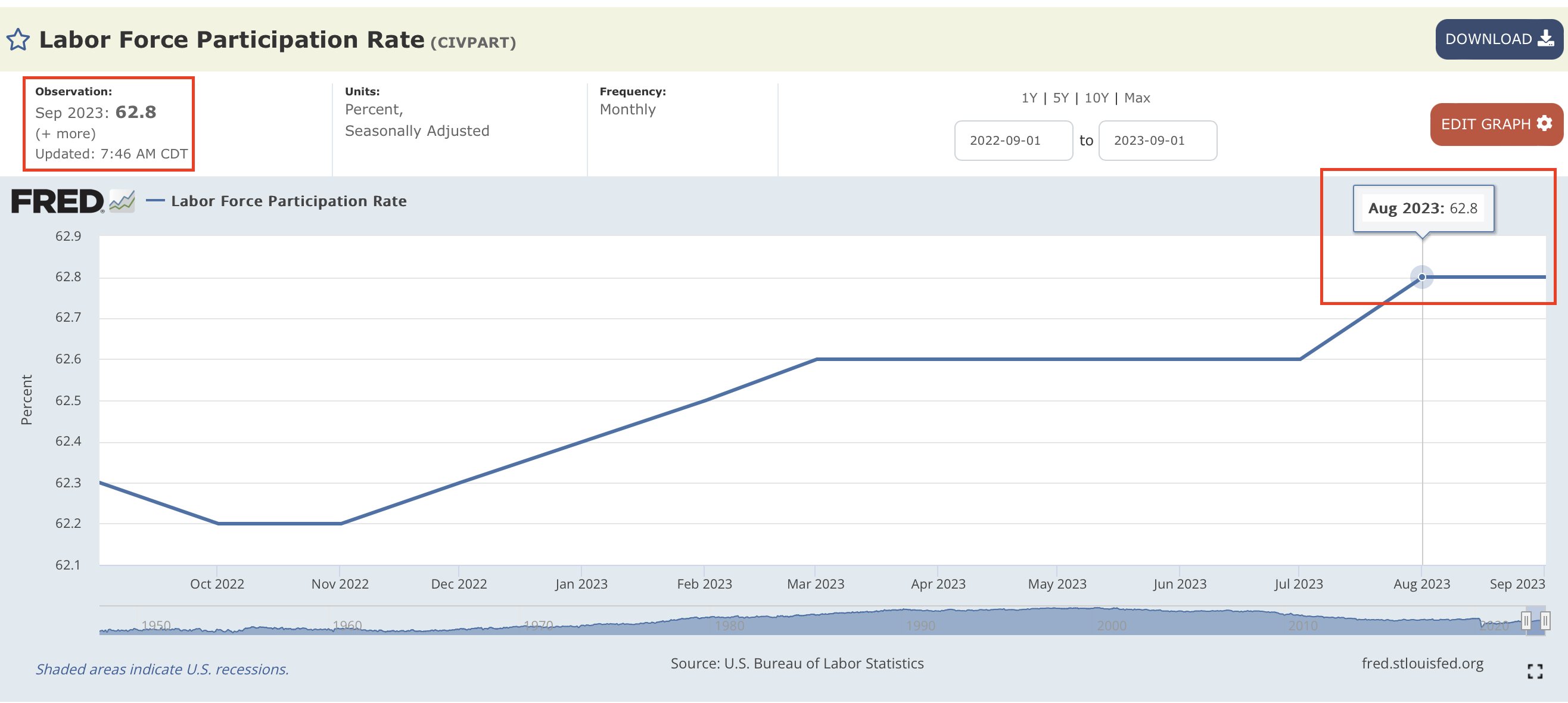
Take a look at total job force participation: it is completely unchanged. All the job changes taking place are just the same employees swapping jobs. There was no net change in the total number of people working.
Further, look at full-time employment numbers. Over the last 3 months, full time employment is down 692,000. This makes the multiple jobs numbers even worse - people are working more jobs, but only part time. This means more people are going without benefits like healthcare and 401k. Struggling to pay for a rising cost of living, and fewer people contributing to retirement accounts. While it’s a small impact to markets overall, it still means less money being invested.
In summary, if you look at all the jobs data together, it suggests more people are working multiple jobs. This is a sign of struggling households, not economic strength.



Peter retweeted
1/3 Long Form MEGA Thread
🚨The Hidden Shadow Money Space🚨
🧵On a typical day, a staggering FOUR TRILLION dollars flow through a concealed shadow money space, lurking beyond the reach of bank balance sheets. But that's just the tip of the iceberg – estimates suggest there could be up to 100 TRILLION dollars in outstanding contracts, all hidden from plain sight.
Brace yourselves, the shadowy heart of the eurodollar system is fickle and fragile, and it's not through repos, though they're important. No, the real danger lies in the enigmatic world of FX, and you need to know what goes in here.
FX Market: The Heart of Darkness
First things first – dealers are the lifeblood of this colossal system. It's not merely a market; it's a global redistribution of currency and monetary resources. We're not trying to glorify it, but this is how our world operates today. The eurodollar system still thrives, albeit at reduced capacity since its 2007 breakdown. But now, the emphasis has shifted to the FX market, and the importance of dealers cannot be overstated.
A Glimpse into the Shadows
Enter the (BIS) and their recent report on Bank Positions in FX Swaps. "Payment obligations in FX swaps are massive yet shrouded in opacity. The short-term nature of these instruments makes the FX swap market susceptible to funding squeezes Central banks stepped in during the 2020 pandemic” with dollar swaps to rescue the day (according to the official story, anyway). But the FX market's significance is undeniable – even if you can only find them in bank footnotes!
Why We Obsess Over Curves
Without any direct window into the shadow money operations, that's why we delve into all the various esoteric curves for useful information. Money curves, bond curves, and FX movements unveil the system's inner workings, free from bias and unfiltered. Curves can't be faked, the tape is the tape; it reveals the system's essence, its importance, and why dealer banks are right at the center of the global money universe.
This is Part 1/3 of The Important of FX markets Deep Dive, check my next post for the rest, or watch the full video i did here: youtu.be/IC47LyAdX_E?si=RaS2…


RT @JC_Investment: Carve this to your foreheads :
1. Stocks will bottom soon. Treasury yields will top out
2. This will cause stocks to r…
Peter retweeted

The first anti-CBDC bill in the United States passed out of the Financial Services Committee today! A historical step in defending against an ever-expanding government surveillance state.

