
Pesquisas eleitorais, tendências de voto, chances de vitória, avaliação dos institutos e apuração em tempo real. Tudo em um só lugar.
Joined April 2022
- Tweets252
- Following8
- Followers12.9K
- Likes345


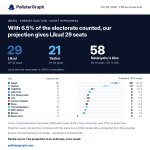



Israel, partial count (31% of the electorate, 3,906 ballot boxes, read 4:51 am Israel time): @PollsterGraph projection gives Likud 27 seats (80% range 25–28) and Netanyahu's bloc 56 (54–58); 61 or more in <1% of simulations. pollstergraph.com/results/il…

🇮🇱 ISRAEL ELECTION UPDATE
With 6.5% of the electorate counted, PollsterGraph projects:
• Likud: 29 seats
• Yashar: 21 seats
Likud is projected to finish first in over 99% of simulations, but Netanyahu's bloc has just a 14% chance of reaching the 61-seat majority.

Who wins the most Knesset seats? Here, PollsterGraph and Polymarket answered essentially the same question, but reached opposite conclusions.
PollsterGraph: Likud 70.5%, Yashar 28.5%.
Polymarket: Likud 32.5%, Yashar 67.5%.
Full forecast: pollstergraph.com

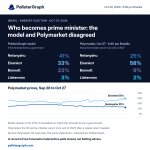
Who becomes prime minister?
Our model, conditional on this Knesset forming a government: Netanyahu 41%, Eisenkot 33%.
Polymarket, predicting the first PM sworn in by the end of 2027, including after a possible new election: Eisenkot 58%, Netanyahu 25%.

How did the model perform historically?
Tested on seven Israeli elections from 2013 to 2022, the actual seat count for Netanyahu's camp fell within the model's 80% prediction range in 6 of 7 elections.
Each election was forecast using a model fitted on the other six.

Forming a government could be even harder.
Accounting for parties' publicly stated coalition red lines, a government formed in just 27% of simulations.
When those red lines were assumed to be three times more likely to break, that figure rose to 73%.
Forming a government could be even harder.
Accounting for parties' publicly stated coalition red lines, a government formed in just 27% of simulations.
When those red lines were assumed to be three times more likely to break, that figure rose to 73%.
Winning the most seats is not the same as securing a majority.
Netanyahu's bloc averaged 53.5 seats, reaching the 61-seat threshold in just 8% of simulations.
The opposition without Arab parties averaged 51.7 seats, reaching 61 in 5%, or 24% in a coalition with Ra'am.

Likud was projected to win 24.4 seats on average, followed by Yashar with 21.9 and Together with 12.4.
Four smaller parties faced uncertainty around Israel's 3.25% electoral threshold, where a fraction of a percentage point can determine whether a party enters parliament.

🇮🇱 Israel has voted. What did our model predict before the election?
Using 84 polls from 9 firms and 40,000 simulations, PollsterGraph gave Netanyahu's Likud a 70% chance of winning the most seats, against 29% for Eisenkot's Yashar.

A diferença final foi de 3,6 pontos, contra 3,4 projetados inicialmente.
Como funciona a projeção? O modelo combina pesquisas eleitorais, resultados históricos e votos apurados em cada estado para estimar os votos que ainda faltam ser contabilizados.
Às 19h14, com apenas 1,7% dos votos apurados, a projeção já indicava Lula 3,4 pontos à frente.
Às 20h09, com 31,2% dos votos contabilizados, a probabilidade de vitória de Lula já superava 95%.
A liderança na apuração oficial só veio às 20h24.
Na véspera da eleição, a média das pesquisas apontava Flávio Bolsonaro 1,7 ponto à frente de Lula, com 65% de chance de vitória.
Mas, com o início da apuração, os primeiros resultados começaram a indicar um cenário diferente.
O PollsterGraph antecipou a vitória de Lula 1h10 antes de ele assumir a liderança na apuração oficial.
Com apenas 1,7% dos votos apurados, já era possível projetar o vencedor da eleição presidencial.
Veja como foi.

PollsterGraph estima 95% de chance de vitória para Lula, contra 5% para Flávio Bolsonaro.
Com 33,2% dos votos esperados apurados, o modelo projeta Lula com 51,4% dos votos válidos.

Veja como mudou a margem de votos entre 2022 e 2026 nas mesmas seções eleitorais:
pollstergraph.com/analises/b…

Com a apuração do TSE paralisada, o PollsterGraph comparou 725 grupos de seções no Brasil.
Lula avançou em 61,9% deles. A margem passou de 2.398 votos pró-Jair Bolsonaro em 2022 para 2.637 pró-Lula em 2026, uma mudança de 5.035 votos.

A apuração do 2º turno já começou no exterior!
Acompanhe ao vivo no PollsterGraph os resultados da eleição com mapa interativo, evolução da apuração e probabilidades de vitória.
Mais de 57% das seções no exterior já foram apuradas.
Acompanhe: pollstergraph.com/results

ELEIÇÕES 2026 | #Tocantins
Na pesquisa Atlas/PollsterGraph, Vicentinho Júnior (PSDB) registra 59,5%, contra 40,5% de Professora Dorinha (União Brasil)
No agregador: 56,4% a 43,6%
Probabilidades de vitória: Vicentinho 99% e Dorinha 1%
#Eleições2026 #PollsterGraph


