

Leading the charge to keep prediction markets accessible to everyone. Views are the Coalition's own.
Joined November 2025
- Tweets451
- Following310
- Followers1.5K
- Likes384




Yep. We need to keep prediction markets federally regulated here in America.
If we do, we'll have stronger consumer protections, real-time surveillance, anti-money-laundering safeguards, and enforceable market-integrity standards that don't exist on unregulated overseas platforms.

Prediction markets are growing because Americans want them.
Robinhood's @JBMackenzie_ warns against policies that could drive that demand overseas:
“What we don't wanna do is shut that engagement down and send it overseas.”
"we're talking about accuracy in the realm of 98%+"

@nkagan_official is the true midterms 🐐
bloomberg.com/news/videos/20…

Coalition for Prediction Markets retweeted

Last night, the power to decide what America sees changed hands.
I have spent a ton of time in DC over the last few months. The elites were certain the markets were off. I heard many variants of “no chance markets are right about X” and “I’ve been in politics for a decade. ‘These people’ don’t really know much.”
Last night, ‘these people’ beat the elites.
Prediction market favorites won 479 of the first 487 races. That’s 98%.
The elites live in a bubble. They theorize, write, ideate, and mistake credentials for an understanding of lives they’ve never lived. They don’t see and feel what the everyday man, on the ground, sees and feels.
Knowledge is not exclusive to the elites but scattered across millions of people.
Someone knows their hometown better than any national pundit. Someone has followed a local race passionately for months. Someone has followed a local race dispassionately for months. Someone notices a shift in their community before it makes the headlines. Someone is shaped by an incident at work. Someone is shaped by what’s getting harder or easier for their families.
Each holds a piece of the picture that no expert can see in full.
And for the longest time, that knowledge had no way to reach the rest of the world.
For generations, election night meant turning on the TV and waiting for a handful of people to tell you what happened.
Prediction markets change that.
You don't need a title, a large following, or an editor to publish you. All you need is a perspective and the conviction to back it.
That changes who holds power over information.
Anyone can see the market. Anyone can contribute to it. Anyone can question it. No title gives you the final word. No gatekeepers can filter your view.
Sometimes the signal can be wrong. But anyone can challenge the consensus and improve it.
And when people consolidate their knowledge together, something remarkable happens: millions of individual perspectives become a signal that we all can learn from.
Over the last few months, the people showed up on Kalshi to tell the world what they were going to do.
Last night, the megaphone was passed to them.


🔥🔥
@SeanPMaloney: "Maloney says just 25 percent of the site’s traffic comes from traders; the other 75 percent is from people looking at the crowd-sourced forecast. If this election is any indication, more people will be watching prediction-market odds on TV as networks embrace the trend."

The prediction market Kalshi cemented its place in political coverage on Tuesday night — and, like it or not, for future elections to come. nymag.com/intelligencer/arti…


Coalition for Prediction Markets retweeted
Excellent performance from prediction markets this election. RWers kept insisting they were rigged. But the wisdom of crowds did an excellent job of forecasting.
"which forecasted a blowout hours before traditional media made that call."


Coalition for Prediction Markets retweeted
Markets over noise.
For far too long, we’ve relied on polls, pundits, and experts to tell us what America thinks.
But the truth doesn’t belong to a select few.
It belongs to everyone.
Prediction markets put power in the hands of the people, turning millions of independent opinions into a collective view of the future.
No gatekeepers. No central authority deciding what’s true.
Just real people putting their conviction behind what they believe on a free market.
Because the best way to understand what America thinks isn’t to handpick a few voices and give them a megaphone.
It’s to let the market speak.

Coalition for Prediction Markets retweeted

Bloomberg's @TheStalwart lays out why he trusts prediction markets:
"I doubt any of us know more than what people bet."
"Markets are really good conventional wisdom distillers, and that's actually very valuable."
"People will say that as a sneer. They're like, oh, this is just conventional wisdom. And I'm like, no, that's actually really good."
"You say candidate A is favored over candidate B. Well, is it 55% or is it 80%? Now we actually have a number that we can put on it."
"When a market has a Democrat at a 40% chance of winning Texas, my view is you got to take that seriously."
Happy Election Day 🗳️🇺🇸
Prediction markets aren't crystal balls. They don't replace polls, news or pundits - they add to them.
They're a nonpartisan information source and a useful real-time signal of what's happening. And tens of millions of people will be watching them tonight.
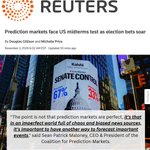
More from @SeanPMaloney in @Reuters:


Election prediction markets are growing faster than ever, outpacing the growth of sports markets.
As voters look for real-time insight into where key races stand, it's clear prediction markets are an essential source of election-night information.
@SeanPMaloney @bloombergtv on what's driving that growth:
A must-listen before Tuesday 🎧👇

The final pre-election episode of Beyond the Polls features @SeanPMaloney talking prediction markets, Cook Political’s @JessicaTaylor explaining the Senate races, and @scottbraddock choosing Texas. Listen!!
ricochet.com/podcasts/beyond…

Coalition for Prediction Markets retweeted

Questions I'd like to understand better about states rights vs federal pre-emption for prediction markets.
Could a state decide it does not want its residents to have access to the stock exchange or 401k plans?
If prediction markets are regulated as financial markets, what is the difference?

Utah has filed criminal charges against Kalshi Inc, alleging the company illegally promoted online gambling in the state amid an escalating fight over prediction markets bloomberg.com/news/articles/…

"If anything, it proves my argument: we need one clear federal standard, set by the regulator Congress actually picked - not fifty states and a dozen courts each drawing the line somewhere different."
@GivnerAriel makes the case in today's @rcmarkets op-ed on the Ninth Circuit's recent decision. Read more 👇


Coalition for Prediction Markets retweeted

.@SeanPMaloney on prediction markets: "It's you and me trading as counterparties... with a neutral exchange we're transacting on that's taking a small fee."
Sportsbooks kick out winners. Markets don't.
"By the tens of millions, the consumer has said, 'We'd rather do it that way.'"
Worried about manipulation and insider trading in prediction markets?
@SeanPMaloney on @BloombergTV breaks down how our members protect market integrity:
☑️ Being based in the U.S. with strong federal oversight from the @CFTC
☑️ Market forces that make manipulation costly
☑️ Proactive surveillance, insider trading restrictions, and safeguards against trading on material nonpublic information
☑️ Working with law enforcement to investigate, refer, and prosecute misconduct
Trust in markets isn't automatic. It's built through strong rules, active enforcement, and accountability.
WATCH: @SeanPMaloney @BloombergTV on polls vs. markets.
Polls can be biased, expensive, and only capture a snapshot.
Markets move in real time.
That's why candidates on both sides of the aisle - and major news organizations - turn to prediction markets to see where expectations are shifting and stay ahead of the story.