

Yihe Huang's Earthquake Physics Lab @ University of Michigan
Joined April 2020
- Tweets271
- Following277
- Followers739
- Likes645





Huang Earthquake Mechanics Lab UMich retweeted

🚨 AGU26 Faultless Friendship Network
We are re-launching the Faultless Friendships Network! Establish networks with fellow seismologists, whether you’re a first-time attendee ✨️, solo traveler 🎒 or a virtual attendee! 🌍💻
🔗 Sign up: forms.gle/yfnUHVYpLtLcGPTRA #AGU26

Excited to share our recent Science Advances publication was highlighted in the news!
By studying both the fault and the region surrounding the fault, we explain why different earthquakes occur and what size they might be.
news.umich.edu/u-m-researche…

Huang Earthquake Mechanics Lab UMich retweeted

U-M researchers build a better earthquake model news.umich.edu/u-m-researche…
Huang Earthquake Mechanics Lab UMich retweeted

Yoshida, K., Ide, S., & Huang, Y. (2026). Multi-scale growth of an Mw 7.0 earthquake via hierarchical cascading rupture from an Mw 3.8 repeating event. Geophysical Research Letters, 53, e2026GL125835. doi.org/10.1029/2026GL125835

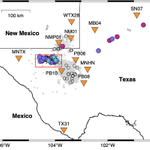
It’s out! Earthquakes are becoming increasingly common in the Delaware Basin of West Texas and New Mexico. Our research improves how earthquake size is measured, helping advance understanding of seismic hazard and risk across the continental U.S.
doi.org/10.1785/0220250246

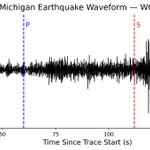
Did you feel this earthquake in southeast Michigan on May 4th? Here’s a local station showing the P and S wave arrivals! #earthquake #GoBlue #Umich #Michiganearthquake


Astrid, one of our undergrads, presented her research on Southern California Earthquake Swarms at the Michigan Geophysical Union. Great job, Astrid!
#Seismology #earthquakeresearch #Umich #GoBlue #earthquakeswarms


In honor of International Day of Women and Girls in Science, read about a @UMich alumna who helped change geology and geophysics forever through her discovery of continental drift! 🌍
👉 smithsonianmag.com/history/s…
#WomenInScience #MarieTharp #STEM #UMich #GoBlue

Last month, our lab attended #AGU25 in New Orleans 🌎 We had a great time and look forward to the future of Earth science and seismology!
#seismology #earthquakescience #AGU

M7.6 Earthquake off the coast of Japan near Misawa! The area is located near the subduction of the Pacific and North American plates, which has historically experienced multiple M 7.5+ events.
earthquake.usgs.gov/earthqua…
#earthquake

Members of our lab group were excited to be able to attend the 2025 annual CRESCENT meeting— connecting, learning, and sharing research with others!
cascadiaquakes.org/2025/09/1…

Huang Earthquake Mechanics Lab UMich retweeted

📣 Register today for SSA's Networking to Find Collaborators and Build Your Career
📆 Tuesday 18 November, from 11 AM-Noon Pacific
✅ Registration link: buff.ly/jQB6Ki6
@sacnas @AccessibleGEO @ADVANCEGeo @DiverseGeos

Huang Earthquake Mechanics Lab UMich retweeted

The 28 March earthquake in Mandalay, Myanmar, caused fatalities across a broad swath of the country and beyond.
This special issue of Science features papers exploring the risk and reasons behind the anomalously fast, sustained rupture. scim.ag/3LeVvSz

ALT A Buddha statue lies face down in rubble in this photo taken a week after the 28 March earthquake in Mandalay, Myanmar.
Huang Earthquake Mechanics Lab UMich retweeted
DAS Moment Magnitude Calculation in the Time Domain for General Dislocations: Application at Utah FORGE #BSSA
How do you calculate seismic moment with DAS data?
buff.ly/wdxm8Nj

Huang Earthquake Mechanics Lab UMich retweeted
Yaolin Miao, Yihe Huang, Jing Ci Neo, Wenyuan Fan, Zack J Spica, Assessing the Applicability of Distributed Acoustic Sensing in Rupture Imaging: a Case Study with the 2022 Michoacán Earthquake, Geophysical Journal International, 2025;, ggaf401, doi.org/10.1093/gji/ggaf401
⚠️ Three M7+ earthquakes have occurred in the Drake Passage — located between South America & Antarctica — since May. The strongest, a M7.6 on Oct 10th, was recorded within the Antarctic Plate as a shallow strike-slip event, near the August M7.5 quake. #earthquake

Large earthquake (7.4M) just struck off the east coast of Mindanao, Philippines! This earthquake occurred in a highly hazardous region where the Philippine Sea plate is subducting under the Sunda plate. #Earthquake #Philippines

A new damage rheology model simulates how fault slip and deformation evolve across seismic cycles and successfully reproduces key #earthquake observations, including shallow slip deficit, fault-zone structures, and seismic velocity changes! doi.org/10.1093/gji/ggaf274
