Michael Kee (@RealMichaelKee) header
Michael Kee (@RealMichaelKee) profile picture

I am a financial analyst helping you unravel markets. Subscribe for unique insights. Stocks/Options/ETF's #Economics #Finance

Nashville, TN
Joined September 2021
Photo by Michael Kee (@RealMichaelKee)Photo by Michael Kee (@RealMichaelKee)Photo by Michael Kee (@RealMichaelKee)Photo by Michael Kee (@RealMichaelKee)Photo by Michael Kee (@RealMichaelKee)Photo by Michael Kee (@RealMichaelKee)Photo by Michael Kee (@RealMichaelKee)Photo by Michael Kee (@RealMichaelKee)
An extensive break down of put credit spreads! This is the first of many I will posting over the next few weeks. Feel free to ask me questions, or provide any content suggestions!
2
4
1
12
1,295
One time I tried some of the trading strategies promoted by larger FinX influencers in my paper trading account: The paper trades went so poorly that my broker gave me a real margin call! 💩📈📉😂
1
28
So it's not the quality of your content that drives the algorithm, it's the quality of your 'figure' and the willingness to show it 😂📉
Saw a FinX account run by an attractive woman. Most posts were in-depth trading and analysis, with a few posts of her posing at the gym: Her investment post: Average 1-2 comments, <10 likes, and <2.5k impressions Gym bod post: 50+ comments, 200+ likes, and 50k+impressions. 😂
1
44
Michael Kee retweeted
Saw a FinX account run by an attractive woman. Most posts were in-depth trading and analysis, with a few posts of her posing at the gym: Her investment post: Average 1-2 comments, <10 likes, and <2.5k impressions Gym bod post: 50+ comments, 200+ likes, and 50k+impressions. 😂
1
1
51
Saw a FinX account run by an attractive woman. Most posts were in-depth trading and analysis, with a few posts of her posing at the gym: Her investment post: Average 1-2 comments, <10 likes, and <2.5k impressions Gym bod post: 50+ comments, 200+ likes, and 50k+impressions. 😂
1
1
51
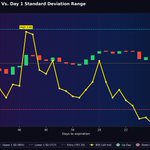
I realize I may have made this post a little more complex than it needed to be with some of the terminology. The chart shows the ACTUAL daily premium prices for the 11/3 XSP 770 call & put options compared to the daily XSP price for the last 30 days. It is purely realized data points of what actually occurred. No assumptions. If you are buying at-the-money or out-of-the-money options, the longer your directional bet takes to occur, the larger and faster the directional move must be. Being directionally correct in the latter half of the trade becomes irrelevant as you get closer to expiration. You have an initial window of opportunity to make your money and get out. That is why selling option premium has a higher success rate. It affords you the ability to sit on losses that may occur in the early part of the trade, allowing time to erode those losses if the option remains out-of-the-money. This concept holds regardless of how far out expiration day is. Whether you are trading OTM LEAPS or 0 DTEs, it is all relative. The only thing that changes is how large the window of opportunity is before you need to cut your loss. This goes back to the "time-stop loss" I hit on in a prior post. If you have any questions or pushback, please ask!
Option traders, take a look at this!! 📉📈👇 IMO, this is the coolest chart I have put together in this entire XSP study. It clearly illustrates the most fundamental phenomenon in options trading: Time Decay outside of theoretical assumptions. 50 days ago (56 DTE), I started tracking the 11/3 XSP 770 Call (ATM call) when XSP was trading at --> $767.35 30 days ago (36 DTE), I added the 11/3 XSP 770 Put (basically the ATM put) to the study. On this day, XSP was trading at --> $768.37 I added the put option to the study so I could observe the straddle for the 770 call I was already logging. I didn't even pay attention to the underlying price at that moment. However, as a matter of pure luck, on that same day (36 DTE), XSP closed only $1 above the day 1 mark, making the 770 straddle pretty much the ATM straddle as well! So with 36 DTE: - XSP = $768.37 - 770 Call Premium = $13.29 - 770 Put Premium = $11.22 Making the call side pretty rich. Over the last 30 days, XSP has traded above and below the $770 mark; both contracts have gone in and out of the money. As of yesterday (7 DTE): - XSP closed at -> $772.28 - 770 Call Premium = $7.39 - 770 Put Premium = $4.44 Even though XSP closed almost $4 higher than it did 30 days prior, the 770 call still lost 44% of its value. The 770 call option is also $2.28 in the money, so only $5.11 of the total $7.39 premium is extrinsic value. 30 days ago, the same contract was out of the money at $13.29 -> 100% extrinsic value. So, out of that original $13.29: -> $2.28 has now been converted to intrinsic value -> $5.90 was lost to theta decay. The 770 Put Option tells the same story. 30 days ago, it traded at $11.22 and was $1.28 in the money, with $9.59 of extrinsic value. Yesterday (7 DTE), the 770 put closed at $4.44, equating to a 60% loss in value. While some of that premium was lost due to an upward move in the underlying, time decay was the dominating contributor. I would also like to note that IV for both the put and the call is currently even, or slightly higher today than it was at 36 DTE. The loss in premium value was not IV crush or extreme price movement in any direction. It was simply just TIME! Now hindsight is always 20/20, but it's still an interesting point to make: If you had sold the straddle with 36 DTE (Sold both the 770 call AND the 770 put) and closed the trade out yesterday (7 DTE): - Total Premium Collected = $24.51 ($2,451) - Current Profit on trade = $12.68 ($1,268)-> 51% of max profit - Total days held = 30 days - Largest drawdown [occured at 28 DTE] = - $0.54 (-$54) I am by no means suggesting this as a viable strategy, or supporting this as a real trade. This post is purely educational and observational. The purpose is to provide insight into options from a neutral perspective. The lesson here is the significant influence that time has on premium compared to any other variable.
2
5
142
🚨Set a reminder for The Good Place ~ Stock Market Social!! My Co-Hosts @CaffeineCraig @ElijahColeman21 @RealtorStarShar We'll be discussing the FED's Interest Rate Decision! How it could effect the Stock Market moving forward 🔥 🕖 7 PM CT xitter.gq/i/spaces/1NxarobyaMrKj

12
5
1
26
906
Option traders, take a look at this!! 📉📈👇 IMO, this is the coolest chart I have put together in this entire XSP study. It clearly illustrates the most fundamental phenomenon in options trading: Time Decay outside of theoretical assumptions. 50 days ago (56 DTE), I started tracking the 11/3 XSP 770 Call (ATM call) when XSP was trading at --> $767.35 30 days ago (36 DTE), I added the 11/3 XSP 770 Put (basically the ATM put) to the study. On this day, XSP was trading at --> $768.37 I added the put option to the study so I could observe the straddle for the 770 call I was already logging. I didn't even pay attention to the underlying price at that moment. However, as a matter of pure luck, on that same day (36 DTE), XSP closed only $1 above the day 1 mark, making the 770 straddle pretty much the ATM straddle as well! So with 36 DTE: - XSP = $768.37 - 770 Call Premium = $13.29 - 770 Put Premium = $11.22 Making the call side pretty rich. Over the last 30 days, XSP has traded above and below the $770 mark; both contracts have gone in and out of the money. As of yesterday (7 DTE): - XSP closed at -> $772.28 - 770 Call Premium = $7.39 - 770 Put Premium = $4.44 Even though XSP closed almost $4 higher than it did 30 days prior, the 770 call still lost 44% of its value. The 770 call option is also $2.28 in the money, so only $5.11 of the total $7.39 premium is extrinsic value. 30 days ago, the same contract was out of the money at $13.29 -> 100% extrinsic value. So, out of that original $13.29: -> $2.28 has now been converted to intrinsic value -> $5.90 was lost to theta decay. The 770 Put Option tells the same story. 30 days ago, it traded at $11.22 and was $1.28 in the money, with $9.59 of extrinsic value. Yesterday (7 DTE), the 770 put closed at $4.44, equating to a 60% loss in value. While some of that premium was lost due to an upward move in the underlying, time decay was the dominating contributor. I would also like to note that IV for both the put and the call is currently even, or slightly higher today than it was at 36 DTE. The loss in premium value was not IV crush or extreme price movement in any direction. It was simply just TIME! Now hindsight is always 20/20, but it's still an interesting point to make: If you had sold the straddle with 36 DTE (Sold both the 770 call AND the 770 put) and closed the trade out yesterday (7 DTE): - Total Premium Collected = $24.51 ($2,451) - Current Profit on trade = $12.68 ($1,268)-> 51% of max profit - Total days held = 30 days - Largest drawdown [occured at 28 DTE] = - $0.54 (-$54) I am by no means suggesting this as a viable strategy, or supporting this as a real trade. This post is purely educational and observational. The purpose is to provide insight into options from a neutral perspective. The lesson here is the significant influence that time has on premium compared to any other variable.
1
1
6
281
The Tampa Bay Rays walking into game 5 of the World Series later tonight!
2
80
The Brewers will have to wait!! Crazy game!
3
224
On a serious note, is @grok Bot actually safe to connect accounts details to? Or will I just get hacked and lose all my money?
1
1
112
I asked Grok Bot to help me get a million impressions on X. It booked me in for a boob job next week, and bought me yoga pants on Amazon… 👀😂
3
5
236
Michael Kee retweeted
Interesting Update on my XSP option study!! 📈📉👇 The 805 call has provided some interesting insight into the difference between the future assumptions for time decay (theta rate) when entering a trade versus what actually happens in the real world. -On entry day (56 DTE), XSP closed at 767.35, and the 805 premium was $3.22, and Implied Volatility for this contract was 12.34% -At 13 DTE, XSP closed at $775.72 ($10 higher than our entry level), yet the 805 call premium fell to $0.30; that represents a 91% value loss in premium. Implied volatility had fallen to 11% (1.34% lower than day 1) -At 12 DTE (the very next day), XSP closed at $766.34, almost exactly $1 lower than our day 1 price, and the 805 call premium closed at $0.08. Implied volatility had also increased to 11.83% (only 0.51% lower than our day 1 IV) -At 11 DTE, which was Friday 10/23, XSP closed at $762.37, and the 805 premium was trading at only $0.04. Implied Volatility was 11.94% (only 0.40% lower than day 1 IV). That's roughly a 98% loss in premium value. If you factor in spreads and possible trade fees, this is essentially a 100% premium loss, and the option still has 11 days until expiration. -The current delta on the 805 call is realistically around 0.005, requiring XSP to make a 2.5 standard deviation upward move (less than a 1% chance) before expiration for this contract to become relevant again. If you were still long this contract, your chance of at least breaking even is less than 0.05% ($808.22 BE point). If you had sold this contract for premium, you're all but guaranteed the max profit on the trade if you let it expire. Regardless of whether you went long or short, you should have closed this trade out well before this point. The last 40 days of data show some of the disconnect between Greeks and future assumptions at entry versus what actually happens, even when many of the variables remain relatively stable. Premium is driven by supply and demand, and supply and demand are influenced by time first, and underlying price second. The Greeks are just an attempt to quantify the market's premium valuation at any particular point in time. $SPY $QQQ
2
8
126
For anyone on X paying a fee to a prop firm in order to trade a funded account, I have an even better business idea for you! 📉📈🔽🔽👇👇 There is a lucrative opportunity where you're the one getting paid the fee and trading a funded account. Here is how it works: Several companies will sponsor and pay you to study and take two quick assessment tests. They are known as the Series 7 and Series 66. As long as you pass these assessments with a mere 72%, people will literally pay you a fee to trade their money with full discretion! You can trade options, ETF's, mutual funds, bonds, individual stocks, etc... It gets even better! The fee you get paid grows relative to the success of your trading. You can also get paid a fee simply for providing people with great investment/trading ideas. Think of it as a bona fide financial influencer! The best part of all: Your chances of being successful are substantially higher than 99.9% of funded trading account opportunities that prop firms are charging you for. In fact, your biggest risk of losing money are usually recognized by the IRS as "business related" and are generally tax deduction. Oh, and I almost forgot! Most of the time you can do all of this from home!
1
6
137
If Jahmyr Gibbs just got hurt taking a knee instead of just scoring the touchdown, I’m going to be livid!
1
6
471
Why wouldn’t Utah go for the two-point conversion?! You miss it you’re still up by 7. You make it, your up by 9 and game is out of reach… Seems like a no brainer there
4
214
The pull ups were a bad idea haha
Alright College football workout for today: - 3 pull ups every offensive/special teams play for UTAH - 5 squats for every Houston offensive/special teams play. This one is going to hurt
5
233
Ok, I’ll make a compromise on the 24 team playoff: All of the “promised” non-conference P4 match-ups have to be played at the END the season when it’s do or die time.
1
74
Texas basically threw the onside kick back to ole Miss! Unreal!
3
196