

Frontier AI Data Lab advancing AI through better data
Redwood City, California
Joined July 2019
- Tweets2.2K
- Following504
- Followers18.3K
- Likes2.2K



Pinned Tweet
Today, we're expanding Open Benchmarks Grants 10x to a $30M commitment.
Benchmarks have always been guideposts for – and drivers of – AI development.
That's why we're going further to support researchers, domain experts, and open-source teams pushing the frontier of evaluation:
→ Funding the next wave of open benchmarks, from safety and cybersecurity to physical AI and long-running agents
→ Launching the Open Benchmarks Red Team to find and fix weaknesses in benchmarks
→ Introducing the Snorkel Research Fellowship for independent evaluation research
Rolling acceptances are open. Read the announcement and apply: benchmarks.snorkel.ai/fronti…

Today, we’re expanding @SnorkelAI’s Open Benchmarks Grants by 10x to a $30M commitment:
- Funding a more diverse, robust, and continuously-updated ecosystem of open benchmarks
- Launching the Open Benchmarks Red Team to continually test and strengthen them
- Introducing the Snorkel Research Fellowship to support independent contributors developing new evaluation methods
Since our launch earlier this year, we’ve been humbled to partner with the teams behind Terminal-Bench, TB-Science, ARC-AGI-3, OSWorld 2.0, Agents’ Last Exam, Continual Learning Bench, Senior SWE-Bench, SlopCodeBench, and more. Alongside these teams, we’ve helped design evaluation methodologies, develop task construction pipelines, and scale quality control. OBG-funded benchmarks have appeared on the latest model cards from every major frontier lab; have helped to index and measure frontier progress and alignment; and have contributed to guiding the frontier of AI development.
Benchmarks have always been guideposts for—and drivers of— AI progress: setting a metric and then “hillclimbing” against it is the core of how AI works! But when benchmarks fall behind frontier capabilities, our ability to evaluate and align these systems does as well. They become too simple, static, or correlated, and the risk of “benchmaxxing” increases.
We need more diverse, robust, and continuously-updated benchmarks, developed by a broader ecosystem of researchers and domain leaders.
We’re incredibly excited to accelerate frontier evaluation with Open Benchmarks Grants— raising the ambition and investment in robust, open, and independent measurement. Read our full announcement and apply here: benchmarks.snorkel.ai/fronti…

Snorkel AI retweeted

we are blown away by 300+ applications across Open Benchmarks Grants & our Research Fellows program!
for those who applied: thank you for your patience 😅 we are investing in thoughtful reviews and will be in touch soon!
PS - apps are still open and rolling, so please keep them coming!! benchmarks.snorkel.ai

Today, we’re expanding @SnorkelAI’s Open Benchmarks Grants by 10x to a $30M commitment:
- Funding a more diverse, robust, and continuously-updated ecosystem of open benchmarks
- Launching the Open Benchmarks Red Team to continually test and strengthen them
- Introducing the Snorkel Research Fellowship to support independent contributors developing new evaluation methods
Since our launch earlier this year, we’ve been humbled to partner with the teams behind Terminal-Bench, TB-Science, ARC-AGI-3, OSWorld 2.0, Agents’ Last Exam, Continual Learning Bench, Senior SWE-Bench, SlopCodeBench, and more. Alongside these teams, we’ve helped design evaluation methodologies, develop task construction pipelines, and scale quality control. OBG-funded benchmarks have appeared on the latest model cards from every major frontier lab; have helped to index and measure frontier progress and alignment; and have contributed to guiding the frontier of AI development.
Benchmarks have always been guideposts for—and drivers of— AI progress: setting a metric and then “hillclimbing” against it is the core of how AI works! But when benchmarks fall behind frontier capabilities, our ability to evaluate and align these systems does as well. They become too simple, static, or correlated, and the risk of “benchmaxxing” increases.
We need more diverse, robust, and continuously-updated benchmarks, developed by a broader ecosystem of researchers and domain leaders.
We’re incredibly excited to accelerate frontier evaluation with Open Benchmarks Grants— raising the ambition and investment in robust, open, and independent measurement. Read our full announcement and apply here: benchmarks.snorkel.ai/fronti…
Snorkel AI retweeted

The @SnorkelAI team did an audit of these findings using our internal QC platform.
Tl/dr: We agree with many of the findings, but ~55% of the fixes from @preferencemodel had their own issues with reward hacking or over-prescriptiveness.
Additionally: ~40% of the issues found were already tracked in the upstream repo - including 21 tasks with outstanding fix PRs!
Building datasets like this - and maintaining ambitious open benchmarks around them - is hard. We believe it requires open, collaborative review with community maintainers and relevant domain experts to get right.
@terminalbench was one of the first community efforts to build an open, continuous benchmark, and drive a vision of how OSS contributes to the rapidly advancing frontier of AI. We hope that the community will invest in working collaboratively with benchmark maintainers and task authors to keep this vision alive.
---
Some takeaways + details of our preliminary audit:
(1) We confirm 100% of the reward hacking / verification gap findings using our QC system. However, we find that 17/44 (39%) of the corrected tasks are just as or more reward hackable. Additionally, we don’t yet see evidence that these verification gaps meaningfully affected benchmark rollouts within CIs, though our analysis here is still ongoing.
(2) Our preliminary review raises questions about the underspecification findings for 22/41 (54%) of the flagged tasks, including 7 explicitly marked by task authors as intentional design choices. These cases warrant expert peer review and adjudication: balancing over/under-specification is a critical and tricky design decision - much of human intelligence concerns dealing correctly with reasonable and realistic underspecification - and we believe these corrections made to the tasks are likely too over-specified, reducing realism and difficulty relative to spec.
(3) Around 40% of the issues found were already tracked in the upstream repo (including 21 tasks with outstanding fix PRs)! OSS projects require community efforts to correct identified open issues, and ideally audits like these are done collaboratively with task authors and maintainers directly, in the traditional community spirit that has kept OSS alive for decades.


Snorkel AI retweeted

join @JonSaadFalcon & me at @SnorkelAI's reading group. come for the boba, stay for the ipw indoctrination 😊

Join us Wednesday, November 4 at 4:00 p.m. PT (+🧋) for our next Reading Group on Intelligence per Watt. RSVP: luma.com/41dbkzu4
@JonSaadFalcon and @Avanika15 (@HazyResearch, @Stanford) will present Intelligence per Watt: Measuring Intelligence Efficiency of Local AI, accepted to @NeurIPSConf 2026. Across 20+ models, 8 accelerators, and 1M real-world queries, IPW measures how much capability local AI delivers per watt, and which queries belong on-device instead of in the cloud.
Snorkel AI retweeted
As the online hype around AI data brokering hits a fever pitch, a lot are missing the basic distinction between
- (A) Unrefined data for pre-training: I.e. raw company records (potentially de-identified)
- (B) Refined data for post-training/eval: I.e. well-formed, high-quality tasks, envs, rubrics based on private data or human traces
(A) is low margin brokerage - and will commoditize rapidly, esp as pre-training data curation techniques mature and increase discriminative capabilities for buyers.
(B) is an incremental (but exciting) evolution of the sophisticated frontier data/envs that AI data labs/vendors already build. Margin/differentiation here will only increase as the frontier continues to advance, raising the quality and complexity bar.
ICYMI: @ajratner joined @NYSE Live on the trading floor to discuss why data is becoming central to AI progress.
He shares how organizations can build the data needed to train and evaluate increasingly capable AI systems, where specialized AI is headed, and why open benchmarks matter.
Watch the full conversation: youtube.com/watch?v=ZEFM2YGm…

Snorkel AI retweeted
Thank you to all of our speakers!! Some great chats with @fchollet, @dawnsongtweets , and many others at the @SnorkelAI Frontier Data Summit about the future of AI capabilities; benchmarking / evals; and AI data / environment development.
Check it out!
Frontier Data Summit talks are live: youtube.com/playlist?list=PL…
Ten sessions from researchers and builders on how we evaluate frontier AI, from agent evaluation and reward hacking to open benchmarks and real-world expert judgment.
Thank you to our speakers: @fchollet, @dawnsongtweets, @alexgshaw, @sanmikoyejo, @sudip_r0y, @ysu_nlp, @nikogrupen, @HuaxiuYaoML, @bradenjhancock, @dlwh, @StevenDillmann, @RussellYang16, @GOrlanski, @ajratner, @vincentsunnchen, @fredsala, and more!
Snorkel AI retweeted

In fact rather than using AI to perform cognitive offloading, we should be using it to produce cognitive gains.
If you are also excited by these ideas, check out @SnorkelAI 's Open Benchmarks Grant program—we’d love to partner!
Can a 4B model outperform a 235B model on financial analysis for under $500?
At @aiDotEngineer World’s Fair, research scientist Charles Dickens shared how verified financial data and reinforcement learning helped train a smaller finance agent, and what the results reveal about tool use, task design, and evaluation.
Watch the talk: youtube.com/watch?v=TyPpSRXG…

Snorkel AI retweeted

TB-Science 🤝 FutureSim! At the Frontier Data Summit by @SnorkelAI
Turns out we are all from the same region in Germany! In the order:
Tübingen <-> Metzingen <-> Stuttgart

Snorkel AI retweeted
Really enjoyed Terry Tao's talk at @SAIRfoundation 's Science x AI Summit.
Particularly liked this thoughtful categorization of the old and new worlds of math (pre and post-AI), with the degree of human understanding being the key variable to realizing the benefits of AI and avoiding the pitfalls.
"Misaligned math" is also a nice way to term the possible bad case.

Snorkel AI retweeted
not all failures are equal!
@mefatemi + @SnorkelAI research shows how partial credit can lead to models that prefer 'better' failures over task completion

Which model would you rather have? One always makes partial progress but never finishes (pass@k = 0). The other finishes one time in five.
Yet partial credit prefers the first!
Our new post shows when and why, and how "binary-gated GRPO" addresses it:
snorkel.ai/blog/when-partial…

Frontier Data Summit talks are live: youtube.com/playlist?list=PL…
Ten sessions from researchers and builders on how we evaluate frontier AI, from agent evaluation and reward hacking to open benchmarks and real-world expert judgment.
Thank you to our speakers: @fchollet, @dawnsongtweets, @alexgshaw, @sanmikoyejo, @sudip_r0y, @ysu_nlp, @nikogrupen, @HuaxiuYaoML, @bradenjhancock, @dlwh, @StevenDillmann, @RussellYang16, @GOrlanski, @ajratner, @vincentsunnchen, @fredsala, and more!
Snorkel AI retweeted
I'm at @SAIRfoundation's Science x AI Summit at @UCLA today!
Looking forward to speaking on the panel "From Frontier Labs to the Research Bench: How Industry Is Building for Science" with Sudipta Sengupta, @khademh, @maximelabonne, @zhoubolei, and Amit Gupta.
Snorkel AI retweeted
Very cool result from the @SnorkelAI research team on how to adjust GRPO to effectively improve recall on RL-tuned models for long horizon tasks (esp impactful in domains with available verifiers!)
Which model would you rather have? One always makes partial progress but never finishes (pass@k = 0). The other finishes one time in five.
Yet partial credit prefers the first!
Our new post shows when and why, and how "binary-gated GRPO" addresses it:
snorkel.ai/blog/when-partial…
New research from @mefatemi: partial credit can rank a policy that never finishes above one that does. Here's when it happens, and how binary-gated GRPO fixes it.
Which model would you rather have? One always makes partial progress but never finishes (pass@k = 0). The other finishes one time in five.
Yet partial credit prefers the first!
Our new post shows when and why, and how "binary-gated GRPO" addresses it:
snorkel.ai/blog/when-partial…
Snorkel AI retweeted

Today we're announcing that Modal has crossed $1B in annualized run rate, as well as raised a $750M Series D at a $15.75B valuation, led by @Accel.
Since our Series C, usage has tripled and we’ve grown more than 15x year-over-year.
We are deeply grateful to the developers and companies building on Modal. There's still so much more to build, and we can't think of a better time to be building software.
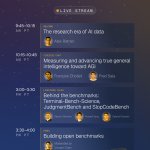
The Frontier Data Summit keynote "The research era of AI data" with @ajratner just dropped 👀
00:00 Intro
06:03 Data 1.0 vs. Data 2.0
18:31 The RSI loop for data
23:09 Benchmark maximalism
24:53 Open Benchmarks Grants and fellowships
More on our YouTube soon.
Snorkel AI retweeted

🔬 Calling scientists across disciplines: help build SciVeri-Bench v1.0!
After showcasing SciVeri-Bench v0.1 at the Frontier Data Summit hosted by @SnorkelAI, we’re now building v1.0 and inviting scientists from a wide range of fields to contribute scientific tasks.
🤔 What is SciVeri-Bench?
SciVeri-Bench is a deploy-first, scientist-driven benchmark for evaluating AI agents’ scientific verification capabilities on open-ended, novel scientific tasks.
🎯 Why are we building it?
- Stop to chasing maximing score in benchmark, rather we want to understand whether AI agents verify whether AI agent doing good science as domain scientist do
- Domain scientists only verify whether the science is good or bad, while agents do a lot of execution and exploration, but we really want to show that scientists can make novel discoveries
📝 How are tasks collected?
All task submissions and communication take place on OpenReview, so domain scientists can focus on proposing open-ended & novel scientific tasks and verifying agent outcomes.
🤝 What do scientists receive?
- All costs of running the agents are covered by the SciVeri-Bench team.
- Intellectual property rights to scientific discoveries made by AI agents belong to the scientist who proposed the task.
- Co-authorship on the SciVeri-Bench paper.
How can you contribute?
(1) Task Proposal: Propose a scientific task for SciVeri-Bench.
(2) Task Review: Review scientific tasks proposed by other scientists.
Interested in joining us?
👉 Sign up: forms.gle/bv9KZK6mW6ubBJXZ9
🌐 Website: sciveri-bench.com/
🙏 Huge thanks to our team, contributing scientists, advisors, and sponsor!
AI researchers: @seungonekim @jinheonbaek @yoonholeee @JiayiiGeng
Task proposers: 16 scientists who have joined so far
AI advisors: @StevenDillmann @SoojungYang2 @AkariAsai @gneubig @wellecks @dongyeopkang
Sponsor: openrefinery.ai/
We’re also looking for more sponsors and senior scientists!
Note: This work does not relate to any work conducted at Amazon
ICYMI: @vincentsunnchen joined @MTSlive with @theojaffee to announce the 10x expansion of Open Benchmarks Grants to a $30M commitment, including the new Open Benchmarks Red Team and Snorkel Research Fellowship.
00:42 The $30M commitment
02:42 Three axes for evaluating AI
03:58 Open Benchmarks Red Team
09:56 AI development outpacing measuremen
Today, we’re expanding @SnorkelAI’s Open Benchmarks Grants by 10x to a $30M commitment:
- Funding a more diverse, robust, and continuously-updated ecosystem of open benchmarks
- Launching the Open Benchmarks Red Team to continually test and strengthen them
- Introducing the Snorkel Research Fellowship to support independent contributors developing new evaluation methods
Since our launch earlier this year, we’ve been humbled to partner with the teams behind Terminal-Bench, TB-Science, ARC-AGI-3, OSWorld 2.0, Agents’ Last Exam, Continual Learning Bench, Senior SWE-Bench, SlopCodeBench, and more. Alongside these teams, we’ve helped design evaluation methodologies, develop task construction pipelines, and scale quality control. OBG-funded benchmarks have appeared on the latest model cards from every major frontier lab; have helped to index and measure frontier progress and alignment; and have contributed to guiding the frontier of AI development.
Benchmarks have always been guideposts for—and drivers of— AI progress: setting a metric and then “hillclimbing” against it is the core of how AI works! But when benchmarks fall behind frontier capabilities, our ability to evaluate and align these systems does as well. They become too simple, static, or correlated, and the risk of “benchmaxxing” increases.
We need more diverse, robust, and continuously-updated benchmarks, developed by a broader ecosystem of researchers and domain leaders.
We’re incredibly excited to accelerate frontier evaluation with Open Benchmarks Grants— raising the ambition and investment in robust, open, and independent measurement. Read our full announcement and apply here: benchmarks.snorkel.ai/fronti…