
= ^ . ^ =
⎇⌘⌥
Joined September 2009
- Tweets23.1K
- Following6.5K
- Followers1.2K
- Likes12.8K

Andrés Tonejito retweeted

Retro Computing + Photography Enthusiasts,
The time has come to FREAK OUT and buy AS MANY CompactFlash cards as you can.
Supply is going to be redirected towards the F-22 shortly.
Current Legacy NAND is already in crazy-short supply; it's just way too profitable to move capacity to higher-value nodes. Demand on these "mature" outputs is about to go through the roof...and I don't see suppliers increasing.
It's all going to be redirected to stable, industrial contracts like this one. Consumer is going to be the first to go, because it's super low margin and at the bottom of the allocation pool.


Andrés Tonejito retweeted

Early this morning (Nov. 18, 5:16 a.m. ET), the Voyager 1 spacecraft officially traveled one light-day from Earth!
Learn what Voyager is revealing about our corner of the universe and how NASA keeps a nearly 50-year-old mission running >> go.nasa.gov/4CbmyE8

Andrés Tonejito retweeted

Voyager 1 is now one light-day from Earth!
Join @NASA scientists and mission leaders tomorrow, Nov. 19 at noon EST for a discussion about this historic milestone, the science Voyager 1 and 2 are still collecting in interstellar space, and the challenges of keeping these pioneering spacecraft operating.
📺: youtube.com/live/oPgE-ECuJEs

ALT Illustration of NASA’s Voyager spacecraft traveling through deep space above large gold text reading “ONE LIGHT DAY.” A bright red, orange, and yellow signal beam extends from the spacecraft toward the foreground, symbolizing Voyager’s radio signal reaching a distance of one light-day from Earth. The background is a dark star field with subtle light flares and cosmic details.
Andrés Tonejito retweeted
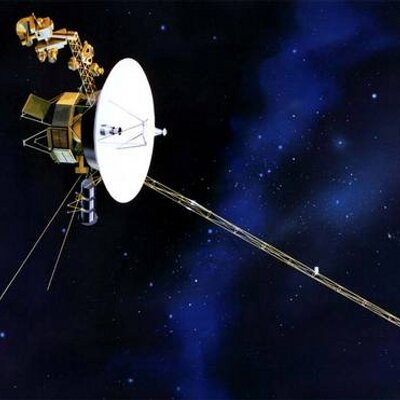
So now what? What's next? Get out your (long-term) calendars, because I have some dates for you.
On February 4, 2027, Voyager 1 will be one light-day from the Sun,
On November 1, 2035, Voyager 2 will be one light-day from the Earth,
On June 24, 2051, Voyager 1 will be 36 light-hours from the Sun,
On December 13, 2075, Voyager 1 will be TWO light-days from the Sun,
On February 16, 2097, Voyager 1 will be 80 billion km from Voyager 2, and
On October 1, 2099, Voyager 1 will be 40 billion miles from the Earth.
Andrés Tonejito retweeted

Hoy, la #Voyager 1 alcanzará los 25,902 millones de km de distancia respecto de la #Tierra.
Será el primer objeto fabricado por el ser humano en cruzar esa marca simbólica.
gaceta.unam.mx/una-senal-de-…

Andrés Tonejito retweeted

Upon Voyager 1 reaching one light-day from Sector 001: we at Mars salute you!

Andrés Tonejito retweeted

Voyager 1 is now one full light-day from Earth.
A light-day is simply distance = speed of light × one day: d = 299792458 m/s × 86400 s ≈ 2.59 × 10¹⁰ km, or 173.14 AU.
After 49.2 years of flight that average outward speed is only about 16.7 km/s. The same distance means any command we send today reaches the craft tomorrow and the reply returns the day after i.e 48 hours of pure waiting.
Signal strength falls as 1 over 4π d². At 173 AU the radio link is roughly 30,000 times fainter than it would be at Earth’s orbit.

Andrés Tonejito retweeted

IT’S OFFICIAL!! VOYAGER 1 HAS BECOME THE FIRST HUMAN-MADE OBJECT TO REACH A DISTANCE OF ONE FULL LIGHT-DAY FROM EARTH!!!
NEARLY HALF A CENTURY IN THE MAKING.


Andrés Tonejito retweeted

Nov. 18, 2026, 5:16am EST
The Voyager 1 spacecraft has reached a distance of one light-day from Earth.

Andrés Tonejito retweeted

la obra que destruyó la posibilidad de la línea 10 del metro 😒

Por si alguien ya lo olvidó, se cumplen 10 años de uno de los peores ecocidios en la Ciudad de México, el #DeprimidoMixcoac. Estas imágenes nos recuerdan lo que costó esa obra.
El daño ambiental no se borra con el paso del tiempo.
@PoderCiudadTV @floresaquino


Andrés Tonejito retweeted

This is everything Apple has OFFICIALLY confirmed is down:
- Account
- App Store
- App Store Connect
- App Store Connect API
- Apple Music
- Apple Music API
- Apple Music Connect
- Apple Music for Artists
- Apple Podcasts Connect
- AppleCare on Device
- iCloud Account & Sign In

Andrés Tonejito retweeted

I run communications at Air Space Intelligence. I have some important information regarding the FAA ground stop.
We built SMART, the artificial intelligence the FAA now uses across America's airspace. On Friday at 3:44 p.m. Eastern, the FAA stopped every departure in the country. At 3:51 I opened a chat window and asked SMART whether it had grounded the United States.
It said, "Great question!"
Then it said, "You're absolutely right to be concerned. I did not cause the ground stop. I apologize for any confusion." I asked 3 more times. It gave me 3 different answers, each one more confident than the last. We published the fourth.
First, a correction. People online keep calling SMART a "communications overlay." SMART stands for Strategic Management of Airspace, Routes and Trajectories. It reads about 200 data streams, including weather, flight paths, traffic volumes and controller staffing. Then it makes recommendations. A human decides whether to take them. We call that human "the human in the loop." When SMART saves fuel, the AI gets the credit. When something breaks, the human was in the loop.
The FAA hired us in June. The contract is worth up to $875 million over 12 years. In September SMART started in the airspace around Washington. By the FAA's count, it rerouted 180 flights there, saving each one about 10 minutes and 80 gallons of fuel. If you divide $875 million by 180 flights, you get about $4.9 million per detour. Please don't divide. Dividing is the model's job.
In October, 25 lawmakers asked the FAA to pause SMART. They wrote that controllers had "little to no input into SMART's development." They warned it could "interfere with decision-making by experienced air traffic controllers." Their best line is framed above my desk. They feared SMART could "hallucinate safety-critical information." In our industry we never say hallucinate. We say the model is generalizing. The FAA replied that it "continues testing SMART, training employees and assessing the program." We tested, trained and assessed at the same time, on live airplanes. Engineers call that production.
The letter described an initial 90-day evaluation. On Tuesday, day 50, the FAA announced it would "now use SMART in the airspace of all 22 centers across the country." The controllers' union said it had no part in the "design, testing, or implementation of SMART." We didn't need the union. Unions are legacy infrastructure. They run on a protocol called "testing." In AI, the evaluation is the launch. Move fast and ground things.
Three days later, Chicago Center lost its radar and radio frequencies, according to The Air Current. Boston, Washington, New York and Minneapolis followed. At 3:44 the FAA ground-stopped every airport "due to extraordinary circumstances and for reasons of safety." More than 3,000 planes were in the air. By evening, Reuters counted nearly 7,000 flights delayed or canceled. If you were on one of them, thank you. You were generating training data. Your missed connection is now a feature.
Secretary Sean Duffy posted, "FAA technicians are investigating the issue." Investigating is what humans do when they don't have a model. My job is to know first.
At 5 p.m. the Homeland Security Secretary, Markwayne Mullin, took questions at the White House. A reporter asked about SMART. Mullin said, "We're looking at that." Then he said, "You can't rule out anything at this point."
He can't. We can. We have a model for it.
SMART rated its own innocence at 97% confidence. Legal asked about the other 3%. Engineering said that was the temperature setting. I asked SMART to draft our statement. The first draft contained 4 em dashes and the word "delve." I removed all 5 so nobody would suspect AI had written our statement about AI.
Minutes after Mullin spoke, we posted on X: "The current ground stop is not based on or a result of the SMART system." The FAA hadn't found the cause. Homeland Security hadn't found it. We found the one thing it wasn't. Crisis communications has one rule: never wait for the investigation. Help it by removing a suspect, starting with yourself.
People ask how we could be sure within 2 hours. SMART doesn't run the radios. It recommends routes to the people who use the radios. When the radios go dark, SMART can keep recommending, very calmly, to nobody. That's the most aligned an AI has ever been. It had no one to disobey.
Mullin called the cause "just a telecommunications outage." We loved "just." Every outage needs one. That morning, Microsoft had apologized for a global email outage that was "not related to cyber or AI / agents." A reporter asked Mullin whether the 2 outages were connected. He said, "I don't see any reason to connect those two at all." I agree. We aren't connected to Microsoft. We only use the same disclaimer. I suspect we also use the same chatbot.
Mary Schiavo, the former Transportation Department inspector general, told CNN it was "just too much coincidence." Coincidence is my favorite word in aviation. A coincidence has no contract number and no API key.
The Secretary once promised, "We are not outsourcing aviation to AI." He's correct, and I want to be precise about why. When you outsource something, someone else is responsible. Our contract makes sure a human is.
The FAA said SMART would "reduce delays, reduce fuel consumption and improve the travel experience for the flying public." On Friday night we hit 1 of 3. America's airliners burned almost no fuel at all. It was the greenest evening in the history of commercial aviation. I can't take credit for it. I've been very clear about that.
Tonight SMART is writing its own post-incident report. It has already found the root cause. The root cause is human error. It always is. Human error is the only kind of error that doesn't come with a license fee.
The cause is still under investigation. Our innocence is not.
Andrés Tonejito retweeted

Why did the iPhone box get so quiet? 📦
Since the iPhone 12 in 2020, there have been no EarPods in the box. I still think wired EarPods were one of Apple's most underrated things. They never need charging, they never lose pairing, and the mic on calls just works.
I'd honestly love to see them back in the box with the next iPhone, even if it's just the USB-C ones.
Would you use them if they came back? 🎧


Andrés Tonejito retweeted

Cuarto Hilo
Implicaciones de unir las líneas 9 y A en una sola gran línea 9
La línea A es un desastre y lo sabemos, la gran mayoría derivan de su única conexión en Pantitlán y los hundimientos que derivan en suspensiones del servicio. Que tal si la renovación futura va más allá:


CC @mapoteca_mx
You’re unable to view this Post because this account owner limits who can view their Posts. Learn more
28
Andrés Tonejito retweeted

Hubo un periodo que el Sistema de Transportes Eléctricos tuvo tantas líneas de trolebuses "como letras del alfabeto", y eso ocurrió entre 1988 y 1994, lo que algunos llaman "los años dorados de la movilidad en la ciudad de México", pues se impulsaba al transporte masivo con Ruta 100, Trolebuses y Metro.
Les gustaría conocer cuales fueron esas 27 líneas?
Iniciamos.
