

Buy-side investor researching AI infrastructure & semiconductors.
Hong Kong
Joined March 2016
- Tweets175
- Following363
- Followers979
- Likes202




Pinned Tweet
Great point. I think a lot of people are missing what Gavin is saying.
Just look at what Jensen keeps showing at GTC. Tokens per watt are improving dramatically, and better hardware and prefill/decode optimization are driving down the cost of producing tokens. Meanwhile, GPU rental prices are actually going up.
Open-weight models are driving a huge increase in token usage, and all that demand still needs compute.
For CSPs and neoclouds, this creates a pretty interesting opportunity. Higher GPU utilization, strong rental pricing, and for those running their own inference services, potentially much better margins as production costs fall faster than API prices.
Even existing A100 and H200 fleets can become more economically valuable as inference software improves.
What’s really interesting is the growing gap: the cost of producing each token keeps falling, token demand is exploding, and GPU rental prices are still holding up.
Cheaper tokens don’t necessarily mean less money for AI infrastructure. They could actually make the whole market much bigger.

1) Trying again.
TLDR: Everyone can win. Open-source, frontier labs, infrastructure, applications and most importantly the American people.
I understand all of the jitters about Anthropic losing share, real rates, spreads and second derivatives. Still think the most likely future outcome is a hybrid, multi-model future where almost everyone wins, open-weight tokens are likely the overwhelming majority of tokens, the dominant frontier model companies still do well albeit perhaps not the outcome that seemed possible in May and AI infrastructure/applications benefit immensely from the increased fragmentation, competition and lower margins at the model layer.
Lower margins at the model layer mechanically drive higher compute demand as long as someone is willing to pay for the training. And Jensen is obviously willing to be the “trainer of last resort.” As below-market compute contracts signed in 24/25 roll-off and reprice higher, cloud and neocloud revenue should continue to accelerate which will help address financing fears; I think we may be near peak external financing for this buildout. Noteworthy that using data from 3Fourteen Research, B200 clusters will generate a 37% IRR *if* their rental price declines 40% per year. Prices are still going up, but that IRR math is too ridiculous to print. 37% IRRs available at scale should get funded.
Re: this weekends controversy about MOUs, Anthropic’s $413 billion of real contractual commitments sounds scary. Reality is that it works out to roughly $31 billion of annual cloud spend, which is easily internally financed given their reported ARR, and $161 billion of spend at Broadcom which will be financed by Broadcom and private credit.
Continue to believe fragmentation at the model layer is the best outcome for ordinary Americans and humans everywhere. As I have said before, do not trust any 5-20 individuals to make the best possible decisions about the direction of this technology. I want as many AIs as possible to maximize the odds that they encompass the diversity of human values across the world and richness of human variation. And I want an AI that shares my own personal values. Safety, freedom and the maximization of human agency through democratization, distribution and diffusion vs. centralization. History has spoken on the dangers of the latter path.
Finally, from my perspective anything that slows this buildout down is net positive over the long-term as the biggest risk and worst outcome is an *actual* overbuild. We are structurally short watts, wafers and increasingly capital. That is all good. God forbid we were still in ZIRP, TSM ramped capex to 3x their current plan and we weren’t short turbine blades: there would almost certainly be an overbuild and a bubble. That would be terrible. Slower and smoother for longer is better both for investors and for the world. A terrible cyber event is the most plausible near term bear case IMHO, but AI cyberdefense ramping quickly and I was happy to hear Sholto say that cyber probably becomes defense dominant in the near future.
Longer, threaded version follows:

WTF🥲

Nvidia CEO Jensen Huang's email to Nvidia employees:
To my colleagues at NVIDIA,
I owe my family and all of you an apology.
I was unfaithful to my wife. My actions hurt her and our children. There is no excuse for what I did. I am deeply sorry.
Throughout my life, my family has given me love and support. They deserve my honesty and loyalty. Instead, I let them down and damaged the life we built together. I take full responsibility for what I did and the hurt I caused, and I accept the criticism that comes with it.
To my wife and family: I love you. I know an apology cannot undo what I have done. I hope our family will heal and that, over time, I can earn back your trust.
To my colleagues at NVIDIA, including those I have worked alongside for decades, and to our board, partners, and shareholders around the world: you deserve better from me. Leading NVIDIA is the privilege of my life. My responsibility is to serve you and be worthy of your trust. I have fallen short of that responsibility. I am fully committed to NVIDIA and will work to earn back your confidence.
Regarding the national security concerns raised in news reports, NVIDIA’s Board of Directors has initiated an independent investigation. I support the investigation and will cooperate fully. I love our country and our company. I am committed to protecting NVIDIA and supporting America’s national security. I am proud and grateful to be an American.
My family bears no responsibility for my choices. I do. Please give them privacy.
Jensen
transLog1c retweeted

I wrote this to counter the potential for inconsequential cancellation of HBM orders. Obvs I used AI to structure it, but the arguments are mine and I’m lazy.
Long-term HBM take-or-pay contracts are fundamentally different from traditional commodity DRAM purchasing arrangements. Several factors make default commercially and strategically unattractive.
1. Only three manufacturers: SK Hynix, Samsung and Micron are the only companies producing HBM in significant commercial quantities. A customer cannot easily find an alternative supplier.
2. Loss of future allocation: If XYZCo defaults on its contract, its supplier may reallocate production capacity to other customers. When XYZCo subsequently needs HBM, it risks finding itself at the bottom of a long waiting list, behind customers that honoured their commitments.
3. Strengthening competitors: Capacity surrendered by XYZCo could be allocated to Nvidia, AMD, Google, Amazon or another competitor. XYZCo would potentially be financing its competitors’ growth by surrendering access to a scarce strategic resource.
4. Contractual penalties: Under a genuine, enforceable take-or-pay agreement, XYZCo may remain liable for contracted purchases even if it no longer requires the memory. Default could therefore create substantial financial liabilities without eliminating the underlying cost.
5. Increasing product customisation: From HBM4 onwards, customer-specific logic base dies, packaging and integration make memory progressively less interchangeable. Abandoning a supply agreement could mean losing years of joint development, qualification and engineering investment.
6. An expanding technological moat: Each HBM generation requires increasingly sophisticated fabrication, stacking, packaging, thermal management and integration technologies. China’s inability to purchase EUV lithography equipment, together with other technological restrictions, makes the emergence of additional leading-edge suppliers particularly difficult.
7. Increasingly proprietary architectures: Future technologies such as zHBM and 3D DRAM could integrate memory much more closely with compute, incorporating customer-specific intellectual property. This would increase switching costs and deepen long-term supplier relationships, although these technologies remain under development.
8. Expanding underlying demand: AI training, inference, agentic AI, hyperscalers, neoclouds and sovereign AI infrastructure all compete for computing capacity. Customers may therefore prefer to retain HBM allocations through temporary demand slowdowns rather than risk being unable to expand subsequently.
9. No established HBM commodity cycle: Unlike conventional DRAM, AI-driven HBM demand has not yet experienced a complete boom-and-bust cycle. There is consequently no demonstrated historical basis for assuming that HBM prices and profitability must follow traditional DRAM cycles.
Conclusion
For XYZCo, the cost of defaulting could greatly exceed the cost of honouring its contract.
Default could expose XYZCo to contractual liabilities, destroy its credibility, jeopardise future access to one of the world’s most strategically important semiconductor technologies and hand scarce production capacity to competitors.
The combination of concentrated supply, increasing customisation, formidable barriers to entry and expanding AI demand gives customers powerful incentives to maintain their contractual commitments.
The greatest deterrent may not be the financial penalty for default. It is the prospect of being unable to obtain HBM when the customer needs it again.
This argument is strongest while HBM capacity remains scarce. It does not make defaults impossible, particularly if a customer becomes insolvent or industry-wide oversupply develops. But it provides a compelling reason why long-term HBM contracts could prove considerably more resilient than conventional memory purchasing agreements.
One thing I find funny about the memory bear case right now.
Everyone seems to assume that CSPs can just walk away from their LTAs, delay data center projects, and leave memory makers stuck with all the new capacity coming online next year.
But if those contracts can really be canceled that easily, what's stopping memory makers from saying, "Fine, then we won't expand capacity either"?
How does the bear case play out then?
It's almost as if the whole narrative assumes memory suppliers have no say in any of this. They just have to sit there and take the hit.

I agree with Damnang on this.
The whole discussion about CSPs canceling their memory LTAs doesn’t seem to start with supply and demand. It starts with the assumption that a lot of these data centers won’t get built, and then works backward to the conclusion that memory will be hit the hardest.
But what has actually changed in the fundamentals? Not much that I can see. What’s changed is the stock prices and the narrative the market is trading. And somehow that’s completely changed how people think about these memory LTAs.
Back in May or June, when everyone was talking about the LTAs memory makers had signed, the discussion was about tens of billions of dollars in customer deposits and how CSPs could lose a huge amount of money if they walked away from those contracts.
Now people talk as if all these agreements can just disappear overnight.
Maybe the better question to ask these CSPs is: do they regret signing those LTAs in the first place?
transLog1c retweeted

Some industry commentary regarding a few claims recently on memory + Softbank Turbine defaulting.
- On claims that LTAs are "meaningless while prices fall":
$MU: "strategic customer agreements cannot be unilaterally canceled. Customers are obligated to pay for their committed volumes whether they take delivery or not"
"These are take or pay agreements and there are no contractual outs for our customers from these agreements"
Regarding historical contracts breaking: "These LTAs that we used to have never had any binding terms." The new SCAs contain extensive contractual obligations
Regarding Elon's claims on Softbank defaulting on Turbines:
Question from Morgan Stanley to $GE Vernova CEO on whether they see cancellations or financing difficulties with counterparties on their turbine orders:
“No… we are not”
TLDR:
- Micron states LTAs/SCAs are noncancellable take/pay (where counterparties are hyperscalers). And that these types are different from historical memory cancellations.
- On Softbank turbine orders, GE Vernova CEO Scott Strazik said it wasn't seeing customer financing disruptions, requests to exit turbine reservations, or slowdowns.
Maybe Elon's claims are more narrow, but should be evaluated more closely given competitive interests vs. Softbank/OpenAI.


I agree with Damnang on this.
The whole discussion about CSPs canceling their memory LTAs doesn’t seem to start with supply and demand. It starts with the assumption that a lot of these data centers won’t get built, and then works backward to the conclusion that memory will be hit the hardest.
But what has actually changed in the fundamentals? Not much that I can see. What’s changed is the stock prices and the narrative the market is trading. And somehow that’s completely changed how people think about these memory LTAs.
Back in May or June, when everyone was talking about the LTAs memory makers had signed, the discussion was about tens of billions of dollars in customer deposits and how CSPs could lose a huge amount of money if they walked away from those contracts.
Now people talk as if all these agreements can just disappear overnight.
Maybe the better question to ask these CSPs is: do they regret signing those LTAs in the first place?

I respect Jukan, but I feel a little frustrated whenever I see this kind of argument.
You can build any scenario around plausible assumptions, and yes, of course, the outcome will follow from those assumptions. If you assume demand collapses, customers accumulate inventory, and contract terms get renegotiated, then naturally, memory companies’ revenue and profits will decline.
But honestly, this feels like the perspective of analysts who treat memory as just a commodity you manufacture and sell, without properly understanding the technological changes taking place in custom memory.
Who exactly are these customers we are talking about when we say they could cancel LTAs or defer deliveries? They are the very customers working with memory companies to design the next generation of HBM and 3D stacked DRAM.
After jointly designing and validating these products, can customers really cancel those volumes so easily or push deliveries out by one or two years? How would they manufacture their own products, which were designed around that memory? What happens to the launch and system deployment schedules they have already coordinated? Switching suppliers also raises questions of design compatibility and requalification. If you are going to argue that contracts can be adjusted, you also need to explain what that decision would mean for the very customers canceling them.
This is one of the biggest reasons I keep saying that memory is no longer the same cyclical industry it used to be. The parties to these LTAs are already tied together from the design stage. But if you still view memory simply as a commodity where rising prices lead to more production, and inventory buildups lead to price cuts or canceled orders, you will inevitably miss this shift in the technical and business relationships.
One more thing. These arguments about a collapse in memory demand seem to assume that planned AI data center investments will be canceled on a massive scale, or that AI infrastructure expansion will slow so substantially that memory demand falls sharply. What interests me more than whether contracts can be adjusted is why you expect demand to weaken that dramatically in the first place.
I think it would be more realistic to discuss directly whether the AI era we expect will actually fail to materialize, and whether much of the AI infrastructure investment currently planned will disappear. If that is your outlook, I can at least understand why you would expect memory demand to collapse and customers to cut volumes even for products they have jointly developed.


Optical networking stocks are down more than 20% this week, and $CRDO is probably my favorite name for a rebound.
What's interesting is that the fundamentals have actually been moving in the right direction lately.
Part of the selling may be tied to concerns around SpaceX/xAI. Some investors worry that Democratic pushback against new data center projects could delay deployments and slow growth.
I'm not sure how much of that will actually play out.
If those concerns start to fade, I still think CRDO looks like one of the cheapest names in copper and optical interconnects at these levels.
I've also been seeing a lot of industry data pointing to a massive shortage of 1.6T optical transceivers next year. BofA estimates demand could reach 90–100 million units in 2027, while DSP shortages may limit shipments to just 60–70 million.
I think this could be a real opportunity for Credo to gain share with its own 1.6T ZeroFlap optical transceivers, especially if other suppliers struggle to keep up with demand.
Separately, there have been rumors that SpaceX may adopt Credo's ALC technology. I hope management has more positive updates on ALC during the December earnings call. The market still seems skeptical that ALC can become a major revenue driver.
Great read!
MicroLED and micro-VCSEL deserve more attention. Really solid work covering both technologies.


transLog1c retweeted

Heard Dario said “Thank you” sincerely three times during the Fidelity roadshow to the buy side investors.
The IPO was saved although with a low ball offer.

Following up on my earlier post about the divergence in AI sentiment across Asian markets.
I think this shift in sentiment is particularly visible in Chinese optical stocks. Innolight is probably one of the best examples.
Back in June, I remember hearing some pretty aggressive earnings expectations from Chinese investors. Some were looking for close to RMB 100B in net profit next year, largely based on capacity expansion and contributions from new businesses such as NPO. At its peak, Innolight reached a market cap of around RMB 1.4T. I even heard some investors putting forward more optimistic numbers.
Today, with its market cap down to around RMB 530B, that implies roughly 5-6x next year's earnings if the RMB 90B-100B profit scenario is achieved.
Just to be clear, I'm still very bullish on Innolight's long-term prospects. I continue to see significant growth opportunities across optical interconnects, NPO and other emerging technologies. But my own view of the business and how the market chooses to price it are two different things. I think it's worth understanding what has changed in investors' minds.
I've been thinking about this, and I believe two major factors are behind the derating.
The geopolitical discount has never really gone away.
I've been following the Chinese optical module industry for around four years. For much of that time, investors were still debating how sustainable the industry's growth and profitability could be. Optical modules were often viewed as relatively low-tech manufacturing businesses, and there was considerable skepticism about how much value Chinese manufacturers could ultimately capture.
There was also a geopolitical concern in the background: if Chinese optical module companies eventually became hugely profitable, would that attract more restrictions from the US?
Innolight's roughly 10x rally has largely happened over the past year. It wasn't an easy journey. Even as earnings continued to surprise on the upside, it took time for the market to become comfortable underwriting those numbers.
Then came the FCC-related reports and rumors in October. To me, this brought an old concern back into the spotlight. It was almost like the Sword of Damocles that had been hanging over the sector for years suddenly became much more tangible.
I suspect this geopolitical overhang will remain an important factor in how Chinese optical companies are valued going forward.
The other issue is how much of today's profitability the market believes these companies can actually sustain.
For most of the past three years, Innolight and Eoptolink generally traded at around 10-15x forward earnings.
Looking back at 2025, I noticed that whenever their valuations approached 15x next year's earnings, the stocks would often struggle to move higher and eventually pull back. That level had almost become a reference point for the sector.
This finally changed in May-June this year. Both companies broke through that valuation range and started trading above 20x forward earnings, as investors became more comfortable looking beyond 2026 and pricing in 2027 and even 2028 earnings.
But following the recent correction, sentiment has shifted considerably. In conversations I've had recently, some Chinese investors are now questioning whether these companies can even sustain a 10x multiple going forward.
The $MRVL $LITE deal has added another layer to that discussion. Investors are increasingly concerned that greater vertical integration and control over critical components could eventually put a ceiling on module manufacturers' margins.
Even with new opportunities from NPO, OCS and other technologies, there is growing skepticism about whether Innolight can maintain its current margins, let alone expand them further.
I don't necessarily agree with all of these concerns, but I do think they are important to understand if we're trying to make sense of the current valuation.
What stands out to me is just how dramatically expectations have changed in such a short period of time.
Back in June, investors were willing to price in earnings growth well into 2028. Today, much of the discussion has shifted towards whether current margins are sustainable and whether the sector deserves even 10x earnings.
I remain constructive on Innolight's long-term business prospects. But being bullish on a company's fundamentals doesn't mean ignoring the risks the market is pricing in.
That's a pretty dramatic change in how the market is thinking about this industry.
A few things I've been hearing from some Hong Kong-based funds:
They believe 2027 will mark the peak in AI capex growth. Spending may continue to rise in 2028–2029, but a slowdown in the growth rate is inevitable. Interestingly, I've been hearing this same argument from them for the past 2–3 years.
Quite a few remain skeptical that CSPs will ever earn an adequate return on their massive AI investments. They also doubt that the current profitability of memory companies is sustainable.
Their valuation argument follows from this: once capex growth starts slowing, these stocks can no longer justify 20–30x earnings.
One of them put it this way: "Even if a stock looks cheap at 10–15x today, that valuation doesn't mean much if capex growth starts decelerating next year."
They also believe the market needs a much stronger "new narrative" to trigger a meaningful reversal in sentiment.
Personally, I find this reasoning a little amusing. It's almost the complete opposite of what I've been hearing from funds in Taiwan and the US.
Same industry, same data, yet such different conclusions.
I see it the same way
If you believe AI capex is peaking and want to sell AI stocks, stay away from the sector, or even short AI, that’s completely fair. I can understand that argument
But what I don’t buy is the idea that money rotating out of AI should automatically pour into consumer stocks or other sectors with mediocre, or even deteriorating, fundamentals
To me, that’s more of a short-term narrative and a hedge fund pair trade than a genuine reason for these companies to deserve higher valuations
Let’s not forget that EPS growth across many of these non-AI names hasn’t been particularly impressive. Yet their stocks are being pushed higher largely through multiple expansion, rather than actual earnings growth
Selling AI because you think the growth outlook is deteriorating is one thing. Paying increasingly higher multiples for companies with weak earnings growth is another
I don’t see why the first should automatically justify the second

Yes, this is exactly what I was talking about yesterday. Sentiment in China is extremely bearish right now, especially after the TRS channels were reportedly shut down, making it much harder for domestic capital to gain exposure to US stocks through total return swaps.
Meanwhile, A-shares are also getting hammered. It’s a pretty painful situation.

Thoughts from my Shanghai field trip
Sentiment among Greater China investors was far worse than I expected. Unlike the US market, A shares had not seen a single rebound since July. Still holding Chinese and Hong Kong AI stocks that had crashed and Korean memory stocks that had collapsed, investors kept pressing me on when memory would bounce back.
Many investors said the AI trade was over, and a few said they doubted whether even 2027 capex, not just 2028, would go ahead as planned.
Overall, the bearish sentiment was so strong that even I, a bull before coming to China, started to waver.
It got to the point where, faced with the bear case that memory prices could start falling in the third quarter of next year, I took it seriously and couldn't refute it.
As the conversations went on, I gradually began to understand where their pessimism was coming from. In the end, they were all asking the same question.
So what comes after AI coding? What will be the next engine of ARR for Anthropic and OpenAI?
Several candidates came up. AI4S, AI chip design, and so on... But none of them clearly convinced investors.
I couldn't offer a clear answer either. Sure, there are rumors that Anthropic has made major breakthroughs in both AI4S and AI chip design, but what we actually want to know is when any of that turns into money.
With AI4S, there could be beneficiaries right away, such as companies that sell lab monkeys or diagnostic kits. In fact, there already are. But while we can trade those names in the short term, what we ultimately want to know is whether Anthropic can make money by developing drugs. That is still several years away.
As for AI chip design, the TAM itself is hard to calculate, and even if you do calculate it, it is hard to monetize. That makes it difficult for the market to believe in.
Honestly, this feels like the hardest market in history. If a company isn't making money, selling makes sense. But right now the market sells even when companies are making money, even when they beat, and even when they say demand will stay solid all the way through 2028 and 2029.
So my recommendation to investors was to buy memory, and within memory, DRAM. Not because I have conviction in the DRAM cycle, but because I see it as a relatively defensive choice within the AI trade.
Memory stocks are now trading close to 1x P/B on 2027 BPS. Historically, memory stocks have staged technical rebounds when they fell below 1x P/B.
And even if the broader market falls further from here, the three DRAM makers will keep buying back their own shares. I thought that would guarantee a certain level of buying and concluded the stocks would have downside support.
Of course, I don't know whether memory stocks can break above their previous highs. That depends on whether sentiment across the broader market recovers. But I think there is a fairly good chance that memory outperforms the rest of the AI trade.
One concern that has persisted among Chinese investors is whether Innolight’s margins can remain at current levels as the optical supply chain evolves.
Following the $MRVL $LITE acquisition announcement, Innolight shares fell nearly 8% today. I think this deal could plant the seeds of a longer-term concern around margin sustainability.
To be clear, nothing has actually changed yet. Just a couple of days ago, Innolight’s management said its DSP supply remained stable. From what I understand, MRVL hasn’t raised DSP prices for Innolight this year, and the relationship between the two companies remains very stable.
The market’s concern is really about what happens after the merger. Will MRVL continue supplying Innolight on the same terms? Could the combined company prioritize its own optical module business when allocating critical components? And could this eventually put pressure on Innolight’s margins?
Innolight still has significant advantages in manufacturing scale, yields, customer qualifications and system integration. But I think the market is beginning to question whether those advantages will be enough to sustain further margin expansion in a more vertically integrated supply chain.
Yeah, I’m also struggling to understand why this merger needs to happen. It almost feels like the two companies don’t particularly like each other, yet somehow they’re trying to merge. Pretty strange.
I also have a feeling Jensen Huang wouldn’t be too happy to see this deal go through.
Interestingly, I think Google could end up being one of the biggest beneficiaries of this merger.
RT @JonahLupton: Every week there’s a new FUD narrative for the memory companies and the neoclouds.
Over the weekend a couple accounts cl…
This quoted post is unavailable.
I think $MRVL is about to begin its long-term challenge to $AVGO.
Looking at Marvell’s recent acquisitions, especially Celestial AI, XConn, and now the proposed Lumentum deal, the strategy is becoming increasingly clear.
MRVL is no longer just building custom ASICs and optical DSPs. It’s moving toward a much more complete AI infrastructure platform, spanning custom silicon, switching, SerDes, optical DSPs, InP lasers, CPO, OCS, and scale-up connectivity.
In many ways, Marvell is starting to build something increasingly similar to Broadcom.
Of course, AVGO is still far ahead, particularly in Ethernet switching, custom ASICs, and its established hyperscaler ecosystem. That gap won’t be easy to close.
But I think this marks the beginning of MRVL’s attempt to challenge Broadcom at the system level, rather than competing in just a few individual product categories.
The next few years should be very interesting.
yes!

$crdo and $cohr up pre-market. Two of the winners we identified in our note:
fundaai.substack.com/p/resea…
transLog1c retweeted

A few interesting takeaways from Zhongji Innolight (300308.SZ) mgmt latest earnings call (Oct 29th):
- 2027 demand visibility remains exceptionally strong. Firm POs from major customers already cover the full year, with no signs of order cuts. Early 2028 guidance from some key customers points to further growth.
- NPO and other next-gen optical interconnects are expected to start ramping in 2H27, with large-scale deployment anticipated in 2028.
- Most of the company's future capacity expansion is expected to take place in Thailand and other SEA countries.
- DSP supply remains tight, but mgmt is confident in securing sufficient supply to meet customer demand and believes concerns over the potential $MRVL $LITE deal are overblown.
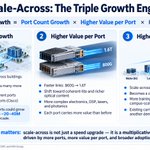
- Mgmt cited industry research projecting 70%+ CAGR for the scale-across market over the next few years, driven partly by power constraints that are pushing AI clusters toward greater interconnectivity.
Overall, mgmt remains very confident in both the industry outlook and the company's competitive position heading into 2027–2028.


A few things I've been hearing from some Hong Kong-based funds:
They believe 2027 will mark the peak in AI capex growth. Spending may continue to rise in 2028–2029, but a slowdown in the growth rate is inevitable. Interestingly, I've been hearing this same argument from them for the past 2–3 years.
Quite a few remain skeptical that CSPs will ever earn an adequate return on their massive AI investments. They also doubt that the current profitability of memory companies is sustainable.
Their valuation argument follows from this: once capex growth starts slowing, these stocks can no longer justify 20–30x earnings.
One of them put it this way: "Even if a stock looks cheap at 10–15x today, that valuation doesn't mean much if capex growth starts decelerating next year."
They also believe the market needs a much stronger "new narrative" to trigger a meaningful reversal in sentiment.
Personally, I find this reasoning a little amusing. It's almost the complete opposite of what I've been hearing from funds in Taiwan and the US.
Same industry, same data, yet such different conclusions.
I've been hearing that many Hong Kong-based funds see the recent weakness in $SOXX as the beginning of a bear market, with some even moving to outright short positions.
Interestingly, the sentiment I'm hearing from funds in Taiwan and the US is quite different. They don't seem nearly as bearish.
Pretty interesting divergence in positioning and sentiment across regions.