

AI Group @ucsantabarbara. Profs. @xwang_lk, @YuhengBu, Xifeng Yan, @WilliamWangNLP, @CodeTerminator. Account run by Student Social Committee.
Santa Barbara, CA
Joined July 2021
- Tweets382
- Following639
- Followers2.5K
- Likes649







UCSB AI retweeted

🚀 𝐏𝐞𝐫𝐬𝐨𝐧𝐚𝐥 𝐀𝐠𝐞𝐧𝐭𝐬 𝐀𝐫𝐞 𝐓𝐚𝐤𝐢𝐧𝐠 𝐎𝐟𝐟: 𝐆𝐨𝐨𝐠𝐥𝐞 × 𝐔𝐂𝐒𝐁 𝐈𝐧𝐭𝐫𝐨𝐝𝐮𝐜𝐞 𝐒𝐭𝐫𝐞𝐚𝐦𝐕𝐢𝐛𝐞 𝐭𝐨 𝐔𝐧𝐝𝐞𝐫𝐬𝐭𝐚𝐧𝐝 𝐄𝐯𝐨𝐥𝐯𝐢𝐧𝐠 𝐔𝐬𝐞𝐫 𝐈𝐧𝐭𝐞𝐧𝐭 𝐓𝐡𝐫𝐨𝐮𝐠𝐡 𝐈𝐧𝐭𝐞𝐫𝐚𝐜𝐭𝐢𝐨𝐧
🤔The promise of personal agents is compelling: an assistant that understands what we need as we go about our day. But understanding a user is a moving target.
🍳 When we say "help me cook this dish," the next useful action depends on what we do next. A step gets completed. A mistake happens. We change our mind. The agent has to keep up with both the world and our intent, deciding when to help and when to stay quiet.
🔥 Introducing StreamVibe: Proactive Video Agents for Evolving User Intent.
🧩 Three key pieces power StreamVibe: ① StreamVibe-VL learns when and how to help; ② StreamVibe-Harness tracks evolving user intents and task progress; ③ StreamVibe-Bench tests proactive assistance in real-world, long-horizon interactions.
🎬 Watch the demo. More on the ideas and results below. 🧵
🌐 stream-vibe.github.io/
UCSB AI retweeted

🏆 Huge congratulations to @WengZhaoti39773 and our UCSB students on winning the 𝗢𝘂𝘁𝘀𝘁𝗮𝗻𝗱𝗶𝗻𝗴 𝗣𝗮𝗽𝗲𝗿 𝗔𝘄𝗮𝗿𝗱 at the COLM 2026 Lifelong Agent Workshop for our 𝗚𝗿𝗼𝘂𝗽-𝗘𝘃𝗼𝗹𝘃𝗶𝗻𝗴 𝗔𝗴𝗲𝗻𝘁𝘀 paper!
This is Zhaotian’s 𝘃𝗲𝗿𝘆 𝗳𝗶𝗿𝘀𝘁 𝗽𝗿𝗼𝗷𝗲𝗰𝘁 in our group; what an incredible achievement!
𝗖𝗼𝗹𝗹𝗲𝗰𝘁𝗶𝘃𝗲 𝗲𝘃𝗼𝗹𝘂𝘁𝗶𝗼𝗻 𝗶𝘀 𝗷𝘂𝘀𝘁 𝘁𝗵𝗲 𝗯𝗲𝗴𝗶𝗻𝗻𝗶𝗻𝗴!

🏆 Honored that Group-Evolving Agents won the Outstanding Paper Award at the Lifelong Agents Workshop @ #COLM2026!
Agents that evolve as a group, sharing experience, keep improving open-endedly 🧬🤖
Grateful to my wonderful coauthors and @xwang_lk !
Had a great time at #COLM2026
📄 arxiv.org/abs/2602.04837
💻 github.com/UCSB-AI/GEA


UCSB AI retweeted

We got a Spotlight Position Paper at NeurIPS 2026! What a week full of events. And I got to author this paper with some of the best minds in AI.
The paper will be available at the end of this month! Stay tuned

𝐍𝐞𝐮𝐫𝐈𝐏𝐒 2026 𝐒𝐩𝐨𝐭𝐥𝐢𝐠𝐡𝐭! Huge congrats to @AlfonAmayuelas on our position paper "Sampling Is Not Curiosity: Why LLM Agents Should Investigate" being selected as 𝐨𝐧𝐞 𝐨𝐟 𝐭𝐡𝐞 𝐨𝐧𝐥𝐲 11 𝐩𝐚𝐩𝐞𝐫𝐬 𝐚𝐬 𝐒𝐩𝐨𝐭𝐥𝐢𝐠𝐡𝐭!
Paper coming soon!

UCSB AI retweeted

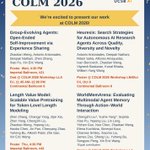
🎤 I will be giving an Oral Presentation today! @ Lifelong Agent Workshop · Fri Oct 9, 11:45 AM–12:00 PM · Continental Ballroom 6
✨ Group-Evolving Agents: Open-Ended Self-Improvement via Experience Sharing
GEA treats a group of agents, not an individual, as the unit of evolution. Agents share experience as they self-improve, outperforming prior state-of-the-art open-ended self-improving methods and matching or exceeding top human-designed agent frameworks, all with zero human intervention.
AI agents aren't biological individuals. So why make them evolve like one?
They can directly share experience and learned artifacts. Not bounded by reproduction, lineage, or genes.
Meet 𝗚𝗘𝗔, accepted to 𝗖𝗢𝗟𝗠 𝟮𝟬𝟮𝟲 🎉
𝟳𝟭.𝟬% SWE-bench Verified / 𝟴𝟴.𝟯% Polyglot · zero human intervention
🧵👇
Most self-evolving agent systems follow a similar pattern: select a parent, refine it, produce an offspring, repeat. Evolution unfolds as a tree.
It's great at generating diversity, but that diversity gets trapped. Agents explore independently, and instead of serving as stepping stones, their discoveries stay stuck in local branches. Most variants are short-lived.
𝗘𝘅𝗽𝗹𝗼𝗿𝗮𝘁𝗶𝗼𝗻 𝗵𝗮𝗽𝗽𝗲𝗻𝘀; 𝗿𝗲𝘂𝘀𝗲 𝗮𝗻𝗱 𝗮𝗰𝗰𝘂𝗺𝘂𝗹𝗮𝘁𝗶𝗼𝗻 𝗿𝗮𝗿𝗲𝗹𝘆 𝗱𝗼.
It's time to rethink the evolution of AI agents: why keep evolving them like biological individuals?
AI agents aren't bound by reproduction, lineage, or genes. They can directly share trajectories, tools, workflows, and learned artifacts, aggregating complementary skills instantly. 𝗪𝗵𝘆 𝗻𝗼𝘁 𝗿𝗲𝗱𝗲𝘀𝗶𝗴𝗻 𝗲𝘃𝗼𝗹𝘂𝘁𝗶𝗼𝗻 𝗮𝗿𝗼𝘂𝗻𝗱 𝘄𝗵𝗮𝘁 𝘁𝗵𝗲𝘆 𝗰𝗮𝗻 𝗮𝗰𝘁𝘂𝗮𝗹𝗹𝘆 𝗱𝗼?
That's GEA.
GEA makes a 𝗴𝗿𝗼𝘂𝗽 𝗼𝗳 𝗮𝗴𝗲𝗻𝘁𝘀 𝘁𝗵𝗲 𝗳𝘂𝗻𝗱𝗮𝗺𝗲𝗻𝘁𝗮𝗹 𝘂𝗻𝗶𝘁 𝗼𝗳 𝗲𝘃𝗼𝗹𝘂𝘁𝗶𝗼𝗻. Each round, a parent group is selected under a Performance-Novelty criterion that balances competence with exploratory diversity. All members within the group then pool their experience, model patches, failure modes, eval logs, and solutions, into a shared pool, and the whole group jointly produces the next generation.
Exploration is no longer wasted. It gets consolidated.
The results show a significant improvement over prior state-of-the-art self-evolving methods, and GEA matches or surpasses top human-designed frameworks with 𝗻𝗼 𝗵𝘂𝗺𝗮𝗻 𝗶𝗻 𝘁𝗵𝗲 𝗹𝗼𝗼𝗽.
The analysis is the more interesting part. GEA's gains come from explicitly reusing diversity, not from lucky outliers: stronger performance under the same number of evolved agents, more robust to framework-level bugs (repaired in 𝟭.𝟰 iterations vs 𝟱), and improvements that target workflows and tools rather than overfitting to one model, so they transfer consistently across GPT- and Claude-series backbones.
The key to open-ended evolution is not only generating enough diversity. What matters more is whether discoveries accumulate and get reused. 𝗚𝗘𝗔 𝗹𝗲𝘁𝘀 𝗲𝘅𝗽𝗹𝗼𝗿𝗮𝘁𝗶𝗼𝗻 𝘀𝘁𝗮𝗿𝘁 𝗰𝗼𝗺𝗽𝗼𝘂𝗻𝗱𝗶𝗻𝗴.
📄 arXiv: arxiv.org/abs/2602.04837
Grateful to my advisor @xwang_lk and my wonderful coauthors @anton_iades @deepaknathani11 @zhenzhangzz @XiaoSophiaPu .
Interning in Palo Alto this summer. See you at COLM 2026 👋
UCSB AI retweeted
Presenting GEA at #COLM2026 this week! 🧬
✨ Group-Evolving Agents: Open-Ended Self-Improvement via Experience Sharing
GEA treats a group of agents, not an individual, as the unit of evolution. Agents share experience as they self-improve, outperforming prior state-of-the-art open-ended self-improving methods and matching or exceeding top human-designed agent frameworks, all with zero human intervention.
📍 Poster · Wed Oct 7, 4:30 PM · Imperial Ballroom · #21
🎤 Oral @ Lifelong Agent Workshop · Fri Oct 9, 11:45 AM–12:00 PM · Continental Ballroom 6
My research focuses on recursive self-improvement and autoresearch. Stop by the poster to chat, or DM me to grab a coffee! ☕
📄 arxiv.org/abs/2602.04837

AI agents aren't biological individuals. So why make them evolve like one?
They can directly share experience and learned artifacts. Not bounded by reproduction, lineage, or genes.
Meet 𝗚𝗘𝗔, accepted to 𝗖𝗢𝗟𝗠 𝟮𝟬𝟮𝟲 🎉
𝟳𝟭.𝟬% SWE-bench Verified / 𝟴𝟴.𝟯% Polyglot · zero human intervention
🧵👇
Most self-evolving agent systems follow a similar pattern: select a parent, refine it, produce an offspring, repeat. Evolution unfolds as a tree.
It's great at generating diversity, but that diversity gets trapped. Agents explore independently, and instead of serving as stepping stones, their discoveries stay stuck in local branches. Most variants are short-lived.
𝗘𝘅𝗽𝗹𝗼𝗿𝗮𝘁𝗶𝗼𝗻 𝗵𝗮𝗽𝗽𝗲𝗻𝘀; 𝗿𝗲𝘂𝘀𝗲 𝗮𝗻𝗱 𝗮𝗰𝗰𝘂𝗺𝘂𝗹𝗮𝘁𝗶𝗼𝗻 𝗿𝗮𝗿𝗲𝗹𝘆 𝗱𝗼.
It's time to rethink the evolution of AI agents: why keep evolving them like biological individuals?
AI agents aren't bound by reproduction, lineage, or genes. They can directly share trajectories, tools, workflows, and learned artifacts, aggregating complementary skills instantly. 𝗪𝗵𝘆 𝗻𝗼𝘁 𝗿𝗲𝗱𝗲𝘀𝗶𝗴𝗻 𝗲𝘃𝗼𝗹𝘂𝘁𝗶𝗼𝗻 𝗮𝗿𝗼𝘂𝗻𝗱 𝘄𝗵𝗮𝘁 𝘁𝗵𝗲𝘆 𝗰𝗮𝗻 𝗮𝗰𝘁𝘂𝗮𝗹𝗹𝘆 𝗱𝗼?
That's GEA.
GEA makes a 𝗴𝗿𝗼𝘂𝗽 𝗼𝗳 𝗮𝗴𝗲𝗻𝘁𝘀 𝘁𝗵𝗲 𝗳𝘂𝗻𝗱𝗮𝗺𝗲𝗻𝘁𝗮𝗹 𝘂𝗻𝗶𝘁 𝗼𝗳 𝗲𝘃𝗼𝗹𝘂𝘁𝗶𝗼𝗻. Each round, a parent group is selected under a Performance-Novelty criterion that balances competence with exploratory diversity. All members within the group then pool their experience, model patches, failure modes, eval logs, and solutions, into a shared pool, and the whole group jointly produces the next generation.
Exploration is no longer wasted. It gets consolidated.
The results show a significant improvement over prior state-of-the-art self-evolving methods, and GEA matches or surpasses top human-designed frameworks with 𝗻𝗼 𝗵𝘂𝗺𝗮𝗻 𝗶𝗻 𝘁𝗵𝗲 𝗹𝗼𝗼𝗽.
The analysis is the more interesting part. GEA's gains come from explicitly reusing diversity, not from lucky outliers: stronger performance under the same number of evolved agents, more robust to framework-level bugs (repaired in 𝟭.𝟰 iterations vs 𝟱), and improvements that target workflows and tools rather than overfitting to one model, so they transfer consistently across GPT- and Claude-series backbones.
The key to open-ended evolution is not only generating enough diversity. What matters more is whether discoveries accumulate and get reused. 𝗚𝗘𝗔 𝗹𝗲𝘁𝘀 𝗲𝘅𝗽𝗹𝗼𝗿𝗮𝘁𝗶𝗼𝗻 𝘀𝘁𝗮𝗿𝘁 𝗰𝗼𝗺𝗽𝗼𝘂𝗻𝗱𝗶𝗻𝗴.
📄 arXiv: arxiv.org/abs/2602.04837
Grateful to my advisor @xwang_lk and my wonderful coauthors @anton_iades @deepaknathani11 @zhenzhangzz @XiaoSophiaPu .
Interning in Palo Alto this summer. See you at COLM 2026 👋
UCSB AI retweeted

1/6 🧠 𝗬𝗼𝘂𝗿 𝗔𝗜 𝗔𝘀𝘀𝗶𝘀𝘁𝗮𝗻𝘁 𝗖𝗮𝗻 𝗥𝗲𝗺𝗲𝗺𝗯𝗲𝗿 𝗪𝗵𝗮𝘁 𝗬𝗼𝘂 𝗦𝗮𝗶𝗱—𝗮𝗻𝗱 𝗦𝘁𝗶𝗹𝗹 𝗜𝗴𝗻𝗼𝗿𝗲 𝗪𝗵𝗮𝘁 𝗬𝗼𝘂 𝗪𝗮𝗻𝘁.
Long-running assistants accumulate facts, preferences, and constraints across conversations. But remembering them is not enough: a response can sound fluent and relevant while still recommending exactly what the user has ruled out.
We present 𝗠𝗲𝗺𝗙𝗼𝗹𝗱: 𝗟𝗲𝗮𝗿𝗻𝗶𝗻𝗴 𝗖𝗼𝗺𝗽𝗮𝗰𝘁 𝗦𝗼𝗳𝘁 𝗠𝗲𝗺𝗼𝗿𝘆 𝗳𝗼𝗿 𝗟𝗼𝗻𝗴-𝗖𝗼𝗻𝘁𝗲𝘅𝘁 𝗣𝗲𝗿𝘀𝗼𝗻𝗮𝗹𝗶𝘇𝗮𝘁𝗶𝗼𝗻 𝘃𝗶𝗮 𝗢𝗻-𝗣𝗼𝗹𝗶𝗰𝘆 𝗢𝗽𝘁𝗶𝗺𝗶𝘇𝗮𝘁𝗶𝗼𝗻. MemFold trains a model to use compact soft memory by learning from the answers it produces, combining task-level rewards with more detailed token-level guidance.
𝗢𝘂𝗿 𝗸𝗲𝘆 𝗳𝗶𝗻𝗱𝗶𝗻𝗴𝘀 🔥:
🎯 𝗝𝘂𝗱𝗴𝗲 𝗺𝗲𝗺𝗼𝗿𝘆 𝗯𝘆 𝘁𝗵𝗲 𝗮𝗻𝘀𝘄𝗲𝗿𝘀 𝗶𝘁 𝘀𝘂𝗽𝗽𝗼𝗿𝘁𝘀. Reconstruction alone does not tell us whether a model will respect a user’s preferences.
🔄 𝗢𝗻𝗲 𝘀𝗲𝘁 𝗼𝗳 𝗿𝗲𝘀𝗽𝗼𝗻𝘀𝗲𝘀, 𝘁𝘄𝗼 𝗹𝗲𝗮𝗿𝗻𝗶𝗻𝗴 𝘀𝗶𝗴𝗻𝗮𝗹𝘀. GRPO rewards task outcomes, while token-level guidance provides more detailed feedback on the same generated responses.
📈 𝗟𝗮𝗿𝗴𝗲𝗿 𝗴𝗮𝗶𝗻𝘀 𝘄𝗶𝘁𝗵 𝗹𝗼𝗻𝗴𝗲𝗿 𝗵𝗶𝘀𝘁𝗼𝗿𝗶𝗲𝘀. Across three Qwen backbones, the margin over the strongest baseline widens from PersonaMem-32K to PersonaMem-128K.
🌍 𝗧𝗿𝗮𝗻𝘀𝗳𝗲𝗿 𝗯𝗲𝘆𝗼𝗻𝗱 𝘁𝗵𝗲 𝘁𝗿𝗮𝗶𝗻𝗶𝗻𝗴 𝗱𝗮𝘁𝗮. MemFold transfers to PrefEval and LongMemEval without target-domain training.
👇 𝗖𝗵𝗲𝗰𝗸 𝗼𝘂𝘁 𝘁𝗵𝗲 𝗽𝗮𝗽𝗲𝗿, 𝗽𝗿𝗼𝗷𝗲𝗰𝘁, 𝗮𝗻𝗱 𝗰𝗼𝗱𝗲:
📄 Paper: huggingface.co/papers/2609.3…
🌐 Project: memfold.github.io
💻 Code: github.com/Johnny221B/memfol…

UCSB AI retweeted
AI agents aren't biological individuals. So why make them evolve like one?
They can directly share experience and learned artifacts. Not bounded by reproduction, lineage, or genes.
Meet 𝗚𝗘𝗔, accepted to 𝗖𝗢𝗟𝗠 𝟮𝟬𝟮𝟲 🎉
𝟳𝟭.𝟬% SWE-bench Verified / 𝟴𝟴.𝟯% Polyglot · zero human intervention
🧵👇
Most self-evolving agent systems follow a similar pattern: select a parent, refine it, produce an offspring, repeat. Evolution unfolds as a tree.
It's great at generating diversity, but that diversity gets trapped. Agents explore independently, and instead of serving as stepping stones, their discoveries stay stuck in local branches. Most variants are short-lived.
𝗘𝘅𝗽𝗹𝗼𝗿𝗮𝘁𝗶𝗼𝗻 𝗵𝗮𝗽𝗽𝗲𝗻𝘀; 𝗿𝗲𝘂𝘀𝗲 𝗮𝗻𝗱 𝗮𝗰𝗰𝘂𝗺𝘂𝗹𝗮𝘁𝗶𝗼𝗻 𝗿𝗮𝗿𝗲𝗹𝘆 𝗱𝗼.
It's time to rethink the evolution of AI agents: why keep evolving them like biological individuals?
AI agents aren't bound by reproduction, lineage, or genes. They can directly share trajectories, tools, workflows, and learned artifacts, aggregating complementary skills instantly. 𝗪𝗵𝘆 𝗻𝗼𝘁 𝗿𝗲𝗱𝗲𝘀𝗶𝗴𝗻 𝗲𝘃𝗼𝗹𝘂𝘁𝗶𝗼𝗻 𝗮𝗿𝗼𝘂𝗻𝗱 𝘄𝗵𝗮𝘁 𝘁𝗵𝗲𝘆 𝗰𝗮𝗻 𝗮𝗰𝘁𝘂𝗮𝗹𝗹𝘆 𝗱𝗼?
That's GEA.
GEA makes a 𝗴𝗿𝗼𝘂𝗽 𝗼𝗳 𝗮𝗴𝗲𝗻𝘁𝘀 𝘁𝗵𝗲 𝗳𝘂𝗻𝗱𝗮𝗺𝗲𝗻𝘁𝗮𝗹 𝘂𝗻𝗶𝘁 𝗼𝗳 𝗲𝘃𝗼𝗹𝘂𝘁𝗶𝗼𝗻. Each round, a parent group is selected under a Performance-Novelty criterion that balances competence with exploratory diversity. All members within the group then pool their experience, model patches, failure modes, eval logs, and solutions, into a shared pool, and the whole group jointly produces the next generation.
Exploration is no longer wasted. It gets consolidated.
The results show a significant improvement over prior state-of-the-art self-evolving methods, and GEA matches or surpasses top human-designed frameworks with 𝗻𝗼 𝗵𝘂𝗺𝗮𝗻 𝗶𝗻 𝘁𝗵𝗲 𝗹𝗼𝗼𝗽.
The analysis is the more interesting part. GEA's gains come from explicitly reusing diversity, not from lucky outliers: stronger performance under the same number of evolved agents, more robust to framework-level bugs (repaired in 𝟭.𝟰 iterations vs 𝟱), and improvements that target workflows and tools rather than overfitting to one model, so they transfer consistently across GPT- and Claude-series backbones.
The key to open-ended evolution is not only generating enough diversity. What matters more is whether discoveries accumulate and get reused. 𝗚𝗘𝗔 𝗹𝗲𝘁𝘀 𝗲𝘅𝗽𝗹𝗼𝗿𝗮𝘁𝗶𝗼𝗻 𝘀𝘁𝗮𝗿𝘁 𝗰𝗼𝗺𝗽𝗼𝘂𝗻𝗱𝗶𝗻𝗴.
📄 arXiv: arxiv.org/abs/2602.04837
Grateful to my advisor @xwang_lk and my wonderful coauthors @anton_iades @deepaknathani11 @zhenzhangzz @XiaoSophiaPu .
Interning in Palo Alto this summer. See you at COLM 2026 👋
UCSB AI retweeted

Key to realizing Auto Research Agents that can make novel discoveries in AI is understanding and improving their exploration capabilities.
To this end, we built Heuresis, a composable framework that combines coding agents with arbitrary search algorithms within a flexible loop.

UCSB AI retweeted

I will be attending @icmlconf in Seoul 🇰🇷 next week presenting SAW-Bench!!
Would love to chat about embodied perception, spatial reasoning, world modeling, and general video understanding 😃
DMs are open 🙌
⌚️Tue, Jun 7, 10:30 am -- 12:15 pm
📍Hall A #4309

Human perception is inherently situated – we understand the world relative to our own body, viewpoint, and motion.
To deploy multimodal foundation models in embodied settings, we ask:
“Can these models reason in the same observer-centric way?”
We study this through SAW-Bench: a novel benchmark for observer-centric situated awareness:
- 786 real world egocentric videos
- 2,071 human-annotated QA pairs
Across all tasks, we evaluate 24 state-of-the-art MFMs:
📉 Best model: 53.9%
🧑 Humans: 91.6%
Models systematically:
❌ Confuse head rotation with physical movement
❌ Collapse under multi-turn trajectories
❌ Fail to maintain persistent world-state memory
👉 We see that maintaining a stable observer-centric representation remains challenging.
As MFMs are increasingly integrated into embodied agents, situated awareness becomes essential for reliable real-world interaction.
We release SAW-Bench and encourage further research toward improving observer-centric reasoning in multimodal foundation models.
UCSB AI retweeted
Auto-research is a search problem.
𝐒𝐞𝐚𝐫𝐜𝐡 𝐢𝐬 𝐚 𝐟𝐨𝐫𝐦 𝐨𝐟 𝐡𝐨𝐥𝐢𝐬𝐭𝐢𝐜 𝐫𝐞𝐚𝐬𝐨𝐧𝐢𝐧𝐠 𝐨𝐯𝐞𝐫 𝐚𝐧 𝐞𝐯𝐨𝐥𝐯𝐢𝐧𝐠 𝐥𝐚𝐧𝐝𝐬𝐜𝐚𝐩𝐞 𝐨𝐟 𝐩𝐨𝐬𝐬𝐢𝐛𝐢𝐥𝐢𝐭𝐢𝐞𝐬.
A scientist does not simply solve a task. They generate hypotheses, design experiments, interpret failures, update beliefs, and decide where to explore next. The central challenge is navigating the search space efficiently.
This perspective is largely missing from today’s autonomous research systems, where reasoning is often confined to a single trajectory.
In ARTS, we introduce a reasoning-guided tree search framework with test-time learning, enabling agents to reason about the search process itself. We show that a fine-tuned 4B model can achieve performance comparable to frontier closed-model research agents on MLGym and MLEBench, while operating at substantially lower inference cost.
More broadly, we believe that progress in autonomous research will increasingly come from better reasoning-driven search, not just larger models.

UCSB AI retweeted

While AI scientists are getting better, two core challenges remain: (i) deciding what to explore next and (ii) handling the growing context.
ARTS addresses both with reasoning-guided exploration and test-time RL to learn from long search histories.
UCSB AI retweeted

A good researcher has intuition about when to drop a line of work and when to push. Current auto-discovery systems delegate this decision to scalar scores, which cannot represent this judgment. ARTS (Agentic Reasoning for Tree Search) reasons over the search state to decide.
UCSB AI retweeted
Excited to be at @icmlconf in Seoul🇰🇷🎉!
Presenting my work on Reasoning, RL, Co-Evolution & automated discovery.
Would love to chat about RL, Agents, Reasoning, Automated Discovery, Co-Evolution & anything else.
Come say hi by my posters July 8 and 9 in Hall A! 🙌

UCSB AI retweeted
Interesting observation: even after TTT, diversity doesn't collapse. We test-time-train the ARTS "scientist" on a simple, performance-only reward. Intuition says this should collapse solution diversity. But it doesn't, this is attributed to verbalized sampling which still surfaces the low-probability solution.

UCSB AI retweeted
Automated discovery is a search problem over combinatorially large spaces. It requires reasoning to explore promising ideas while handling long contexts.
Introducing ARTS, a search algorithm that (i) reasons to guide exploration and (ii) test-time trains to handle long context
UCSB AI retweeted

Had so much fun working on this! ABC provides robot data and base models for all!

Introducing ABC: open data, training, and infrastructure for robotics.
We release the largest teleop dataset to date, and extensively investigate design decisions, pretraining, and post-training techniques.
@arthurallshire @Cinnabar233 @adamrasb @redstone_hong @davidrmcall
UCSB AI retweeted
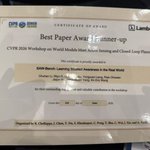
Excited to share that our paper SAW-Bench: Learning Situated Awareness in the Real World received the Best Paper Award Runner-Up at the #CVPR2026 WMAS workshop!
Congratulations to all co-authors, and thanks to the organizers and reviewers for the recognition.
Special thanks to @jieneng_chen for hosting me at WMAS!


Human perception is inherently situated – we understand the world relative to our own body, viewpoint, and motion.
To deploy multimodal foundation models in embodied settings, we ask:
“Can these models reason in the same observer-centric way?”
We study this through SAW-Bench: a novel benchmark for observer-centric situated awareness:
- 786 real world egocentric videos
- 2,071 human-annotated QA pairs
Across all tasks, we evaluate 24 state-of-the-art MFMs:
📉 Best model: 53.9%
🧑 Humans: 91.6%
Models systematically:
❌ Confuse head rotation with physical movement
❌ Collapse under multi-turn trajectories
❌ Fail to maintain persistent world-state memory
👉 We see that maintaining a stable observer-centric representation remains challenging.
As MFMs are increasingly integrated into embodied agents, situated awareness becomes essential for reliable real-world interaction.
We release SAW-Bench and encourage further research toward improving observer-centric reasoning in multimodal foundation models.
UCSB AI retweeted
🤔It is time to rethink how we evaluate agent memory
🌍 As agents become longer horizon and more autonomous, memory is no longer just a module for storing past chats.
🛠️ It determines how agents track changing worlds, learn from past actions, revise outdated information, and reuse experience for future decisions.
🔍 This raises three key questions:
Are human designed write store retrieve memory pipelines still the best choice?
If harnesses such as Codex, Claude Code, and OpenClaw already let agents observe, act, call tools, write files, and reorganize context, can memory also be managed by the harness itself?
Do current evaluations really cover how agent memory is used in realistic settings? Many benchmarks are still text centric or single modal, with limited pressure from screenshots, GUIs, tool feedback, and environment changes.
❓ Is final QA accuracy enough?
🔥 We present WorldMemArena, a multimodal benchmark for evaluating agent memory through action world interaction.
📌 Key insights:
🧩 Memory is a lifecycle, not a static cache.
📉 Better memory storage does not necessarily lead to better final performance.
🖼️ Multimodal memory remains a major bottleneck for current systems.
🌍 Real agentic trajectories expose the fragility of memory systems.
⚙️ Harness-based memory is more flexible, but still costly and unstable.

UCSB AI retweeted
𝐓𝐡𝐞 𝐁𝐢𝐭𝐭𝐞𝐫 𝐋𝐞𝐬𝐬𝐨𝐧 𝐨𝐟 𝐀𝐠𝐞𝐧𝐭𝐢𝐜 𝐌𝐞𝐦𝐨𝐫𝐲: memory should be a derived capability that exists because it makes an agent better at acting over time.
𝐖𝐨𝐫𝐥𝐝𝐌𝐞𝐦𝐀𝐫𝐞𝐧𝐚 is designed around this principle. Rather than evaluating memory as a storage problem, WorldMemArena evaluates memory through 𝐚𝐜𝐭𝐢𝐨𝐧–𝐰𝐨𝐫𝐥𝐝 𝐢𝐧𝐭𝐞𝐫𝐚𝐜𝐭𝐢𝐨𝐧, instrumenting the full write → maintain → retrieve → use lifecycle across 400 multimodal, multi-session tasks.
And it exposes the findings that should mark the end of the storage-centric era:
→ Storage ≠ use. Better memory storage and retrieval do not necessarily produce better task performance. Optimizing the component we designed does not optimize the capability we actually care about.
→ Harness-based memory performs best where memory is hardest. Agents that can write files, reorganize context, create artifacts, and interact with persistent environments adapt most effectively in long-horizon settings. They are costly and unstable today, which is exactly what many Bitter Lesson transitions look like before scaling and learning take over.
The deeper move is in what gets measured. Memory shouldn't get a score; it should be inferred from capability: how much does remembering improve performance over time.
WorldMemArena drags evaluation off the static object and into the action–world loop, the only place you can tell whether an agent has developed memory or is just simulating it convincingly.


🤔It is time to rethink how we evaluate agent memory
🌍 As agents become longer horizon and more autonomous, memory is no longer just a module for storing past chats.
🛠️ It determines how agents track changing worlds, learn from past actions, revise outdated information, and reuse experience for future decisions.
🔍 This raises three key questions:
Are human designed write store retrieve memory pipelines still the best choice?
If harnesses such as Codex, Claude Code, and OpenClaw already let agents observe, act, call tools, write files, and reorganize context, can memory also be managed by the harness itself?
Do current evaluations really cover how agent memory is used in realistic settings? Many benchmarks are still text centric or single modal, with limited pressure from screenshots, GUIs, tool feedback, and environment changes.
❓ Is final QA accuracy enough?
🔥 We present WorldMemArena, a multimodal benchmark for evaluating agent memory through action world interaction.
📌 Key insights:
🧩 Memory is a lifecycle, not a static cache.
📉 Better memory storage does not necessarily lead to better final performance.
🖼️ Multimodal memory remains a major bottleneck for current systems.
🌍 Real agentic trajectories expose the fragility of memory systems.
⚙️ Harness-based memory is more flexible, but still costly and unstable.
UCSB AI retweeted
Finally, this got done. It always felt off when people were treating VLAs as a separate class from multimodal LLMs. Better late than never.

Excited to share Qwen-VLA paper, our exploration of generalist Vision-Language-Action models.
It extends Qwen’s multimodal backbone from visual understanding and reasoning to continuous action generation and trajectory prediction.
Paper:
arxiv.org/pdf/2605.30280
