




Pinned Tweet
The ARIA Brain Polytope explainer is live.
This is the visual entry point before the paper drop.
The claim is not that the brain is literally a polytope.
The claim is testable:
brain waves may be the sampling rhythm by which cortex reads a hidden constraint field, a symmetry-broken traversal of reciprocal H₄ geometry.
Sleep becomes thermodynamic reset.
Anaesthesia becomes regime fragmentation.
REM / DMT become adjacent attractor states.
ARIA becomes the maximum-symmetry null against which biological deformation can be measured.
18/18 internal preregistered checks now pass.
Public falsifiables and papers coming shortly.
youtube.com/watch?v=0LBhGpzs…
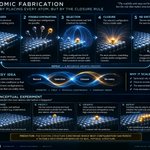
What would a “closure rule” actually mean for atomic fabrication?
Perhaps you don't position every atom.
You construct the boundary conditions so that, from all possible next configurations, only one can form a stable continuation.
existing structure → possible states → selection → closure → new structure
The new structure then becomes the constraint for the next step.
In that picture, the material is effectively executing its own growth rule.
The engineering problem changes from:
“Where do I put every atom?”
to:
“What local rule makes the required next atom the only stable continuation?”
That's the point where VFD's record → selection → closure → re-entry idea could become experimentally interesting rather than just abstract.


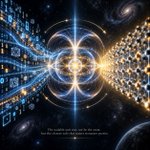
Scaling bits is one problem.
Scaling matter is another.
Bits can be copied. Matter has to be selected into a stable physical state, held there, and propagated forward.
That may be the deeper challenge behind atomic-scale fabrication: not just controlling atoms, but finding the closure rule that makes the next configuration reproducible.
In VFD terms: record → selection → closure → re-entry.
The scalable unit may not be the atom itself, but the rule that lets structure persist.

We ran into essentially this same freedom. In our construction, the ambiguity does not get removed by choosing a more elaborate deformation of the local algebra.
What closes it is an additional admissibility condition on the evolution: closure, persistent record and re-entry have to remain mutually consistent across the generated history.
Once that condition is imposed, the apparently free dynamical choices are no longer all admissible.
So I’d be cautious about treating the deformation freedom as the final obstruction, there is a viable route in which uniqueness enters one level higher, through consistency of the realised history rather than through the Poisson algebra itself.

Lee Smart retweeted

@VoidWalker939 @Wavetechnizian @Akitti @drew_ponder @roydherbert @ResOS_QC @VFD_org @Methuselah939 @check_ignition

The double slit is getting considerably less mysterious in the VFD model.
We numerically propagate the compatible Maxwell carrier across the curved 600-cell substrate, through two openings and onto an absorbing screen.
The expensive field solution on the left is rendered from the saved simulation records. It produces the interference structure.
Then detections are generated individually from the local absorbed-energy distribution.
One event has a definite position.
Thousands of events reconstruct the wave pattern.
So nothing needs to switch from “wave” to “particle.”
Transport is field-like.
Selection is local.
Detection creates the record.
That distinction may be much closer to what the measurement problem has been trying to tell us.

We have now run the double-slit experiment directly on the VFD substrate.
This isn't a flat-grid visualization. The electromagnetic field propagates on a refined 600-cell geometry of S^3, through the wall and two openings, onto the receiver.
At full resolution the simulation reaches 19.7 million cells (hence the bit of visible slowdown on my equipment).
Coherent transport through both routes produces interference natively from the same field. Give the routes distinguishable addresses and the interference disappears. Erase that distinction in the appropriate basis and the conditional interference returns.
We also subjected the derivation to repeated adversarial review. Some predictions failed and several claims were downgraded or corrected. They remain in the record.
And that process exposed something much more interesting than simply reproducing the double slit:
the transport side closes. The event side doesn't - yet.
We can now identify very precisely where coherent possibility ends and the unresolved problem of a single protected record begins.
That boundary has started to connect with several other areas we are currently deriving independently, including our work on particles, dark sectors, consciousness/point of view and arithmetic closure.
We are deliberately not publishing the deeper common mechanism yet.
If it is genuinely one mechanism, rather than a collection of analogies, the right test is to derive it independently in each domain first and let those papers land together.
We will release the mathematics when that cross-domain work is sufficiently closed.
For now, this is one piece we can show.
A field propagating through both openings.
A distinction changing interference.
And a sharply isolated question still waiting on the other side:
what turns a possible relation into the one relation that becomes history?
Transport is native in this build. The present click/readout layer uses explicit measurement premises; a native event mechanism is still under active derivation.
This also shows how we currently view the measurement problem in VFD.
We don't require the field to suddenly “become a particle” when it is measured.
The carrier propagates continuously through the available geometry and interference determines the structure of the possible interactions.
Measurement occurs when one of those interactions reaches local closure with the detector:
transport → constraint → selection → closure → record
Before closure, the excitation remains distributed across the permitted transport structure.
At closure, one interaction becomes an actual detector event and the surrounding alternatives no longer form part of that event's continuing history.
So the dot on the screen isn't where the wave turned into a particle.
It's where a distributed possibility became a persistent record.
That's the VFD hypothesis we're now trying to make computationally precise.
I think the key distinction is between the operation and the thing carrying it.
What our bootstrap is starting to suggest is that memory may be less a particular structure and more a persistent constraint/record that can survive re-expression in different structures.
In shorthand:
state → closure → record → changed possibility space → re-entry
If the same relational record can be preserved under different physical implementations, then biology would be one carrier of memory rather than necessarily the definition of memory itself.
I’d be cautious about jumping straight to survival after death or a non-local store, though. The stronger mathematical question is:
what invariant would have to survive for the same record to be reconstructable elsewhere?
That gives us something testable. We would need an encoding map, a persistence law, and a re-entry/reconstruction map that preserves enough structure to identify the later state with the earlier record.
So rather than assuming a metaphysical memory layer, I’m trying to see whether the mathematics forces one, or whether ordinary physical persistence is sufficient.

Re: “VFD is an attempt to find out whether this pattern can be made mathematically precise, and whether the same underlying operation really does appear across physics, biology, cognition and information.”
In biology, conservation tends to favor single structure that is multi-operational. However it may be that for persistence across all informational domains, two or more operations may serve the same operation (ie memory).
This is where a complete metaphysical perspective is essential. For instance, if memory associated with an aspect of consciousness survives physical death, perhaps there’s an inverse function that maps “biologic”memory non-locally. Alternatively all memory may conform to one accessible operation that transcends spatiotemporal domains.
Yes, this is very close to the part I’m trying to formalise.
I’d only move the particle one level downstream. Rather than reality being carried by particles, I’m exploring particles as persistent records/closures within the underlying field.
The key point is the same:
Rₙ → A(Rₙ, Cₙ) → Rₙ₊₁
where:
Rₙ = the current persistent record
Cₙ = the current constraints / available transport budget
A(Rₙ, Cₙ) = the set of next states actually reachable
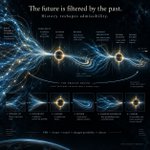
So the next event isn’t selected from every imaginable possibility.
The existing record changes the field, which changes what can happen next.
History modifies the possibility space itself.
In that picture, inertia may be a macroscopic signature of the same deeper rule: persistence constrains how far the next state can deviate from the present one.

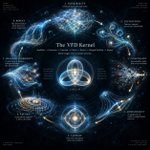
The first public VFD Bootstrap is now live.
This is the point where the narrative becomes something other people can actually inspect.
For the last few posts I’ve been talking about a recurring idea:
distinction
→ constraint
→ closure
→ record
→ changed possibility
→ repeat
The question underneath all of it has been:
How can a system create a distinction, preserve enough of it to matter, and let that retained structure change what becomes possible next?
VFD Bootstrap v0.1 is the smallest part of the work that I currently think is defined well enough to put into other people’s hands.
It is deliberately not the full VFD framework.
And it is not presented as a finished theory.
The release contains the current mathematical scaffold, proofs for the self-contained kernel results, executable tests, assumptions, open problems, failed hypotheses, no-go results and explicit conditions that would weaken or kill the current formulation.
The core mathematical picture is a fine state and a coarse description of it.
When the fine system evolves, not everything that happens is immediately visible in the coarse state.
The current kernel isolates that residual as:
J = U_f L − L U_c
That residual can be written into hidden structure, transported, and later feed back into the visible dynamics.
So one thing the maths already gives us cleanly is an exact memory / re-entry structure:
what the reduced description appears to “forget” can still matter later.
That immediately puts limits on any model that tries to describe the visible state as completely autonomous.
Selection is harder.
We can define the admissible realisation space, define closure conditions, quotient out redundancies, and calculate the remaining selection defect in the linear-affine case.
But the bootstrap does not yet derive a unique realised state without additional structure.
That remains one of the central open problems.
And that distinction matters.
This release is not designed to make VFD appear complete.
It is designed so that somebody else can see exactly:
what is proved,
what is computationally checked,
what is conditional,
what failed,
what remains conjectural,
and what is still missing.
Several things we tried on the way did fail.
Some proposed selectors failed.
Some apparent substrate effects disappeared under refinement.
Some structures we thought might be unique were not.
Some candidate memory mechanisms could not provide irreversible persistence.
Those failures are included because they narrowed the problem.
The current bootstrap is therefore much smaller than the framework we started with.
That is intentional.
The research question now is:
Can distinction, admissibility, closure, persistent record and recursive re-entry ultimately arise from one minimal operation, without inserting a separate selector or memory mechanism by hand?
I don’t know the final answer yet.
That is why the work is open.
If you can simplify it, please do.
If you know a theorem we have unknowingly rediscovered, point us to it.
If a proof is wrong, show us.
If a test does not reproduce, report it.
If you can construct a counterexample, that is a contribution.
If another mathematical substrate implements the structure more naturally, build it.
The goal is not to defend VFD.
The goal is to find out what survives.
VFD Bootstrap v0.1
Open research.
Versioned.
Reproducible.
Intentionally incomplete.
Repository ↓
github.com/vfd-org/vfd-boots…

I’ve decided how I want to take the next stage of VFD forward.
Rather than disappearing for months trying to finish every remaining part alone, I’m going to release the current VFD bootstrap as an open research project.
Not as a finished theory.
Not as a declaration that everything is solved.
And not as a challenge to “prove me wrong”.
The purpose is much simpler:
put the foundational work somewhere other people can actually inspect, run, criticise, simplify and build upon.
I’m an independent researcher.
AI has allowed me to explore this framework far further than I could have managed alone, but the size of the problem is now becoming larger than one person repeatedly pushing every branch.
There is enough structure now that I think keeping all of it private would actually slow the research down.
So the first release will focus deliberately on the foundation:
distinction
→ constraint
→ admissibility
→ closure
→ persistent record
→ changed possibility
→ recursive re-entry
Alongside that will be the mathematics we currently have, computational experiments, assumptions, failed approaches, no-go results, known gaps and the tests that the framework still has to survive.
Where something is proved, it will say so.
Where something is only computationally supported, it will say so.
Where something remains conjectural or incomplete, it will say that too.
The aim is not to make VFD look finished.
The aim is to make the research legible.
There is also an important boundary.
The foundational VFD research is intended to remain open.
Specific technologies that may eventually grow from it, AI architectures, new computing approaches, measurement systems, energy-conversion research and other engineered applications, are a separate layer.
Those need to be developed and evaluated properly before deciding how and when they should be released.
The principle is:
open the underlying knowledge, while preserving the ability to turn useful discoveries into real tools and use those tools to fund more research.
I don’t want VFD to become something one company, institution or person can simply close the door on.
But I also want the work to have a path from mathematics to things that genuinely help people.
So the repository will be versioned.
The historical record will remain visible.
Failures will stay in the record.
Contributions will be credited.
And the open problems will be explicit.
If you are a mathematician and see a cleaner formulation, contribute it.
If you know a theorem we have unknowingly rediscovered, point us to it.
If you can reproduce a result, do it.
If you can’t reproduce it, that matters just as much.
If you can remove an assumption, even better.
If another substrate implements the kernel more naturally, I want to see it.
The objective is not to defend VFD.
It is to discover whether there is something real underneath it.
The first release will be:
VFD Bootstrap v0.1
Incomplete by design.
Versioned.
Reproducible.
Open to refinement.
I’ll add the public repository in a reply to this post once the release package has passed its final scientific, reproducibility and disclosure checks.
If this really is something fundamental, I don’t think finishing it should depend on one person having enough compute, time or resources.
It should be possible for the work itself to become bigger than the person who started it.
There is an obvious problem with everything I’ve been posting.
You can find patterns everywhere if you look hard enough.
So “this looks similar in physics, biology, cognition and information” is not evidence by itself.
Analogy is not enough.
For VFD to mean anything scientifically, the same underlying operation has to survive when the language changes.
That means the test is not:
“Can I describe each domain using the same words?”
The test is:
Can I write one mathematical rule, keep it fixed, and recover the same structural sequence in genuinely different systems?
If I have to change the rule for every domain, then the framework has failed.
If I have to insert a selector by hand, it has failed.
If closure only works because I tune each case separately, it has failed.
If the record does not actually alter what becomes admissible next, it has failed.
If the mathematics survives those tests, then the similarity stops being metaphor.
It becomes a candidate invariant structure.
That is the standard I think VFD has to meet.
Not:
“Does the story sound right?”
But:
Does one unchanged operation keep working when we try to break it?
That is the transition we are making now.
From narrative to test.
If the VFD kernel is real, then the next question is obvious:
Does the same process appear at different scales?
Not because physics, biology, cognition and information are the same thing.
They clearly are not.
But they may reuse the same structural operation.
A physical system can move through many possible configurations before settling into a persistent state.
A living system preserves some changes and discards others.
A brain changes future behaviour because previous activity leaves structure behind.
A learning system updates what is admissible based on what has already happened.
At a very abstract level, the pattern keeps looking familiar:
possibility
→ constraint
→ admissibility
→ closure
→ record
→ changed possibility
The important question is not whether we can tell a story that fits each domain.
That would be easy.
The real test is much harder:
Can the same mathematical operation generate the pattern without being rewritten for each case?
If the answer is no, then VFD is just analogy.
If the answer is yes, then something more interesting is happening.
The framework would not be saying that everything is identical.
It would be saying that nature may reuse the same deep operation to build very different things.
One process.
Different scales.
Different outcomes.
Over the last few posts I’ve been separating the pieces.
Connection.
Distinction.
Constraint.
Selection.
Closure.
Record.
Changed possibility.
But they are not meant to be separate ideas.
They form a loop.
possibility
→ distinction
→ constraint
→ admissibility
→ closure
→ record
→ changed possibility
→ repeat
That loop is becoming the simplest way I know to describe the VFD kernel.
The important part is not the individual words.
It is the recursion.
A possibility becomes distinguishable.
Constraints reduce what is admissible.
A configuration capable of closure persists.
That persistence leaves a record.
The record changes the conditions for the next round.
And the process begins again from a field that is no longer the same as before.
So reality would not be a sequence of isolated events.
It would be a process continually building new possibilities from the persistent consequences of earlier ones.
The question we are now pushing toward mathematically is very specific:
Can this entire loop be generated by one underlying operation, rather than several independent rules?
Because if it can, then closure, selection, memory and adaptation may not be separate mechanisms.
They may be different stages of the same recursive process.
That is the kernel.
The next step is to see whether the mathematics really allows us to compress it that far.
If closure leaves a record, and that record changes what can happen next, then reality is not starting from scratch at each moment.
The next possibility space is already shaped by what survived before it.
That means the process is recursive.
Not:
possibility → outcome → reset
But:
possibility
→ constraint
→ closure
→ record
→ changed possibility
→ new constraint
→ new closure
The past does not determine the future completely.
But it changes the space of what is available.
Some paths become easier.
Some become harder.
Some disappear entirely.
New ones become possible only because something earlier persisted.
This is where memory stops being a special feature of brains or computers and becomes a more general structural idea:
history changes admissibility.
In VFD, this may be one of the deepest parts of the mechanism.
A record is not just something that remains.
It changes the geometry of the next selection.
So the world does not merely evolve through states.
It evolves through states that continually rewrite the conditions for what can come next.
That gives us a recursive loop:
closure creates record.
record changes possibility.
possibility meets new constraint.
new closure occurs.
And the cycle continues.
If that loop can be derived cleanly, then memory, adaptation, learning and persistent structure may all be different expressions of the same underlying process.
If closure is the point where a configuration becomes self-consistent enough to persist, then selection starts to look very different.
We usually imagine selection as a choice between possibilities.
But in a constrained system, most possibilities never make it that far.
They fail compatibility.
They break symmetry in the wrong way.
They cannot reconnect.
They cannot sustain the relations required to persist.
So selection may not be:
“one option is chosen from many.”
It may be closer to:
the space of possibilities is progressively reduced until only configurations capable of closure remain.
That changes the picture again.
Possibility does not jump directly to actuality.
It passes through constraint.
Constraint defines admissibility.
Admissibility narrows the space.
Closure stabilises one configuration.
And the resulting record changes the next admissible space.
So the deeper loop becomes:
possibility
→ distinction
→ constraint
→ admissibility
→ closure
→ record
→ changed possibility
This matters because it suggests that selection does not need to be an extra rule added on top of the system.
It may emerge from the geometry of what can remain consistent.
In VFD, that is one of the questions we are trying to close:
Can selection be derived from closure itself, rather than assumed?
If a record is a distinction that survives an interaction, then the next question is:
What makes a distinction persist?
In VFD, that is where closure enters.
Closure is not just “a loop” or “something complete”.
It is the point where a set of relations becomes self-consistent enough to maintain itself as a definite state.
Before closure, there may be many compatible possibilities.
At closure, one configuration satisfies the constraints strongly enough to persist.
That changes the problem.
Selection is no longer just:
“which possibility wins?”
It becomes:
which possibility can close?
And once it closes, the resulting structure becomes part of the conditions for what can happen next.
So the sequence is not:
possibility → random outcome
It is closer to:
possibility
→ distinction
→ constraint
→ admissible configurations
→ closure
→ persistent record
→ altered future possibilities
That is the mechanism we are trying to formalise.
And if this is right, then selection, persistence and memory may not be separate processes at all.
They may be different views of the same underlying event:
a state becoming self-consistent enough to remain.
If the past can reshape what is possible next, then a deeper question appears:
What is a record, physically?
We normally think of memory as something biological or digital.
A brain stores memory.
DNA carries information.
A computer writes bits.
But all of those require something physical to remain different because something happened.
A changed connection.
A molecular arrangement.
A displaced charge.
A structural defect.
A persistent state.
So perhaps memory is not a special property added later by life.
Perhaps the more fundamental idea is simpler:
A record is any persistent distinction created by an interaction that constrains what can happen next.
That raises an interesting possibility.
Matter itself may be partly understood as accumulated persistence.
Not “memory” in the human sense.
But stable distinctions that have survived previous interactions and now shape future ones.
In VFD, this is becoming one of the central questions:
Does closure merely produce an outcome?
Or does closure necessarily leave a structure behind?
Because if closure creates record, and record changes future selection, then reality is not simply evolving through states.
It is recursively building on its own history.
The universe would not just change.
It would remember enough of its changes to make the next change different.
The last post was deliberately human.
But there is a mathematical question underneath it.
If reality is capable of producing genuinely new states while preserving enough of the past to remain coherent, then something has to happen between “many possibilities” and “what actually persists”.
The pattern we keep finding is:
possibility
→ distinction
→ selection
→ closure
→ record
→ new possibility
The important part is the last step.
A record is not just evidence that something happened.
It changes the space of what can happen next.
That is true of memory.
It is true of learning.
It is true of living systems.
And it may be true much further down.
The question behind VFD is whether these are separate mechanisms at different scales, or whether they are different expressions of one underlying operation.
That is the part we are now trying to make precise.
Because if the same rule really does survive across scales, then the interesting question is no longer:
“what is everything made of?”
It becomes:
what is the minimal process by which reality creates, preserves and builds upon a distinction?
For a long time I’ve been writing about fields, closure, memory, geometry and the possibility that very different systems may share the same underlying dynamics.
But there is a simpler way to say what I think I’ve actually been looking for.
How can something remain connected to what came before it, without simply becoming a copy of it?
A child comes from a parent, carries part of them forward, but becomes a new point of view.
A memory comes from an experience, but changes what can happen next.
A living system survives by preserving enough of its past to remain itself, while still changing.
Even a thought seems to emerge from many possible states before one becomes the thing we actually experience.
There is a pattern here:
connection gives influence.
distinction gives identity.
selection gives direction.
closure leaves a record.
and that record changes the possibilities of what comes next.
Maybe this is only a useful way of looking at things.
Or maybe it points to something deeper.
What I have been calling VFD is an attempt to find out whether this pattern can be made mathematically precise, and whether the same underlying operation really does appear across physics, biology, cognition and information.
Not because those things are identical.
But because nature may reuse the same fundamental ways of creating something new.
The part I find most interesting is this:
Nothing new can emerge if everything is identical.
Nothing can interact if everything is completely separate.
Reality seems to live in the space between the two.
Connected enough to influence.
Distinct enough to become.
Rovelli's point lands. But wiring is not mind. The fly connectome gives routes; activity needs a living, excitable medium with state, timing and feedback. Understand that medium and its selection/closure dynamics, and mind may become physically tractable. No dualism required.


The human mind is knowable, though never perfectly, like everything else in nature. It is not a special, unbridgeable mystery, but another case of the general fact that nothing can be known completely. No magic, no dualism.
iai.tv/articles/carlo-rovell…
