
Smart contract Auditor| Explorer| I talk about Web3, Blockchain, AI
India
Joined June 2021
- Tweets2.4K
- Following614
- Followers577
- Likes5.1K







Aman retweeted

Day 10 of trying to land a private audit
Lately, I've been spending time learning MPC and exploring the security of threshold signature implementations.
I'm now studying Fireblocks' `mpc-lib`, going through its security model and trying to understand how the protocols are implemented in actual code.
One thing that's becoming clearer to me is that understanding the cryptography is only part of the job.
You also need to understand the threat model, know what an attacker can actually do, and prove that a suspicious behavior leads to a real security impact.
I'm still learning, still hunting, and trying to get better with every investigation.
One step at a time.
@Schnilch @CyfrinUpdraft @Maybach_hunter @Web3_Vinay @WebdevAnas @alexabelonix @pashov @PashovAuditGrp @_biggids @HaneefahYusuf1 @That_young_girl

Day 9 of trying to land a private audit
One thing bug bounties are teaching me is that finding suspicious code isn't the same as finding a vulnerability.
I've had submissions marked as duplicates and informational. It hurts, but it's teaching me to approach auditing differently.
Here's what I'm trying to do before submitting a finding:
1. Understand the protocol first.
What is the protocol supposed to do? Who are the actors? Where does the money flow?
2. Identify the security assumptions.
What must always be true for the protocol to remain secure?
3. Think like an attacker.
Can I actually violate one of those assumptions? What would I need to do, and what prevents me from doing it?
4. Trace the entire attack path.
I don't want to stop at a suspicious function. I want to understand how an attacker could reach it and what happens afterward.
5. Try to kill my own finding.
Can the attack actually happen? Is there a restriction I'm overlooking? Has someone already reported it? Does it have a real security impact?
6. Prove it with a PoC.
If possible, I want a reproducible test that demonstrates the issue rather than relying on assumptions.
I'm still improving this process, and I know there's a lot more to learn.
But I'd rather submit fewer findings that I can defend than submit dozens I can't.
To experienced auditors: What's one thing you always check before submitting a finding?
Still hunting. Still learning. Still building.
@CyfrinUpdraft @HackenProof @Maybach_hunter @Schnilch @alexabelonix @pashov @PatrickAlphaC @Web3_Vinay @WebdevAnas @_biggids @arsen_bt
Aman retweeted
Day 6 of trying to land a private audit
The next bug bounty I worked on was the STBL smart contracts.
After dealing with several informational, OOS, and duplicate findings, I realized I needed to improve how I validated my bugs before submitting them.
A few researchers gave me advice that changed how I approach findings:
@Web3_Vinay taught me to develop a lawyer mindset.
It's not enough to say “this is a bug.”
I need to be able to defend my finding:
Why is it actually exploitable?
Who can exploit it?
What's the realistic attack path?
What's the impact?
What assumptions does the exploit depend on?
Then @Schnilch taught me to try to kill my own findings before the triager does.
If I can't find enough evidence to defend a finding after trying to disprove it myself, I shouldn't submit it.
That mindset alone has helped me filter out a lot of weak findings.
And @arsen_bt taught me to pay close attention to integrations.
Sometimes the critical bug isn't inside the function you're looking at.
It can come from how the contract interacts with another protocol, contract, oracle, token, or external component.
I applied all three lessons while auditing STBL.
I found 2 bugs.
Both were marked as duplicates.
At first, that wasn't the result I wanted.
But this time, I looked at it differently.
The goal wasn't just to get a bounty.
The goal was to become a better researcher - someone who can identify, validate, defend, and communicate real vulnerabilities.
So, shoutout to @Web3_Vinay @Schnilch @arsen_bt for the advice.
Your lessons have genuinely changed how I approach security research. 🫡
Still hunting. Still learning. Still trying to land that first private audit.
@CyfrinUpdraft @PatrickAlphaC @Schnilch @Web3_Vinay @WebdevAnas @rosarioborgesi @Maybach_hunter @pashov @PashovAuditGrp @DefimonAlerts @crypto_vazima @web3jobsx @tinchoabbate

Day 5 of trying to break into private audits.
The next bug bounties I tried were DodoLimit and Nado Smart Contracts.
The codebases were much larger than what I was used to, and honestly, it was easy to get lost in the code. 😭
A huge shoutout to @schnilch for his AI notes. I used them to keep track of where I was in the codebase, the areas I'd already audited, and my dead leads.
That helped me stay organized and avoid going in circles.
I submitted 3 findings:
• 2 INFORMATIVE
• 1 OUT OF SCOPE
No valid finding this time, but the biggest takeaway wasn't the submission result.
I was learning how to approach large codebases systematically.
Audit the area → document what I found → track dead ends → move to the next area.
That process has become just as important to me as finding the bug itself.
Still learning. Still hunting.
We keep going.
@pashov @CyfrinUpdraft @Schnilch @Maybach_hunter @PashovAuditGrp @arsen_bt @_biggids @Web3_Vinay @WebdevAnas @crypto_vazima @CryptoJobsList @PatrickAlphaC @rosarioborgesi

Aman retweeted

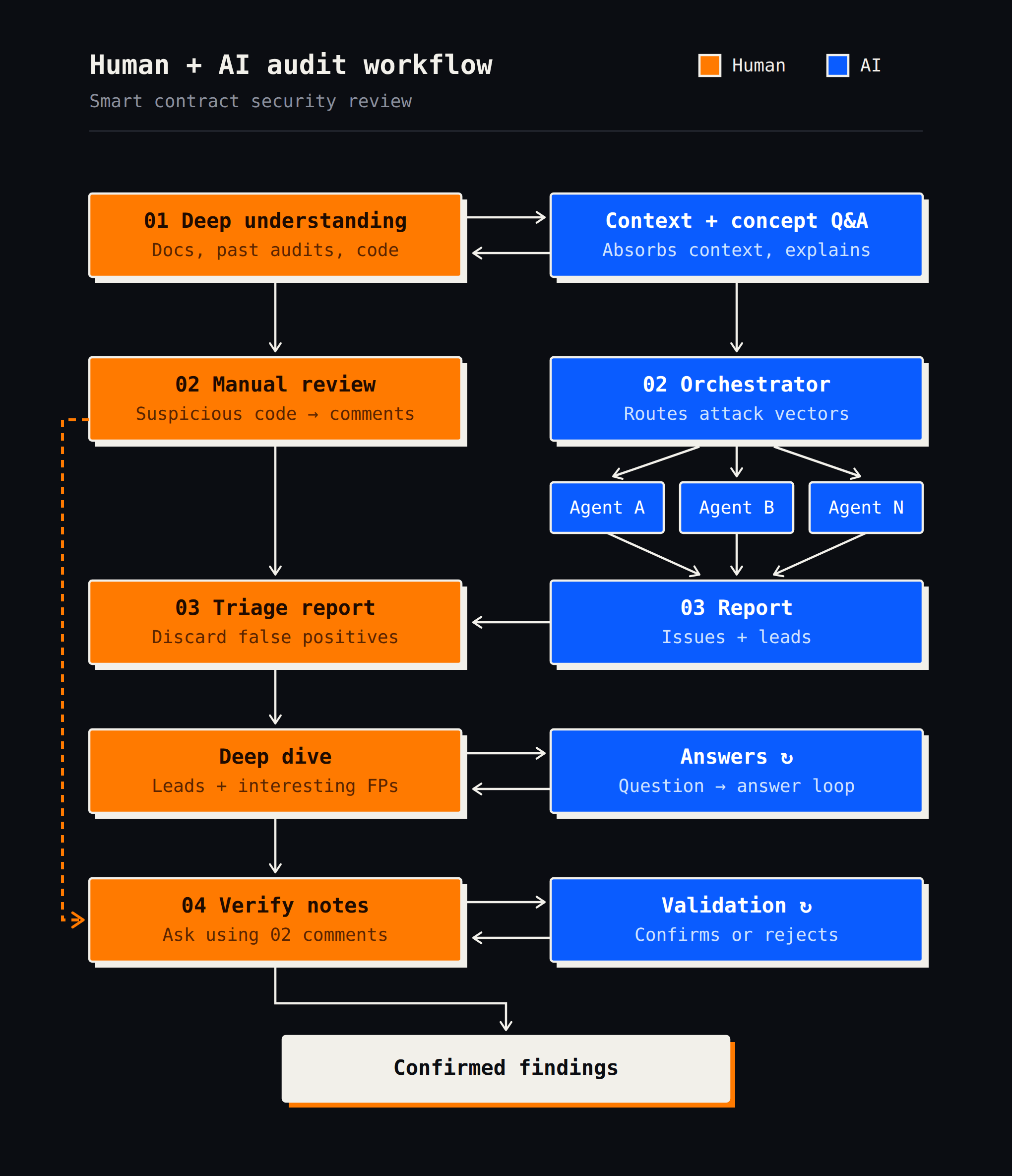
A lot of people ask me which workflow I use to audit with a Human + AI approach.
This image describes very well how I’m working right now:
1. Understand the code faster
The most important part for me is using AI to speed up my understanding of the codebase. I use AI to quickly understand the architecture, flows, and important parts of the system.
2. Run your AI agent
Next, I run my own AI workflow or another open-source AI auditor. The Solidity Auditor from @pashov is very good, and I recommend trying it.
3. Investigate the findings
Once I understand the code and have the AI-generated report, I read through it and verify the issues. If I find a false positive that I consider interesting, I ask the AI to investigate it further and generate new leads to explore.
4. Go deeper with a loop
I create a continuous loop:
Question → Answer → Question → Answer
I use AI like another auditor on the team. We have conversations, challenge each other’s assumptions, and use the results to go deeper into interesting attack paths.
The goal isn’t to let AI do the audit for me. It’s to combine AI’s speed and reasoning with my own experience to find the most valuable issues.
Aman retweeted

@DevDacian just now watched your podcast with @PatrickAlphaC
It's amazing noted down many points
But that video was recorded around 2 years ago and a lot of things have changed.
I have few questions
- you said you put 90% of your time in manual audit and 10% in fuzzing
How does looks like this in current time with AI?
- what all tools you have added now earlier u were using medusa and so on. Still do you use it or just put it to AI and review it ?
- how you use checklist now ?
Just feed into ai and let it do all the things ?
- what all heruisitics you have added on in AI era?
- anything that you would like to add on
I would request you to do a podcast again🫡🫡
Thanks 🙌

Aman retweeted

Putting myself out there.🧵
I am an aerospace Engineering student building in Web3..Solidity, smart contracts, security, ZK, Noir, Aztec, EVM & blockchain research.
Currently building privacy applications on @aztecnetwork .
I am open to Smart Contract, ZK & Blockchain roles.
Aman retweeted

Hi everyone!
I'm currently looking for a remote developer role in:
→ Frontend Development
→ Backend Development
→ Full-Stack Development
→ GenAI / AI Engineering
I have hands-on experience with Next.js, MERN, FastAPI, RAG, and Generative AI, and I'm excited to contribute to a team where I can build real-world products and grow as a developer.
If you're hiring or know of any relevant opportunities, my DMs are open.
A repost could help me reach the right opportunity. I'd genuinely appreciate your support.
Thank you! 🤝
Aman retweeted

A small tip for reducing the number of invalid bug bounty submissions:
Even if a bug bounty program defines the in-scope contracts through a GitHub repository rather than deployed contract addresses, always check the current on-chain configuration and protocol state before submitting.
A vulnerability may be completely valid in the in-scope code, but if the affected component is currently disabled, not configured, not connected, or otherwise inactive on-chain, the protocol will most likely still invalidate the report.
So before submission, verify not only the code, but also whether the vulnerable path is actually reachable and relevant in the protocol’s current deployed state.
Aman retweeted

I am looking for a job . If u are protocol/team , looking for a dev with security knowledge or a security engineer . Please reach out
Aman retweeted

My highest-paid bug bounties didn't come from a security course.
They came from Eben Pagan's "Mind Control," a course on how the mind works and systems thinking that I took years ago.
Credit where credit is due.


Aman retweeted

Web3 Auditors:
- it took you years.
- it took failures you don’t talk about.
- it took pushing through when quitting made more sense.
- it definitely wasn’t risk-free.
That’s why you’re here now. 👏
To everyone starting now:
Respect the process.
It’s brutal, but it compounds


Aman retweeted
What happened to cyfrin BattleChain. It was meant to be next big thing after contests.
@cyfrin @PatrickAlphaC
Aman retweeted

$50m for supposedly saving $320m 🔥🔥
Crazy!!
While hunting in the wild. I have saved close to $1b in losses, by responsibly disclosing the bugs to the affected project team, but i have never earned $50k in bounty for any single bug report, and I have reported a bug with about $800m at risk, $123m and $54m, and other multiple minting class bugs.
Notably @Islamic_Coin sat on a critical minting bug i reported for nine days until an attacker exploited it, they then fixed it and another bug i sent over. It has been radio silence for three months.
There are multiple other such projects, but let me save that for another time.
Given how well this went for the grey hat, I presume we will likely see more of those in the coming weeks.
If you are seeing this and I have sent a critical bug report your way, please encourage me by paying me what the bug is worth 🙏
Aman retweeted
🤯🚨UPDATE:
We have just might witnessed the biggest post-exploit “bounties” ever - $47M!
~$268M in BTC has now been sent back to Liquid Network
but the hackers kept ~600 BTC, worth ~$47M which is ~15%
ABSOLUTELY INSANE! 🤯

🤯🚨 $320M IN BITCOIN HACKED
~4,000 BTC was drained from @Liquid_BTC , a Bitcoin sidechain, through its peg-out system.
The hackers then sent an on-chain message: "patch every node first, then we’ll return the BTC once the fix is confirmed"
THANK GOD ITS WHITE HATS 🙏

Aman retweeted

Yesterday, @injective was exploited for ~$4.8M.
The attacker reportedly repeated the same path across 299 markets in 19h, while the chain halted for ~4h.
Injective still hasn’t addressed it publicly.
Months earlier, a white hat said he saved $500M and was offered $50K😮

Aman retweeted

Most AI startups start with:
“What can we build with AI?”
Ask a different question:
“Which painful workflow can we redesign because AI makes a fundamentally different workflow possible?”
Think:
Customer
↓
Problem
↓
Existing workflow
↓
AI leverage
↓
Verifiable outcome
↓
Human escalation
↓
Product
↓
Distribution
↓
Data + feedback
↺
That last part matters.
Every customer interaction can improve the workflow, which can improve the product, which can improve the outcome.
And here's the founder test:
Tomorrow, your model provider ships your feature.
Why would your customer still choose you?
If the answer is only “our prompts are better,” keep digging.
The model is a component.
The business loop is the company.
