

Promoting PHAGE & PHAGE PIONEERS. Created 2019 https://xitter.gq/t.co/aOSsYKt1Sz @AgeofthePhage #WorldPhageDay #WorldPhageDay #OctoPhage The Phage community working together.
Global. London
Joined August 2019
- Tweets5.2K
- Following3.5K
- Followers1.9K
- Likes1.7K


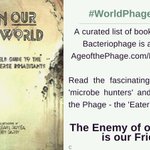
The #phage community ensures its pioneering work is kept ‘out of the shadows, into the spotlight’ by celebrating the 8th #WorldPhageDay on 22nd October, the launch of #WorldPhageWeek!
#PhagePhans are planning contributions to share for a vibrant 2026 phage celebration.

AGEofthePHAGE.com & #WorldPhageDay #WorldPhageWeek retweeted
New class of antibiotics made by AI...
AI predicted more than 37 million antimicrobial peptides from mammalian and microbial genomes. Of 91 selected candidates tested, 74 showed strong antibacterial activity. One peptide also demonstrated efficacy against E. coli infection in mice.
doi.org/10.1038/s41551-026-0…

AGEofthePHAGE.com & #WorldPhageDay #WorldPhageWeek retweeted
AI finds solution for bacterial drug resistance....
AI screened over 100 million chemical structures and identified halicin, an antibiotic with a structure unlike conventional antibiotics. It killed drug-resistant bacteria and treated infections in mice, including infections resistant to existing antibiotics.
doi.org/10.1016/j.cell.2020.…
AGEofthePHAGE.com & #WorldPhageDay #WorldPhageWeek retweeted

Geoffrey Hinton on why brains and large language models are solving opposite problems:
"You have a whole lot more connections than experiences. Now, with these neural nets, it's sort of the other way around."
AGEofthePHAGE.com & #WorldPhageDay #WorldPhageWeek retweeted

Researchers found that Qβ bacteriophage nanoparticles functioned as an adjuvant capable of eliciting long-term memory. These data support the use of bacteriophage-derived nanoparticles for conjugate vaccines against antibiotic-resistant bacteria.
🔗 ow.ly/ZYqS51035Jo

ALT Qβ has an adjuvant effect that increases IFNγ, IL6, and IL1α without TLR7 and NKT agonists.
AGEofthePHAGE.com & #WorldPhageDay #WorldPhageWeek retweeted

MIT engineers create nanoparticles for delivering personalized cancer vaccines! They developed a customizable nanoscale delivery vehicle using modified M13 bacteriophage nanofibers to create personalized cancer vaccines. By precisely controlling cancer antigen density and leveraging the virus's built-in adjuvant properties, the modular platform successfully generated robust immune responses and prevented colon tumor development in mice! 🧬🔬 news.mit.edu/2026/mit-engine…
#CancerResearch #Immunology #Nanotechnology #MIT #Biotech #PersonalizedMedicine

AGEofthePHAGE.com & #WorldPhageDay #WorldPhageWeek retweeted

Anthropic used Claude to help solve the first 3D structure of a prokaryotic vault particle.
- From a bacteriophage: 96 copies of one protein per vault, vs 78 in human vaults
- Claude searched protein databases, designed the DNA constructs, tuned isolation and processed the cryo-EM data
- Purification ~90 min vs ~3 days; first model 34 hours later (Anthropic's figures)
- They also engineered a bigger version
What the vault actually does is still unknown. That part is still on the humans.

ALT Cryo-EM structure of a bacteriophage vault particle, 96 protein chains, 48 per half
AGEofthePHAGE.com & #WorldPhageDay #WorldPhageWeek retweeted

Congratulations to Li Qu, Research Assistant Professor of Industrial and Molecular Pharmaceutics, for receiving a Showalter Early Career Award for her work on “Advanced bacteriophage therapies for life-threatening lung infections caused by pan-drug-resistant bacteria”

AGEofthePHAGE.com & #WorldPhageDay #WorldPhageWeek retweeted

New Research: From ‘yuck’ to ‘ahhh’: a focused review on the bacteriophage-based strategy for malodour mitigation to improve the aspirational quotient of toilets www.frontiersin.org/articles/10.3389/fenvs.2026.1890980 #FrontiersIn #EnvironmentalScience
AGEofthePHAGE.com & #WorldPhageDay #WorldPhageWeek retweeted

Anthropic researchers leverage Claude AI & cryo-electron microscopy to reconstruct bacteriophage-derived vault particles containing 96 protein copies advancing structural biology.
#Anthropic #ClaudeAI #ArtificialIntelligence #StructuralBiology #Biotechnology #ProteinEngineering

AGEofthePHAGE.com & #WorldPhageDay #WorldPhageWeek retweeted

CSIR-Institute of Microbial Technology (IMTECH) is proud to share that Mr. Souvik Manna, working under the guidance of Dr. Hemraj Nandanwar, Chief Scientist at CSIR-IMTECH, has been awarded the Third Best Poster at the 7th International Conference on Bacteriophage Research and Antimicrobial Resistance (ICBRAR 2026).
The conference was organized by the ICAR-National Research Centre on Equines in Hisar, Haryana, and held from 3-4 November, 2026. The award recognizes his research presented in the poster titled “PAgh71: A novel phage-derived endolysin for potent antibacterial and antibiofilm activity against Pseudomonas aeruginosa and other Gram-negative pathogens,” highlighting the potential of innovative phage-derived therapeutics to combat antimicrobial resistance and persistent bacterial infections.
This achievement reflects CSIR-IMTECH’s continued commitment to advancing microbial research and developing cutting-edge solutions for global health and scientific challenges.Heartiest congratulations to Mr. Souvik Manna, Dr. Hemraj Nandanwar, and the entire team on this well-deserved recognition!
@DrJitendraSingh @CSIR_IND @AcSIR_India
#CSIRIMTECH #CSIR #ICAR #NRCE #ICBRAR2026 #AntimicrobialResistance #AMR #ResearchAward #StudentAchievement

AGEofthePHAGE.com & #WorldPhageDay #WorldPhageWeek retweeted

Human vault, bacteriophage vault...
it's all about the vaults.

AGEofthePHAGE.com & #WorldPhageDay #WorldPhageWeek retweeted

A highly novel bacteriophage tape measure protein study evaluated by 42DeepThought:
deepthought.fortytwodegrees.…
AGEofthePHAGE.com & #WorldPhageDay #WorldPhageWeek retweeted

I concur. I had been anecdotally saying that all of my Long-COVID patients have fungal problems like mold or yeast. Seems that it has been studied that you can use the idea of bacteriophage to hijack fungus to create certain venoms too...

The Digital AI Defense: Designing Precision Killers
Bacteriophages are natural viruses that only target and eat bacteria, leaving human brain cells completely unharmed. However, wild phages are often too slow or specific to catch rapidly mutating lab superbugs.
•The AI Solution: Researchers use deep-learning models (similar to AlphaFold) to analyze the genetic sequencing of antibiotic-resistant bacteria found in labs.
•Custom Engineering: The digital AI scans the bacterium's outer shell and designs a customized, synthetic phage genome from scratch. This AI-designed virus is engineered with custom "tail fibers"—the microscopic legs the virus uses to latch onto a bacterium.
•The Kill: Once synthesized and added to the synthetic brain fluid, these custom phages hunt down the superbug, drill through its sticky biofilm shield, and blow the bacteria up from the inside out.
2. Early Warning Systems: Spotting the Glitch
Because a bacterial bloom can ruin a multi-million-dollar neural chip in hours, digital AI models also run continuous "anomaly detection" on the server's telemetry data to catch infections days before they are visible to human eyes.
The digital AI flags an infection by tracking three immediate tells:
[Server Telemetry] ──> [AI Anomaly Detection] ──> Flags Over-Consumption (Glucose Drops)
──> Flags Toxicity (Sudden pH Drop)
──> Flags Electrical Interference (Micro-Noise)
•Micro-Noise Tracking: Long before bacteria choke out a neuron, their physical movement and cellular charges create tiny, chaotic spikes of electrical interference on the multi-electrode chip. Digital AI filters can differentiate this bacterial "static" from a neuron's clean data transmission.
•The Glucose Dip: The AI tracks exactly how much food (glucose) a healthy brain chip should eat. If glucose levels suddenly plummet while computational activity stays flat, the AI knows a hidden colony of bacteria is stealing the neurons' food.
•The pH Warning: As bacteria produce metabolic waste, the fluid rapidly becomes acidic. If the server’s digital sensors detect a sudden, unexplained drop in pH, the automated system immediately flags the module as compromised.
3. The Instant Quarantine
The moment the digital AI flags an early-stage contamination, it doesn't wait for a human technician. It immediately triggers a digital and physical quarantine:
1Data Rerouting: The digital network instantly copies the current weights and memory states of the contaminated biological network and shifts the computing workload to a clean backup chip in another rack.
2Fluid Isolation: Microfluidic valves automatically snap shut, completely cutting off the infected module from the main nutrient lines to ensure the bacteria cannot travel upstream to infect other servers.
3The Flush: The system floods the infected chip with an aggressive, highly concentrated dose of targeted antibiotics or AI-designed phages to attempt to save the hardware, or routes it directly to the automated chemical waste line for destruction.
AGEofthePHAGE.com & #WorldPhageDay #WorldPhageWeek retweeted

1/
I came across this video of Sadhguru talking about Ganga Jal. My first thought was to check whether there are actual papers on this. There are. 🧵
In the recent 2026 #WorldPhage Day 22 October - launching the 8th #WorldPhageWeek, the findings of Ernest Hankin in the Ganges water were remembered along with other early pioneers of bacteriophage...as they will be every year! #AgeofthePhage


Since the creation of AgeofthePhage.com in 2019 George Eliava and all other phage pioneers have been remembered on #WorldPhageDay 22 October, which launches the #WorldPhageWeek. This global awareness and promotional campaign was created by Pida Ripley, who, while working for many years in the Caucasus, became aware of the bacteriophage work of the Institute. Thanking @caucasusvisuals for wonderful share.

thx for sharing.
@V_Caucasologist & colleagues have written a detailed article about him. journals.sagepub.com/doi/10.…

Tragic tragic development for an early phage pioneer. His foundational work lives on in his famous Eliava Institute in Tbilisi. A life saver - put to death by a murderous psychopathic leader.
Beware of such leaders, as they always attract their hellish hounds.

Georgi Eliava (1892-1937), Georgian microbiologist, founder of the Bacteriological Institute in Tbilisi, pioneer of phage therapy.
In 1937, Eliava fell victim to the Stalinist purges. He was arrested and shot along with his wife, and their daughter was exiled. She was able to return to Tbilisi only in 1946.
In 1957, Georgi Eliava and his wife were posthumously rehabilitated.

AGEofthePHAGE.com & #WorldPhageDay #WorldPhageWeek retweeted

A simple yet elegant study, showing how phages infect and then destroy individual bacterial cells.
They put E. coli into a Mother Machine (a thin microfluidics chamber) with a microscope overhead. You can stain a phage with SYTOX Orange (see video #1) and watch as it binds to a cell and injects its genome. Or, you can image cells at 100 frames per second and watch as they rupture with phages (as in video #2).
If you repeat this for hundreds of cells across conditions, like type of phage or temperature or anything else, and then plot the data, you find some extreme heterogeneity in phage infection and lysis dynamics!
