






Pinned Tweet
I am excited to share that I am going to be interviewing Professor Brian Schmidt, Nobel Prize in Physics, 2011 this December for the Decoded Podcast.
We're also launching Ask a Nobel: forms.gle/mhcpN1LUnV559ssb9

finally vibecoded my TV
(before and after attached)
thanks for the repo @gathint!

ALT before

ALT after
2
8
369


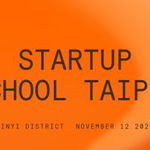
I'm excited to share that I have been invited to @ycombinator's Startup School Taipei on November 12, 2026.
There's a lot to look forward to, including listening to founders like @andyfang (@DoorDash), Michael Chiang (@ollama), and a @ycombinator partner lineup including @garrytan, @sdianahu, @xuster, @agupta, and @borisjabes.
If you're attending Startup School Taipei or based in Taipei, I'd love to connect while I'm there. Drop a comment or send me a message, let's meet up!

4
8
244
We are excited to share that Decoded is going to be hosting Professor Peter Hegemann, Nobel Prize 2026 Laureate in Physiology or Medicine.
We're also launching Ask a Nobel Laureate, an open call for questions from students, young people, and anyone curious about science and the world around us. We want to make conversations with some of the worlds leading thinkers more accessible, and give young people a chance to participate in them, in line with our mission of youth education and literacy.
We would for you to submit your question through the link below, and tag someone who would love to ask one too!
docs.google.com/forms/d/e/1F…

4
208

amen.

so many books to read, instruments to learn, languages to speak, poems to write, countries to visit, songs to sing, movies to watch, people to meet, pictures to take, food to taste, places to see, sunsets to watch, stories to hear, stories to tell, things to create, hobbies to discover, dreams to chase, love to give, memories to make, lessons to learn, and a whole life to live.
2
75
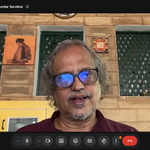
I am delighted to share that my conversation with Sundar Sarukkai is now live on the Decoded Podcast!
Professor Sarukkai earned his PhD in particle physics at Purdue University before turning to philosophy, and he is the author of Philosophy for Children, Homo Philosophicus, and The Cracked Mirror. Through his Barefoot Philosophers project, he teaches philosophy to children in rural India in Kannada and Tamil.
I have been interested in financial literacy for a while, and this conversation gave me a new way to think about it. Children who learn to question their assumptions early will make better decisions later. Professor Sarukkai also argues that examining language reduces misunderstandings, and that applies directly to how we talk about money as well!
Thank you to Professor Sarukkai for his time, and for all reading this, I would love to hear your thoughts in the comments! Link in the comments :)
📷: Recording with Professor Sundar Sarukkai

1
5
215

we are hiring.
We're building out the Newsletter Department at the Decoded Podcast, and we are looking for people who can write and who think about ideas in tech, science, and commerce the way we try to on the podcast.
If you want to apply and join our wonderful team, send an email to Anya, the Head of the Newsletter Department, at [email protected] with a few pieces you have written before, on any subject, so we can see how you think and how you write.
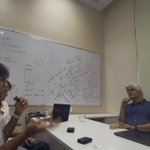
📷: me and Amaira Akbar interviewing Professor Sandeep Juneja @AshokaUniv for the podcast

Last week, I had the opportunity to attend a live session with scientists and explorers aboard the E/V Nautilus through UC Santa Cruz’s Shadow the Scientists programme, exploring deep-sea habitats around the Hawaiian Archipelago.
It is always a pleasure to attend sessions and webinars on STEM topics that are new to me, and a special privilege to shadow some of the foremost scientists in their fields and learn directly about their work and research.
This builds on some incredible sessions I attended through the programme last year. Grateful to the Lodha Genius Programme for its collaboration with Shadow the Scientists and for making experiences like these accessible to students.
📷: E/V Nautilus from Nautilus Live, Ocean Exploration Trust

4
98
I am delighted to share that our episodes with Cary S. Krosinsky are now live on Spotify!
Cary teaches at @Yale, @BrownUniversity, and @nyuniversity, co-founded the Carbon Tracker Initiative, advises the New York State Common Retirement Fund, and has written eight books on sustainable finance, including Sustainable Investing and his latest, Transition Momentum. I was extremely delighted when he agreed to my request to sit down for a live conversation and student Q&A with our team and the students who joined us for the webinar.
We split the event into two parts (hence the two part episode series), our associate team teaching the fundamentals, then our full conversation with Cary. I would also like to thank our incredible associates Vidyanshi Mittal, Aly Muhammad Dadwani, and Akshara Durugkar for their AMAZING teaching!
I would love to hear your thoughts on these episodes, both of which are available on the streaming platform of your choice :)
Listen on Spotify: open.spotify.com/episode/20v…

3
123
I did not grow up thinking I would study math at an undergraduate level, or that I would pursue it after high school.
I always considered mathematics a subject which I was moderately good at, and which was ussually pretty boring in high school. It was also the subject that was the closest to economics, which I really enjoyed. I was interested in economics early, and when I first encountered the @Lodha Genius Programme at @AshokaUniv, I chose the mathematics track largely because it felt like the most natural way to understand the mathematical ideas behind the economics I was already interested in. I was not particularly interested in doing science for its own sake.
Then I started loving mathematics. It became abstract enough to be interesting and useful without needing to be reduced to an application.
I found myself sitting in courses that were far removed from anything I had encountered in school. I loved studying number theory with Professor Shanta Laishram, I loved studying abstract algebra. I remember sitting in graduate-level lectures as a high school student and realizing how strangely incomplete my picture of mathematics had been. There was this enormous intellectual world sitting behind the relatively small collection of techniques I had been taught in school.
The part that stayed with me was the timing I discovered this love.
I discovered the existence of olympiad mathematics, IOQM, RMO, INMO, and institutes like ISI, CMI and the rest of that ecosystem extraordinarily late. I did not even know that these pathways existed until Class 12. I cleared IOQM that year, but a family emergency meant I could not sit the next stage (RMO), and by then there was no real opportunity to start again. I had found something I loved at almost exactly the point when school was already telling me to move on to something else.
I returned the following year as a research apprentice and teaching assistant at Lodha Genius, working with Professor Shanta Laishram at the Indian Statistical Institute, while continuing to study mathematics myself and preparing students for international competitions. The more time I spent around people who had been doing mathematics seriously for years, the more obvious the problem became to me: discovering mathematics is often less about ability than about exposure. A student cannot choose a path they have never been told exists.
I met @IshaanHarish3 in Class 9, and what brought us together initially was economics. Mathematics came later for both of us. Ishaan found his footing towards the end of Class 11 and has stayed with it since, now preparing for ISI and CMI. He had grown up doing the usual school olympiads, but had never encountered the much larger world of olympiad mathematics as well (same as me).
That coincidence has stayed with us. We both arrived at mathematics late. We both found it largely by accident. And we both had the experience of discovering, after years of school, that there was an entire subject behind the subject we thought we knew. I keep thinking about what would have happened if someone had told us about it earlier.
Not necessarily so that we would have won competitions or become mathematicians. Those things are secondary. Perhaps we would simply have spent a few more years asking harder questions. Perhaps we would have learned earlier that being unable to solve a problem is not evidence that you are bad at mathematics. Perhaps we would have discovered that there are forms of thinking available to us that school had never had a reason to show us.
That is ultimately why Ishaan and I started Project Fermat.
It comes from a fairly personal frustration with how accidental our own discovery of mathematics was. We were fortunate enough to eventually find teachers, professors, programmes and communities that opened the subject up for us. But we found them years later than we should have.
If someone had told us sooner, our relationship with mathematics might have been very different.
We want to be that person for someone else.

I’m trying something new.
We are starting a small initiative to help middle school students build a foundation in olympiad mathematics, training I would have loved to receive in 6th grade. The students are currently in Classes 6–8, working toward competitions like SOF IMO and NMTC, and eventually IOQM and RMO as they reach Class 8 and beyond.
I’m looking for talented Class 11 and 12 students and mathematics undergraduates who enjoy solving problems and, more importantly, enjoy thinking about how to explain them. The idea is to have volunteers teach these students regularly, introduce them to olympiad-style problem solving, and help them develop the mathematical maturity that comes from wrestling with problems rather than simply learning procedures.
This is completely volunteer-based. You do not need to be a professional teacher or have formal teaching experience. If you have a strong mathematical background, have participated in olympiads yourself, or simply spend an unreasonable amount of time thinking about mathematics, I’d love to hear from you.
I’m especially interested in people who can make mathematics feel intellectually exciting to a 12-year-old. There is a huge difference between teaching someone how to solve a particular problem and teaching them how to look at a problem.
If you’d like to volunteer as a tutor, email me at [email protected] or Ishaan at [email protected] with a short introduction and your mathematical background.
We’re keeping this small to begin with, and I’m curious to see what we can build from it.
We initially planned to cap registrations for our Decoded × HERizon session with Cary Krosinsky at 100, but somehow forgot to actually put the cap in place. By the time we realised, we had already crossed 160 registrations, so we had to shut them down there. Huge turnout!
The session itself was a huge success. We ended up having a really interesting discussion around sustainable finance, climate action, the role of capital in shaping long-term outcomes, and a lot of other questions that sit at the intersection of finance, technology, policy, and the future. There was a lot to unpack, and I think the conversation went considerably deeper than what we had initially planned.
Really grateful to everyone who joined and contributed to the discussion. We recorded the session, and we'll be releasing it soon!

3
105
We have already received dozens of applications for the Edunomix India Essay Competition 2026, and it has been really interesting to see students from different schools and backgrounds engage seriously with questions in economics, policy, society and the modern world.
Last year, the competition reached students across 19 states in India, and one of the things I found most interesting was seeing how differently students approached the same broad questions depending on their own experiences, interests and intellectual backgrounds. This year, we are trying to take that further, both in terms of the number of students we reach and the quality of the work we are able to identify and support.
I think opportunities like this matter because writing an essay forces you to do something that is increasingly rare in an environment dominated by short-form content and instant answers: develop an argument, read beyond the obvious sources, confront competing explanations, and arrive at a position that you can defend. For students interested in economics, mathematics, finance, or public policy, this is also a chance to produce something substantive that can become part of an academic portfolio.
The strongest essays will be published by the Edunomix Institute, with additional recognition and opportunities to join the Edunomix India Research Team. One of my personal goals with this competition is to identify students who are interested in research and build a strong group of young researchers who can work together on serious questions in economics and related fields.
We already have a great research team here at Edunomix India, and I want to increase the breadth and capability of our group. If you are a student who enjoys thinking about difficult problems, reading papers, writing, doing research or simply trying to understand why the world works the way it does, I would strongly encourage you to participate. Submissions are open until September 30.
edunomixinstitute.com/india-…
Looking forward to reading your essay :)

3
134
We have a new episode of the Decoded Podcast!
We sat down with Professor Sandeep Juneja, Professor of Computer Science at @AshokaUniv and former Senior Professor and Dean at TIFR Mumbai, for one of the widest-ranging conversations we've done on the podcast.
Professor Juneja studied engineering at @iitdelhi and Operations Research at @Stanford, and his work sits at a pretty interesting intersection of applied probability, mathematical finance, simulation, machine learning, and decision-making.
One of the things I was most interested in was hearing about his work during the COVID-19 pandemic.
While at TIFR, Professor Juneja worked on epidemiological models that were being used to track the spread of COVID-19 through Mumbai in real time. We talked about what it actually meant to build and use those models during 2020 and 2021, when the numbers coming out of the models were feeding into decisions being made on the ground.
It's one thing to learn about mathematical models in a classroom. It's another to hear from someone who was building them while a pandemic was unfolding around them.
We then moved into AI, and this was probably my favourite part of the conversation.
We talked about where current AI progress is actually meaningful, where some of the claims around AI are getting ahead of the evidence, and whether AI can contribute to problems that have resisted mathematicians for decades.
That led us to the Navier-Stokes equations, one of the famous unsolved problems in mathematics.
There has been a lot of recent discussion around using AI to attack problems like this. We spent quite a bit of time trying to understand what that means. What would count as a meaningful contribution? And how should we think about these systems when they produce results that look mathematically interesting but still need to be verified?
I really enjoyed this conversation because it moved between very different questions without losing the mathematical thread: probability, epidemiology, mathematical research, AI, and some of the hardest problems we still don't know how to solve.
It was also a little surreal recording this one at Ashoka.
Huge thanks to Anubhav Bhattacharjee, Vidyanshi Mittal, Akshara Durugkar, Soujanya Banik, and Mohammad Arif Abdullah for the research and outreach that went into this episode.
And of course, thank you to Professor Juneja for taking the time to have such a wide-ranging conversation with us.
The new episode of Decoded is out now.
Spotify: open.spotify.com/episode/4Gd…


Yesterday, I went back to @AshokaUniv to interview Professor Sandeep Juneja for an upcoming episode of Decoded.
Professor Juneja is a Professor of Computer Science and Director of the Safexpress Centre for Data, Learning and Decision Sciences at Ashoka. His work spans applied probability, mathematical finance, sequential learning, simulation, and machine learning.
It felt especially good to be back on campus.
Ashoka has been a pretty important part of my last two years. I spent a month there in 2025 for the Lodha Genius Programme, studying undergraduate level pure mathematics funded by the Lodha Foundation, and came back for another month in 2026 for the Lodha Genius Undergraduate Research Mathematics Apprenticeship (with a 10,000 INR stipend!). This year, I also got to work as a Teaching Assistant across the same programme I once attended in 2025 as a student.
So yesterday felt a little strange in the best way. I was walking around a campus that I had spent so much time on, except this time I was there to sit down with a professor and record a conversation for a podcast.
We had a great conversation about mathematics, probability, research, and how mathematical ideas end up being used to understand real-world problems.
The episode is coming soon.

1
6
256