

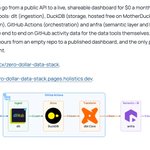





This guy @lelouvincx built a $0 data stack that he runs every day.
His entire stack is simple, free, and easy to replicate:
- @dltHub pulls data from the GitHub API.
- @duckdb stores the data.
- @getdbt models it into a star schema.
- @github Actions runs the pipeline daily in about a minute.
- @anfraAI turns the data marts into a dashboard.
Full breakdown below:


The context/semantic layer discourse is unproductive. A trustworthy agentic analytics system needs both, and three other layers.


a few observations about the context / semantic layer discourse, with benefit of seeing a lot across 2,500+ Hex customers:
There are things that work at small, simple scales that break down as things get more complex. If you're a very tiny startup, you can get away just connecting some systems to an AI agent and letting it sort everything out. But if you're a large enterprise with years of accumulated context and scattered systems, it gets much harder on every dimension.
We have customers at Hex with thousands of tables in multiple warehouses coming from dozens of systems, with hundreds of semantic definitions being used by 10's of thousands of users – you cannot just shove that all into a context window and tell the agent to "figure it out"
With all due respect, a lot of the people pushing the "bitter lesson" point of view are missing this distinction because they're operating at small scales!
A semantic model is helpful but isn't magic by itself; it's just one way to organize context, and in 2026 one proprietary spec vs. another just doesn't matter
I believe there are two vectors that will determine what systems actually work going forward:
1. Ability to extract and search across context in a variety of systems. Semantic models, unstructured guides, existing analyses, external docs, etc. - being able to quickly, accurately, and consistently retrieve against it requires some kind of structure and indexing. I believe this probably looks different than it might have a year or two ago, and there's a lot of room for new thinking on how to approach it.
2. "self-learning" systems that can continually update context and get smarter as the organization does. This is the idea behind what we've launched with Knowledge Engine at @hexanalytics as well as @hwchase17's "Knowledge Factory" concept. Unfortunately, there's also a lot of snake oil of people claiming they've built systems like this that obviously aren't. Only time will separate the wheat from the chaff.
I'm appreciating the thoughts from @mattarderne @kirsten_lum_ @eddiedzhou – we should all get together!
2
13
1,399
anfra retweeted

Day 5 of building an open-source agentic BI in public. Today is a quick rant about {context,semantic} layer.
There has been a lot of discussions about semantic layer and context layer recently. And one argument that I came across is this: if the AI models are getting so good, do you really need semantic layers, or just the context layer is good enough?
Honestly, I don't understand why there's such an argument.
To me, semantic layers and context layers are 2 complementary things, they represent both the quantitative and the qualitative side of the business.
While the context layer obviously contains the messy business context across different documents, the semantic layer (aka the the metrics layer) represent the formularized, quantitative aspects of the business. And you need both in order to function well.
Not needing a semantic layers is like saying I can already describe my proof in English, why should I need to use some sort of mathematical formula with it?
Well of course you can describe your proof in English, but English (or any other human language) is an imprecise language, there can and will be different interpretation of the same thing. While not just use a indisputable, computable formula for it.
This is why in anfra we ship both a context layer with a powerful semantic search functionalities, and a semantic layer with an advanced semantic query language. Both are independent components that interact well together.
Am I missing anything of the arguments?
p/s: If you want to implement an BI that has the best practices of agentic analytics, give anfra a shot.
anfra retweeted
Day 4 of building an open-source agentic BI engine in public.
Over the weekend my colleague @imanthonytd built a prototype of anfra's desktop app, because… why not?
Here’s a rough demo (live recording).
Claude/Codex integration is done using using ACP, originally built by the @zeddotdev team. This way, users get AI directly from their Claude/ChatGPT subscription. They don't even need to install Codex or Claude Code app.
What do you guys think? Can this be the agentic alternative of Tableau Desktop or PowerBI Desktop?
Day 5 of building anfra:
This account seems to be getting shadowbanned. 😅
We were too eager to talk about anfra. We comment often, which is apparently unusual for a new account.
(which is weird because that's normal human behavior, we talk a lot about things we believe to be good and interesting)
Anyway, if you see this post, please let me know in the comments
3
7
58


anfra retweeted

Mom come pick me up they’re arguing about semantic layer vs ontology in the group chat
Day 3 of building @anfraAI
We picked one of @tableau's best dashboards to see if we could build one just as good (or better) with anfra.
Tableau is known for great visualisations, especially maps. Sales territory planning is a common example to demonstrate its frontend visualisation strengths.
So we used anfra to one-shot a sales territory planning app in one shot.
You can spin the globe to see where the company already wins and where it's missing revenue, compare every market on any metric, and zoom from countries down to states and cities.
Every metric and every interaction is auditable and grounded in a semantic layer.
Take about 20 minutes.
What do you think?
anfra retweeted

web developers have had DevTools for 20 years.
data teams still debug with screenshots in Slack.
so we built DevTools for BI at @anfraAI .
meet Inspect: point at any number, see the SQL that ran, trace it to the table.
your agents can get it too, via the CLI.
check out: demo.anfra.ai


anfra retweeted
Day 2 of building open-source analytics engine in public. Let’s talk about low-cost, open-souce data stack.
Since building @anfraAI I have been trying this setup out, and it has soon become my new favorite open-source/almost $0 agentic data stack.
1. @duckdb (self hosted) or @motherduck free plans for data warehouse.
2. @dltHub and @getdbt for ELT (open-source). If it’s simple tables/sources, I might just skip them or hand-roll something with agents.
3. AMQL (amql.org) as a semantic layer, metrics definition. It ships with anfra. It is static-typed with composable/programmable consturcts (not YAML-based strings).
4. anfra as the open-source agentic analytics engine + custom BI apps frontend. Either self-host or free cloud.
The main cost is just usually hosting, which I typically go with a @Hetzner_Online VPS box ($7/mo), best bang for the bucks I can find.
If the data volume is low, I just go with Motherduck free plan (10 GB free storage) + anfra Cloud (free plan) to save the management hassle.
Contexts are either markdown files, dbt descriptions or Notion, that get ingested into anfra via anfra context layer.
All this is set up with coding agents (Claude Code, Codex or @opencode). I rarely look at the code anymore.
What you get:
- Interactive, customizable dashboards on top of a governed analytics backend
- Everything stored as code, checked in to Git
- Connect ChatGPT/Claude to anfra MCP and you get AI analytics with trusted metrics for free (no extra API token cost)
What does your low-cost agentic data stack look like?

Day 2 of building anfra:
Sales asked if we should change the dates on our changelog so it looks like we ship one feature a week.
They worried that releasing a bunch of features on the same day would look fake.
This is how fast we actually ship. The changelog is generated straight from our code repo. Shipping once a week is how software used to be built. It's not how we build it now.
Check out anfra and our release notes. If you don't find what you need, trust that it's coming your way at the speed of light.

ALT check out anfra.ai/releases/
1
5
167

Day 1 of stress-testing anfra (open-source engine for agentic analytics)
Today we build a data app that asks whether your city is built for people or for cars. This data app lets you compare how much each country walks, try a makeover on a real street, then zoom from the planet down to a single block.
Want to build a data zine like this? Comment below, and I'll share the repo.