Creative Partner @ https://xitter.gq/t.co/miha2o6AaS https://xitter.gq/t.co/QmQd36Gv7f
Sydney
Joined August 2008
- Tweets4K
- Following652
- Followers598
- Likes25.8K







Pinned Tweet
Simple memories are the most consistent influence on purchase behaviour. It’s not as complex as we make out. It’s the idea that people trust their own memories more than anything else and this means a brand’s biggest job is to create relevant memories with potential customers.
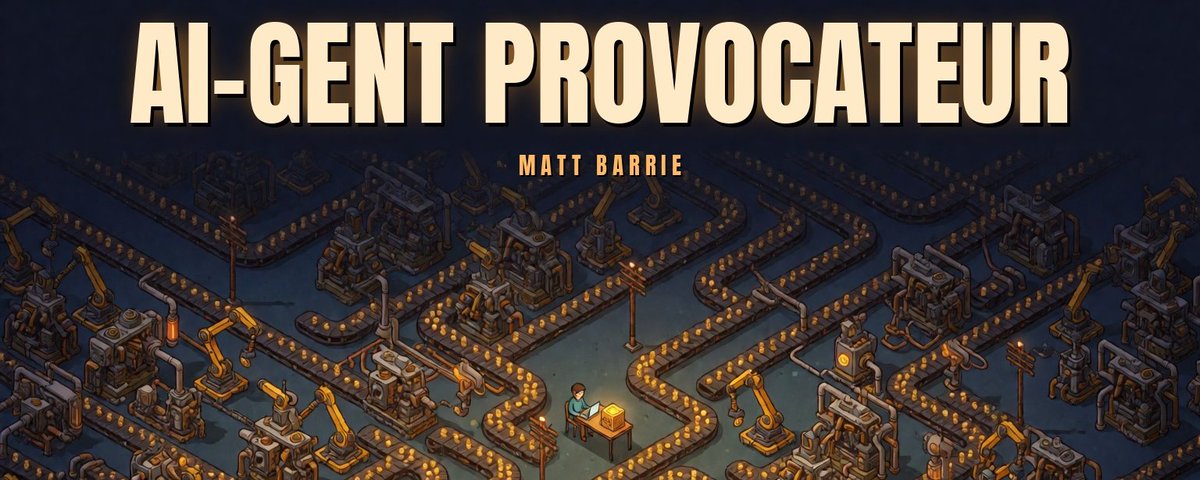
“The job that was a workflow became software, and the job that got created sits one level up the stack, doing the thing the agent I think will struggle with: taste.”



Matt Arbon retweeted

I cant stand these millennial tech companies with these 'cute' nonsense names like "granola" or "clay." if I had a company youd see me calling that shit the American Computing Corporation. National Electron. United Tabulation. thats a name with some chest hair


“Once handmade becomes valuable, it becomes something to mimic. The aesthetic becomes a proxy for the labour and the signal gets mistaken for the thing itself.”

My first @itsnicethat column of the year is about fake riso prints, the history of photography, digital gardens, and the resurgence of analog aesthetics without analog tools 📷
itsnicethat.com/articles/eli…

Matt Arbon retweeted

Steve jobs spots in six months something that has eluded the world's advertising agencies for 30 years, since the end of commission.

Pixar's Early Days - A Never-Before-Seen Interview With Steve Jobs, 1996 youtu.be/R0XmBKsRJF8?si=FmxX… via @YouTube

Matt Arbon retweeted

First to market is also a curse, you need to change consumer behaviour to boil the ocean.
Last to market you benefit from all the category marketing and education.

Marc Andreessen explains why the “curse of the entrepreneur” is being too early
“My experience is the great founders almost always feel like they’re too late, and you’re almost always too early.”
The reason is because the idea seems obvious to the founder:
“You’ve got some idea in your head, and as far as you’re concerned, the world should already work this way, which is why you’re pursuing it. And so it’s a little inexplicable as to why it hasn’t happened to it… It must be just about to happen and I must be too late.”
This is how Marc felt at Netscape when he co-authored the first widely used web browser. But in reality, Marc explains, founders are almost always too early:
“We almost never see a qualified founder fail because they were too late to market. It’s almost always because they’re too early to market. And I don’t say that critically. When we screw up investments, I think that’s often the reason as well.”
It usually turns out that the world just wasn’t ready yet. Marc points out that when Apple launched the Newton in 1989, it was basically the same thing as the iPad. The world just wasn’t ready yet, and the required technologies weren’t in place (e.g. mobile broadband, high-resolution screens, battery technology, etc.).
“It convinced people for 20 years that tablet computing would never work. And then they did it again with the iPad, and it worked. I think that’s the permanent curse of the entrepreneur.”
In a previous YC talk, Marc told founders that if what you’re working on was the hot thing 3-4 years ago, you’re probably right on time because the infrastructure and consumer behavior has now caught up.
Video source: @ycombinator (2016)


Matt Arbon retweeted

One of the biggest public health mistakes that has ever been made is pushing the idea that sunlight is dangerous. Read the full article with references here:
ricciflow.substack.com/p/sun…


This is even more relevant given what I've now learnt about the affects of blue light and nnEMF.

As I’ve said previously, the screen is going to be our generation’s tobacco. xitter.gq/tomfgoodwin/status/101…
“While the rest of the world seems to move towards a dead level of uniformity, the living organism is evolving new substances and more and more intricate forms.”

We study energy to harness, to transform it, and to gain from it. But loss matters too.
#Entropy is the quiet architect of change.
Life temporarily defies it and death releases energy to new fates—trees, stars, dust. To create better models of life and innovate, we must account not just for energy input, but for where and how it’s lost.
nature.com/articles/158153a0
“AI won’t disappear from headlines — it’ll just quietly become infrastructure, like electricity…reshaping everything from geopolitics to daily workflows. Time to plant your roots deep, adapt swiftly, and ride out what comes next.”
New Essay:
AI of the Storm
A year ago AI was just a curiosity — now it’s a full-blown Category 5 hurricane tearing the roof off business, politics, and reality itself.
[Just click X on the annoying popup asking to sign up]
medium.com/@matt_11659/ai-of…

It makes total sense - I mean, imagine having to filter out everything people think, as well as what they say?
This quoted post is unavailable.


File under emotional memory cards.
“The more intense the emotion, the more likely we are to remember the experience that caused it.”
nautil.us/your-memories-are-…
I like the thinking behind this for both distinctive brand assets and category entry points.

why tagging is not enough: we kinda miss half of the point of why we want to memorize/categorize sth in the first place: we do it because of the way we see sth fits or connects to our existing ideas, not just by itself.
most of the time these connections are hard to articulate and we are already happy we have stored the idea somewhere. but really the connection is the most critical piece.
to not just store sth but can recall and use it later, we could try design interfaces that function as conceptual landscapes. aka embed info proximity as an inherent affordance in the system.
img src: nobel prize org