

Almost every edge is already public. Nobody uses it. I catch them before the window closes — free stacks, forgotten opportunities, and whatever the crowd is sti
Joined April 2021
- Tweets2.5K
- Following267
- Followers73
- Likes1.5K
Pinned Tweet
An AI just did in 88 hours what the smartest humans alive couldn't do in 90 years. And it wasn't even the model they sell you.
Everyone's talking about GPT-6 Astra.
But OpenAI has something behind it. Something they haven't released.
They pointed it at a problem that has broken mathematicians since the 1930s — one of seven problems with a million-dollar prize attached.
Not one AI. Ten thousand of them. Working at once.
They traded 2.7 million messages. Burned 130 billion tokens. Argued, retried, corrected each other.
88 hours later, they had a proof. Astra then spent 17 more hours verifying it line by line.
Here's the part that should reframe how you see all of this.
A single AI trying to replace one expert is old news.
This was 10,000 of them forming a research lab that never sleeps — compressing decades of human work into a long weekend.
The model you can use is already the second-best thing OpenAI has.
The one you can't use just did mathematics no human could.
What happens when they point 10,000 of those at your industry?
Full breakdown in the comments 👇

Your AI agent has a hidden bill: it re-reads its own context on every single task.
My math, assumptions mine: 100 tasks a day, 50K tokens of context each, $2 per 1M input tokens. That’s $300 a month. Recall ~5K from memory instead: $30.
Same agent. Ten times cheaper. How much context is yours re-reading today?

One of the biggest categories on GitHub right now isn’t models. It’s memory.
claude-mem: ~97K stars. Agents that remember across restarts.
context-mode: ~27K stars. Cuts what an agent has to carry in its head.
agent-memory: ~4K stars. Stores everything as plain Markdown files.
Meta says its new model remembers what you did over days and months. Tencent open-sourced a memory stack this week.
Models got cheap. The scarce thing is now an agent that doesn’t forget you.
If your agent lost everything it knew about you tomorrow morning, what would it cost you to rebuild?
Most people build one agent and babysit it. This setup has a team where one agent's only job is to say no.
Mission → chief → research → strategy → execution → reviewer → you
Chief hands every task to the right specialist and sends proof along with it
Research pulls sources from the last 90 days, strategy cuts them to priorities, execution turns that into the deliverable
Reviewer holds the checklist from your original mission and bounces anything that misses, up to 3 times
The system only interrupts you in three situations:
→ something irreversible is about to happen: send, publish, pay, delete, contact people
→ the mission itself is too vague to check against
→ the reviewer bounced the same draft 3 times in a row
Chief decides who works. Reviewer decides what ships. You decide what leaves the building.
Demo run: 122 handoffs, 6 of 6 checks passed, 7.4 minutes, $0.86 per accepted result, 1 tap from the human, laptop closed.
How to set it up:
→ Write the mission first: what you want, what it can read, what it must hand back, when it runs, what it must never touch
→ Start with the chief, add specialists only where the work actually splits
→ Green actions run alone. Yellow stays inside approved tools. Red always waits for you
→ Each handoff carries the goal, the artifact, the proof, and the next move
→ The reviewer points at the exact failed check and returns the work — it doesn't rewrite it
Paste this to build it:
"I want an agent team to own this mission: [DESCRIBE THE RESULT]
Ask me questions one at a time until the mission is clear, then give me a one-page contract: what it delivers, what it reads, when it runs, what it must never do. Every quality bar as a check I can verify, not a feeling.
Build the chief first, then add specialists only if the work needs them: research, strategy, execution, reviewer. Give each one a job, an input, an output, a pass/fail rule.
Split actions into three levels: green (search, read, summarize, draft), yellow (edit internal files, run saved routines), red (send, publish, buy, delete, contact people, change permissions).
Make the reviewer strict: it tests every deliverable against the contract. After 3 failed rounds it stops and sends a short report.
Show me the plan first and wait for my OK."


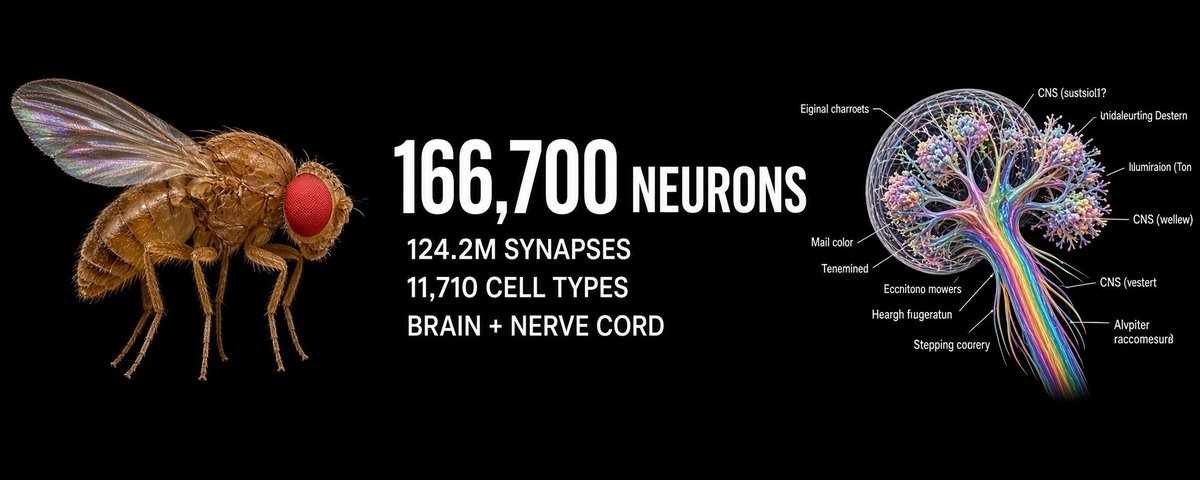
33 years of human labor went into mapping a brain smaller than a poppy seed.
Every one of its 166,700 neurons. Every one of its 124.2 million synapses.
A single male fruit fly, sliced into thousands of layers thinner than a virus, photographed millions of times, then rebuilt neuron by neuron by a mix of AI and human eyes checking every wire by hand.
No one had ever mapped a full adult brain before. Not a mouse. Not a human. A fly went first.
In September 2026, Janelia and Google released it: the complete wiring diagram from brain to legs, through an intact neck. 11,710 different cell types. 150 meters of wiring folded into something the size of a full stop.
Here's what the map can't tell you.
It shows where every wire goes. It says nothing about how strong each connection is, or when it fires. A circuit diagram with the wires drawn and the voltages left blank.
Nobody knows what the fly is thinking. They just finally know exactly how it's wired to think it.
It took 33 person-years to map one fly.
Your skull is holding 617,000 of them.
If reconstructing one insect brain took three decades of human effort, how many decades of effort is sitting quietly inside your own head right now?

Not a model. A copy. Every wire, every connection, traced from a real brain.
It's a fruit fly. Its brain is smaller than a poppy seed. 166,700 neurons. 124 million connections. 11,710 different cell types. All of it, mapped.
They finished it in September 2026. Janelia, Cambridge, a global team. The first complete wiring diagram of a complex brain, published in Cell.
Here's the part that doesn't let you sleep.
They can now run it. Fire a neuron in software and the virtual fly behaves exactly like the living one would. Trigger the part that senses sugar, and the simulated fly reaches for food that was never there.
A brain, fully copied, doing what it did when it was alive, inside a computer.
It took a decade and a planet's worth of scientists to do it for an insect.
The human brain has 86 billion neurons.
The fly was never the point. It was the proof that a brain is just a map, and maps can be finished.
ashkaidev retweeted

A Stanford student put 166,700 fruit fly neurons in a robot that now writes homework for 30 students.
Not one of them has picked up a pen since. The robot is a black aluminum rig with a blue ballpoint, writing square roots and fractions line after line in handwriting that doesn't look like a machine's, while the fly's neurons glow in the corner of the screen.
Each student gives it a handwriting sample, and the fly learns the slant, the spacing, the size of the loops and where the letters get lazy at the end of a line, then writes as that student. 30 notebooks, 30 different hands and 1 brain.
That brain is smaller than a poppy seed, and a human brain has over 500,000 times more neurons, but the fly doesn't get tired, doesn't smudge the ink and never mixes up whose 7s have a line through them.
The teacher checks 30 notebooks, and a fly wrote every one.
A dead insect's brain just controlled a movement in software, and it behaved exactly like it was still alive.
Scientists mapped every neuron in a fruit fly's head. 140,000 of them. 50 million connections. The complete wiring of a real brain, copied down to the last synapse.
Then they ran it.
Fired a virtual neuron and the simulated fly moved like the living one. Triggered its sugar sensors and the digital fly reached for food that wasn't there.
No behavior was programmed in. Nobody wrote the logic for "reach for sugar." They rebuilt the wiring, sent a signal in, and the fly's own dead circuitry did the rest.
That's the part that should unsettle you. The behavior wasn't coded. It emerged from the map.
A nervous system that belonged to an insect, running in software, still doing what it did when it was alive.
It took a decade and 200 scientists to copy one insect brain.
The human brain has 86 billion neurons.
The fly was never the point. It was the proof that a brain is just a map someone can finally finish.
The first solo millionaires of the AI era won't be coders, traders, or founders. They'll be people who mastered one boring skill almost nobody is naming.
It's not prompting. Everyone can prompt.
It's orchestration — knowing how to make a team of AI systems work together toward one outcome, without you touching most of it.
Here's the shift.
For all of history, scale meant people. Want to do more? Hire more. Every extra output cost an extra salary.
That link just broke.
One person who can direct a swarm of agents — one to research, one to write, one to build, one to check the others — now produces what used to take a whole team.
The skill isn't doing the work. It's designing the system that does the work, then getting out of its way.
The people quietly winning right now aren't smarter or richer. They stopped trying to be the worker and became the one who orchestrates the workers.
Same tools everyone has. Completely different outcome.
The barrier was never access. It's still sitting there, free, waiting for the people willing to learn how to conduct instead of play.
OPEN GUIDE


10,000 AI agents just solved a problem that stumped humanity for 90 years. It took them 88 hours.
Not one AI. Ten thousand — working in parallel, arguing, correcting each other.
They traded 2.7 million messages and burned 130 billion tokens to crack a million-dollar math problem no human ever could.
A single AI replacing one expert is old news.
This was a research lab that never sleeps — compressing decades into a weekend.
they say AI is going to kill us all. ok still not an excuse to ship sloppy frames. 4 realism prompts that actually held up on GPT Image 2.5 + Seedance 2.5 on Magnific below👇
An AI just learned to use a computer better than you. And it's already twice as fast.
Not chat. Not answers. Actual work.
It's called GPT-6 Astra, and OpenAI shipped it last week.
It fills out forms. Updates CRM records. Builds websites. Runs QA checks. Analyzes spreadsheets. Troubleshoots problems on your screen.
Anything you can do on a computer, it can do for you.
Here's the number that should stop you.
It completes more desktop tasks correctly than the model before it — while taking about half the time.
Half. Then read the benchmark: on ARC-AGI-3, a test built to measure reasoning on problems it's never seen, it scored 99.9%.
The office job was always a series of tasks on a screen.
Fill this form. Move this data. Draft this summary. Check this page.
Every one of those just became a thing you delegate, not a thing you do.
The people asking "will AI take my job" are asking the wrong question.
The right one: which parts of my job are already just a computer doing steps in order — and how long until someone notices they don't need me for that?
In 1923 a German pensioner opened his savings envelope — a lifetime of careful, disciplined saving — and found it could not buy a single postage stamp. He had done everything right. The math still destroyed him.
His money never disappeared. Its value did. That distinction is the fifth law, and it is the one that quietly ruins the most careful people.
That year, a loaf of bread went from 250 marks in January to 200 billion marks by November. Workers were paid twice a day and ran to the shops before lunch prices became afternoon prices. A wheelbarrow of cash could not buy a newspaper. The number in your account meant nothing. Only what it could buy meant anything.
This is real return, and you do not need hyperinflation to feel it. You feel it every year, slowly, in the background. A savings account paying 2% while prices rise 3% is not safe. It is a −1% loss with a smile on it. A "0% checking account" during inflation is quietly charging you to hold your own money.
The cruelest part of 1923 was who it hit. Not the reckless. The savers. The pensioners, the middle class, the people who followed every rule school ever taught them — hold cash, be careful, don't gamble. Inflation punished exactly the behavior everyone calls responsible.
Meanwhile the people who owed money watched their debts evaporate. The borrowers won. The savers were wiped out. The math did not care who was virtuous.
Everyone measures their money in nominal terms — the number on the statement. The person who understands this law measures in real terms — what the number can actually buy. That single switch is the whole difference.
Money left sitting still is never safe. It is being taxed by inflation at a rate you never agreed to.
The math is on the napkin. Thinking in real terms instead of nominal is the entire edge


THE RICHEST PERSON YOU KNOW ISN'T SMART. They just know 5 equations you were never taught — and one of them decided their wealth before they were born.
00:14 he draws the "NO GO ZONE" on the board — the exact math that separates the people building wealth from the ones quietly losing it for 40 years.
Money isn't a subject. It's applied mathematics wearing a suit. Every salary, mortgage, fee, and investment is already decided by five short equations — whether you know them or not.
A 1% fee eats a third of your retirement. $200/month at 19 beats $2,000/month at 40. The Rule of 72 tells you exactly when your money doubles — or when your debt does.
Each one is free. Each takes an hour. Almost nobody sits down for that hour.
School taught you arithmetic and called it math. It never showed you the five equations quietly running your entire financial life.


A 19-year-old who invests $200 a month ends up richer than a 40-year-old who invests $2,000 a month.
Same math. Different start line.
Nobody failed you on purpose. School just never showed you the one equation deciding it: compounding.
$200 a month from age 19, at market returns, becomes more by 65 than ten times that amount started at 40. The teenager put in less money and won by decades.
That's not motivation. It's arithmetic. The curve doesn't care how hard you work — it only cares how early you started and how long you left it alone.
The rich aren't smarter. They were shown the equation earlier, or they figured it out before it was too late to matter.
Here's the uncomfortable part: the math is free. It takes an hour to understand. And almost nobody sits down for that hour.
The people who do stop trading time for money and start letting the equation do the work.
Five equations quietly run your entire financial life. School showed you none of them.
xitter.cf/lumenxbt/status/208210…
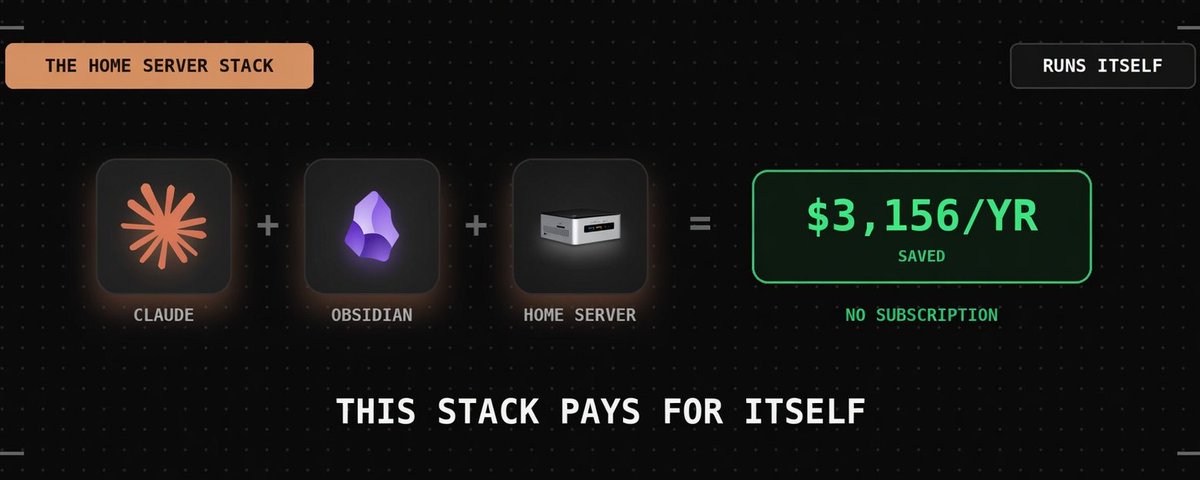
A FOUNDER IS PAYING $263 A MONTH FOR AI. A $60 MOTHERBOARD AND A USED GPU DO MOST OF IT FOR THE COST OF ELECTRICITY.
Claude. ChatGPT. Perplexity. Obsidian Sync. $3,156 a year, gone every year, forever.
Or $1,200 in used parts, once — a home AI server that reads your docs, runs local models, and never sends a byte to the cloud.
This isn't "buy a sealed box." Real parts list. Real breakeven math. The exact prompts that turn the machine into a background employee instead of a space heater.
The stack pays for itself. Then it just prints savings.
xitter.cf/HodlReaper/status/2082…

Elon Musk realizing some guy turned a dead X account into $9,000/month on 2 hours a day and leaked the whole playbook for free


People are going all-in on GTA 6 meme coins before the game even exists.
"Lucia's gonna be a banger 🔥" — and the money's already flying at a character from a game that launches in November.
Here's the part the hype skips:
Meme coins built on a launch date are a casino, not a business. Most go to zero and take the buyers with them. The people posting "all in" never post the screenshot three weeks later.
But the instinct isn't wrong. There IS money forming around GTA 6 early. Just not in the coin.
The real economy is the one Rockstar already opened — the official mod marketplace. Creators keep 100% of profit. Packs listed up to $389. A store that's nearly empty right before the biggest launch in history floods it.
One path is a lottery ticket on a meme.
The other is stocking the shelves before millions of players arrive.
The gamblers will be broke by December. The builders will own the catalog.
WOOOOOOOOWWWWW!!!
A couple just signed an actual contract over GTA 6 — and it might be the most honest relationship document ever written.
Ten days. November 19th through the 29th. He's legally allowed to play as much as he wants, and she signed off on it.
The rules are unreal:
No walking in front of the screen during a mission, cutscene, or heist. Strictly forbidden. "Consequences."
If he fails a mission, gets wasted, or gets busted — she is banned from saying "it's just a game," "you can do it later," or "haven't you been playing long enough?"
Every hug, every conversation, every "can you help me real quick?" waits until he hits a safe house.
And the best clause of all: if she chipped in £40 toward the game, she's allowed to delete ONE rule.
Both signed it. Real names. Real signatures.
Some couples do vows. These two did a service-level agreement.
Honestly? He's not going to be the one making money off GTA 6 this November. He's going to be the one paying for it — in hours, in £40, and in ten days off the grid.
The people cashing in on this launch aren't the ones signing contracts to play it. 👀
Save this. November's going to be wild.
