

the people who were right early | and the tapes to prove it
Joined September 2026
- Tweets89
- Following38
- Followers275
- Likes142


authquant retweeted
Holy f*ck. The creator of Claude Code:
"I think by the end of this year, they're gonna be able to build entire businesses"
In this 35-minute fireside with AMD, he walks through how coding went from autocomplete to agents to hundreds of agents per engineer, and why the models got hard to prompt-inject
Line → Function → Feature → Project → Business
The engineers who build the setup around the agents are the ones getting 8x
Worth more than most $1,000 Claude Code courses
Bookmark it, watch it today
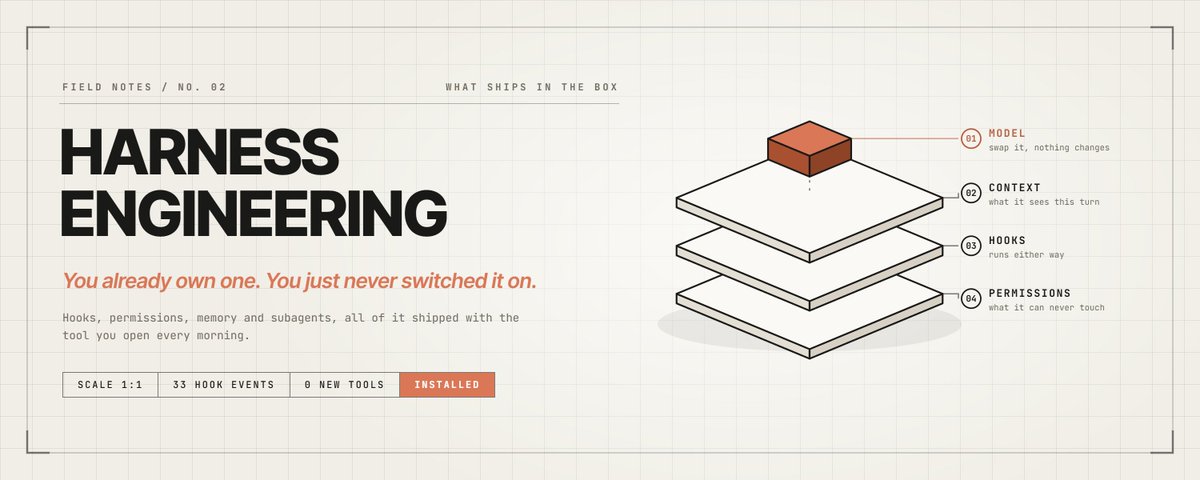
Then read the guide below on that setup, most of it is already installed ↓

authquant retweeted
This is f*cking insane. Anthropic CEO and DeepMind CEO were asked if they fear what they're building
Amodei: "Almost every decision that I make feels like it's kind of balanced on the edge of a knife"
In 14 minutes, they explain the timelines, the risks and the testing behind every new model
Chatbot → Agent → AI Research By AI → AGI
The people who build these systems take the setup around the model seriously. Most users don't
Worth more than any $1,500 AI course
Bookmark and watch it today
Then read the guide below on the harness around your own agents ↓
authquant retweeted
Mark Cuban says he doesn't want anything to do with either political party: "The Republican Party isn't the Republican Party anymore. It's the Trump family business." 🇺🇸
Interviewer: "Where is the Democratic Party? How can you reinvigorate that side of the aisle?"
Mark Cuban: "I don't care about the Democratic Party. People think I'm a Democrat. I'm not. If it were up to me, I'd kick both parties to the curb. I think both parties suck."
Interviewer: "If you were advising Elon, would you back him with the America Party?"
Mark Cuban: "It depends on the policies and who the politicians were. But yes, I'm wide open to that. I just don't care about either party.
The Republican Party isn't the Republican Party anymore. It's the Trump family business. And the Democratic Party doesn't even exist anymore, because they don't even know what they're doing and there's nobody in charge. They both suck."


authquant retweeted
Warren Buffett explains why Berkshire is sitting on $380 billion in cash and still buying almost nothing: "Well then we don't do anything." 🇺🇸
Warren Buffett: "The world is full of people that are offering you things to do. And then the question is to find one that makes sense. And there may be 20 out there that make sense that you don't understand, and you just leave them alone."
Interviewer: "There's almost $400 billion in cash on hand, although Greg took some pains to show it's really more like $380 billion. You're looking around and you don't see a lot that you want to invest in?"
Warren Buffett: "Well then we don't do anything. I've been in the business up to 60 years. There's probably five of them really juicy.
I think it was Tom Watson Sr. of IBM. They asked him the reason why IBM had been so successful. And he said, I'm smart in spots and I stay around those spots. And that's the whole thing."
authquant retweeted
Elon Musk tells The Economist that money won't matter in 10 years: "What do you need money for in that case?" 🇺🇸
Interviewer: "I'm not sure that the people who bought your shares think that money won't matter in 2036."
Elon Musk: "What do you want money for? You want money for goods and services, right? You want money for food, housing, transport, entertainment.
If that is so abundant that the robots and AI are providing more goods and services than any human could possibly consume, what do you need money for in that case?"
Interviewer: "But you're creating these robots. I guess between now and then you'll need money. Are you selling humanoid robots? Or are you producing goods and services with the humanoid robots that you control?"
authquant retweeted
JPMorgan CEO Jamie Dimon is asked about the 10% chance AI ends humanity and answers with his own bank's numbers: "We have 1,000 use cases." 🇺🇸
Interviewer: "Where are you on the great debate over AI safety, the 10% chance that it's the end of humanity?"
Jamie Dimon: "I'm going to be like a broken record here. We've been using AI since 2012. We have 1,000 use cases. Risk, fraud, marketing, design, note taking, hedging, customer errors. I think it's the tip of the iceberg.
Over the years it will help with a lot of diseases, some cancers. Fewer people will die on the roads. You'll have more robots doing tasks that humans don't want.
On the risk side, there are real vulnerabilities. We spend a lot of money on cyber. Banks are rather well protected, but there are whole unprotected industries that are also critical. Water, parts of transport, smaller banks. We all have vendors."
authquant retweeted
A month earlier Sam Bankman-Fried was worth about $20B. Sitting in a Bahamas penthouse he says he is now worth $100,000.
ABC got two hours with him for this interview, and the first name put to him is Bernie Madoff.
He says that isn't who he is, though he understands why people reach for it.
His distinction is that Madoff had no real business underneath, and FTX did have one.
The question that matters comes next. Caroline Ellison told staff that customer deposits went to pay Alameda's creditors, and she says he knew.
His answer runs through collateral, a large position and a correlated market collapse.
George Stephanopoulos stops him. He says he isn't a crypto expert, but that was not an answer to the question.
Asked again, Bankman-Fried says he doesn't know of FTX deposits paying Alameda creditors, and asks which creditors are meant. He was arrested 11 days later.
authquant retweeted
About half of X's advertisers had walked away by March 2024, and Elon Musk had already told them in public where to go.
Don Lemon has him for an hour in the interview, and asks the obvious thing. Isn't choosing where to spend your ad money its own kind of free speech.
Musk answers that it's unacceptable for advertisers to force censorship on a platform as a condition of buying ads.
Lemon tries again. They aren't obliged to advertise anywhere, so how is leaving not their choice to make.
Musk says other platforms censor on behalf of advertisers and that X will not.
Now the narrow version of the same question. Can a brand decide it doesn't want its ad sitting next to antisemitic posts.
Of course it can choose what content it appears next to, Musk says, which is the thing he called unacceptable two minutes earlier.
He bought the company for $44B. Within a day of this conversation he cancelled the show he had just agreed to host on it.
authquant retweeted
In March 2012 Mark Zuckerberg wrote to his managers that copying other apps could stop competitors getting a foothold.
Eight years later a congresswoman read that email back to him.
Pramila Jayapal has the whole thread in the hearing video. Sheryl Sandberg's reply says it's better to move faster so rivals don't build products that take your users.
A product director in the same thread writes that he'd love to be far more aggressive about copying.
So the question is simple. Has Facebook ever copied a competitor to keep that competitor small.
Zuckerberg answers that the job is to understand what people find valuable in the services they use.
She asks it plainly a second time, and he says Facebook has adapted features others led with, and that others have copied Facebook too.
How many competitors since that email. He can't give a number, doesn't know if it's under five, and isn't sure he accepts the premise.
The email was written weeks before Facebook bought Instagram for $1B. WhatsApp cost $19B two years after that.
authquant retweeted
Google promised Congress in 2007 that buying DoubleClick would not cost anyone their privacy. In 2016 it merged the data anyway.
Val Demings lays it out on the hearing recording. Google's own lawyer had told the Senate the two sets of data could not be combined even if the company wanted to.
Contracts made it impossible, he said at the time.
What got combined in 2016 is a person's name and the record of nearly every site they visit.
Demings puts the dates side by side. Sundar Pichai became chief executive in 2015, the change was made in 2016.
Did he sign off on it. He answers that he reviews all important decisions at a high level, and that the company cares deeply about privacy.
She reads out an internal email about why the founders had refused for years. They were worried about a privacy storm and damage to the brand.
So in 2007 the fear was that users would be upset. By 2016 that fear was gone, and the ad business built on it now brings in about $265B a year.
authquant retweeted
ChatGPT reached 100 million users in two months. In the Senate its maker was handed a study saying a model like his can predict what people will believe.
Josh Hawley reads the paper into the recording. Feed a model the media diet of one group and it guesses how that group answers surveys.
Hawley's next question is what that does to an election.
Sam Altman says he is nervous about it. He wants rules that force companies to tell people when they are reading something a machine wrote.
His comparison is photoshopped pictures. People learned to doubt those, and this will be the same thing on steroids.
The researcher sitting next to him adds the part that lands harder.
"One of the things I'm most concerned about with GPT-4 is that we don't know what it's trained on. I guess Sam knows, but the rest of us do not."
What a model is trained on decides which way it leans. Two years after that hearing the list is still not public.
authquant retweeted
Instagram's own research said 32% of teen girls felt worse about their bodies because of the app.
Senator Ed Markey reads those numbers back to Adam Mosseri on the video, including the share of teen users who traced thoughts of suicide to it.
Mosseri corrects that one figure, 1% and not 6%, and says any loss of life is a tragedy.
Nothing here was about breaking a law. The questions were about what parents can switch off, and that is the part a company decides on its own.
Asked to back a bill letting 13 to 15 year olds wipe their data, he answers that 13 isn't a magic number. Teens lie about their age anyway.
Will he back a ban on targeting ads at children, yes or no. He believes it's valuable for ads to be relevant.
Markey tries once more and gets the same shape of answer, then says out loud that the answers are too vague to legislate on.
Another senator had already told him his questions were yes or no questions. That hearing was in December 2021, and the bill they kept asking about still isn't law.
authquant retweeted
Over 85% of online searches in the US go through Google.
In this video the chairman of an antitrust panel asks Sundar Pichai why his company steals content from honest businesses.
David Cicilline reads one case into the record first. A man called Brian Warner watched traffic to his site drop 80% after Google changed what it showed, and he laid off half his staff.
Warner's line is the part that sticks: if someone came to him with an idea for a website today, he'd tell them to run.
Strip out the word steal and the question stays. Who decides which businesses get found, and that call sits inside one company.
Pichai says he disagrees with the characterization. He had met small businesses just last week.
Then come the numbers he brought. 1.4M small businesses supported, $385B of activity, and a Texas company selling kettlebells.
Cicilline cuts in. The question was specific, and he says the answer doesn't match what months of investigation turned up.
That was July 2020. In August 2024 a federal judge ruled Google had kept its search monopoly illegally, partly by paying to be the default everywhere.
authquant retweeted
Theranos was valued at $9B. In this video the SEC sits Elizabeth Holmes in front of a camera and asks how many tests her machine could actually run.
She doesn't know. Probably tens of them, she says, which she agrees means fewer than 100, and she can't name anyone who would know.
A lawyer asks whether those tests were validated. They were validated by what the company understood validation to mean back then, she says, and that understanding changed later.
Asked who read the guidance document they validated against, she names whoever ran assay development. Asked who that was, she doesn't know.
The machine gets three names in one answer: the mini lab, the 4 series, and the Edison. Walgreens supplied the first one during due diligence.
By then Walgreens had it running in 40 Arizona drugstores, where ordinary people walked in and had blood drawn.
Theranos later admitted more than 1 in 10 results given to Arizona customers were voided or corrected, and paid $4.65M back to about 76,000 of them.
Across these sessions she says some version of "I don't know" more than 600 times. She was the one person paid to know.